You Cry, I Cry
What Women Facing Cancer Taught Me About Presence
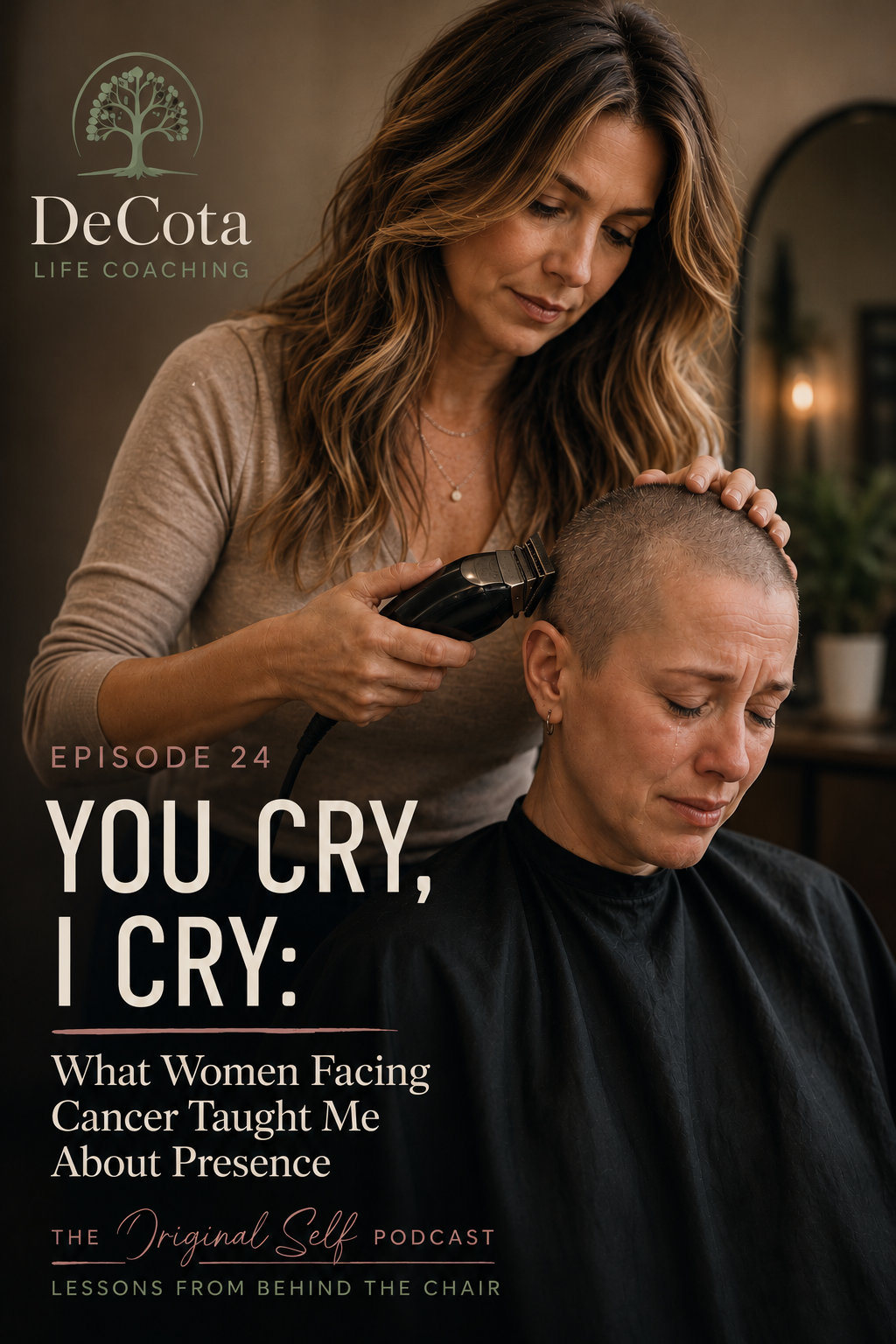
My sister-in-law is sitting in my chair. Her kids- my niece, who’s 16, and my nephew, who’s 11 at the time- are standing behind her just watching.
She’s joking around, but I can tell that she’s very nervous because her shoulders are up, her eyes look a little too wide, and
It’s because she doesn’t want to lose her beautiful long thick
curly hair. I ask her Do you want me to do it? Do you want to do this yourself? Or do you want the kids to help?
She says no, she doesn’t want to shave her head herself, but looks over at the
kids and says Do you want to participate?
My niece says okay, and my nephew just shook his
head no.
When I have to shave someone’s head, I never shave it bald in one pass. It’s too shocking. It’s shocking for the client and for whoever else is in the room.
So we start very slowly.
I turn the clippers on; they’re buzzing in my hand, and I put the clippers to the back of her neck. I ask her if she’s ready.
She nods, and that’s where we started.
Hey everyone, it’s Evet.
Today I would like to discuss the benefit of presence.
How we show up for each other really matters.
I’ve worked with a lot of cancer patients over the years. It started when I was 18. My
mom and I volunteered for the American Cancer Society’s Look Good, Feel Better
program.
This was a program that women... could come to at no cost, no charge, and they could
get their wig styled or shown how to put on a wig. And if they didn’t want to wear a
wig, we showed different ways we would show them different ways on how
to tie a scarf. And then they could also get their makeup done.
And at 18. watching these women with no eyebrows, no eyelashes, let alone
completely bald, they would divulge that they completely miss their hair and miss
putting on mascara and makeup, and their eyes were tearing all the time, and they
were so exhausted, yet they would look in the mirror and see someone that didn’t look
like themselves.
And so our job was to make them feel just a tiny bit more like themselves
but also just listen. Be present. Camaraderie between women. It was very difficult for
me, I’m not gonna lie. It was a real education because I was watching what this
chemotherapy treatment did to their bodies, and it was like they were being taken
apart and had no control over it.
And so the first couple sessions I walked out because I was crying. And I kept
thinking, well, it’s not about you. Like, don’t cry. You know, don’t show that emotion.
And I realized after volunteering a few more times - what’s wrong with that?
As long as I could get it together and say, “hey, let’s try something, let’s try to make
you feel a little bit more like yourself. Let’s see what we can do.”
So as I volunteered a little bit more, it became not easier, but it became about being present.
There’s something psychologically real that goes on in the room when this is happening.
I think naming it is worth doing because it explains why that moment hits as hard as it does.
It’s called anticipatory grief. It’s like grieving a loss before it’s fully happened.
My sister-in-law wasn’t just losing her hair in that chair.
She was rehearsing a much bigger loss. A loss of normalcy, of control, maybe of certainty of what’s to come next.
Shaving the head as a ritual on her terms, let some of that grief happen in a way that
she could actually be present for, instead of ambushing her later in the shower or alone watching it all fall out by herself.
And the way we did it- the crop, then the sides, then the mohawk, then the final
shave, wasn’t just me being gentle.
It’s actually an anthropological structure called the rite of passage.
It’s a separation, threshold, and return.
Every culture that’s figured out how to help people through hard transitions uses some
version of a three -part structure.
Because going through a threshold in stages is genuinely easier for the human mind to process. than just being shoved into it all at once.
That Mohawk stage, where we all laughed, that was the threshold.
That’s where the room could basically exhale for a second before the final part.
So the second part to that is the return.
And in this scenario, it’s when the hair returns.
Hair almost always grows back after treatment.
That’s the part people really expect.
What they don’t expect is how much joy there is when it starts to come back
in.
And right alongside that joy is how much impatience that goes along with it.
It never grows back fast enough. It never fills in the way people remember their hair previously looked.
And a lot of times, it doesn’t come back the
same.
People that had straight hair now have curly hair. People that had dark hair all of
a sudden now have very gray hair.
I’ve sat with a lot of clients while they looked in the mirror
and tried to recognize themselves in hair that wasn’t quite theirs anymore.
One of my clients who had to go through treatment had naturally
red hair her entire life. When her hair grew back after treatment, it came in brown- just plain old brown. That’s what she would call it.
We waited almost a year just to see if it would return to its former color. It didn’t.
So we colored it back to red. It was her natural red, just a little bit enhanced.
When we finished that first color appointment, she just started
crying in the chair.
Remember, you cry, I cry.
She said that she finally felt like herself again.
That’s the return.
My sassy redhead client experienced something different than my sister-in-law.
She experienced disenfranchised grief, which is grief that isn’t socially recognized as real grief.
Like, no one sends a card because your hair grew back the wrong color. Like, oh, we’re
so sorry.
Nobody tells you that it’s really allowed to feel like a loss.
But imagine, it’s very real to her. Her identity, she knew herself as a redhead.
It took her almost a year to even let herself name something worth grieving. Before she could decide to do anything about it. It wasn’t just me saying to wait. She was like, well, let’s wait. Maybe, you know, maybe it’ll grow in red.
Underneath all of that is something that I just mentioned is identity.
It’s called identity continuity.
It’s the need to feel like I’m still me across any changes you come upon.
The mirror is one of the main ways we confirm that to ourselves, right? Look in the mirror, there’s me.
It wasn’t vanity when her reflection stopped matching who she’d always known herself to be.
It was a real disruption of the sense of self.
Coloring her hair back, it wasn’t so much about looking pretty.
It was about closing that gap in how she looked and who she knew herself to be.
Looking back on both of these experiences, the shave and the redhead’s year of waiting,
I didn’t actually fix anything for either woman, obviously.
I didn’t stop my sister-in-law’s hair from falling out, and I didn’t restore my other client’s natural color biologically.
What I did in both cases was to help two women stay connected to who they were through something neither of them could control.
That’s different from what I thought this job was when I was 18.
Back then, I think I was fear-based.
Not only did I want to make people feel better, but some of me wanted to fix it, or at least perform to fix it.
I don’t do that anymore.
I’m not the person who tells someone, you’re going to beat this.
I don’t give false hope because I have no idea. I’m not a doctor. I don’t know.
What I can do is cry with them. I can hold their hands. I can hug them. I can tell them I’m here to listen.
And that doesn’t stop when they leave my chair. It means texting and phone check-ins before, during, and after treatment.
Mostly I listen and gently ask what they’re thinking. What’s actually going on in your mind?
Sometimes they can tell me, sometimes they can’t.
When time has passed, after they finish their treatments, I always ask the
same question.
How are you thinking about your life differently now that you’re on the other
side of it?
I always get very interesting answers, but they usually contain the word presence.
They talk about the presence of people that were there with them, that showed up for them in various ways.
I think that’s the real thread between shaving my sister-in-law’s hair and my redhead
story.
Neither one of them needed me to have an answer, or anyone else for that matter.
They needed someone to stay present while they found their own way through.
My client said it better than I ever could. She said, I feel like myself
again.
Unfortunately, not every story ends that way.
My sister -in -law’s hair grew back more than once. and fell out many more times.
She never got the chance to find her way back to the image of herself before any of it started, that return.
That day in the chair, the mohawk, the laughing, my niece doing one side, me doing
the other, and all the tears at the end; that wasn’t the moment she made peace with any of it.
What came after was four years of a road with real hope, real denial, and real disappointment all tangled together.
So I’m not trying to say that presence fixes that timeline. It doesn’t guarantee that things get better or that they improve when you want them to.
On the rare occasion, they don’t get better. That’s the reality of the big C.
My sister-in-law didn’t move through that threshold in that afternoon. She lived there
for years.
There were moments where we’ve all thought that things were turning around and moments when they weren’t.
I used to think that day in the salon was the hardest part. It definitely
wasn’t.
I think it was just the day that we simply realized that everything and what she knew of life, what we knew of her life, and in it, was the change.
Sometimes the middle part, the threshold, is the whole thing- you know, someone can live in that in -between place, no longer who they were, but not yet at peace with who they’ve become for years.
Her sense of I’m still me didn’t return because life returned to normal.
It returned because she slowly learned to recognize herself in a very different life.
Hair was never really the lesson.
Hair was simply the place where grief first became visible.
What people needed wasn’t someone to make it okay. They need someone willing
to stay with them while it isn’t.
Looking back after nearly 40 years behind this chair, I think
that’s what presence really is.
It’s not fixing.
It’s not rescuing.
It’s just refusing to leave someone alone in the middle of being someone
they’ve never expected to have to be.
My wish is to never shave another head because of cancer ever again.
We all know that that’s not going to happen.
And so instead of being angry about it, I feel grateful that I’m chosen to be a part
of it.
And I will do my best to make it as comfortable as possible, and as real and loving as I possibly can.
I’m Evet DeCota, and my hope for today is that you walk away from this episode with
a deeper understanding of your own identity and the quiet strength that presence,
place can offer both to yourself and to the people you love.
If you’d like to continue this conversation or have a different topic that resonates with
you, you can find all my contact information in this episode’s notes.
Thank you for listening, and I hope you have a great day.