
ADHD in Midlife: What It Takes to Look Fine
What does it cost to appear organized when no one sees the work behind it? Evet DeCota talks with Jen Walters about ADHD in women, the stories we learn about ourselves, sleep, reproductive health, and what midlife can bring into focus.
Interview with Jen Walters


Why ADHD in Women Gets Missed
Square cover detailed description: The established square series artwork places Evet DeCota’s portrait on the right and the show name and episode title on the left, with DeCota Life Coaching branding beneath. Use the final exported cover to confirm and add its exact background motif, colors, and clothing before publishing.

Chapter 1- Cold Open
One client told me, “Everyone thinks I have it together. They have no idea what it takes.”
She has three calendars, which she checks twice before every appointment because she is terrified of forgetting it.
She can manage a complicated day for everyone else, yet leave a simple email or text unanswered for days.
When a deadline gets close, she gets the work done and then wonders why she just couldn’t start earlier.
From the outside, she knows she looks capable.
Inside, she’s tired of being at war with herself.
Years later, her child was assessed for Attention-Deficit/Hyperactivity Disorder, or ADHD.
Around the same time, changes in her sleep and hormones made the systems she relied on less dependable.
As she learned more, she asked herself for the first time, “What if I haven’t been lazy, scattered, or preoccupied all of these years?”
Chapter 2- Introduction
Hey everyone, I’m Evet DeCota, and you’re listening to The Original Self Podcast: Lessons from Behind the Chair.
My client’s question is where I want to start.
Why is ADHD easier to miss in girls and women? What does it take to appear fine while working twice as hard to keep up? And why might midlife make those difficulties harder to manage?
By the end of this episode, I hope you’ll be able to separate a difficulty you’ve lived with from the judgment you learned to attach to it.
If this brings up an old story you’ve told yourself, you don’t have to sort through it alone.
I offer a free discovery call to talk about what’s coming up for you and whether coaching might be a good fit. There’s no pressure, no pitch, no commitment required.
You’ll find the link in the episode’s notes.
Chapter 3- The Same Child, Different Name
For a long time, many people pictured a child with ADHD as a little boy who couldn’t stay seated or who constantly interrupted.
That picture described some kids, but it missed others:
the girl staring out the window, forgetting an instruction halfway through, or working late to finish her schoolwork that many completed at school, or feeling restless while sitting quietly.
In one experiment, parents and elementary school teachers read descriptions of children with ADHD.
The descriptions were identical except some had a typical boy’s name and others a typical girl’s name.
Parents and teachers alike were less likely to seek or recommend services for the child with a girl’s name.
Not every girl was overlooked, but it shows that expectations can influence whether a child gets referred for help before an assessment can take place.
A large Swedish study found that females reached their first recorded ADHD diagnosis or medication at an average age of over 23.5, compared with 19.6 for males.
That’s about four years in age at recognition across the groups, not the length of time every woman spent seeking a diagnosis.
The two findings leave me with a question:
If someone sees that a girl is struggling but doesn’t think to ask about ADHD, what explanation does she receive instead?
She may hear that she’s careless, too emotional, or capable of so much more if she would only try harder.
She may learn to believe those descriptions long before anyone asks what’s actually making school or everyday life difficult.
Anxiety, depression, trauma, and sleep difficulties can also affect attention.
That’s why a careful evaluation matters. A girl deserves an investigation of what she’s experiencing, rather than a judgment about her character.
Chapter 4- What It Costs to Look Fine
One of the most striking things about adult ADHD is that somebody can be doing well and struggling at the same time.
In a qualitative study, adults with ADHD described the systems they developed before diagnosis:
Checklists and reminders written on paper, saved on devices, and sometimes on their own hands.
Other people saw the completed task, but rarely saw the effort behind it.
That’s why “But you’ve always been so organized” may not feel like the compliment it’s meant to be. She is organized. She has worked hard to become that way because she knows what can happen without those systems.
So I think there are two different questions worth asking:
Did she remember what she was supposed to remember?
And what did it take to remember?
A yes to the first question doesn’t answer the second.
Psychologists use the term executive functions for processes involved in holding information in mind, planning, starting a task, controlling impulses, and shifting between activities.
Knowing what needs to be done isn’t always the same as being able to begin it when you want to.
A five-minute reply may require her to stop what she’s doing, recall the conversation, decide what to say, and shift into writing it.
She may know exactly why the message matters and still struggle with those transitions.
By the time she finally sends it, nobody sees the work that came before the words.
Research on adult ADHD suggests that both cognitive control and motivation matter.
In one small experiment, changing the reward attached to a task changed some aspects of performance.
That doesn’t mean a reward fixes ADHD, but it helps explain why the conditions surrounding a task can affect when someone begins.
Many women with ADHD that I have spoken to regard urgency as the condition that most fuels them to start today what they couldn’t start yesterday.
But here’s where the gears catch: if she was taught that the only explanation for that inconsistency was laziness, she may turn it into a judgment about herself.
There can be a social cost, too: overcommitting, apologizing before anyone is upset, or working late so nobody sees how long an ordinary task takes.
I know that everyone is different and doesn’t operate in the same way, but ADHD has certain operating patterns that are similar.
Let me ask you this:
How much of your energy goes toward doing the task, and how much goes toward hiding the effort it takes?
Chapter 5- Sleep and the Clock Nobody Sees
Some of that effort may begin before the day even starts— with a night spent trying to fall asleep.
Sleep timing is the physical piece of this picture that rarely comes up when a woman says she can’t focus.
Research reviews find that ADHD is associated with a later chronotype— a tendency toward later sleep and waking times— and delayed signals from the body’s circadian clock.
One of those signals is melatonin. As evening light fades, the brain begins releasing melatonin to help prepare the body for sleep. It’s called dim-light melatonin onset.
Many adults with ADHD have difficulty falling asleep because their internal evening signal arrives later than the schedule their lives require.
In studies of adults with ADHD, melatonin onset has an average delay of about ninety minutes compared with others in the study without ADHD.
Imagine going to bed at ten because you need to be up at six, but your body is completely alert.
The next morning, your brain feels foggy, and you’re irritable, or worse, miss the alarms, meetings, or scheduled events.
By afternoon, it’s hard to hold a thought together, and then nighttime comes, and you feel wide awake again.
Someone may tell you to be more disciplined about bedtime, to work on your sleep hygiene. Yet for some people, there’s a genuine timing mismatch that may not be understood.
Sleep loss itself can worsen attention and emotional regulation, creating a difficult cycle.
My friend Silvina describes another part of the nighttime that matters to her. She says it’s the only time when no one expects anything from her.
The day’s demands have lifted; she can breathe and choose how to spend her time.
Sometimes that means organizing her closet at 11:30 P.M.
Once she’s started, she wants to finish because going to bed feels like giving up the first quiet hours that have belonged entirely to her.
Silvina’s experiences don’t mean every late night has the same explanation.
A delayed body clock, the pleasure of uninterrupted time, and difficulty stopping an absorbing task are different reasons for staying up late. For some, all three play a part.
Being a night owl doesn’t mean you have ADHD.
Sleep timing, insomnia, sleep apnea, anxiety, and medication effects can call for different kinds of help.
But if falling asleep has been difficult for years, tell your doctor.
Chapter 6- Why Feelings Belong in This Conversation
A difficult night can affect how you feel the next day.
But Silvina’s experience also raises a question about the feelings that come from being misunderstood for years.
Attention deficit is in the name of ADHD, but Silvina feels that the label describes her mind only by what it supposedly lacks.
In her experience, her divergent thinking moves quickly through many possibilities, making connections and seeing options other people might miss. She sees all the puzzle pieces, their shapes and edges, and connects them into one cohesive picture.
For Silvina, the harder part can be convergent thinking: narrowing those options, choosing which one to pursue, and moving forward.
Seeing possibilities can be a strength, even when choosing among them takes considerable effort.
All of this has an emotional side.
A study that followed young adults in daily life found that changes in emotion helped account for the relationship between ADHD symptoms and symptoms of anxiety or depression.
There isn’t concrete proof that one condition causes the other, but it does show why feelings deserve a place in a conversation that often focuses only on attention.
Many recognize in themselves something called rejection-sensitive dysphoria, or RSD, which is feeling intense pain after criticism or perceived rejection.
Because rejection sensitivity can have several origins, I think it’s useful to ask:
“What happens inside you when feedback lands, and what do you do next?”
A short message from a friend might lead to an evening of wondering whether she’s angry.
Maybe a reasonable correction at work turns into “I never get anything right.”
Or one mistake may feel bigger because it lands on years of being told you’re careless.
The feeling can be real even when you’re uncertain about what the other person meant.
There’s room to take the emotion seriously and still examine the conclusion you drew from it.
A qualified doctor can help someone assess ADHD, anxiety, and difficulties with emotional regulation.
In coaching, we can look at the story a person tells themself in those moments and consider how they want to respond.
Chapter 7- Earlier Turning Points: Pregnancy & Postpartum
Midlife isn’t the only time hormonal changes may affect ADHD symptoms. For some women, pregnancy and the postpartum period bring those questions into focus years earlier
Here’s a piece worth understanding before I speak about percentages.
Estrogen appears to enhance dopamine activity in the brain— the same dopamine system involved in attention, motivation, and focus.
When estrogen rises or falls, that system doesn’t stay still either.
That’s why ADHD symptom severity isn’t fixed.
It can shift across the menstrual cycle, across pregnancy, through the postpartum period, and later through perimenopause.
Researchers are still working out how hormonal changes at different stages of life may affect ADHD symptoms.
Pregnancy and the months after are one of the clearest examples.
In a Swedish register study, almost 17% of women diagnosed with ADHD before pregnancy received a postpartum depression diagnosis— compared with about 3% without.
This is about a fivefold difference in that population.
Postpartum depression deserves care in its own right. An ADHD diagnosis is also an important part of the history a clinician should know.
Chapter 8- A Wider Reproductive Health Picture
Pregnancy and postpartum are only part of a woman’s reproductive health history.
Researchers are now asking how ADHD may overlap with other conditions— questions that have received far less attention than the familiar conversation about hormones and focus.
In a nationwide Swedish study, women with endometriosis were more likely to receive a later ADHD diagnosis.
The researchers also compared sisters, which helps address some shared family factors; the association remained. It’s not evidence that endometriosis causes ADHD, but we don’t yet know why the conditions overlap.
Endometriosis can involve severe menstrual or pelvic pain, fatigue, pain with sex, and fertility difficulties.
Consider how it might feel to have years of physical pain explained away while your difficulties with attention are dismissed as a failure of discipline.
That dismissal might make you stop trusting your own experience because different parts of it are repeatedly minimized.
And I must say that is only a consideration; it’s not a description of every woman with a diagnosis.
Another condition researchers have examined is Polyendocrine Metabolic Ovarian Syndrome, or PMOS— the newer name for what many people know as PCOS.
The question here is:
Are children born to mothers with PMOS more likely to be diagnosed with ADHD?
Some studies have found an association between a mother’s PMOS and ADHD in her children.
Researchers have explored possible explanations, but they haven’t established that PMOS, or a particular hormone level during pregnancy, causes ADHD in a child.
There’s a reason why researchers are trying to find a connection in all of this. I just want women hearing this to leave feeling curious, not with just a checklist of conditions she has to have.
A good explanation should account for the whole person without claiming more than the research can tell us.
And something tells me Gen X and the generations that follow will keep asking those questions until we have better answers.
Chapter 9- When Midlife Changes the Balance
One of those questions becomes especially pressing in midlife: What happens when the tools a woman has relied on for decades become less reliable?
Sleep changes. More responsibilities. Menstrual cycles shift.
Perimenopause itself can bring difficulties with memory, attention, mood, and sleep to women whether or not they have ADHD.
A 2025 review describes plausible interactions between estrogen and dopamine systems and reports worsening symptoms for some women during hormonal transitions.
Researchers are still testing those mechanisms.
In one population study in Iceland, 54% of women who reported an ADHD diagnosis also reported more severe perimenopausal symptoms— compared to 30% of women without ADHD.
That means women with ADHD are about twice as likely to experience severe perimenopausal symptoms as women without ADHD.
Broken down further: 30% of women with ADHD reported more severe hot flashes, joint pain, and sleep issues— compared to 14% of women without ADHD.
58% reported severe psychological symptoms like depressive mood, anxiety, and irritability— compared to 36% without ADHD.
And 43% reported the rarely spoken-about urogenital symptoms of bladder issues and related concerns— compared to 28% without ADHD.
What catches my attention is the broader picture. Someone might arrive at a doctor’s appointment with poor sleep, anxiety, changes in concentration, and a sense that she’s suddenly become a lot less capable.
If each concern is put in a different folder, she may never have a conversation about how they interact.
And if she had a highly effective coping system at thirty, the loss of that system at fifty may be the first time her longstanding difficulties become visible to anyone else.
Chapter 10- What Happens When You’re Not Believed
When those difficulties become finally visible, a woman may bring them to her doctor hoping for an explanation. What happens if her account is dismissed instead?
Another term for that is medical gaslighting, and it is often a painful experience.
I know that many symptoms overlap, evidence can be incomplete, and science changes.
But when a person’s account is repeatedly given less weight because of assumptions about who she is, we can ask a different question about credibility.
Philosopher Miranda Fricker calls this testimonial injustice.
A person receives an unfair deficit of credibility because of prejudice.
Was the woman’s description explored?
Were possibilities investigated?
Or did “you are just stressed” end the conversation before the questions began?
We can’t know the reason behind every delay, but we remain curious about whether our listening habits make some experiences easier to overlook.
I’ve shared findings from Sweden and Iceland today, but not from the United States.
I don’t think the questions facing Swedish or Icelandic women are somehow foreign to American women.
Research in those countries has helped reveal patterns we should be asking about here, too.
If we had a more connected health care system in this country.
We could begin to see patterns that are harder to follow when care and records are spread across separate systems.
Hmm… imagine if there were only some way.
Some of the evidence I’ve shared comes from women in other countries, where researchers were able to ask questions we need to keep asking here.
When a girl says that she is trying as hard as she can and hears “try harder,” whose account becomes the accepted one?
When an adult says her concentration and sleep have changed and hears “that’s just your age,” what else might go unexamined?
Listening carefully doesn’t mean accepting a self-diagnosis without assessment.
It means taking the experience seriously enough to find out what is truly happening.
Chapter 11- The Story She Learned to Tell About Herself
When a woman’s difficulties go unexplored for years, she may come up with her own explanation, and it may even be pretty harsh.
A 2025 study asked twenty-eight women diagnosed with ADHD later in life to describe their experiences before diagnosis.
Many spoke about absorbing criticism and feeling shame.
Some felt relief when they finally had an explanation; some also grieved what might
have been different.
I asked my friend Silvina whether she felt angry about her late diagnosis. She told me she ultimately felt relief. It was as if the missing puzzle piece had finally fallen into place.
She could see why she had spent years building so many ways to cope.
That speaks to the part of the story that interests me most: how a woman comes to understand herself.
Psychologists use the word schema for a pattern of beliefs that shapes how we interpret experience.
Imagine hearing “careless” for fifty years.
You forget to pay your child’s tuition on time, and the word comes back.
You lie awake worrying that you’ll miss a meeting, oversleep, and arrive late.
There it is again: careless.
The bills you paid on time barely count. Neither does the meeting you led brilliantly the week before.
The moments that fit the old belief feel like proof; the moments that challenge it are easier to dismiss.
Learning that ADHD may be part of the picture offers a new explanation, but it can take time to stop hearing “careless” every time something goes wrong.
Missing a deadline describes something that happened. It doesn’t describe who you are.
A diagnosis can open the door to treatment, support, accommodations, and language for an experience that was hard to explain.
It won’t automatically erase a lifetime of self-criticism. Relief can sit alongside anger and grief.
I think back to the woman in my chair who told me nobody knows what it takes.
She knows she’s capable. What she wants is room to tell the truth about the effort behind the capability, and to reconsider the explanation she was given for needing to work so hard.
Chapter 12- Close
I’d like to leave you with a couple of questions to ask yourself.
What have you called a flaw in yourself that deserves a closer look?
What coping strategies have you built that nobody else notices?
These answers may help you find more precise words for the questions you bring to an assessment.
In the next episode, I will sit down with my friend Jen Walters.
We will hear what these questions mean inside one woman’s actual life:
What it took to cope
What changed
What she understands about herself now.
Her experience will be hers, but I hope it helps you feel free to be curious about your own.
If this episode found you at a point where you are reconsidering an old story about yourself, I would welcome a conversation.
You don’t need to have it figured out first.
You can book a free discovery call through the link in this episode’s notes, and we can talk about where you are, what matters to you now, and where you want to go next.
I’m Evet DeCota, and I thank you for listening to The Original Self Podcast.
I hope you have a beautiful day
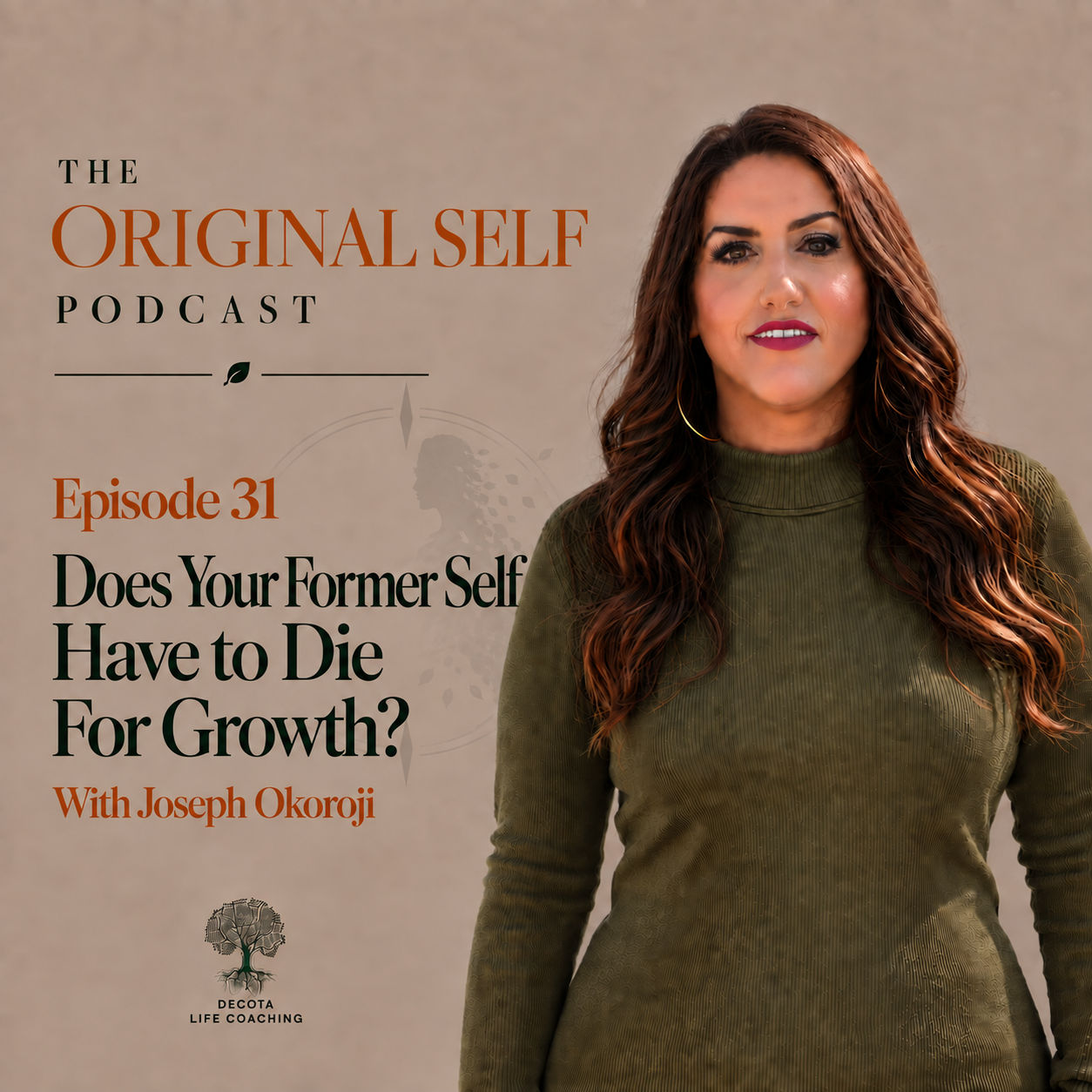
Does Your Former Self Have to Die For Growth
When you change, the people around you may not simply be resisting your growth. They may be grieving the version of you they knew how to relate to. Evet DeCota and A Mark in the Sand author Joseph Okoroji explore identity, loss, people-pleasing, ownership, momentum, sacrifice, and whether becoming requires the death of a former self.
A conversation with Joseph Okoroji, author of A Mark in the Sand
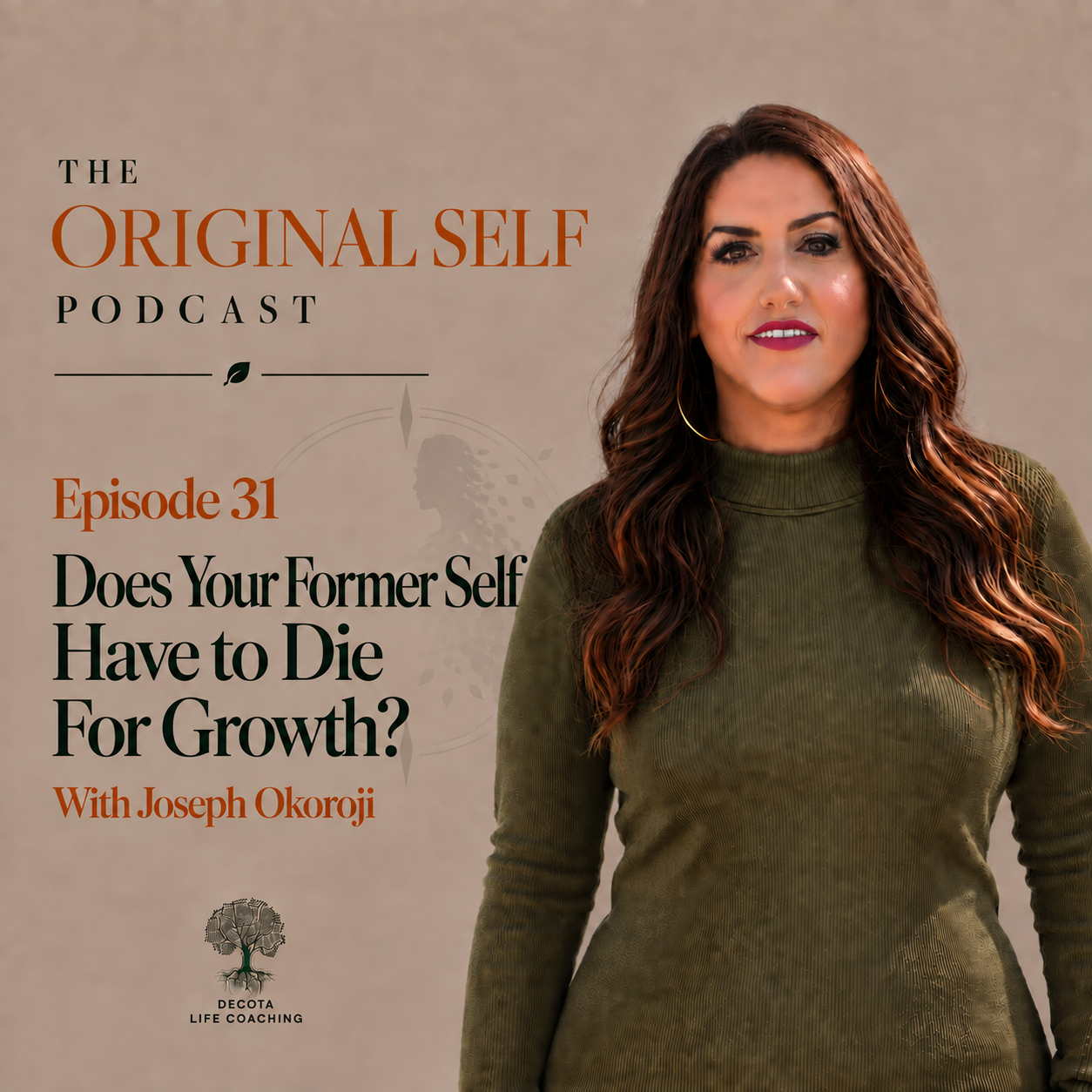
Episode 31 cover for The Original Self Podcast, Does Your Former Self Have to Die For Growth, featuring host Evet DeCota and guest Joseph Okoroji.
What if people do not recognize the new you because the person they knew no longer exists in the same form? That question brought author Joseph Okoroji to The Original Self Podcast after he heard Episode 29 on labeling theory and the way people respond when we change.
In this long-form conversation, Evet and Joseph explore the darker and more complicated side of transformation. The agreeable version of us may stop agreeing. The people-pleaser may begin setting limits. The identity built around anger, insecurity, overpreparation, or self-protection may no longer be in charge. Those changes can feel liberating, but they can also create grief for the people around us and for the parts of ourselves that once relied on those identities to survive.
Joseph explains why he uses the language of death, including his memorable metaphor about evolution and giraffes with short necks. Evet challenges the finality of that framing. What if growth is not the destruction of the former self but an integration of what it taught us? What if the goal is not to erase who we were, but to decide which part of us gets to lead now?
Drawing on Joseph's book A Mark in the Sand, the conversation moves through a lost cruise-ship opportunity, shame, the fear of hope, the difference between blame and ownership, permission-seeking disguised as advice, the power and danger of momentum, the cost of sacrifice, and the importance of remaining teachable. This episode is for anyone who has changed and been told, 'You're not the person I used to know,' or who is trying to grow without turning against the person they once needed to be.
Listen to the full conversation, then ask yourself: What did my former identity once protect, and what does it no longer need to decide for me?
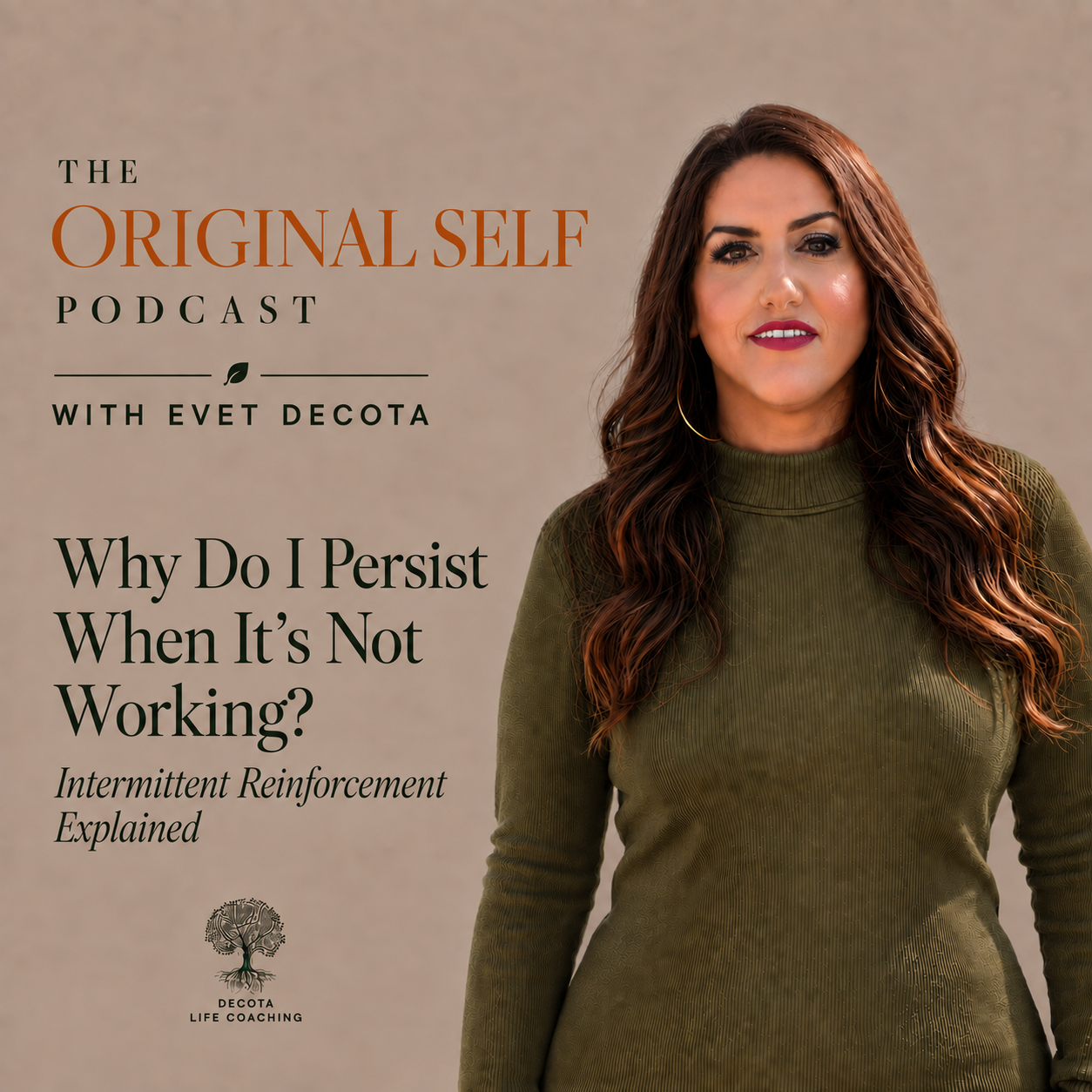
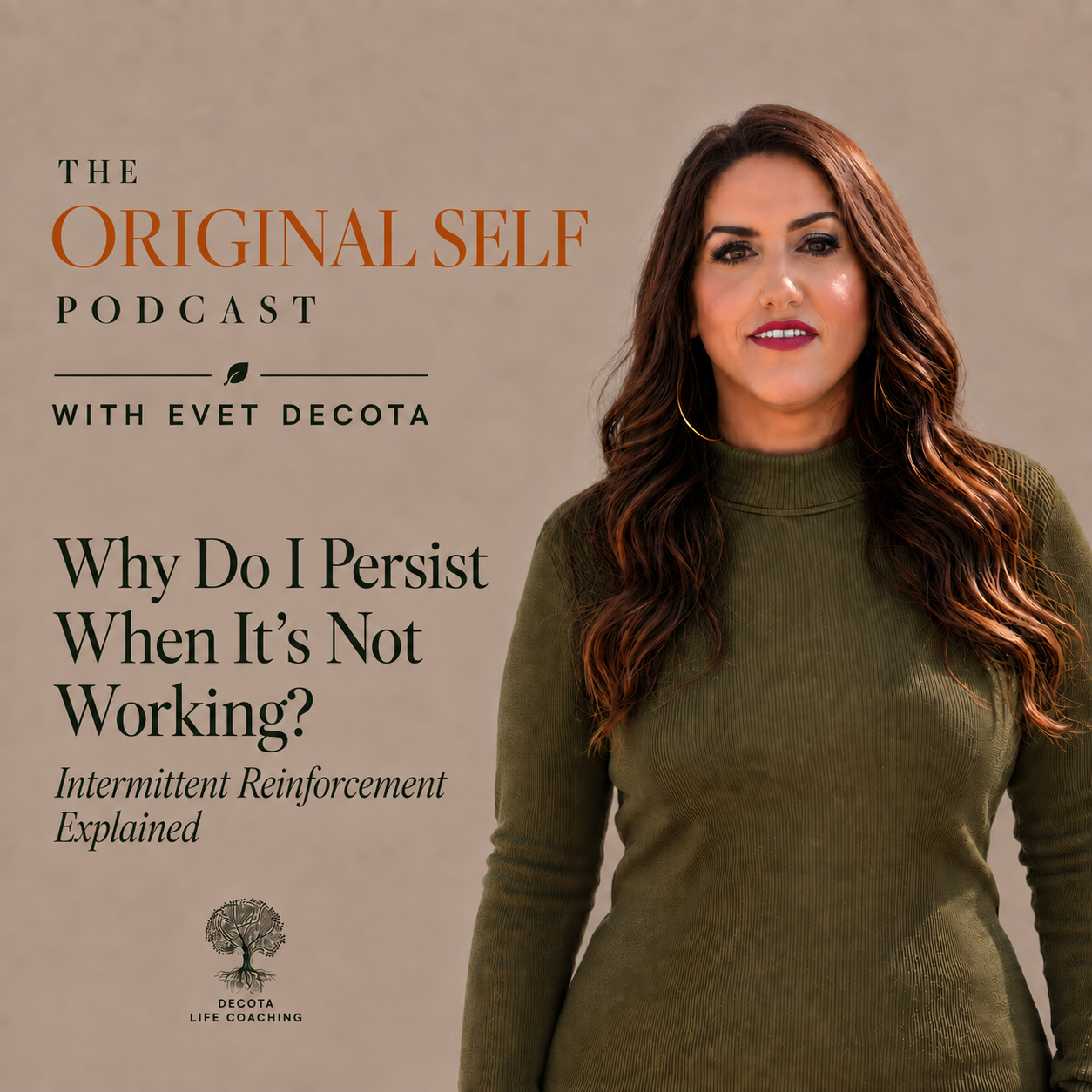
Why Do I Persist When It’s Not Working?
This episode's thread: the difference between a story we perform for outside approval and a story we're actually choosing. Evet traces her own drift from writing for the work itself toward writing for the metrics — and what it took to notice the shift was happening.
Intermittent Reinforcement Explained
Chapter 1- Cold Open
The numbers are sitting right there on the screen.
Downloads.
Average listen duration.
Click-through rate.
I look at them longer and more often than I need to.
The upward momentum is barely visible. I’ve spent weeks putting something real out into the world, yet the graphs still almost mirror Florida’s flat terrain.
My brain reaches its conclusion quickly:
No one’s listening. This isn’t going anywhere. Why am I still doing this?
I sit with that for a second. Let it be as ugly as it wants to be.
And then — quieter, but not gone — there’s another voice.
It isn’t cheerful. It doesn’t say, “You’ve got this!”
It’s just…stubborn.
Keep going.
That’s it. That’s all it says. Not an argument. Not a pep talk. Just two words, scratching at the back of my skull.
And for reasons I don’t fully understand, I keep listening to that voice instead of the numbers.
Chapter 2- Introduction
Hey, it’s Evet DeCota.
That stubborn little voice telling me to keep going raises a question I suspect many of us have asked ourselves:
When something isn’t giving us the results we hoped for, how do we know whether continuing is an act of perseverance or evidence that we’re having trouble letting go?
Because persistence is complicated.
We tend to speak about persistence as though it’s always evidence of strength.
Keep showing up. Don’t quit before the breakthrough. Success might be waiting for you right around the corner.
And that advice may protect us from abandoning something during the slow, unglamorous middle.
But persistence also has another side.
Sometimes we remain committed to something because it matters deeply to us.
Or maybe we remain because every once in a while, something happens that renews our hope just enough to keep us invested.
A struggling relationship suddenly gives us one wonderful weekend.
A job that regularly drains us brings an unexpected compliment from a supervisor.
Or a podcast with a nearly flat analytics graph receives a message from someone who says, “I needed to hear this.”
That moment may be sincere and meaningful. It may also affect our behavior in ways we don’t consciously recognize.
Psychology calls the broader pattern intermittent reinforcement.
In B.F. Skinner’s framework, this particular version resembles a variable-ratio schedule of reinforcement: the reward comes after an unpredictable number of attempts rather than after every attempt. Because we never know which attempt might pay off, we may continue the behavior far longer than we would if the outcome were predictable.
But that doesn’t necessarily mean continuing is a mistake.
It leaves us with a harder question: How do we tell the difference between persistence rooted in meaning and persistence sustained by the hope of receiving one more reward?
In this episode, we’ll look at why unpredictable moments of encouragement can become so powerful, how outside responses can influence something we originally chose because it mattered to us or we believed it might help someone else, and what we might ask ourselves when the numbers say stop, but something inside us continues to say:
Keep going.
Chapter 3- When Meaning Became Measurable
I started this podcast because I wanted to reach more people than I could ever reach coaching one at a time.
After almost forty years of working closely with the public, studying psychology, and becoming a life coach, I felt I had something valuable to contribute.
I could see connections among the stories people told me, the psychology I was studying, and the patterns so many of us experience. I also saw how the right coaching questions could help someone look at those patterns differently.
I believed those connections could help people.
I also had ambition for the podcast. I hoped it would grow.
I wanted it to stand apart in two very crowded spaces—podcasting and coaching—by combining psychological research with the kind of human understanding that can only come from decades of listening closely to people and noticing what they reveal about themselves.
And yes, I hoped that one day the podcast might be picked up by a company willing to pay me to continue creating it and bring it to an even larger audience.
That was part of the dream, too.
I wasn’t expecting instant success, not really. I was hoping for evidence that the podcast was moving toward something.
An expanding audience. More engagement. A growing body of work that people found useful and wanted to share.
Because podcasting was new to me, I asked friends and clients for honest feedback.
Some took notes while they listened and told me which ideas stayed with them, how the episodes made them reflect, and where they wanted to hear more.
Much of that feedback was incredibly encouraging.
They weren’t simply telling me, “Good job.” They were engaging with the ideas and showing me that something I said had made them pause or recognize something in themselves.
I took the feedback seriously because I wanted to learn.
When I first started, my focus was primarily on what I could offer.
But once I began releasing episodes, I also had to think about how anyone would find them and what would make someone choose to listen.
That’s when even more advice started pouring in.
Post more often, be consistent. Pick a lane.
Turn every episode into multiple pieces of content. Strengthen the hook.
Sound less like you’re reading. Get better equipment. Compress the audio.
Study what performs well, and then do more of that.
I listened. I tried. I implemented many of the suggested changes.
I experimented with social media posts, promotional videos, reels, titles, and artwork. I thought carefully about which few words might persuade someone to stop scrolling long enough to listen.
Most of the advice was useful. It helped me become clearer and more intentional about how I presented the podcast.
But it also changed what I was paying attention to.
Something that began as a place to explore why we behave the way we do, and how we find our way back to our authentic selves, became something I could measure.
Downloads. Views. Clicks. Listening time. Subscribers.
And I’ve realized that once something can be measured, it becomes very easy to let the measurement decide what it’s worth.
Over the past few months, I’ve begun questioning whether all the time and effort I’ve invested are paying off. And whenever I’ve come close to seriously doubting it, I’ve heard or read something unexpected.
Someone tells me they listened to an episode more than once because there was so much in it, they wanted to absorb.
Someone else tells me that a particular perspective stayed with them.
Occasionally, a complete stranger comments that they recognized a part of their own life in something I said.
Those responses never arrive on a schedule. I can’t predict which episode will reach someone or when they will decide to tell me about it.
Then my friend’s kid told me about something that happened while he was avoiding a task he needed to complete.
Instead of doing it, he decided to clean his room. While he was cleaning, he listened to my episode about procrastination.
At one point, I described the exact thing he was doing: completing a different, less important task to avoid the discomfort of beginning the necessary one.
He laughed when he recognized himself.
Then he stopped cleaning and listened to the rest of the episode.
When it ended, he went to his computer and took the first action required to begin the task he had been avoiding. He had broken through the resistance fueling his procrastination.
I was stoked to hear that.
Something I had written and recorded did exactly what I hoped it could do. It helped someone recognize a pattern and take action.
Suddenly, my mostly flat graph mattered a little less.
His response didn’t erase my doubt, but it definitely interrupted it.
It gave me just enough evidence to think: Maybe the work is reaching people in ways the numbers can’t show me.
So I kept going.
For a while, I called that trusting my instincts.
But I’d learned enough psychology to know that instinct might not be the entire explanation.
Sometimes, the thing that keeps us invested isn’t a steady reward, but the possibility that another reward might be coming.
Chapter 4- The Problem with “Maybe”
That possibility — that another reward might be coming — is exactly what Skinner’s research speaks to. The most relevant part is what happens when rewards become scarce or appear to stop altogether.
A behavior that’s rewarded consistently is often easier to abandon once the reward disappears. The change is clear.
Something that used to happen every time is no longer happening.
But when reinforcement has always been inconsistent, its absence doesn’t give us the same clarity.
We’re already accustomed to waiting.
One attempt without a reward doesn’t mean anything. Neither do five attempts, necessarily, because we never knew how long the wait would be in the first place.
The absence of a reward can’t tell us whether it’s over or whether it simply hasn’t happened again yet.
That uncertainty is what makes the behavior so resistant to what psychologists call the partial reinforcement extinctioneffect: behaviors reinforced unpredictably are harder to let go of than behaviors reinforced every time.
Extinction is simply the term for what happens when a previously reinforced behavior gradually fades, and partial reinforcement is what slows that fading down.
A definite no gives us information. Maybe keeps the story open.
Maybe can appear anywhere we’re waiting for an outcome.
We may wonder whether a relationship is slowly improving or whether one good experience has temporarily renewed our hope. We may question whether a career opportunity is developing behind the scenes or if we’re holding on because no one has given us a definitive answer.
When the outcome remains uncertain, almost any encouraging sign can become a reason to wait a little longer.
I can interpret several weeks of nearly flat analytics in two completely different ways.
I can see evidence that the podcast isn’t growing.
Or I can tell myself that growth takes time and the right audience hasn’t found it yet.
Then a meaningful response arrives, and “maybe” becomes powerful again.
Hope returns—but not certainty.
And that’s where persistence becomes difficult to evaluate. Continuing can be an act of patience and commitment. It can also be a way of postponing a truth we don’t want to confront.
The fact that we’re still willing to try doesn’t prove that continuing is wise.
But the absence of immediate success doesn’t prove that stopping is wise, either.
Intermittent reinforcement can help explain why I continue the behavior. It can’t tell me whether the behavior is still aligned with what I value.
For that, I have to look beyond the reward and ask what was motivating me before it arrived.
Chapter 5— What Am I Really Working For?
Psychologists Edward Deci and Richard Ryan developed Self-Determination Theory (SDT) to explain not just what motivates us, but also the quality of that motivation—if it comes from inside us or from something outside us.
I started this podcast because I believed I could help people. I also enjoy the work itself— finding the connections, writing about them, and translating what I learn into something someone can use. That’s intrinsic motivation. It comes from within.
But I also wanted the podcast to grow. I wanted people to recognize its value, and yes, I hoped it might lead to a paid opportunity someday. That’s extrinsic motivation.
Both can be true at the same time. Someone can find genuine purpose in their work and still want the promotion.
A person can exercise because it makes them feel strong and still enjoy being told they look good.
Someone can create something because the process itself is satisfying and still hope people will buy it.
SDT says healthy motivation rests on three needs: autonomy — choosing what we do rather than being controlled by outside pressure. Competence — feeling like our efforts are actually landing. And relatedness — feeling connected to other people through what we do.
This podcast feeds my autonomy because I choose what it’s about. It feeds my competence when someone tells me something I said stayed with them. And it feeds relatedness when a listener recognizes their own life in an episode.
The trouble starts when an outside response becomes the only evidence that the work is worthwhile. Certain external rewards — especially the ones that feel expected or controlling — can actually weaken an interest that used to come from within. What we chose starts to become something we perform to get the reward.
But not every outside response has that effect.
A listener’s message is an external reward, and it can still feed competence and relatedness at the same time — still reconnect me to why I’m doing this.
I can feel that connection and still want the validation of a rising graph.
I care about helping people. I enjoy making this podcast. I also want recognition, a bigger audience, and some financial reward for it.
So maybe the more useful question isn’t whether my motivation is intrinsic or extrinsic.
Maybe it’s: which one is making the decision right now?
Chapter 6— Persistence Isn’t the Same as Repetition
The question sounds simple until I try to answer it honestly.
My motivations are usually mixed, so I start with: Am I committed to the purpose, or have I become attached to one particular outcome?
That one alone takes some sitting with.
Then a few more, quieter but just as pointed: If the next effort went unnoticed, would there still be value in making it? What part of this matters to me independently of the response I receive?
And then the one that’s harder to answer than it sounds: What would I change if I weren’t waiting for the next reward to reassure me?
Those questions don’t guarantee a clear answer, but they shift my attention away from waiting for reassurance and hand some of the decision back to me.
Author James Clear recently wrote in his 3-2-1 newsletter: “Winning isn’t what makes you feel good. Growth is what makes you feel good.”
I needed to hear that during my moments of doubt and hesitation because the distinction matters.
Winning depends on a particular outcome. The numbers rise. The audience expands. The opportunities arrive.
Growth can happen even when none of that has.
I may be becoming a stronger writer, a clearer communicator, and a better researcher.
I may be learning which advice is useful and which advice is pulling me away from what I’m actually trying to create.
Growth doesn’t require me to pretend that the outcome no longer matters. I still want the podcast to succeed.
But if winning is the only result I’m willing to count, I might miss what the work is already producing in me.
And persistence doesn’t mean repeating the same approach forever. We can stay committed to a goal while changing the strategy — the pace, the amount of energy we’re investing, if we ask for help, and what “meaningful progress” even looks like.
In a career, that might mean pursuing the same purpose through a different role.
In a relationship, it might mean staying open to repair without accepting the same harmful pattern again.
With a personal goal, it might mean adjusting the plan instead of treating one failed attempt as proof we’re incapable.
Changing direction isn’t always giving up. Sometimes, it means we’re finally paying attention.
I can believe in the purpose of the podcast without believing that every part of my current approach is working.
Maybe the healthiest form of persistence isn’t blind continuation or abruptly walking away.
Maybe it’s staying connected to the purpose while remaining willing to change the plan.
Chapter 7- Closing
When I look at the analytics now, the graph hasn’t magically changed.
But the question has.
Instead of asking, Why am I still doing this?
I can ask, Am I still choosing this?
For now, the answer is yes.
Not because I’ve been promised that the next episode will be the one that changes everything. Not because I believe persistence always leads to success.
I’m choosing it because I still have something to say. I’m still curious about the ideas I explore, and I still believe the work has the potential to help people.
There may come a time when my answer is different. If that happens, stopping won’t necessarily mean I failed or gave up too soon. It may mean I paid attention long enough to recognize that the work, or my relationship with it, had changed.
Maybe the thing you’re questioning is a relationship, a career, a personal goal, or a future you’ve invested years imagining.
The question isn’t simply how much longer we can hold on.
It’s whether we’re still consciously choosing this, or just waiting for the next reward to decide for us.
That stubborn voice in our head still says:
Keep going.
But this time, it’s not just obedience.
This time, the answer is ours:
Yes. For now. By choice.
I’m Evet DeCota. If this episode resonated with you and you’d like to connect with me, all of my information is in this episode’s notes.
Thank you for listening and have a great day.
Why People Treat You Differently When You Change
Why do people treat us differently when we change? Explore labeling theory, gender backlash, confidence, boundaries, and the roles others expect us to play.
Labeling Theory Explained
Chapter 1-Cold Open
“You know what I mean?”
I look up from setting up my tray for the day. I have no idea what she’s talking about.
I’ve only been at this salon for about six weeks. I know this coworker’s name. I don’t yet know the version of her that shows up after a year working together.
She’s waiting for me to agree with something, so I raise an eyebrow instead.
So she says it again, like it’s obvious. “That client of mine, the one who lost all the weight, she used to be so nice. Now she’s kind of a bitch.”
I smile. Mutter “…Wow…” and go back to setting up my tray, hoping that’s the end of it.
It isn’t.
She laughs. “You know what I mean, right? How people lose weight and then get super bitchy?”
I tell her I’m not familiar with that characteristic.
She looks at me for a second like I’d missed the punchline of a joke everyone else already agreed on.
Fortunately, my client walks in, and I’m saved before I have to say anything else.
I was probably twenty-five pounds heavier than I am now. I don’t know if that’s why she said it to me like that— as if I’d get it.
Maybe I’ll never know, but I’ve thought about that conversation more than once over the past two years.
Chapter 2-Introduction
Hi, it’s Evet.
That was a real exchange you just heard.
I had no idea which client my coworker was talking about. All I knew was the woman had lost a significant amount of weight, and somewhere during that process, my coworker decided she liked her better before.
I didn’t know whether this client had actually become unkind. I still don’t know what she was like before she’d lost the weight, what else might have been happening in her life, or how much of the story I wasn’t hearing.
What stayed with me was the way my coworker said it as though it were a fact: people lose weight, especially women, and become off-putting.
I mean, I know water boils at a certain temperature. I know Jon Stewart is brilliantly sharp and quick-witted. And I know Aretha Franklin is the greatest soul singer who ever lived.
Those are facts to me.
But when my coworker said, “You know what I mean?” as though we both understood this predictable consequence of weight loss, I was genuinely puzzled.
I kept returning to the conversation because it seemed to be about more than one woman’s weight or personality. It made me think about what happens whenever someone changes in a way that disrupts how other people have come to know them.
Someone loses weight and is suddenly considered arrogant.
Someone becomes more confident and is told they’ve become difficult.
Someone begins setting boundaries and is accused of being selfish.
Sometimes a person stops accepting a role they’ve played for years, and the people around them experience that as a problem instead of growth.
It made me wonder whether people were reacting to who we have become or to the loss of the person they expect us to remain.
There’s a sociological concept called labeling theory that helped me decipher this.
In this episode, I’ll explore why change can alter not only how we see ourselves, but how other people see and treat us.
I also want to look honestly at the roles we sometimes learn to play so we’ll be accepted, and what happens when we no longer need or want to play them.
Because sometimes when people tell us, “You’ve changed,” what they really mean is, “You are no longer behaving the way I expected you to.”
Chapter 3- The Story Becomes the Person
My coworker took a complicated human going through a significant change and reduced her to: “She used to be nice, and now she’s kind of a bitch.”
That sentence didn’t leave much room for anything else to be true. The change was identified, the explanation was decided, and the woman was given a new label.
This is where labeling theory becomes important.
Labeling theory was originally developed to explain how certain behaviors and eventually certain people come to be defined as normal, acceptable, problematic, or outside the rules.
One of its central ideas is that a label doesn’t merely describe someone; it can influence how others interpret that person, how they respond to them, and eventually how that person understands themselves.
In other words, the label becomes a lens.
Once a label is in place, another familiar tendency can strengthen it: confirmation bias. We begin collecting evidence that supports what we already believe about the person.
If they disagree with our assessment, well then, that’s proof that we’re correct.
If they say no to us, or don’t return a call quickly enough, it’s all added to the proof file to support our theory.
The bummer of our quick assessment is that we don’t often reopen the file and ask whether we named it correctly in the first place.
I’m not suggesting that a person’s behavior is always imaginary or that every judgment we make is unfair. I have an entire podcast on judgment.
Sometimes people really are inconsiderate, and sometimes people can change in ways that make them harder to be around.
Labeling theory asks us to notice what happens after we decide what that behavior says about who someone is.
What information do we continually notice?
What information do we dismiss?
How much space do we leave for that person to behave in ways that contradict the identity we have assigned them?
Because once someone becomes the difficult one, even neutral behavior can begin to look problematic.
Once someone becomes the selfish one, a reasonable boundary can look very self-absorbed.
Once someone becomes the emotional one, a legitimate reaction can be treated as unnecessary drama.
And once someone becomes the nice one, anything less than constant warmth can feel like a personality change.
That last label matters in this story.
My coworker may have known this woman as a kind client who happened to be heavier. But it’s also possible that, without consciously realizing it, she had combined those qualities into one identity: the nice, overweight client.
A related sociological concept is called master status. It describes an identity or characteristic that becomes so dominant it begins overshadowing everything else we could know about a person.
We do this with weight, age, race, illness, disability, occupation, money, relationship status, and family roles.
He’s the successful one. She’s the responsible sister. He’s the one with the drinking problem. She’s the heavy one— but she has a pretty face, and she’s so nice.
Chapter 4-The Label Becomes an Expectation
The labels we give people shape what we expect from them.
If I label you “easygoing,” I begin to expect you won’t ever object to a plan or idea.
If I label you “strong,” I may not offer you support because I don’t think you need it.
If I label you “the caretaker,” I may become uncomfortable when you need care.
And if I label you “nice,” I may treat your warmth as an obligation instead of something you freely choose to offer.
Then, when you change, I may not experience that change as you becoming more fully yourself. I may think it’s you breaking an agreement.
Where the problem lies is that you didn’t agree to any of it.
You probably didn’t even know the agreement existed.
Maybe my coworker’s client was especially accommodating in the past. Maybe she had been agreeable, apologetic, or careful not to inconvenience anyone. Maybe she had learned that being warm made it safer to take up space in a body she knew other people might judge.
Or maybe none of that was true.
But if my coworker had come to expect a certain kind of warmth from her, then even a small change could have felt extreme.
A more direct answer, a firmer opinion, or one appointment during which she wasn’t especially talkative might have seemed like evidence that she wasn’t the same person any longer.
Now here’s the fun part, ladies.
Research on gender backlash has found that women are often judged negatively when they behave in ways that conflict with expectations that women should remain warm, agreeable, and accommodating.
I know, shocking!
A woman who becomes more assertive may be considered abrasive.
A woman who speaks confidently may be seen as arrogant.
A woman who stops overexplaining herself may suddenly be described as cold.
Remember in 2008, when Hillary Clinton became emotional while answering a question about how she stayed upbeat and kept going as she fell behind Barack Obama in the presidential race?
For years, she had been portrayed as controlled, cold, and calculating. Then her voice broke, and she showed vulnerability. Rush Limbaugh accused her of “emotional blackmail” and described the moment as calculated.
I saw humanity and strength. I thought her willingness to show emotion helped cut through the persona of someone who was never affected by anything.
What interests me is how the label followed her either way. When she remained composed, she was perceived as cold. When she did show emotion, the emotion was dismissed as manipulation.
That’s the bind many women face. There’s a very narrow range of behavior that some people are willing to interpret generously. A woman can behave in two completely different ways and have both treated as proof of the same opinion people already hold about her.
Which brings us back to the client in my coworker’s chair. A person’s growing confidence can challenge other people’s expectations about how they should behave.
This doesn’t prove that every criticism directed at a confident woman is unfair, but it does raise a possibility worth considering.
What if the quality my coworker had interpreted as “bitchy” was confidence instead of anything negative?
What if this woman had just stopped performing smallness?
Perhaps losing weight changed how much space she felt permitted to occupy, how often she apologized for voicing an opinion, or how much responsibility she accepted for keeping everyone else comfortable.
That might have felt like freedom for her on the inside, but from the outside, especially to those who preferred an earlier version, it might have looked like an attitude problem.
Chapter 5- Believing the Label
Those reactions can be especially confusing when they come from friends and family who have known us for years.
Just because they have known us the longest doesn’t mean they know us the most accurately.
People who have known us for years can become accustomed to a particular version of us.
The relationship develops a familiar rhythm. One person is treated as the expert and does most of the talking. Another asks questions and listens.
Someone keeps the peace or makes everyone laugh.
Over time, we become accustomed to whose thoughts get the most room.
As someone becomes more confident, they may begin contributing in ways they didn’t before. That change in their voice and presence can interrupt the relationship’s familiar rhythm.
I’ve noticed this in my own life, and it’s never happened dramatically. It may happen when I’m expressing an opinion, sharing something I’ve read or seen, or simply trying to add to a conversation.
I’ve experienced many interruptions, with people adding in their own thoughts before I can even get mine out. People tell me to hold on, redirect the topic back to themselves, or say they have to go after they’ve been the one speaking for most of the conversation.
I’ve wondered whether this happens more now, or whether I notice it more. Going back to school, losing weight, and getting older have given me reasons to reconsider what I accept in a conversation. I’m more aware of whether I’m being given the capacity to finish a thought.
Before I changed, I rarely asked for the space, acknowledgment, or respect I deserved. I don’t think I believed I deserved it, or thought much about it.
For much of my life, while I was overweight, I learned to be liked by being funny, smart enough, very friendly, but mostly not too assertive.
Now don’t get me wrong, I can be aggressive- I become especially outspoken about injustice when it affects other people. I’m more willing to push back, speak up, and refuse to tolerate discrimination or rudeness toward others.
But I was less likely to do that for myself.
That history makes me ask myself: how much space have I been giving myself all along?
When I heard the words I’d just used- funny, friendly, smart enough, and mostly not too assertive- I stopped at “smart enough.”
Smart enough? That’s an interesting choice, isn’t it? Enough for what? And who was deciding when I’d reached the limit?
Those words make me wonder how much I actually edited myself before anyone else even had the chance to respond. How often did I decide that something I wanted to say could wait, or that it would be easier to let someone else keep talking?
This is where labels become personal for me. Over time, we can absorb other people’s expectations into our own understanding of who we are.
We begin making decisions around them, and eventually, we may carry on enforcing a role even when nobody is asking us to.
If being agreeable has become part of how you understand yourself, disagreeing can feel uncomfortable before you’ve even opened your mouth.
You may anticipate how it will sound, whether someone will be disappointed, and what they might think of you afterward.
You may have a perfectly reasonable opinion and still feel the urge to soften it, apologize for it, or keep it to yourself.
Because I do value being warm. I value humor and kindness. Those qualities matter to me, and I want to be true to them.
I also want to understand how much of my friendliness has sometimes been tied to wanting people to accept me.
Both things can exist in the same interaction. I can genuinely enjoy someone and be interested in what they’re saying but also hesitate to ask for the same interest in return.
I think that for many years, as an overweight person, I believed I needed to bring a little extra to every interaction. Being funny and attentive felt like a way to make people more comfortable with me, and more accepting of me.
I can recognize that bargain now and feel compassion for the version of me who believed she needed it.
The difficulty of that bargain comes when we feel permitted to use only one part of ourselves.
If I’m always the funny one, what happens when I’m hurt and don’t want to make a joke?
If I’m always the understanding one, can I say something upset me without immediately explaining why the other person meant well?
If I built my identity around being easy to get along with, how do I respond when getting along means swallowing something I need to say?
As I change that role, I still want to consider my tone, my timing, and how I treat the other person. I don’t want to be a jerk simply because I’ve become more assertive.
I want to honestly look at my own behavior. If I interrupt someone, I want to notice. If I go on too long, I want to make room. I want the people I care about to feel heard, and I want to be included in that same consideration.
An interruption by itself tells us very little about someone’s motives. People get excited, distracted, or pressed for time. What interests me is the pattern: whether we regularly have the capacity to contribute, and what happens when we ask for it.
The difference now is that I rarely hold back my opinion. I’ve learned that what I have to say deserves the same expanse I’ve spent years giving to everyone else.
When someone interrupts me while I’m saying something important, I’m more likely to stop them and say, “Hang on” or “Wait, let me finish.” I have learned that I’m not required to disappear.
I also don’t spend as much time worrying about whether everyone likes me. It used to bother me deeply, and I would adjust so that they would.
Now I ask a different question: Was I being myself? Was I kind? Was I present?
If the answer is yes and someone still doesn’t like me, I can live with it.
The same change has happened in how I think about attraction. If a man doesn’t find me attractive, I no longer treat that as information about what I should change.
I don’t need to become quieter, thinner, less opinionated, more agreeable, or more like whatever he prefers.
His preference belongs to him. My life and my body belong to me.
Rejection can still sting. I mean, I’m still mostly human. I’m simply saying that someone else’s approval no longer gets the final vote on who I am authentically.
Maybe some people will experience that as a change in my personality.
Maybe some people will say I’m more outspoken, more difficult, or less accommodating than I used to be.
They are right; I have changed.
I’m less willing to abandon myself so that someone else can remain comfortable with the version of me they already knew.
And thinking about that brings me back to my coworker’s client. I wonder whether she had been going through some version of this herself.
Chapter 6- Looking Beyond the Label
So all I had was the label.
My coworker never described a specific interaction or told me what her client had said or done. She only gave me her conclusion about who the woman had become.
The question that may have opened the story back up was: What exactly changed?
That question separates a label from behavior.
“She’s selfish” judges her character.
“She canceled our plans without telling me” describes what happened.
“She’s arrogant” gives her an identity.
“She interrupted me several times while I was speaking” identifies a behavior I can examine.
Specificity creates room for reflection. I can consider what I did, understand how it affected someone, apologize if needed, and choose differently next time.
A character label makes the accusation much larger. Instead of responding to what I did, I’m left defending who I am.
This matters when we’re labeled and when we describe someone else. When I hear myself thinking of or describing a person as difficult, dramatic, selfish, or arrogant, I can pause and ask what they actually did.
Is it a pattern or just one moment?
Did their behavior cause harm, or did it challenge an expectation I had of them?
Can I describe what happened without deciding what kind of person they are?
In that salon conversation, the label stood in for the answer. Certainty replaced curiosity.
Curiosity gives us another option. We can remain interested in what actually happened and what context we may still be missing.
Chapter 7- Closing
“You know what I mean, right?”
At the time, my answer was no.
Two years later, my answer is still no, and I think that’s the point.
I didn’t know the client. My coworker knew her in one setting, through one relationship, and from her own point of view. Yet one label made the story sound complete.
That conversation stayed with me because labels can create the feeling that we know more than we do.
I’ve changed in these last few years.
I speak more freely.
I protect my place in a conversation.
I’m less willing to shape myself around another person’s approval.
Some may appreciate those changes; others may prefer the earlier version of me.
Their reactions are information, not instructions for how I should present myself.
Although I remain accountable for how I treat people, I will continue to decide for myself who I’m becoming. And I hope you do too.
I’m Evet DeCota. If this story resonates with you and you would like to discuss this further, you can find all my contact information in the episode notes.
Thank you for listening, and have a fantastic day.
How a Person’s Belief Can Change Your Life
Episode 28 cover art for The Original Self Podcast showing the host of the podcast, Evet DeCota, with the title How a Person’s Belief Can Change Your Life and the DeCota Life Coaching logo.
The Psychology of Self-Efficacy
Chapter 1: Cold Open
As I’m applying color to her roots, section by section, I notice her watching me in the mirror. My client has a particular look when she is about to say something, whether I’m ready to hear it or not.
“Evet,” she says. “You’re such a smart, dynamic, capable woman.”
I laugh the way I always do, and try to turn the conversation back toward her.
She doesn’t let me.
“I mean it,” she says. “I don’t say things I don’t mean.”
I keep applying color so I don’t have to answer.
Chapter 2: Introduction:
Hi, it’s Evet
Today I want to talk about how other people’s belief in us can help us build self-efficacy at any age or any time in our lives.
Although I begin with one particular exchange, this episode is really about a pattern I have witnessed across several long relationships behind the chair.
Accepting a compliment has never been one of my more developed skills. I can explain it away, make a joke, or quickly find something nice to say about the other person.
Anything that keeps the attention from resting on me for too long.
But some part of me hears them.
Some part of me has always heard them.
Over the years, clients have watched me open salons, return to college later in life, and even start this podcast.
I didn’t feel confident through it all. I questioned almost every new step, sometimes repeatedly and with great creativity.
Their belief didn’t remove the doubt.
It sat beside it.
And sometimes, that was enough to keep me moving.
Chapter 3: The Voice That Stayed:
I’m lucky. Many people in my life have said kind things to me. Clients have told me I’m talented. Friends have encouraged me and have even suggested that I write a book.
I don’t know about that one.
The point is, it’s always nice to hear, but much of it disappears.
But certain voices stay with me.
I’ve wondered why some words become the ones we hear when we’re standing at the edge of something new, trying to decide whether we’re capable of doing it.
Maybe it’s because, for me, the people saying them have never offered one of those inspirational wall plaques you find at Home Goods for your beach house.
“Life’s A Beach”
“Be Shore to Smile”
Those slogans were actually hanging on the walls of a beach house my family and I rented and, of course, we had fun mocking them all weekend.
But back to what I was saying.
The clients whose words stayed with me had been paying attention. They knew the version of me who had not yet returned to school and the version who eventually graduated. They had asked questions and listened while I talked myself out of things, then watched me eventually do some of them anyway.
They had seen the confident decisions and the decisions I made while feeling anything but.
Their belief came from years of paying attention to who I was becoming.
And that makes a difference.
There’s a psychological concept called mattering. At its simplest, mattering is the feeling that we occupy a meaningful place in someone’s life— that they notice us, that our experience actually registers with them.
We trust that we are not interchangeable or invisible.
I didn’t have a name for it at the time– I just knew that when they said something, I believed it more than when other people did.
Their encouragement carried the weight of all those years they had spent paying attention.
When I first returned to school and had to take statistics, I was convinced I would fail. I have always believed I am horrible at math.
And I mean, it’s not only a belief. There is actual evidence demonstrating how little I understand it.
So, with that well-established story about myself, I knew I would fail the class.
One longtime client told me about taking statistics in college. She joked that her professor finally passed her to get her out of his class. Because she struggled so much with the material, she was always the first person waiting outside his office, ready with more questions.
She kept telling me that if she could pass, then I could pass too.
She encouraged me to ask as many questions as possible and to believe that I could make it through the class.
I watched countless hours of YouTube tutorials, called my brother more times than he cared to count, and tried getting my tech clients to explain problems to me. It didn’t help much.
I wrote so many emails to my professor that she probably had to go home and have a drink to relax.
But I passed.
My client’s belief didn’t pour confidence into me simply because she said nice things.
It made failure feel less inevitable.
It gave me enough room to believe that success was still possible.
Chapter 4: Self-Efficacy: Belief That Leads to Action
Psychologist Albert Bandura used the term self-efficacy to describe a person’s belief that they can organize themselves and take the actions a situation requires.
Self-efficacy is not the belief that you will succeed at everything. It’s also not positive thinking or pretending fear has disappeared.
It’s the belief that you can engage with what’s in front of you. You can try, adjust, and keep going.
Bandura argued that self-efficacy influences whether we begin, how much effort we invest, and how long we persist when something becomes difficult.
When our self-efficacy is stronger in a particular area, we are more likely to treat setbacks as information. When it’s weaker, we may treat those same setbacks as proof that we shouldn’t even try.
Bandura identified four main sources of self-efficacy.
The first is a mastery experience. This is the evidence we gather by doing something.
For me, finishing statistics without perishing was a mastery experience.
Not because I suddenly understood the material. I still don’t, not really.
But a year later, in a research methods class, my professor asked a statistics question.
I rattled off the answer like I actually knew what I was talking about— with the same unearned confidence as that scene in Romy and Michele’s High School Reunion where Lisa Kudrow’s character Michele explains how she supposedly invented Post-it note glue, throwing out real chemistry terms she clearly didn’t understand but remembered.
I was completely shocked that I remembered the answer, and I must have looked shocked, because the professor laughed and said, “Good job, Evet.”
It was a mastery experience because I did the thing I was certain I couldn’t do, and I came out the other side with proof instead of theory.
Proof is different from encouragement. Encouragement is someone else’s word. Proof is mine.
So is surviving a mistake and discovering that we can recover from that mistake.
Difficulty doesn’t prove that we are incapable. When we adapt, keep going, and complete something we weren’t sure we could do, we create evidence that we can handle more than we believed.
The second source is a vicarious experience. This happens when we watch someone we identify with do something and begin to imagine that it may also be possible for us.
This is why I became a life coach. One of my clients was also a life coach, and I would hear about the classes and seminars she led. Watching her do it is the reason I became one.
Watching someone we relate to succeed can strengthen our belief in what may be possible for us. We don’t even have to know them personally. It might be a public figure, someone we encounter in a biography, or an athlete we admire.
How many kids watch Steph Curry make his trick shots, then go outside and practice because seeing him do it makes them believe it might be possible for them too?
Who we admire can show us a possibility we hadn’t previously imagined for ourselves.
The third source is social persuasion. This happens when someone credible tells us that they see ability in us. Their words don’t prove that we can do the task, but they may keep us from quitting before we’ve collected our own evidence.
The person encouraging us has to be believable. Generic cheerleading from someone who barely knows us usually doesn’t carry much weight. Specific, repeated belief from someone who has watched us over time works differently.
My thesis professor knew exactly how many nervous breakdowns “working toward a deadline” could produce, because he watched most of them happen. Every so often he’d remind me how far I’d come and that if I stayed the course, I’d succeed. It worked because he’d earned the right to say it.
The fourth and final source is our physiological and emotional state. A racing heart can mean “I can’t handle this,” or it can mean, “This matters, and my body is getting ready to respond.”
The sensation may be the same. What changes is the meaning we give it, which changes what we do next.
I once turned an Arctic white blonde client’s roots orange. I mean like the kind you pluck off a tree in Florida. I began to panic, my heart started racing, my mouth went dry, and all logic left my brain.
I applied a treatment to her hair, walked away, and let my pulse slow down. A couple of hours later, her hair was back to the white she loved, and all was well.
When I consider my own self-efficacy today, I realize the belief my clients expressed was a form of social persuasion. Their words couldn’t substitute for my effort, but they helped me stay engaged long enough to build mastery of my own.
Returning to school, graduating, and earning my credential gave me evidence.
Producing the first podcast episode, then the fifth, and eventually the twenty-seventh gave me evidence.
Chapter 5: Reclaiming a Sense of Agency
Their belief also helped me in situations where the challenge wasn’t learning how to do something. It was recognizing that I still had the power to take action.
Psychologists use the term problem-focused coping to describe directing our attention toward the parts of a stressful situation we can influence. Instead of remaining overwhelmed by the entire problem, we gather information, identify our options, and choose a practical next step.
When I was opening my own salon, I ran into problems getting the necessary building permit because the building wasn’t up to code, but my lease stated that it was. The landlord denied responsibility and tried to frighten me into paying for the improvements required to continue the build-out.
The landlord owned what seemed like half the commercial buildings downtown. They had an endless stream of money and the attitude to match.
The landlord’s son-in-law was my contractor. He continued asking for payments without moving the project forward. He told me the city wouldn’t approve my building plans because there was something wrong with them. He neglected to mention that the real problem was their building.
I confided in my client about what was happening. I told her I didn’t think it was too late to back out of the contract, although I would lose much of the money I had already invested.
I didn’t believe I had the money, experience, or the power to go up against this family, and quitting felt easier.
My client reminded me that I knew how to speak to people, ask questions, and get answers. She convinced me I could walk into the city’s planning department and find out what was actually happening.
In my memory, the planning department was open from approximately 8 AM to 8:01 AM on the fourth Tuesday of a leap year.
It was a very narrow window of service for the many businesses waiting for building permits.
My client’s confidence in my ability pushed me to go there despite how intimidated I felt.
That’s where I discovered that my plans were perfectly fine. In fact, the permits weren’t issued solely because the building was non-compliant with accessibility codes, even though the landlord had stated in the lease that it was up to code.
Once I had documented proof in my hand, my brother and I summoned our Italian ancestral roots and went to the mattresses.
I’m kidding,
We confronted the landlord and made them bring the building up to code.
My client didn’t solve the problem for me. She helped me recognize that I still had agency within it. Once I gathered the facts, I could respond from evidence instead of intimidation.
But the deeper lesson wasn’t only about what their belief gave me. As my own evidence grew, my attention shifted toward the clients who offered that belief so freely.
Many of them had spent much of their lives being the people everyone else relied on.
Their stories showed me another side of what it means to be capable.
Chapter 6: When the Strong Ones Need Support
Over the years, I have known several women who learned to become capable very early in life.
Some were the oldest children in large families. Some grew up moving from place to place or adjusting to instability. Many became skilled at noticing what everyone else needed before asking what they needed themselves.
Those qualities served them well. They became dependable friends, attentive mothers, dedicated teachers, and the people their families called when something went wrong.
But I have also watched what happens when the strong one becomes overwhelmed.
I have sat with clients whose spouses or loved ones became seriously ill. They managed appointments, absorbed frightening information, supported the rest of the family, and continued functioning while carrying fear that few people ever saw.
Their stories were different, but I noticed a shared belief beneath many of them:
I’m the one who handles things.
I’m the one who helps.
I’m not the one who needs.
Psychologically, self-reliance can begin as an adaptive response. It helps us function when other people depend on us. But a strength becomes restrictive when we no longer feel permitted to respond any other way.
Research on help-seeking has found that a strong preference for self-reliance can prevent people from seeking psychological support. Sometimes it isn’t that they believe asking for help is wrong. They simply have difficulty believing that the same permission they give everyone else also applies to them.
But for some whose identity was organized around being capable, receiving help can feel almost like breaking a contract.
Who am I if I can’t manage this alone?
What happens if I become the person asking instead of the one answering?
Will people still see me as strong?
Perhaps strength also includes knowing when to stop performing invulnerability.
I have watched some of these women make a different choice.
They accepted help from family and friends. Some did seek professional support. They let another person listen without immediately turning the conversation back to everyone else.
Accepting support didn’t make these women less capable, less generous, or less dependable.
It did, however, allow them to include themselves among the people worthy of care.
Chapter 7: Self-Compassion:
Psychologist Kristin Neff describes self-compassion through three connected elements: self-kindness, mindfulness, and common humanity.
Self-kindness means responding to ourselves with care rather than harsh judgment when we struggle.
Mindfulness means acknowledging what we are experiencing without suppressing it or allowing it to become a whole story.
Common humanity means recognizing that struggle and needing support are a part of being human.
I think common humanity is especially important for people who are accustomed to being the strong one.
They readily recognize when others need care. The harder part is allowing themselves to need it too.
For some of my clients, self-compassion has meant accepting the meal someone offered, letting a family member take over an appointment, seeking support from a therapist, working with a life coach, or admitting, sometimes for the first time, “I can’t carry all of this alone.”
I have watched clients reach a point where what they were carrying finally became too heavy to conceal.
They would sit in my chair and begin talking, not about their hair or the ordinary events of their week, but about everything that had been accumulating. Their voices were even and controlled until suddenly, they weren't.
Instead of cleaning my area, I’d sit down in the chair beside them.
Often, they apologized, as people do when they have learned to treat their pain as an inconvenience. I made sure they knew that I never saw them that way.
Speaking honestly about what they were carrying was an act of self-kindness. Allowing themselves to experience the exhaustion without turning it into proof that they had failed was mindfulness.
And recognizing that needing help didn’t separate them from everyone else was common humanity.
People who cared about them had often been waiting for the opportunity to help. Receiving that care required them to trust that their needs would not make them less capable or less worthy of respect.
That kind of shift doesn’t happen once and stay finished. It’s a practice we choose again whenever the weight becomes heavy.
I know that because it’s been true for me too, not only when asking for help, but when trusting someone else’s belief in me before I had it myself.
Chapter 8: What I’m Taking with Me
I think we sometimes misunderstand how people influence us. We assume the people who change our lives are the ones who give us exactly the right advice at exactly the right time.
Often, they are the ones who give us a more accurate reflection of ourselves.
Because those relationships were grounded in honesty, my clients’ belief in me helped me develop my own. Their encouragement supported me without making me dependent on their approval.
Through their lives, my clients taught me something else: the generosity we offer other people eventually has to include us too.
Neither lesson requires anyone to fix us, and neither asks us to feel completely confident before we act.
So, here’s what I’m taking with me:
Self-efficacy grows through action, not through waiting until we feel ready.
Problem-focused coping turns a sense of helplessness into a practical question:
What part of this situation can I influence?
Credible belief from another person helps us remain in the experience long enough to gather our own proof.
And self-compassion expands our understanding of strength to include receiving support.
So, when that ugly little voice of doubt starts talking in my head, instead of asking it to shut up, maybe the question is,
“Why am I treating doubt as the only credible voice in the room?”
Chapter 9: Something To Try:
This week, offer one person a specific reflection based on something you have genuinely observed.
“I’ve watched how you keep going when this is difficult.”
“You ask thoughtful questions.”
“I see how much courage this is taking.”
Then try this: The next time someone offers support, practice receiving it fully. Pause long enough to let the help land before deciding what you owe them.
Pay attention to which feels more natural: offering support or receiving it.
That answer may tell you something about the role you’ve learned to play.
Chapter 10: Closing:
Clients have reflected strengths in me that I wasn’t yet ready to recognize. I’ve also watched capable people discover that accepting support doesn’t diminish who they are.
I still deflect compliments. I still laugh, change the subject, or question whether I’ve earned the words.
But I’m slowly learning to let those words land and trust that they might be true…slowly.
The best part is that self-efficacy doesn’t require doubt to disappear. It just means doubt no longer gets to make every decision.
Sometimes another person sees enough possibility in us to help us take the next step.
Sometimes our role is to offer that belief. And sometimes our work is to receive it.
I’m Evet DeCota. If this story resonates with you and you would like to contact me, all of my information is in this episode’s notes.
Thank you for listening, and have a wonderful week.
The People We Carry
Some people stay with us by changing what we notice. In Episode 27, Evet shares the story of Loren, a longtime client whose unhurried way of living led her to explore savoring, mind wandering, and the quiet power of fully receiving an ordinary moment.
How Relationships Shape What We Notice
He told me he was alone at a small table in the back of the deli. A sandwich in front of him and no phone in his hand.
He takes a bite, chews slowly, and then sets the sandwich back down. Around him, the place is very full.
A couple’s quietly negotiating where to sit. A kid’s trying to convince someone that he needs a second cookie. And someone nearby is laughing way too loudly into their phone.
He’s not a part of any of it, but he’s paying attention to it all. He’s sitting there as if he has nowhere else to be. As if the sandwich, the noise, and the strangers are the whole afternoon.
And the whole afternoon is completely enough for him.
Hey everyone, it’s Evet.
After doing hair for decades and now working as a coach, I’ve learned that people
rarely leave us with only memories. Sometimes they leave us with a sentence that we might repeat to ourselves or sometimes they change what we actually pay attention to.
Sometimes their way of moving through the world becomes part of the way we move through ours. We carry people.
Their voices become part of our inner conversations, their questions interrupt our certainty, and their way of living shows us that there just might be another way to live.
Today, I want to explore how that happens through one person I’ve known and knew for many years. His name was Loren
And he taught me something about attention, time, and what it means to be fully inside your own life.
So I just want to start with two questions.
Who taught you how to notice your own life?
And what part of the way they lived has quietly become part of the way you live?
Evet's Substack is a reader-supported publication. To receive new posts and support my work, consider becoming a free or paid subscriber.
So the man in the deli was Loren. I cut his hair every six weeks for 16 years. And every time he came to the salon, he said the same thing to me.
“I can’t believe it’s already been six weeks.”
He wasn’t saying it to make conversation. He was genuinely surprised that time had escaped him.
I believe Loren was 6 ‘5”. He was gentle. Curious, funny, and one of the least hurried people I had ever known.
He wasn’t slow in the sense that he couldn’t get things done. He had gone to law school, built a career, raised a family. He had a full life.
He simply didn’t seem to stand outside his life with a stopwatch, or constantly judging whether the next thing should have already happened.
He was inside of his life. Nothing dramatic happening.
No stranger revealing the meaning of life over that pastrami sandwich. He just ate lunch. He watched the room. He enjoyed being there.
As he was telling me about this deli experience, I was picturing the deli, the sound, the people that were there. What stayed with me, though, was not the sandwich, which apparently he thoroughly enjoyed, but the fact that he had been present enough to even remember the sandwich and the experience.
This sounds so simple. But it raises a larger psychological question. Why do some people seem to inhabit an ordinary experience while the rest of us are already mentally halfway into the next one?
There are two psychologists, Matt Killingsworth and Daniel Gilbert. They studied that question by contacting people at random moments during their day and asking three things:
What were they doing?
What they were thinking about
How they felt in that moment.
They found 47 % of the time people’s minds were somewhere other than what they were doing.
Think about that. Nearly half of the sampled people sampled moments were being lived in one place and mentally occupied in another. They found that the mind wandered during pleasant, unpleasant, and neutral tasks.
And on average, people reported being less happy when their minds were wandering than when their attention was in with what they were doing.
That doesn’t mean that thinking about the past or planning the future is bad, right?
Those abilities are part of what makes us human. We completely need memory and imagination. Who wants to live without those two factors? I don’t.
But the problem begins when the mind is rarely where the body is.
For example, we’re having dinner, but rehearsing tomorrow’s conversation. We’re
on vacation, but planning how we’ll post about the vacation. Someone we care about is talking, but we’re composing our answer before they’ve finished.
I know this pattern very well. I can turn almost anything into a project. I can take a perfectly good day and begin organizing it or improving it and then evaluating it. I can be inside the experience, while still managing it from the control room in my head, basically.
Maybe you do it too.
Attention scans ahead, solves, anticipates, notices what’s missing. It keeps moving so we feel productive, even when there’s nowhere we need to go.
Loren seemed to have trained his attention differently. It wasn’t just the deli. It was how he interacted with most experiences in his life.
Loren’s attention training in positive psychology is called savoring.
It’s the capacity to attend to, appreciate, and regulate the positive feelings available in each experience.
It’s related to mindfulness, but they’re not identical.
Mindfulness asks us to notice what’s happening with openness and whether the experience is pleasant, unpleasant, or neutral.
Savoring focuses specifically on positive experience. It’s what we do when we allow something good to reach us. Without it, something good can happen without us ever fully receiving it.
Think about when someone compliments you. You immediately
explain why the compliment is not true. I do this often instead of just saying, “hey, thanks so much.”
Or we finish something difficult and instead of taking in the accomplishment that
we’ve done, we move the standard or bar, whatever, and begin criticizing how we could have done it better.
Even worse, what about when we’re laughing with someone that we’re super interested in and then that brain of yours that chatter, says, “this won’t last,” as if preparing for a loss will make it safer.
That’s the positive event happening while savoring is absent.
Positive psychologist Fred Bryant describes three ways we can relate
to positive experiences across time.
We can anticipate something good before it happens.
We can savor it while it’s happening.
We can reminisce after it’s over.
Loren seemed capable of all three.
Music was one way he did this. He seemed to know every song from every decade, but he especially loved The Grateful Dead. He loved that band so much that he and his best friends took the year off between college and law school to follow them around the world. I personally do not share this love of the band at all, yet he kept trying to convert me anyway.
Anyone who knows me knows I live for music and make it a daily part of my life. So our connection was strong on that front, just not what the Grateful did.
At one of our appointments, I was telling him about this harmony group that I was in and how when someone suggested we do a song by CSN, I didn’t know who that was. I had to look it up.
He was completely shocked that I didn’t know music by Crosby, Stills, and Nash. He started rattling off songs, and I knew maybe one of them. The look on his face was total bewilderment that I did not know this. And of course it totally made me laugh, right? He just couldn’t believe it.
The next day after our appointment, Loren showed up to my studio with a CD that he personally burned of the greatest hits from CSN. Because he felt life was too short for me not to know their great music.
That wasn’t the first time he made me a CD. And those small gestures encapsulate him. He would notice something that had pleased him, anticipate that it might please someone else, and then extend the experience by sharing it.
Loren was also a nature photographer. I mean, for real, no joking. His images were awesome in the true sense of the word. But what made his images even more powerful was that he paired the image with song lyrics when he would post it on social media.
The image didn’t need explanation. It was... I think he did it because it was a way that one beautiful experience reminded him of another. And he captured it. You’d read the lyrics and just know. Not only that’s what he felt, but it just made sense. It was as if he was gathering moments and then let them speak to each other.
Evet's Substack is a reader-supported publication. To receive new posts and support my work, consider becoming a free or paid subscriber.
His love for his family, it was limitless, even in the hardest of times. He didn’t
shy away from the vulnerability or difficulty ever.
Savoring is not about making life sentimental.
Loren could be completely opinionated. We both argued and championed the Golden State Warriors and whether Draymond Green’s antics that week were justified or not, right?
We discussed politics ad nauseum, and once we spent an entire hour-long
haircut discussing why we didn’t understand Taylor Swift’s music or her fame or the hysteria.
We just eventually succumbed to the fact that millions of teenage girls recognized something in her that didn’t belong to us. That’s how we rectified it and moved on.
We still didn’t like her music, but you know, growth has its limits.
The point is he could remain in a conversation long enough to become less certain of his opinion. He didn’t rush to win a point or prove that he was right. He seemed more interested in what might become visible if we just kept talking.
That’s another form of attention. Sometimes being present means noticing a sandwich or letting a question interrupt an easy answer.
During the pandemic, when the salons were closed and nobody knew when life would return to normal. I drove to Loren’s house and cut his hair in his carport. The haircut took, I don’t know, no longer than 20, 30 minutes. But it was funny because Loren found the lowest chair he could find because, you know, I couldn’t lower him down 12 inches. That’s, you know, necessary for me to reach the top of his head.
And he wanted to cut his hair in the garden, because it was so beautiful. But I don’t know, the ground was uneven, or there were stairs. I don’t remember. But I was still recovering from a hip replacement. So we stayed in the car park.
Afterward, we stayed for almost another hour just talking. And the practical purpose of the visit was over. But neither of us treated the remaining time as just disposable.
I think we sometimes think of savoring as it requires a meditation retreat, a sunset, or a perfectly quiet nervous system. It doesn’t.
It can happen in a carport with hair on the ground and the conversation that continues after its original purpose is finished. The experience doesn’t have to be extraordinary. We simply have to stop abandoning it before it’s over.
The other side of savoring is what I mentioned before: dampening a positive feeling.
Dampening is minimizing or disqualifying, basically mentally stepping away from something good. It can sound like modesty.
“It was no big deal”, or “Anybody could have done it.” “I just got lucky.”
Sometimes it could sound like protection. “Don’t get too excited. Something
will probably go wrong.” We’ve all said those things.
It can also look like constant movement.
If we leave quickly enough, we never have to feel how much it matters. I fully understand that impulse. Receiving joy completely can make us feel vulnerable because once we admit that something matters, we also admit that it can change or possibly end.
Staying slightly detached can feel like emotional insurance.
But refusing to enjoy something won’t prevent that loss, right?
It only means we experience a loss twice.
Once by not fully living in the moment, and then again, when the moment’s gone.
So we might as well take a chance, right?
The reframe of these thoughts and actions is not to slow down and appreciate every
second. That’s a completely impossible standard, and it creates judgment in many ways.
I think the reframe is much smaller.
Can I stay for one more beat? Can I let something good reach me before I explain it away? Or can I notice this ordinary moment is a part of my life and not an obstacle between me and my life?
I think that’s really important to recognize.
Loren died in his sleep two weeks after his birthday. He had seemingly been in good health, and there were no warning signs.
His wife called me herself to tell me.
She was speaking very quickly as though if she slowed down or paused for even a second, she wouldn’t be able to finish her sentence. I could barely speak from how shocked I was at the news, but I finally managed to tell her how sorry I was for her and the kids.
And then she said something that I so wasn’t prepared for.
She said, “I know you were his hairstylist, but he also considered you his friend. And I
think it’s so important for men to have female friends. Thank you for being his friend.”
That sentence broke me a few days later.
I was listening to another CD he had made me. It was the band Monsters of Folk and their song Ahead of the Curve.
I was listening to the chorus that said, I wrote this down,
I’m staying above the flat line.
I’m ahead of the curve.
Take a piece of the sunshine with me
On an all-night drive to another world.
It’s a perfect description of the wonderful human I knew and how I witnessed
he lived his life.
The psychology term savoring is often discussed as a way to deepen happiness.
But it also explains why certain ordinary details become so emotionally powerful after someone passes away.
Reminiscing is not simply replaying the past. It’s really allowing an experience
to produce meaning in the present. The handwritten label on a CD, it becomes more than just handwriting. His phrase, “I can’t believe it’s already been six weeks,” becomes more than a salon conversation.
And a story about a sandwich becomes evidence of how someone has lived their life.
For a while after he passed, I thought I saw Loren out of the corner of my eye, driving, walking down the street. And that sadness would overtake me again.
And it didn’t lift until after I went to the gathering of his celebration of life. I sat in
a room with about a hundred people, maybe a little less. I’m not sure. It was many, many people.
People who loved him. And I was lucky enough to hear about the man I had known every six weeks appear in story after story.
His warmth, his curiosity, humor, and generosity, all of which I experienced behind the chair, had reached everyone in that room in entirely different parts of his life.
His fellow deadheads got up and told funny stories of youthful debauchery on the road. Others shared song lyrics that captured his essence. His coworkers spoke about his generosity. One of his friends even threw Loren under the bus because he gifted him hundreds of cassettes from his music collection, none of which were labeled. It drew a lot of laughter in that room.
That day I realized I had thought of myself as the one providing the space in my salon. I was the hairstylist, listening to the stories, asking questions, right? Giving him a place to show up every six weeks.
What I didn’t understand until that day was that Loren was making space for me too. In that room, I realized he had done it for all of us.
He asked better questions than me and challenged my lazy opinions without humiliating me or anyone else. He brought music to me. He brought kindness. And appointment after appointment, he showed me that an ordinary life becomes way
more vivid when we’re willing to show up for it.
So even though I don’t have another six -week appointment with him, I do have his way of noticing.
Maybe that’s how people remain with us. Not only what we remember about them, but in what they taught us to see.
When I catch myself mentally halfway into tomorrow, I think of Loren sitting in the back of that deli, the sandwich in front of him and the noise of strangers around him. And I reflect on the lesson that he taught me, that an ordinary moment is not what we pass through while we’re waiting for life. It is our life.
That’s one of the ways we carry people.
I’m Evet DeCota. If this story resonated with you and
you’d like to reach out to me, you’ll find all my information in the episode’s notes.
Thank you for listening. Have a great day.
“Don’t I Look Cute?”
A hairstylist notices the same question hiding behind different behaviors: 'Am I okay?' A thoughtful look at validation, presence, and why being seen isn't always the same as feeling seen.
What Validation-Seeking Does to Relationships
00:00:00 Speaker 1:
I have a foil in one hand and a bleach brush in the other, and she’s turning her head towards her phone. Don’t I look cute? I glance at the picture on her phone.
Meanwhile, the foil is still open. The bleach is sitting right next to the part of the hair that I don’t want it on, and I need to close up this foil before disaster strikes, and it forms a tiger spot.
So I do what I always do: a quick glance, and say “adorable.”
I go back to painting and closing up the foil, but she’s not done.
Another photo. A different angle. “Oh wait, look at this one.” I glance again. Two more seconds lost that I don’t have.
By photo number four through infinity. I truly start to like, think about my compensation if I were America’s Next Top Model judge.
Then I realized, no, that’s not on anymore. I wonder if Instagram would pay me.
All photos after the fourth one elicit responses such as “Gorgeous!” “Wow!” Always directed towards the vicinity of her phone because I’m not taking my eyes off of what I’m doing any longer.
She never notices that I stopped looking.
00:01:23 Speaker 2: Music - The Original Self podcast.
00:01:27 Speaker 1:
Hey, it’s Evet DeCota.
I’ve been standing behind a stylist chair for almost forty years now.
One of the very first rules a stylist learns in this business is that the appointment isn’t about you. It’s always about the client, their day, their story, their hair.
Of course, that’s the job. And honestly, it’s one of the things I love most about it because I’ve learned lots of things from people.
They tell me information, and I learn about their life. I love the whole thing when someone sits in my chair. I truly try to give them my full attention. But every once in a while I’ll have a client break social rules.
She might ask me about my weekend or what I’ve been up to, and the second I start to answer her, her attention is already somewhere else. Her phone, her reflection, her watch, whatever.
It’s like it wasn’t that she wanted my attention. It was that she wanted to be seen as giving me hers. Once I noticed this years ago, I couldn’t stop seeing it. It’s not just in the salon. I see it in a lot of places.
During every single appointment, before I even have the cape around her neck, this client will say the same thing to me. “Will you make me pretty today?” Every time. Like it’s brand new. Like I didn’t make her pretty the last thirty times I did her hair.
She is pretty, by the way.
I honestly don’t know whether she’s actually needing reassurance or whether she’s asking because it’s just part of our ritual. That is very possible.
Kind of like, “How are you?” “Fine.” Right?
When she says, “Will you make me look pretty today?” I usually retort with something sarcastic, but, you know, with a smile.
“No, I only do that on Tuesdays.”
She’ll laugh like it’s the first time she’s ever heard it. But that’s our relationship. And honestly, at this point, I think it’s as much my ritual as it is hers.
What most people who are not hairstylists, what they don’t realize is that a lot is going on in the salon that we have to pay attention to, as well as block out, in order to be as present as possible to the client in our chairs.
There is constant noise from nearby conversations. Uh, the high-pitched whine of a full-blast blow dryer while the stylist screams over it to, you know, have the client hear her.
And then meanwhile, people are speaking on, they have their phones on speakerphone. Someone else might be watching a YouTube video without earbuds, and then another client across the salon may be scrolling reels at full volume.
And over all of it, the salon playlist is pumping electronic music that somehow gets more irritating the longer the day goes on.
At the same time, you’re formulating color, carrying on a conversation, and cutting the most precise line of a haircut as if your life depended on it. It does.
And every few seconds, repositioning a client’s head because she keeps turning toward the mirror or her phone, or to look at you.
I know it sounds like I have a lot of grievances. I do.
But I wouldn’t trade it for anything; I swear I would not. It’s just that that’s a fraction of what’s going on in our heads while a client wants me to look at her phone mid-foil.
Eventually, the pictures stopped. At least I think they have. I’ve moved on to the next foil. I’m in my rhythm when I will hear one more time. “Wait, don’t I look cute in this one?” I look. “You look great.” And just when I think that now it’s finally done, she’ll say to me, “You’re such a great stylist.”
At first I used to think that she was complimenting me. Maybe she was. But then I started wondering if the compliment was really just the last sentence in a conversation that had been about her the whole time.
Was she really even asking about the pictures at all?
Psychology calls that external validation seeking. She’s proving that by all the photos, the different angles, and then repeating “Don’t I look cute?” It’s not really a question. All of that. The photos, everything.
They are bids for reassurance.
She’s not asking because she doesn’t know the answer. I think she’s asking because the reassurance fades almost as quickly as she receives it.
Psychologists call this self-objectification. And sometimes I wonder if part of her isn’t really sitting in the chair at all. Like maybe she stepped outside of the moment instead of simply enjoying getting her hair done. She’s actually watching herself have the experience.
That makes me a little sad, because I wonder how often she actually gets to enjoy feeling beautiful before she starts questioning it again.
Here’s the question I still don’t know the answer to.
Can reassurance become a substitute for self-trust? You guys answer that. Help me.
So another scenario that happens is she’ll ask, how’s your family doing? And because I think she’s actually interested, maybe I’ll start to tell her what’s going on with my nephew or something like that.
I’m maybe one sentence in, and I notice her eyes drift. Then comes the phone. Then she unlocks it, holds it up above her head for me to see, and asks, “How much more time should I add to the meter?”
Every time, decades of appointments, and every single time she does it after asking the question. And every time I stop talking.
Not because she asked me to, but because somehow the phone makes me feel like I’m interrupting. Isn’t that weird?
She asked the question, and somehow I end up feeling like the interruption.
That’s where my mind goes, I think. “Why’d you ask?” And then immediately, I’m making it about me.
Maybe she doesn’t really care.
Maybe I’m boring. Oh my God.
My brain can quickly fill in the blanks. I don’t even realize it. I interpreted her behavior through my own lens.
Researchers have a word for that. It’s called phubbing, which is phone and snubbing, using your phone in a way that makes the person you’re with feel less important than the screen.
But now, stepping away from that situation, I start to think about what shapes a real conversation.
Healthy conversations have a rhythm.
I ask, you answer.
I listen and stay with your answer.
And then it’s my turn. That’s conversational reciprocity, right?
It’s basically the backbone of every relationship we have.
Okay, maybe not with our pets. Unless you’re me and you answer for the dog in a voice I only reserve for animals. Did you like that? I know you did. That’s right. Tell me more.
Crazy.
The more I think about it, the more I realize that it’s not about phones, but about how uncomfortable most of us are with direct conversations.
The other day I was with a friend, and she told me that when she was in her early twenties, she worked as a hostess and later on as a server. She said that whenever a conflict arose- maybe a customer complained, a coworker upset her, anything, any scenario where she had to confront someone- she wouldn’t deal with it.
She would just leave. Like walk out, never come back. She never officially quit. She just disappeared.
We laughed about it, you know, at first, like she was laughing as she was telling me. But then I found myself later on that night being fascinated by that behavior. And then when I think about this story, I realize that some people would rather hold up a parking meter, pay app, than say, “Can we move a little faster today?”
But then there’s my other clients, the ones who sit down in the chair and say, do whatever you think. “Do the same thing you did last time; I loved it.”
They don’t spend their appointment wondering how they look or how they will eventually look. They spend their appointments telling me about their lives, what they’ve learned, what they’ve experienced. They tell me about their trips. A great book that they’re reading, or some documentary that they watch that they just know I’ll love.
Many times they ask how my family is and stay for the answer. They’re fully there. They’re fully present. And it’s not like they think they’re perfect or that they never need reassurance. Of course they do. We all do. They’re just not spending the majority of their appointment monitoring themselves.
The clients that are most comfortable in themselves rarely ask me, “Do I look okay?”
And as I said before, even though we’re taught from the very beginning that the appointment isn’t about us, hairstylists are still human. Most of us are.
There are unspoken rules that help conversations feel balanced, and relationships feel mutual. When those rules are broken, even in a small way. It can leave us feeling a little thrown. And I believe that’s usually why my reaction is like that.
Looking back, though, I don’t think she was ever asking me whether she looked cute for real. I think she was asking a much older question. “Am I okay?”
For a long time, that question exhausted me. It felt like being asked to hand over reassurance. I didn’t have an endless supply of it, but the more years that go by of me being a hairstylist, the more I start to think about what’s actually underneath all of this.
And I thought, a lot of people don’t get real one-on-one attention any longer. Not the sustained kind. Like someone fully facing you, not checking their screen, not halfway somewhere else.
There are a lot of places that you used to run into familiar faces: the gym, the coffee shop, especially the office. They have fewer people showing up consistently now. People are alone more, and even when they do connect, it can feel rushed or transactional.
So for many, sitting in my chair may be one of the only places left in their week where someone is entirely there with them; they’re present for them.
My quick judgment about this client at the time was probably, you know, she’s self-absorbed, but it may be that she’s just starved for connection. And my judgy little self has to think about that.
There may be even a part of her that doesn’t quite trust that anyone would look at her for free. So she has to keep asking for proof. When I consider that possibility, that judgment turns to tenderness; it turns to understanding, because I don’t know exactly where reassurance ends and Self-trust begins.
I’m not sure anyone does, but I know this much.
She leaves my chair every time, still asking the question, and I keep answering it. That’s my job. I’m not there to solve it. I’m just one person willing to say yes again and again for as long as it takes.
If this episode brought someone to mind for you, or maybe even brought something up in yourself, I hope you’ll stay curious about it.
If you’d like to continue the conversation, you’ll find all of my contact information in this episode’s notes.
I’m Evet DeCota. Thank you for listening, and I’ll talk with you next time.
00:16:14 Speaker 2: Music- The Original Self podcast.
You Cry, I Cry
Life coach and hairstylist Evet DeCota shares two moving stories from behind the chair about cancer, identity, resilience, and the power of presence. Discover why showing up with compassion can be more meaningful than having all the answers.
What Women Facing Cancer Taught Me About Presence
My sister-in-law is sitting in my chair. Her kids- my niece, who’s 16, and my nephew, who’s 11 at the time- are standing behind her just watching.
She’s joking around, but I can tell that she’s very nervous because her shoulders are up, her eyes look a little too wide, and
It’s because she doesn’t want to lose her beautiful long thick
curly hair. I ask her Do you want me to do it? Do you want to do this yourself? Or do you want the kids to help?
She says no, she doesn’t want to shave her head herself, but looks over at the
kids and says Do you want to participate?
My niece says okay, and my nephew just shook his
head no.
When I have to shave someone’s head, I never shave it bald in one pass. It’s too shocking. It’s shocking for the client and for whoever else is in the room.
So we start very slowly.
I turn the clippers on; they’re buzzing in my hand, and I put the clippers to the back of her neck. I ask her if she’s ready.
She nods, and that’s where we started.
Hey everyone, it’s Evet.
Today I would like to discuss the benefit of presence.
How we show up for each other really matters.
I’ve worked with a lot of cancer patients over the years. It started when I was 18. My
mom and I volunteered for the American Cancer Society’s Look Good, Feel Better
program.
This was a program that women... could come to at no cost, no charge, and they could
get their wig styled or shown how to put on a wig. And if they didn’t want to wear a
wig, we showed different ways we would show them different ways on how
to tie a scarf. And then they could also get their makeup done.
And at 18. watching these women with no eyebrows, no eyelashes, let alone
completely bald, they would divulge that they completely miss their hair and miss
putting on mascara and makeup, and their eyes were tearing all the time, and they
were so exhausted, yet they would look in the mirror and see someone that didn’t look
like themselves.
And so our job was to make them feel just a tiny bit more like themselves
but also just listen. Be present. Camaraderie between women. It was very difficult for
me, I’m not gonna lie. It was a real education because I was watching what this
chemotherapy treatment did to their bodies, and it was like they were being taken
apart and had no control over it.
And so the first couple sessions I walked out because I was crying. And I kept
thinking, well, it’s not about you. Like, don’t cry. You know, don’t show that emotion.
And I realized after volunteering a few more times - what’s wrong with that?
As long as I could get it together and say, “hey, let’s try something, let’s try to make
you feel a little bit more like yourself. Let’s see what we can do.”
So as I volunteered a little bit more, it became not easier, but it became about being present.
There’s something psychologically real that goes on in the room when this is happening.
I think naming it is worth doing because it explains why that moment hits as hard as it does.
It’s called anticipatory grief. It’s like grieving a loss before it’s fully happened.
My sister-in-law wasn’t just losing her hair in that chair.
She was rehearsing a much bigger loss. A loss of normalcy, of control, maybe of certainty of what’s to come next.
Shaving the head as a ritual on her terms, let some of that grief happen in a way that
she could actually be present for, instead of ambushing her later in the shower or alone watching it all fall out by herself.
And the way we did it- the crop, then the sides, then the mohawk, then the final
shave, wasn’t just me being gentle.
It’s actually an anthropological structure called the rite of passage.
It’s a separation, threshold, and return.
Every culture that’s figured out how to help people through hard transitions uses some
version of a three -part structure.
Because going through a threshold in stages is genuinely easier for the human mind to process. than just being shoved into it all at once.
That Mohawk stage, where we all laughed, that was the threshold.
That’s where the room could basically exhale for a second before the final part.
So the second part to that is the return.
And in this scenario, it’s when the hair returns.
Hair almost always grows back after treatment.
That’s the part people really expect.
What they don’t expect is how much joy there is when it starts to come back
in.
And right alongside that joy is how much impatience that goes along with it.
It never grows back fast enough. It never fills in the way people remember their hair previously looked.
And a lot of times, it doesn’t come back the
same.
People that had straight hair now have curly hair. People that had dark hair all of
a sudden now have very gray hair.
I’ve sat with a lot of clients while they looked in the mirror
and tried to recognize themselves in hair that wasn’t quite theirs anymore.
One of my clients who had to go through treatment had naturally
red hair her entire life. When her hair grew back after treatment, it came in brown- just plain old brown. That’s what she would call it.
We waited almost a year just to see if it would return to its former color. It didn’t.
So we colored it back to red. It was her natural red, just a little bit enhanced.
When we finished that first color appointment, she just started
crying in the chair.
Remember, you cry, I cry.
She said that she finally felt like herself again.
That’s the return.
My sassy redhead client experienced something different than my sister-in-law.
She experienced disenfranchised grief, which is grief that isn’t socially recognized as real grief.
Like, no one sends a card because your hair grew back the wrong color. Like, oh, we’re
so sorry.
Nobody tells you that it’s really allowed to feel like a loss.
But imagine, it’s very real to her. Her identity, she knew herself as a redhead.
It took her almost a year to even let herself name something worth grieving. Before she could decide to do anything about it. It wasn’t just me saying to wait. She was like, well, let’s wait. Maybe, you know, maybe it’ll grow in red.
Underneath all of that is something that I just mentioned is identity.
It’s called identity continuity.
It’s the need to feel like I’m still me across any changes you come upon.
The mirror is one of the main ways we confirm that to ourselves, right? Look in the mirror, there’s me.
It wasn’t vanity when her reflection stopped matching who she’d always known herself to be.
It was a real disruption of the sense of self.
Coloring her hair back, it wasn’t so much about looking pretty.
It was about closing that gap in how she looked and who she knew herself to be.
Looking back on both of these experiences, the shave and the redhead’s year of waiting,
I didn’t actually fix anything for either woman, obviously.
I didn’t stop my sister-in-law’s hair from falling out, and I didn’t restore my other client’s natural color biologically.
What I did in both cases was to help two women stay connected to who they were through something neither of them could control.
That’s different from what I thought this job was when I was 18.
Back then, I think I was fear-based.
Not only did I want to make people feel better, but some of me wanted to fix it, or at least perform to fix it.
I don’t do that anymore.
I’m not the person who tells someone, you’re going to beat this.
I don’t give false hope because I have no idea. I’m not a doctor. I don’t know.
What I can do is cry with them. I can hold their hands. I can hug them. I can tell them I’m here to listen.
And that doesn’t stop when they leave my chair. It means texting and phone check-ins before, during, and after treatment.
Mostly I listen and gently ask what they’re thinking. What’s actually going on in your mind?
Sometimes they can tell me, sometimes they can’t.
When time has passed, after they finish their treatments, I always ask the
same question.
How are you thinking about your life differently now that you’re on the other
side of it?
I always get very interesting answers, but they usually contain the word presence.
They talk about the presence of people that were there with them, that showed up for them in various ways.
I think that’s the real thread between shaving my sister-in-law’s hair and my redhead
story.
Neither one of them needed me to have an answer, or anyone else for that matter.
They needed someone to stay present while they found their own way through.
My client said it better than I ever could. She said, I feel like myself
again.
Unfortunately, not every story ends that way.
My sister -in -law’s hair grew back more than once. and fell out many more times.
She never got the chance to find her way back to the image of herself before any of it started, that return.
That day in the chair, the mohawk, the laughing, my niece doing one side, me doing
the other, and all the tears at the end; that wasn’t the moment she made peace with any of it.
What came after was four years of a road with real hope, real denial, and real disappointment all tangled together.
So I’m not trying to say that presence fixes that timeline. It doesn’t guarantee that things get better or that they improve when you want them to.
On the rare occasion, they don’t get better. That’s the reality of the big C.
My sister-in-law didn’t move through that threshold in that afternoon. She lived there
for years.
There were moments where we’ve all thought that things were turning around and moments when they weren’t.
I used to think that day in the salon was the hardest part. It definitely
wasn’t.
I think it was just the day that we simply realized that everything and what she knew of life, what we knew of her life, and in it, was the change.
Sometimes the middle part, the threshold, is the whole thing- you know, someone can live in that in -between place, no longer who they were, but not yet at peace with who they’ve become for years.
Her sense of I’m still me didn’t return because life returned to normal.
It returned because she slowly learned to recognize herself in a very different life.
Hair was never really the lesson.
Hair was simply the place where grief first became visible.
What people needed wasn’t someone to make it okay. They need someone willing
to stay with them while it isn’t.
Looking back after nearly 40 years behind this chair, I think
that’s what presence really is.
It’s not fixing.
It’s not rescuing.
It’s just refusing to leave someone alone in the middle of being someone
they’ve never expected to have to be.
My wish is to never shave another head because of cancer ever again.
We all know that that’s not going to happen.
And so instead of being angry about it, I feel grateful that I’m chosen to be a part
of it.
And I will do my best to make it as comfortable as possible, and as real and loving as I possibly can.
I’m Evet DeCota, and my hope for today is that you walk away from this episode with
a deeper understanding of your own identity and the quiet strength that presence,
place can offer both to yourself and to the people you love.
If you’d like to continue this conversation or have a different topic that resonates with
you, you can find all my contact information in this episode’s notes.
Thank you for listening, and I hope you have a great day.
The Version of Us Stress Reveals
Podcast artwork for Episode 23 of The Original Self Podcast featuring a modern hair salon styling chair and mirror. Evet DeCota explores judgment, identity, stress responses, and the psychology behind human behavior in the first episode of the Lessons From Behind the Chair series.
The Chair Was My First Classroom
After almost forty years behind the chair, I’ve come to believe that a salon is one of the best places in the world to study human behavior. You see people at their happiest, their most vulnerable, and sometimes under an incredible amount of pressure. And if there’s one thing I’ve learned, it’s that stress has a way of revealing the strategies we use to protect ourselves.
Which brings me to the time I mentally renamed an entire wedding party “Jurassic Park” by the time they left the salon.
Now, before anyone thinks that I’ve been secretly nicknaming clients for forty years…I haven’t. Well, not for forty.
Expectations
I started my career specializing in wedding makeup before eventually adding bridal hair, and for years weddings became one of my favorite parts of the job. There was always a different kind of energy in the salon. Music playing. Coffee brewing. Bridesmaids laughing while someone inevitably forgot their earring or spilled a mimosa. The bride would be smiling one minute and tearing up the next, surrounded by the people she loved most. It felt hopeful. Exciting. Like everyone was getting ready for something much bigger than just looking beautiful.
Most wedding mornings were exactly like that. This one was different. When I think back, it started the day of the bridal consultation.
The soon-to-be bride came to my salon about two weeks before her wedding for her hair and makeup consultation. She had a name I’d never seen before, and I remember practicing it over and over in my head before she arrived because I was determined not to mispronounce it.
Foreshadowing…I absolutely mispronounced it and forgot what her name was.
She had this natural, crunchy, earthy kind of energy. No fuss. No drama. She seemed genuinely relaxed and easy to be around. Everything she described came back to one word:
Natural-it was the entire concept of what she wanted.
She wanted her hair down in soft, flowing curls. She wanted makeup that looked like she wasn’t wearing any. More than anything, she wanted to look like herself—just a little more polished.
I explained that wedding makeup is always a balancing act. The camera has a way of washing people out, so the makeup almost always has to be a little more than what you would wear every day. I’m pretty sure she never wore makeup, so I had to be careful because any amount could feel like too much. The goal isn’t to make someone look completely different, unless that’s what they want. Usually, the goal is to enhance their natural beauty in photographs they’ll hopefully treasure for the rest of their lives.
No pressure at all.
We spent the morning doing a full trial. I created hairstyles and makeup exactly as she wanted, while taking notes and photographs along the way. Every curl, every product, every detail was documented so I could recreate it exactly on her wedding day.
I knew there would be five bridesmaids. Three were in my chair, two were with another stylist, and none of them were having makeup—just hair. It was a schedule we’d carefully planned during the consultation, and on paper it should have run like clockwork. I gave the bride one very important instruction for her bridesmaids: they needed to arrive with clean, dry hair, with a little styling product already in it. I explained why those three things mattered, and I remember emphasizing each one of them more than once.
So, two weeks later the wedding day arrived. I got to the salon an hour early, just like I always did. I set up a little goodie bar with bagels, croissants, orange juice, champagne, coffee, and water. I laid out my hair and makeup supplies, checked my notes and photos from the trial one last time, and made sure everything was in place.
The other stylist and I were organized and on schedule.
About thirty minutes after their scheduled arrival time— and two phone calls later— they walked in.
Somewhere in my head, David Attenborough quietly began narrating the scene.
At the time, I thought I was about to style a wedding party. I had no idea I was about to watch four completely different stress responses unfold in front of me— including my own.
Stress Doesn’t Look the Same on Everyone
The first bridesmaid sat down in my chair with soaking wet hair.
I blinked
I’d been very clear with the bride about how the bridesmaids needed to arrive, but there she was… and then I heard the narration:
Emerging from the moist undergrowth, the Damp Raptor appears. Seeking assistance in transforming her saturated curls into a smooth chignon.
Now let me be clear, my first thought was straight up judgment.
How do you show up to a wedding with soaking wet hair after being told exactly what to do? She had just put me 30 minutes behind before I finished blow-drying her hair, but I got it done and figured I could catch up on the next bridesmaid.
Looking back now, coaching has taught me something I didn’t understand then. When someone violates one of our expectations, our brains almost instantly start explaining who they are instead of wondering what happened.
While she might be operating from a completely different set of expectations, we tell ourselves a story that:
She’s irresponsible.
She doesn’t care.
She’s inconsiderate.
Maybe those things are true. Maybe they weren’t.
What I know now is that judgment closes the conversation, but curiosity opens it.
And as it turned out, the Damp Raptor was only the first reminder that people carry stress in very different ways.
____________________________________________________________________________________
When the second bridesmaid, the maid of honor, sat down, everything looked fine at first. Her hair was pulled back in a ponytail, and I could see it had a natural curl to it.
Then I removed the elastic. Her hair exploded into a tangled, oily knot.
Imagine Bob Marley on a humid day. Maybe a little less. Maybe not.
I took a slow, shallow breath, picked up my comb, and started detangling as gently as I could. I’d made exactly one pass through one lock of hair when she suddenly bent forward, put her face in her hands, and stopped moving.
I couldn’t reach her hair any longer, so I waited a few seconds.
“Are you okay?”
Nothing.
I asked again.
Nothing.
I reached over and gently touched her shoulder.
Silence.
At this point, I couldn’t waste any more time, so I yelled out, “Bride!” because I obviously couldn’t remember her name anymore and couldn’t stop to look it up.
The bride knelt at face level to the maid of honor and asked softly, “What’s wrong?”
She slowly lifted her face from her hands.
With her eyes completely dry, she murmured with a straight face, “Nothing, she pulled my hair.”
Somewhere in the distance, Attenborough cleared his throat. “The Tear-a-dactyl has entered the ecosystem. What’s fascinating about this dino is that they have developed a survival strategy for emotional display with surprisingly little moisture”
The bride looked at me with reproach and asked me to be more gentle.
Once again, my first reaction wasn’t curiosity. It was total annoyance. Are you kidding me?
I gently gathered all of her gnarled hair, pinned it up on her head in what could generously be described as a hairstyle, and never used a comb on her again.
Now I was only 15 minutes behind schedule.
Thinking about her now, I realize there was something I sensed even then, although I didn’t have the language for it yet.
After years of doing bridal hair and makeup, I’d noticed a pattern. There always seemed to be one person in the wedding party whose behavior, intentionally or not, pulled attention away from the bride. At the time, I probably would have called it jealousy.
But maybe it’s more complicated than that.
Major life transitions don’t just change the person getting married. They reorganize relationships. Weddings shift roles, expectations, and a person’s sense of where they belong. Someone who has always been the closest friend, the sister everyone depended on, or the person who felt most important in the bride’s life may suddenly find themselves in a different place. That shift can stir up emotions they don’t fully understand themselves.
Was that what was happening to her? I honestly don’t know.
But years later, I realized that the maid of honor never answered me. She only answered the bride.
Under stress, we often turn toward the people our nervous system experiences as safest. Whether that’s what was happening in the moment, I can’t say for certain. But it reminded me that the person someone responds to isn’t always the person speaking. Sometimes it’s the person who represents familiarity, comfort, or connection.
I don’t think her moment was really about the comb-I swear I didn’t pull her hair- I think she needed something I couldn’t give her.
At the time, I thought I’d solved the problem. Now I realize I only solved the hairstyle.
____________________________________________________________________________________
The last bridesmaid’s hair was clean, dry, and smooth. Hallelujah! For a brief moment, I thought maybe the universe was throwing me a lifeline.
I smiled and asked, “So how would you like to wear your hair for the day?”
Her lips moved, but I couldn’t hear a single word. So I leaned in a little closer.
She answered again. Still nothing.
Somewhere in the distance, the narration returned.
The Whisper-saurus moves cautiously along the perimeter of the park. Communication is attempted, though rarely detected by the human ear.
She was like the boomboxing girl in the movie Pitch Perfect who ate her twin in the womb.
Eventually, through a combination of lip reading, pantomiming, and what I can only describe as hairstylist intuition, we managed to agree on a hairstyle.
In retrospect, it’s easy to notice the loud people in a room. The people who cry or argue.
The ones that demand attention. But stress has a quieter side too.
Some people shrink. Some stop speaking. And some become almost invisible
The Whisper-saurus reminded me that withdrawal is just as much a stress response as anger or tears.
But thankfully she wasn’t difficult, just very hard to hear.
Bridezilla and the Stories We Tell About Ourselves
Surviving the Damp Raptor, the Tear-a-dactyl, the Whisper-saurus, and only being 15 minutes behind schedule felt like a miracle.
I quickly set up my makeup and recreated what we did at the trial. The bride was pleased by it, but I could tell she was beginning to feel stressed as she kept looking at the time.
I then began to curl her hair, and she whipped her head around and asked me, “Why are you using that curling iron? You didn’t use it at the trial.”
I explained that it was the second iron I used because the first one was too big and her curls would fall out, halfway through her day.
Her calm, laid-back demeanor completely changed, and she started questioning me and complaining that nothing was the same as it was in her trial. I showed her the pictures but assured her that I could change whatever she wanted.
She was on the phone a lot; I get it—it’s a big day and a lot of people are vying for her attention—she kept getting up and getting something out of her bag on the couch. Asked me several times for more champagne while continuously moving her head while there’s a hot iron attached to her hair.
The third time she asked for more champagne, I just got the bottle and set it in front of her after refilling her glass.
I used a larger curling iron as she requested, no longer worrying about the curls not holding, while catching up to our original time frame.
Her demeanor changed. She became rude and started questioning everything I was doing, even though it looked even better than the trial. After almost spending three hours with this group, my stress response was increasing into anger.
I felt myself becoming more annoyed and knew I needed to walk away for a few minutes. So I excused myself, went into the backroom, and shut the door.
I stood there for about a minute and then began taking in slow breaths and releasing them even slower. I need to calm myself down. As I was breathing, I focused on objects in the room, became very present in my surroundings, body, and in my mind, which regulated my nervous system.
I went back out there, finished everything to her liking, and they finally left.
For weeks afterward, I kept thinking about how different she had seemed during the trial. I found myself wondering if the easygoing, laid-back woman I had met two weeks earlier had simply been pretending.
I don’t think that anymore.
Psychology has taught me that we all carry an identity- a story about who we believe ourselves to be.
My story was simple. I was prepared, organized; I paid attention to details. I knew what I was doing.
So when she questioned the curling iron, my nervous system didn’t hear a question about a tool. It heard a question about my competence.
That’s identity threat in plain English.
Our identities often feel stable—until they're threatened.
We all carry stories about who we are. "I'm easygoing." "I'm patient." "I'm not controlling." Most days, those stories fit. But stress has a way of testing whether they're descriptions...or aspirations.
The bride wasn’t the only one protecting her identity that morning. She was most likely trying to protect the image of the perfect wedding she’d spent months imagining, and I was protecting this image of myself that I was known for.
And that’s how our reactions often become bigger than the moment itself.
Closing
One of the biggest lessons I've learned, both behind the chair and through coaching, is that people usually make sense once you understand what they're trying to protect.
Sometimes it's their role.
Sometimes it's their relationships.
Sometimes it's their competence.
Sometimes it's simply their sense of belonging.
We may never know exactly what's happening inside another person.
But we can choose to become a little less certain...and a little more curious.
And maybe that's where our Original Self begins to show up—not when everything goes according to plan, but when the plan falls apart.
I hope something in this episode resonated with you. If you are interested in working with me, you can find all of my information in this episode’s notes.
Thanks so much for listening.
I'll see you next time, and have a great day.
Coming Home: Learning to Trust Yourself Again
In the series finale of A Psychology of Food, Evet DeCota brings the show's central question full circle, moving from what happened to us around food to who we were before it happened. Episode 22 explores the practical difference between physical and emotional hunger, the psychology of self-compassion and interoceptive awareness, and what it actually takes to rebuild trust with your own body after years of rules, shame, and noise. Evet closes the series with her most personal reflection yet, including her own experience with a GLP-1 medication, food noise, and what coming home to herself has actually looked like.
The Series Finale on Comfort, Hunger, and Rebuilding Self-Trust | The Original Self Podcast Ep. 22
Chapter 1— Open
Nobody reaches for celery after a breakup. Emotional hunger always knows exactly what it wants, and it’s never celery. But telling the difference between wanting comfort and needing food isn’t always that obvious.
[MUSIC STING]
Welcome back. This is the last episode in the series of Before the Rules: A Psychology of Food, and today we’re finally answering the question that we asked from the beginning: who were you before you were taught how to be around food? We’ll get there by talking about how to actually tell hunger from comfort, and about trusting yourself enough to stop keeping score.
What We Mean by Trust
Today isn’t about finding another answer or another set of rules, but It’s about finding our way back to ourselves. It’s about learning the difference between comfort and hunger and rebuilding trust in our own bodies. I’d love it if our first thought were to remember that beneath every rule we’ve ever followed, there’s always been a person worth listening to.
Trusting ourselves isn’t something we can simply decide to have. It’s built over time, and from listening to this series, it’s a lot about knowing the possible why we instilled or succumbed to the rules our entire lives, and trusting that we can live differently.
So let’s define it plainly. Self-trust, in the context of eating, isn’t believing every craving is right. It’s believing your body’s signals are worth noticing before you dismiss them. It means listening instead of overriding on reflex, and staying curious about what you discover instead of judging yourself afterward.
Throughout this series, we’ve seen how that trust gets worn down. Food engineered to override natural stopping points. Systems with little interest in whether your appetite made sense. Patterns inherited before you ever had a say. Over time, it’s easy to believe the scale knows more than you do. The meal plan knows more than you do. That almost anything outside yourself is a more reliable narrator of your hunger than you are.
Here’s what I want to offer instead.
There’s a name for the part of you that can tell the difference when it’s given the chance. It’s called interoceptive awareness: it’s a bit of a mouthful, but it’s your ability to notice what’s happening inside your own body. It could be the feeling of a full bladder, a tight chest, a hollow stomach, or a wave of sadness disguised as a craving for something specific.
Evelyn Tribole and Elyse Resch, the founders of intuitive eating, describe interoceptive awareness as something close to a superpower because it underlies so much of how we understand ourselves. Like hearing or balance, it’s a sense and can become sharper the more we pay attention to it.
Picture a moment that probably feels familiar. You’re standing in front of your pantry with no particular plan, just looking.
In that moment, two things are happening. One is your body’s signal if you give it a chance to finish the sentence. The other is decades of noise layered over it, telling you the pantry is either the enemy or the answer, when it’s neither.
Interoceptive awareness is simply the practice of waiting one extra beat—the pause— before deciding which voice you just heard.
That’s the real subject of today’s episode. Not a technique. Not a seven-step plan. It’s a relationship you get to rebuild, one honest check-in at a time.
Here’s a question I’d like you to consider. It doesn’t have to pertain to food or eating. Maybe it was a decision you made at work, a read/judgment on a person that turned out to be correct, or a moment you knew something before you could explain how or why.
REFLECTION QUESTION:
Where in your life have you already learned to trust yourself, even in some small way?
Follow-up question:
What would it take to extend that same trust to how you eat?
Comfort or Hunger
Let’s get practical, because trust doesn’t mean much if you can’t use it standing in front of the pantry at nine o’clock at night.
Physical hunger and emotional hunger are often talked about as though they’re easy to tell apart. In theory, they are. Physical hunger builds gradually. It’s tied to how long it’s been since you last ate, and it can usually be satisfied by almost anything— a sandwich, a bowl of soup, whatever happens to be on hand.
Emotional hunger is different. It arrives suddenly, wants something specific, and rarely resolves the way physical hunger does because it was never really about food. That’s why you find yourself back in the kitchen looking for something that finally feels satisfying
There’s also a difference in where each one seems to live in the body. Physical hunger tends to register low and quiet: a rumbling stomach, a dip in energy, trouble focusing. Emotional hunger often registers higher and louder: tightness in the chest, a lump in the throat, a pull toward one very specific food that no substitute will satisfy.
It’s the reason a breakup so reliably gets paired with a pint of ice cream in every rom-com movie you’ve ever seen. Nobody reaches for celery in those scenes because emotional hunger knows what it wants, and it’s rarely celery.
I want to add an important caveat: if you haven’t eaten enough throughout the day, by the evening your body can produce something that feels a lot like emotional hunger: urgency, cravings for something calorie-dense and specific, and even a shift in mood. It isn’t evidence that you’re an emotional eater. It may simply be your body getting loud enough to be heard after being ignored since breakfast. However, please don’t mistake an underfed body for an emotional one.
Along the same lines, I have spent a lot of time in this series talking about how the system profits from our appetite, but I don’t want our conversation to misinterpret comfort food as the enemy of all enemies. It isn’t.
Food is one of the most available forms of comfort we have. It’s fast, reliable, and it doesn’t require anyone else’s permission. Reaching for something soothing after a hard day isn’t evidence that something is broken. The concern is that when it’s used as the only tool in the box, it becomes the default response for every uncomfortable feeling, with nothing else within reach.
Instead of another rule, here’s a question to think about. It’s not a test to pass or fail. Just information, the same way checking the weather is information rather than a moral judgment on whether you brought an umbrella with you.
When you notice yourself reaching for food, ask yourself: Would a full meal satisfy this, or does only one very specific thing sound right?
REFLECTION QUESTION:
The next time you reach for food, what do you imagine it would feel like to pause for one breath and ask that question? Not to change your choice. Just to notice what you learn.
The Practice of Listening
If interoceptive awareness is a sense that can be dulled and sharpened, the obvious question is: How do I sharpen it?
The answer is the same way you get better at anything: repetition, not insight. Not one breakthrough afternoon when everything suddenly clicks into place. One accurate read of your body today doesn’t undo years of ignoring its signals, and I personally find that reassuring. It means you don’t have to get it right every time for it to be working.
There’s one more piece of psychology that belongs here: self-compassion. Kristin Neff’s research identifies three parts of self-compassion that can change the way we relate to ourselves, including around food.
The first is self-kindness instead of self-judgment- treating yourself the way you treat someone you love.
The second is common humanity instead of isolation- remembering that struggling with this isn’t evidence you’re uniquely broken; it’s evidence you’re human, living in a body and a culture that made this difficult for almost everyone.
The third part is mindful awareness instead of over-identification- being able to notice a craving without becoming it, without letting one moment turn into a story about your character.
I bring this up because self-compassion is what makes trust possible. You can’t accurately hear a signal you’re already preparing to judge. If every craving is met with an internal courtroom, eventually you’ll stop reporting them honestly, just as anyone stops telling the truth when they know they’ll be punished for it.
In practice, it looks much smaller than most people imagine. Notice what’s happening in your body before you explain it, fix it, or judge it. Just notice.
Think about how trust is rebuilt between two people. It’s rarely one grand gesture. It’s small, consistent moments that slowly become a pattern. You don’t have to train for the Olympic Gold Medal in interoceptive awareness. Just try once. Pause. Listen. Maybe once this week. Then try again.
REFLECTION QUESTION:
What is one small, repeatable way you could check in with your body today?
Coming Home
Eight episodes ago, we opened this series with one question: What happened to us around food? I think we've found a lot of those answers. But they've led us to a different question.
Who were you before you were taught how to be around food?
I’m not asking you to remember some mythical version of yourself with a perfect relationship to food or some golden age before diet culture where everything was simple and easy. I don’t even believe anyone really lived there.
What I’m asking about is something smaller and I think more honest.
Before the rules. Before the shame. Before the noise. There was a version of you that was simply in conversation with your own body. Hungry, then not hungry. Wanting something, then satisfied.
That capacity for conversation is the Original Self this entire series has been circling. It was never a specific diet or a perfect set of behaviors. It was a relationship, and relationships that have been damaged can also be repaired.
Coming home, then, isn’t returning to some flawless way of eating that never really existed. It’s returning to a willingness to listen—and just as importantly, a willingness to be wrong sometimes without believing that says something about who you are.
We’ll all misread a signal occasionally. We’ll reach for food when what we really need is rest, connection, or five minutes of alone time. That’s what being in an ongoing relationship with your body looks like.
I’m closing this series with something true in my own life.
Today, what’s different is that I don’t feel at war with food anymore.
I don’t need to eat it all at once. I don’t feel trapped by cravings, food noise, or the belief that one choice determines my character. I don’t spend my energy counting calories or trying to earn the right to eat.
That doesn’t mean I eat perfectly. I don’t.
Most of the time, I choose foods that nourish me. Sometimes I choose a snickerdoodle or a piece of pie. The difference is that I no longer carry the guilt, shame, and hopelessness that came with those choices.
I’ve shared throughout this series that I take a GLP-1 medication, and I don’t want to pretend it had nothing to do with this story. It did. The medication didn’t do the work for me, but it quieted the food noise enough for me to pause.
That pause changed everything.
For the first time, I had the space to ask why I was eating instead of simply reacting. That space allowed me to become curious, to understand the psychology, to notice the patterns, and to begin changing them one small step at a time.
I never want to vilify food again.
What I trust now is that my body has something worth telling me, and if I slow down long enough to listen, I can hear it. As I’ve aged, caring for my health has become one of the deepest priorities in my life.
Understanding the why of my struggle with food has given me something I never had before: compassion for the person I used to be and hope for the person I’m still becoming.
Before we close this series, I want to leave you with the same questions I’ve asked myself for years.
REFLECTION QUESTION:
Who were you before you were taught how to be around food?
And
What does coming home look like for you today?
Close
So here we are. The end of Before the Rules: A Psychology of Food.
Thank you for taking this journey with me.
I hope you leave this series a little more curious, a little more compassionate, and a little more trusting of yourself than when you began.
If that's happened—even just a little—then I think we've done something worthwhile.
Thank you for listening, for reflecting, and for allowing me to be part of your journey.
If you are interested in working with me, you can find all of my contact information in the episode notes.
Until next time, take good care of yourself.
Food Addiction, Food Shame, & the Cheat Day Lie
Episode cover image for The Original Self Podcast Episode 21. Black background with bold white text on the left reading a short, direct phrase about food guilt or the cheat day myth, and a photo of host Evet DeCota on the right, facing the camera with direct eye contact, matching the established visual brand for the series.
Open
Welcome to The Original Self Podcast. I'm Evet DeCota, owner of DeCota Life Coaching and a psychology-informed life coach exploring resilience, mindset, and the courage to become your authentic self. This is a space for honest conversations about growth, identity, relationships, and all the messy moments in between that shape who we become.
Between the salon chair and coaching sessions, I've watched people move through life in patterns they rarely notice. Patterns that are subtle, familiar, and incredibly hard to see from the inside.
Last time, in Episode 20, we talked about what your body is doing during menopause, the shifting hormones, the changing hunger signals, the cravings that seem to arrive right on schedule every evening. We closed with a question worth sitting with. What if the story isn't about what's wrong with your body, but about what your body is renegotiating? Today, we carry that same question to a place that's harder to reach. We've spent five episodes looking at the system around us and the body underneath us. Now we turn toward the self, and toward the words we've been using about what we eat. Welcome to Episode 21: Food Addiction, Food Shame, and the Cheat Day Lie.
Is It Addiction?
Let’s start with the question many of you have probably asked yourselves at some point, usually somewhere between the third and fourth slice.
Am I addicted to food?
It’s not a small question, and for a long time, the scientific community couldn’t agree on how to answer it. But that’s starting to change.
Late in 2025, an international group of researchers and clinicians who study this area completed the Delphi process, which was essentially a structured way of getting experts to work toward agreement on a contested question. They proposed the name Ultra-Processed Food Use Disorder and concluded that this pattern behaves primarily like a substance use disorder rather than just a behavioral habit. One researcher suggested that this disorder should be included in future editions of the psychiatric diagnostic manual.
The tool most often used to study this disorder is called the Yale Food Addiction Scale. It takes the eleven criteria used to diagnose substance use disorders, things like loss of control, cravings, withdrawal, and continuing to use something despite real consequences, and applies those same criteria to eating.
Using this measure, researchers estimate that around 14% of adults meet criteria that would qualify as a substance use disorder if we were talking about alcohol instead of food.
Not all researchers agree with this assessment, stating that more evidence is needed before formalizing a diagnosis. Other questions concern whether what we’re measuring is truly addiction or whether it’s a predictable response to an environment engineered for overconsumption, which is exactly what we spent Episodes 16 and 17 unpacking.
From that perspective, the issue isn’t addiction in the traditional sense. It’s a rational response to an irrational food supply.
One area getting more attention is withdrawal, which has traditionally been considered a core marker of addiction. Some early studies report withdrawal-like symptoms when people significantly reduce highly processed foods. Symptoms of irritability, fatigue, and mood changes presented during the first several days of reduction.
That evidence is still developing, and researchers are careful not to overstate it, but it’s part of why the substance use conversation has gained traction rather than disappeared.
This is how I think about it. Food isn’t alcohol, and it’s not cigarettes. You can quit drinking, and you can quit smoking, but you can’t quit eating.
For every model of addiction researchers have built, it assumes recovery involves some version of abstinence, putting the substance down for good. Food doesn’t allow for that, though; you have to sit back down at the table tomorrow and the day after that, for the rest of your life. That single fact is what makes this question so complicated.
I have said before that I quit smoking after smoking a pack or more per day for 13 years and have never looked back. It was very hard to quit, and I always say I will never smoke again because I’m never quitting again. With that said, the sugar and hyper-palatable food pull is a constant for me. For my entire life. I barely drink alcohol, don’t smoke, and try to eat foods that are nourishing, but I’m always thinking about that sugar.
I’ve gone to nutritionists, thinking that yet another plan mapped out for me will solve the problem. I have seen a food therapist in hopes that something deep inside me needs nourishing and would solve my cravings. I have gone to food retreats where I have meditated and participated in exercises that tried to make me realize that it’s not hunger; it’s the soul crying out for more. None of it worked
And that’s what fascinates me. Some of the strongest, most resilient people I know have rebuilt entire lives after unimaginable loss, but still describe feeling powerless around certain foods.
It’s not a lack of discipline. It’s trying to rebuild a relationship with something we have to interact with all the time. That’s a completely different challenge, and that is why this research matters beyond the label itself.
Researchers are now developing screening tools clinicians can use in ordinary medical visits, the kind of questionnaire a doctor might hand you alongside the usual intake paperwork.
Early findings suggest a meaningful overlap between this pattern and conditions like type two diabetes, where the two may make each other harder to manage.
So this isn’t just an abstract academic argument. It’s shaping how treatment gets built, even before diagnostic manuals catch up.
But whatever label eventually sticks, a diagnosis is not a life sentence but a way to understand and move forward with the information you have. Recognizing yourself in these patterns is information about the mechanisms, not anything to do with your worth.
The name we give that experience may continue to evolve. Researchers may keep debating whether addiction is the right framework. Whether another explanation fits better, or where this belongs in the future of treatment.
But while the science works through the language, millions of people are living with the experience. And whatever we eventually call it, turning that experience into a judgment about ourselves creates shame and helps no one.
Because the purpose of understanding the mechanism was never to assign ourselves another label to carry. It was to finally have enough information to put one down.
The Binge-Restrict Cycle
There’s a pattern so many of us know intimately, even if we never had a name for it. Many people experience it as a personal struggle they can’t quite understand, but research shows it follows a predictable cycle. It’s called the binge-restrict cycle, and it moves through four stages.
The first stage is restriction. It may be skipping meals, cutting out entire food groups, counting every calorie, or building a long list of rules about what you’re allowed to eat and when.
From the outside, and often from the inside too, this phase feels like discipline and like it’s working. That’s part of what makes this cycle so difficult to recognize. Restriction usually doesn’t feel like the beginning of the problem. It feels like the moment you finally decided to solve one.
It comes with a sense of control, a plan, and that familiar thought: this is the thing that is finally going to work.
I can say honestly, I have tried every one of these restrictions countless times throughout my life.
The second stage is craving. Restriction can send messages to your brain and body that something important is unavailable. And your body responds to scarcity by turning up the volume on hunger and repeatedly pulling your attention toward food.
But craving is different from hunger, because hunger is the body asking for energy. Craving is targeted and specific. It’s the food you decided was off-limits that suddenly seems to be everywhere.
You notice it more, you think about it more, and you start negotiating with yourself around it.
Maybe I’ll just have one. Maybe I’ll wait until the weekend. Maybe I’ll get it out of the house so I don’t have to think about it anymore. The more attention the brain gives something, the more important that thing starts to feel. The food hasn’t changed, but your relationship with the food has.
This is an ancient survival system responding the way it was designed to respond. For most of human history, directing attention to something scarce helped keep us alive. The problem is that today, that same system is responding in an environment where restriction and abundance can coexist at the same time.
The third stage is the binge itself. This is the point where the tension that has been building finally breaks. It often looks like eating past fullness, eating quickly, or eating the very foods that were restricted in the first place.
And for many people, this stage feels confusing because it doesn’t always feel like a conscious decision. It can feel like something switches from thinking about the food to needing the food.
The same food that was avoided for days or weeks suddenly becomes the thing your brain is pushing you toward. And once the rule is broken, another thought enters the conversation: “Well, I already messed up today, so I might as well eat more or whatever I want.”
That thought alone can turn a moment of eating into something much bigger.
The fourth stage is guilt. The problem with guilt is that it doesn’t usually end the cycle. It often becomes the reason for the next round of restrictions, reinforcing the very pattern you were trying to escape.
There’s also a physical layer beyond the psychological pull. Research suggests that long-standing binge-restrict patterns can affect things like hunger hormone regulation and insulin sensitivity. That cycle can leave a physiological imprint, where the body adapts to an unpredictable food supply, the same way it would if scarcity of all food were real instead of self-imposed.
The cycle doesn’t stay contained to appetite either. Restriction and the anxiety it produces can disrupt sleep, whether that’s from being too hungry to settle at night or from the physical discomfort that follows a binge.
Poor sleep then feeds back into the whole system, since we already know from Episode 18 that a tired prefrontal cortex is a weaker brake.
Mood follows a similar pattern. Research on this cycle consistently links it with higher rates of anxiety and low mood, not as a completely separate issue running alongside eating, but as part of the same interconnected system.
Nutrition itself plays a role in the brain’s emotional centers, so when intake becomes uncertain, mood often becomes unpredictable right along with it.
The pull toward the very thing you tried to avoid is something researchers have studied. It’s sometimes called the forbidden fruit effect, and it describes how foods can become more appealing and take up more mental space simply because they’ve been restricted, independent of how the food actually tastes.
That restriction changes the food relationship. I’m sure that many of our experiences involve putting a food on the “nope, I can’t eat that food” list, and then your brain begins to find every reason to think about it. Or even better, every commercial or cooking show you watch shows that specific food that you sent to the no-fly zone.
Picture the food or an entire group of food that makes this scenario sound familiar.
In this scenario, I’ll decide Monday morning that carbs like pasta are officially off the table for the week or completely off the table forever, and I’m sure that will totally work out for me. By Wednesday evening, I’d thought about the Orecchiette Il Davide from my favorite restaurant around the corner more times than you can count, despite not having thought about it once the week before, when it was allowed in my mind.
That’s the forbidden fruit effect showing up in everyday life. I once read an article by author Geneen Roth called Kindness and Calories. She told the story of a mother whose daughter always snuck sweets and was gaining weight. The mother was very concerned, having been an overweight child herself, and to prevent the same results for her child, took the sweets away from her and admonished her about her weight. Roth suggested something that probably felt completely counterintuitive: fill a pillowcase with M&M’s, and whenever it got even a quarter empty, fill it back up again. She also suggested that the mother stop making ill remarks about her daughter’s body. At first, the young girl carried the pillowcase everywhere. Then, slowly, something changed. When the candy stopped being scarce, it stopped holding the same power.
If you’ve lived this cycle, and I’d guess many of you have, I just want to say diet culture markets restriction as the solution to exactly the problem restriction helps create. The advice is almost always to restrict harder, follow more rules, and eliminate more categories.
And because restriction can produce short-term results- weight loss in the first few weeks, a sense of control in the moment- it looks like it’s working right up until the body’s response catches up with it.
Most people never connect their own binge back to the restriction that came before it; I know I didn’t. We just experience the binge as more evidence for the belief that we can’t be trusted around food, and then we reach for more restriction to correct it. That’s the loop closing on itself.
Can we start to question the rules we were handed and the ones we eventually placed on ourselves? Because maybe the way out of the cycle was never another rule. Maybe it starts with understanding why the rules had so much power in the first place.
The Cheat Day Lie
If the binge-restrict cycle is the mechanism, the cheat day is the mechanism with a calendar attached to it.
Plan the restriction for six days, plan the loss of restraint for the seventh, and call it balance.
Words like cheat, clean, good, and bad don’t just describe food. Over time, they can start describing how we see ourselves. A cheat day implies that eating a food you enjoy is something you get away with, something that requires an exception to be granted.
Many dieticians and eating disorder clinicians point out that moralizing food this way can increase guilt, shame, and how much mental space food takes up. This is the opposite of what anyone wants from a system that’s supposed to make eating easier.
But notice what this language does to the rest of our week.
If Saturday is the “cheat” day when you are allowed to enjoy food, then Monday through Friday become the days you’re supposed to earn it.
That’s a lot of days spent turning an ordinary food choice into something loaded with rules, negotiation, and meaning. And as we just learned, restriction sets up the next binge; the cheat day doesn’t always prove to be the release valve it’s marketed as.
It can become another version of the same cycle, except this time the rules are organized around a calendar.
I’ve done this for decades. I can remember ending a day and mentally reviewing everything I ate. If it were on paper, I would have needed to use a red pen to mark every lapse in judgment I thought I had made.
Red marks if I didn’t stay on track, if I messed up and forgot to count the Wint-O-Green mint I shoved in my mouth after drinking coffee. I would assess whether today’s food intake made for a good day or a bad day. It was exhausting, and it took me a long time to notice that the scorecard itself, not the dessert, was the thing that was causing the stress, judgment, and ultimately, the damage to me.
There’s another side to this conversation. Some researchers have found that including enjoyable foods intentionally can help people feel more satisfied and maintain a way of eating that works for them in the long term.
But I don’t think that finding cancels out everything we just covered. I think it points to something more specific.
The difference isn’t whether you planned the food; it’s the meaning attached to it. A cheat day is planned, but there’s a big difference between deciding you’d like pasta on Friday because you enjoy pasta and declaring Friday the only day you’re allowed to have pasta because every other day it represents failure. It’s the moral language wrapped around allowed and not allowed.
Looking at cultures where food is approached with more flexibility offers a different way to think about our relationship with eating. Pasta isn’t saved for Saturday. Dessert isn’t treated like contraband. Food is woven through life rather than rationed out on a schedule, and cravings tend to soften, not disappear entirely, once a food stops being treated as a rare treat you have to earn.
Letting go of the moral scorecard entirely reduces the weight of forbidden foods, and that means there is less for the binge-restrict cycle to hold on to. It means the structure stops being built around morality and starts being built on what actually helps you feel good in your mind and body.
From Blame to Curiosity
Let’s bring these three threads together.
The biologically driven addiction process is still being studied: the way the body responds to scarcity, whether that scarcity comes from the outside world or from the rules we’ve created for ourselves, and the moral weight we assign to foods that eventually gets turned inward.
Not one of those three issues changes by adding another layer of judgment.
That’s the piece I want us to really focus on.
The shift happens when we trade shame for curiosity. When we stop asking, “What’s wrong with me? and start asking different questions.
What pattern keeps repeating?
What rules did I inherit that I never stopped to question?
And then maybe we finally reach that discovery moment of “No wonder it has all felt so confusing.”
Because understanding the pieces is what starts to calm the chaos.
What’s easy to miss in all of this is that curiosity isn’t the same as permissiveness, and it’s not the same as giving up on caring for yourself.
It means we stop using shame as a strategy.
Asking “what is happening here?” is still an act of care, often a more reflective one, because it gives you something you can actually work with.
Where blame keeps you stuck repeating the same conversation with yourself, curiosity helps you understand the conversation you’ve been trying to have.
And that understanding is where we can finally start asking the next question: what is the behavior trying to do for us?
Close
There was a version of you, long before you learned which foods were supposed to be good or bad, who had a different relationship with eating.
No scorecard, no cheat days, no chapters of rules to memorize.
That version of you hasn’t disappeared. It just got layered over the same way we’ve talked about in every episode of this series. By systems, by biology trying to protect you, and now by a vocabulary that turned eating into a moral report card.
If there’s one thing I hope you carry out of this episode, it’s permission to retire a few words.
Cheat. Clean. Good. Bad. They were never accurate food descriptions to begin with, nor were they accurate descriptions of you. Changing the way we talk about food is also an opportunity to change the way we talk about ourselves.
In the next and final episode of this series, we’re going to talk about what happens after we understand the rules. How do we tell the difference between a body asking for food and an emotion asking for comfort? How do we rebuild trust with ourselves after years of second-guessing?
Episode 22 is Coming Home: Learning to Trust Yourself Again
Thank you for spending this time with me. If you'd like to learn more about working with me, my contact information is in the episode's notes.
I'll see you next time. Have a great day.
Menopause, Metabolism, & the 8 PM Problem
In Episode 20, Evet DeCota explores what actually happens in the body during perimenopause and menopause, from the hormonal shifts behind weight and appetite changes to the nightly pull of the 8 PM problem. She also opens up about her own lifelong experience with PCOS, now renamed PMOS, and how it collided with menopause to intensify cravings and metabolic symptoms she'd managed for decades. The episode closes by turning to the brain itself, exploring new research on menopause's effect on brain glucose metabolism and what that means for food choices during this transition.
Open
Welcome to The Original Self Podcast. I’m Evet DeCota, owner of DeCota Life Coaching and a psychology-informed life coach exploring resilience, mindset, and the courage to become your authentic self. This is a space for honest conversations about growth, identity, relationships, and all the messy moments in between that shape who we become.
Between the salon chair and coaching sessions, I've watched people move through life in patterns they rarely notice. Patterns that are subtle, familiar, and incredibly hard to see from the inside.
Last time, in Episode 19, we discussed how biology and generational patterns shaped our relationship with food. Now, we will look ahead to later in life and how the rules are rewritten all over again. This is Episode 20, Menopause, Metabolism, and the 8 PM Problem.
The Body’s New Chapter
Hello, and welcome back.
Over the years, I have listened to so many women describe a similar experience: a moment when their bodies and minds started to feel unfamiliar.
They talk about how the same things that used to work no longer do. The way they eat, exercise, manage stress, lose weight, build strength, push through exhaustion, or handle everything on their plate— it suddenly feels completely different.
And maybe the most frustrating part is that many women are left asking the same questions: What changed? Why does my body feel like it stopped responding to me?
If you have gone through perimenopause or menopause, you probably already know the cultural story we are often handed the moment our bodies begin to change.
Somewhere around midlife, women hear a version of “You let yourself go.” or “You stopped trying.” “You just need more discipline.”
And because that message is everywhere, many women assume the answer must be going back to what worked before. The workouts. The eating patterns. The strategies from our 20s and 30s.
What’s so incredibly frustrating about those messages is that the same input no longer creates the same output. And instead of asking “What changed inside the body?” we often ask ourselves “What am I doing wrong?”
That is one of the more damaging pieces of conditioning women carry into this stage of life. It treats a hormonal transition as a discipline problem. It asks a woman to solve a biological shift with grit and mind control, which is a little like using your old house key over and over again without realizing the locks have been changed.
But what’s actually happening is much closer to a second puberty.
It’s a system-wide renegotiation of hormones, brain chemistry, metabolism, muscle, sleep and energy regulation. And it arrives on its own timeline regardless of how disciplined, healthy, or consistent someone has been for the previous twenty years.
The body is operating with a different set of instructions.
The problem is that most women are never told the rules have changed. Instead, they are often handed the same old advice: eat less, move more, count every calorie, and if it isn’t working, try harder.”
Except the body is not asking for more punishment; it’s simply asking to be understood.
Because once you understand what is actually changing, the whole experience starts to make a different kind of sense.
I think this entire episode might create a series of “no wonder” moments.
No wonder this feels different.
No wonder what worked before stopped working.
No wonder my body feels like it changed the rules.
Let’s figure out what’s happening together.
The Hormonal Shift Behind the Weight
So, what is actually happening inside the body that can make weight, appetite, and metabolism feel so different?
A major part of the story starts with estrogen.
Estrogen does far more than regulate reproduction. It communicates with systems throughout the entire body, including the brain, metabolism, and the pathways involved in hunger and fullness.
As estrogen declines through perimenopause and menopause, some of those signals begin to change. For instance, the systems that help regulate appetite and satisfaction may not communicate in the same way they did before.
Hormones like leptin, which helps signal fullness, and ghrelin, which helps signal hunger, are part of this complicated conversation. As the hormonal environment changes, many women notice that the volume gets turned up on hunger and cravings, while satisfaction feels harder to reach.
The result is not a failure of character or effort, but a body responding to its new hormonal landscape.
This same shift helps explain why fat often redistributes toward the abdomen during and after menopause.
The increase in visceral fat, which is different from the fat just beneath the skin, is well documented and connected to declining estrogen. This type of fat sits deeper inside the abdomen, surrounding organs like the liver, pancreas, and intestines, where it can have a greater impact on metabolic health.
Again, this is biology. It’s the body adapting to a different set of hormonal signals.
And those changes don’t stop once menopause is over.
Research following postmenopausal women found that hormones involved in hunger, fullness, and metabolism— including ghrelin, leptin, and adiponectin— continue to change alongside body weight for as long as 18 to 30 months after the menopausal transition.
In other words, the body doesn’t adjust once and suddenly settle into a new normal. It continues recalibrating.
That means a woman can be years into this stage of life and still feel like her body is changing. Not because she’s doing something wrong, but because her biology is still adjusting.
The 8 PM Problem
Now we get to the part of this episode that I think so many of you will recognize. I call it the 8 pm problem.
So many nights, right about 8 pm, I feel the need to eat something, even though I finished dinner less than an hour before. I need something sweet or salty, or both.
And throughout this series, we’ve already talked about some of the reasons this can happen.
We talked about hyper-palatable foods, intentionally made with a combination of sugar, salt, fat, and enhanced flavors, that activate dopamine pathways connected to reward, motivation, and wanting. These pathways can create a pull toward food even when you are not physically hungry
We discussed food noise and the difference between physical hunger and the constant mental chatter around food. The planning, negotiating, craving, and thinking about food can happen because the brain has learned to connect certain foods, emotions, routines, and memories with comfort, pleasure, reward, or relief.
And we talked about the gut-brain connection, the constant two-way communication happening between our digestive system and our brain through hormones, nerves, and chemical signals. The brain receives information about hunger, fullness and energy, but it also interprets those messages alongside memory, emotion, and reward, influencing how strongly we feel pulled toward food.
And now we are adding another piece to that conversation— what happens when that already complicated system enters menopause as the hormonal environment itself begins to change?
Enter cortisol again, our primary stress hormone.
In a well-regulated system, cortisol follows a daily rhythm of increasing in the morning to help us wake up and gradually decreasing throughout the day so our bodies can prepare for rest.
But you guessed it, perimenopause and menopause can disrupt that rhythm.
Changes in hormones, increased stress sensitivity, eating patterns, and interrupted sleep can all influence the way cortisol behaves. Instead of the body naturally shifting into rest mode at night, the system may stay more activated than it used to.
But cortisol doesn’t work alone; it communicates with the same hunger and fullness signals we talked about earlier. When sleep is disrupted or the body is under stress, ghrelin and leptin can also shift. This can change hunger, cravings, and how satisfied we feel after eating.
This is what makes me feel so frustrated when I want to eat at 8 pm.
I have every intention of not eating for the rest of the evening after dinner, but my brain and body seem to be receiving a different memo.
And then the cycle continues.
Hot flashes, night sweats, and disrupted sleep can make it all more complicated because poor sleep itself influences appetite regulation the next day.
A rough night of sleep can change how hungry you feel, what foods feel rewarding, and how easy it feels to make decisions around food before the day has even really started.
There’s another one of those “no wonder” moments. Sleep is one of the ways the body regulates this entire system. When sleep is disrupted, hunger signals can become stronger, fullness signals may become less effective, and the brain’s reward system can become more responsive to foods that provide quick energy and comfort.
At the same time, the prefrontal cortex, responsible for impulse control and decision-making, doesn’t function at its best when we are exhausted. The part of the brain trying to think long-term is competing with a body asking for immediate energy and relief.
So the 8 PM problem is not always about 8 PM.
Sometimes it is the result of hormones, stress, sleep, and biology having a conversation behind the scenes long before you ever opened the refrigerator door.
When PMOS Meets Menopause
I want to spend some time on this next piece because it is something millions of women experience, and many have been told or have assumed that it simply resolves once menopause arrives.
You may know this condition as PCOS, polycystic ovary syndrome. In 2026, after years of research and input from patients, clinicians, and researchers around the world, the condition was renamed polyendocrine metabolic ovarian syndrome, or PMOS.
I mention the name change because the reasoning behind it matters.
The old name focused on the ovaries and cysts, but the condition itself is much bigger than that. It involves multiple hormone systems, metabolism, and the way the body regulates energy.
PMOS affects roughly one in ten women of reproductive age, making it one of the most common endocrine conditions. And for many years, the focus was on the reproductive symptoms: irregular cycles, fertility, and androgen-related changes.
For me, the signs started with my first menstrual cycle. I had one and then didn’t have another one for an entire year. After that, they were completely unpredictable. I started losing my hair, and I gained weight that felt almost impossible to lose.
At seventeen, my gynecologist put me on birth control to manage the symptoms and told me I should consider having a hysterectomy
At 17!
I spent years dealing with hormonal fluctuations, mood changes, irritability, and anxiety while taking early versions of the pill.
Years later, when more research about PCOS became available, I realized how grateful I was that I didn’t have that hysterectomy because it wouldn’t have addressed the underlying syndrome.
Because PMOS doesn’t simply disappear when menstruation stops.
What often changes after menopause is that the reproductive symptoms become less visible, but the metabolic side of PMOS can continue.
One of the biggest pieces of that story is insulin resistance.
Insulin is the hormone that helps move glucose from the bloodstream into our cells for energy. A helpful way to picture it is that insulin acts like a key, and the receptor on each cell acts like a lock.
With insulin resistance, that key does not work as smoothly as it should, so the body compensates by producing more insulin to get the message through.
Higher insulin levels can influence hunger, cravings, and how the body stores energy.
And this is where menopause can add another layer. Estrogen helps support insulin sensitivity, so when estrogen declines, women who were already dealing with insulin resistance may feel that shift even more.
For some women, perimenopause becomes the moment when weight changes, and cravings and metabolic struggles suddenly feel louder, even if they had found a balance that worked for years.
That was my experience.
For years, birth control helped manage some of the symptoms I was experiencing. But when I stopped taking it in my early fifties because my doctor said I had a higher risk of cancer the older I was on birth control, the more my symptoms increased. The message I received was that PCOS improves after menopause because ovulation stops.
I had spent years researching this condition, including writing about PCOS and menopause in college. And the research was showing a more complicated story.
The reproductive symptoms may change, but the metabolic challenges can continue or even become more noticeable.
After stopping birth control, my body changed again. I gained more weight, became prediabetic, lost more hair, and eventually had a conversation with my doctors about HRT, hormone replacement therapy.
This is also why GLP-1 medications, including medications like Zepbound, have become part of this conversation.
Zepbound, which is the brand name for tirzepatide, works a little differently because it activates two hormone pathways. GLP-1 and GIP. These are natural hormones involved in the communication between the gut, brain, and metabolism, helping regulate blood sugar, insulin response, appetite, and fullness.
For some women dealing with PMOS, menopause, and insulin resistance, these medications are not just changing appetite. They are influencing some of the same biological systems that have been part of the struggle all along.
And that has been part of my story too.
For me, it wasn’t only about weight. I noticed changes in food noise, my hunger signals, my metabolic health, and how my body felt overall. My blood pressure improved, my sleep improved, and for the first time in a long time, the signals inside my body quieted.
Many women describe something similar: less food noise, fewer intense cravings, and a different relationship with hunger.
Of course, medication, whether deciding to take HRT or a GLP-1, is a personal medical decision that belongs between you and your doctor.
But what matters for this conversation is understanding why these changes happen.
Because if symptoms improve when a biological pathway is supported, that tells us that the body was asking for a different kind of support.
The Brain’s Own Menopause
What about your brain and menopause? Because the brain has estrogen receptors too, and when estrogen changes, the brain notices.
Neuroscientist Lisa Mosconi and her team at Weill (pronounce- while) Cornell studied how the female brain changes through the menopause transition. By using brain imaging, their study changed how we understand the relationship between menopause and the brain.
For years, the higher number of women diagnosed with Alzheimer’s disease was often explained by one simple idea: women live longer.
And while lifespan does play a role, research suggests it does not explain the entire difference.
One area scientists are studying is estrogen’s relationship with the brain.
Estrogen does much more than regulate reproduction. It also plays a role in how brain cells use energy. During the menopause transition, there are changes in brain glucose metabolism, including in areas involved with memory and cognitive function.
This is one of those facts that changes the way you look at the whole transition.
Because the brain itself appears to go through its own adjustment period. And it also helps explain why researchers continue to study the relationship between hormone therapy and brain health.
Some evidence suggests timing may matter and that starting hormone therapy closer to the menopause transition may have different effects than starting much later. But this is a complex decision that depends on each woman’s health history, risks, and goals, and it belongs in a conversation with a medical provider who understands the whole picture.
But whether or not HRT is part of someone’s story, understanding what is happening inside the brain matters
Because some of the things women have described for years, like brain fog, trouble finding words, or feeling like their mind works differently, start to make more sense.
For many women, these cognitive changes are temporary. The brain is adapting to a different hormonal environment and finding new ways to maintain balance.
And this is where food enters the conversation again. Not because we need another list of rules.
But because the brain is an energy-demanding organ. Supporting stable energy through enough nutrients, protein, fiber, and balanced meals can matter during a time when the entire system is adjusting.
Research around brain health often points toward eating patterns like the Mediterranean and MIND diets, which emphasize foods rich in omega-3 fats, vitamins, fiber, and antioxidants.
Not because there is one perfect “brain food” that fixes everything. But because the brain, like every other part of the body, needs support through a major transition.
There is also growing interest in whether alternative fuel sources like ketones may support the brain during times when glucose metabolism changes. Some early research, especially in people experiencing cognitive changes, is exploring this connection.
But for the average woman going through menopause, the evidence is still developing
The goal isn’t to chase the next perfect diet. The goal is support. That’s an important distinction.
We are finally starting to expand the conversation around menopause, and the experiences women have described for decades deserve to be studied, understood, and taken seriously.
Close
Everything in this episode points back to the same reframe.
The real question is not, “What is wrong with my body?”
The question is, “What is my body adjusting to right now?”
Because before we can change the story we tell about ourselves, we have to understand the story our body has been trying to tell us. So much of this transition is happening beneath the surface: hormones shifting, signals changing, and systems adapting long before we fully understand what is happening.
And when we understand the biology, we can stop fighting the body and start learning how to support it.
Next time, we turn from what the body is doing to the stories we have attached to what the body does.
Episode 21 is Food Addiction, Food Shame, and the Cheat Day Lie, and it picks up exactly where this conversation leaves off.
Thank you for spending this time with me. If you would like to learn more about working with me, you can find my contact info in the episode notes.
I'll see you next time. Have a great day.
Born into It: Where Your Relationship with Food Really Began
What if your relationship with food didn't begin with your first diet or even your first memory? In this episode, we explore the remarkable science of prenatal flavor learning, epigenetics, the infant microbiome, and childhood food rituals that quietly shaped our eating patterns long before we were old enough to understand them. More importantly, we explore why understanding where these patterns began doesn't remove responsibility; it replaces shame with compassion and reminds us that change is always possible.
Welcome to The Original Self Podcast. I'm Evet DeCota, owner of DeCota Life Coaching and a psychology-informed life coach exploring resilience, mindset, and the courage to become your authentic self. This is a space for honest conversations about growth, identity, relationships, and all the messy moments in between that shape who we become.
Between the salon chair and coaching sessions, I've watched people move through life in patterns they rarely notice. Patterns that are subtle, familiar, and incredibly hard to see from the inside.
In the last episode, we explored what happens inside the brain and body when we eat. The more we looked beneath the surface, the more clearly we saw that eating is influenced by far more than hunger or willpower. Today, we’re going even deeper by exploring how our relationship with food began long before we ever thought about calories, carbohydrates, or healthy eating–before we had language, before we formed memories, and perhaps even before we were born. This is Episode 19: Born into It: Where Your Relationship with Food Really Began.
A Word Before We Begin
Hello, and welcome back.
Before I get into the science today, I want to note that this episode touches on pregnancy, breastfeeding, and early childhood feeding, but I am in no way suggesting blame. Not toward the mothers listening, and not toward the mothers who raised us.
Every mother in this episode’s story was living inside the same systems this series has described. The stress, the food environment, conflicting information, and often a lack of support. Nobody was choosing difficulty for their child, and the influences this episode explores were, in most cases, invisible to everyone involved.
That includes breastfeeding because everyone is different. Some mothers are unable to produce enough milk, and some can’t breastfeed at all, while others choose only to use formula. I will share remarkable research on breast milk. With that said, baby formula has fed healthy children for generations, and no one should ever feel upset about using formula over breast milk.
The goal of this episode isn’t guilt. It’s understanding. Because once we understand the full picture, we stop carrying around the feeling that this was somehow our fault.
Before You Were Born
Most of us can point to a moment we consider the beginning of our complicated relationship with food. Maybe it was the first diet that didn’t work or a comment someone made about our bodies. Or the first time we ate past fullness and then felt shame about it.
But what if none of those were the beginning of our complicated relationship with food?
Current research suggests that our first food preferences begin in the womb— not at the family table, in front of the television, or even in a high chair.
As early as the second trimester, the fetus can detect flavors from the mother’s diet through the amniotic fluid. Garlic, carrots, and vanilla— flavors from the mother’s diet pass into the fluid, which the fetus swallows, and those early exposures shape food preferences after birth. Studies found that infants whose mothers drank carrot juice regularly during pregnancy were more accepting of carrot-flavored foods than those with no prenatal exposure to that flavor.
That’s so fascinating. The fetus isn’t deciding that carrots taste good, but is fundamentally learning that these flavors belong in its world. This is one of the brain’s earliest acts of categorization. It’s not about preference— it’s about what feels familiar and safe.
It’s not only flavor that shapes the meaning but something far older.
When we think of inheritance, we usually think of eye color, height, curly or straight hair, etc. But biology also makes the body carry information about environments. Safe environments. Environments where there is scarcity. Or living in environments of chronic stress. We don’t carry that information as memories in the way we traditionally think of them; we carry it as biological adaptations that can influence how the next generation responds to the world.
Scientists call this epigenetics. It explores how life experiences can leave biological fingerprints that extend beyond a single generation. For example, during the final months of World War II, food rations in the Netherlands dropped to dangerously low levels. Researchers later discovered that children born to mothers who experienced this famine showed lasting metabolic changes that persisted for decades. They had higher rates of obesity, diabetes, and heart disease in adulthood because their developing bodies adapted to an environment of scarcity long before they ever chose their own.
Research on intergenerational trauma is similar. Stress and trauma can alter gene expression in ways that affect the next generation’s stress response, anxiety levels, and metabolic function. In practical terms, this means a child may inherit a nervous system that responds more intensely to stress, develops stronger cravings for calorie-dense foods during difficult times, or has a cortisol system that reacts more quickly. These aren’t certainties, but they are tendencies that can echo across generations.
When I first learned about this research, I couldn’t help but think of my own family and how things that had always felt separate began to feel connected. My mom struggled with anxiety during her difficult pregnancies and also battled bulimia at different points in her life. My grandmother grew up in extreme poverty, where food insecurity was a constant reality. Throughout her life, she cycled between bingeing and severe food restriction. Those weren’t simply individual experiences. They were part of a much longer story that stretched across generations.
I didn’t choose any of that, and I certainly didn’t cause it. Understanding that doesn’t erase my responsibility for the choices I make today, but it does replace shame with compassion. It reminds me that the story I inherited shaped me before I was ever old enough to understand it.
The First Year
In Episode 18, we talked about the gut microbiome— the trillions of bacteria and other microorganisms that constantly communicate with the brain, influence cravings, and help regulate the hormones that stimulate hunger and fullness. I want to go back one step further and ask: How does the microbiome develop in the first place?
One of the most fascinating discoveries in recent decades is that the microbiome begins to develop during our earliest days of life. During a vaginal birth, babies encounter their mother’s microbial community, while babies born by cesarean section first encounter microbes from the skin and surrounding environment. Researchers have shown that these different beginnings can shape the infant microbiome, influencing immune development, metabolism, and the ongoing conversation between the gut and the brain.
That doesn’t mean one child is destined for better health than another, or that birth alone determines the future. The microbiome continues to change throughout infancy and well into adulthood.
Another thing that affects the infant microbiome is early antibiotic use. While often medically necessary and lifesaving, it can reduce bacterial diversity. Research has linked these changes to a higher risk of obesity, allergies, and metabolic dysfunction later in life. The good news is that the microbiome remains adaptable throughout life, and our environment and lifestyle strengthen it. These early influences matter, but they don’t determine the rest of our story.
Scientific findings that breast milk is not a fixed formula are extraordinary. The milk changes or adjusts when an infant is fighting an infection. The milk will contain increased immune factors, white blood cells, and antibodies targeted to what the infant’s body needs at that specific moment. The mother’s body appears to be reading the infant’s biology and responding to it in real time, producing something closer to personalized medicine than to food.
Breast milk also contains complex sugars that the infant can’t digest but that feed specific beneficial bacteria in the infant’s gut. In other words, breast milk is feeding the microbiome as much as it’s feeding the infant. It’s building the ecosystem that will spend decades communicating with the brain.
And the flavors from the mother’s diet are present in the milk as well— continuing the flavor education that began in the womb, further shaping which tastes feel familiar, which feel safe, which feel like home.
Taken together, these findings reveal something remarkable about the body’s original intelligence. Long before we followed and broke diet rules, calorie-counted, or lived in a chaotic food environment, it adapted and responded with extraordinary precision. That intelligence hasn’t disappeared. It’s still there, waiting beneath years of conditioning, habits, and noise.
The Rituals
By the time we were old enough to sit at a family table, the conditioning was already well underway. Childhood added another layer, built through experience, repetition, and emotional learning.
Picture this.
It’s Saturday morning, and you’re in your pajamas. There’s no school today; your parents are still asleep, and you don’t have any chores yet. The house is quiet in the way it only is on weekend mornings. You turn on the TV just as your favorite cartoons begin.
Breakfast was a ritual, but Saturdays felt different. I’d pour myself a bowl of brightly colored Fruity Pebbles or Cap’n Crunch, usually the one with the peanut butter balls that reduced the roof of your mouth to raw pulp. We considered that a reasonable trade for the sugar rush, and it never stopped us from pouring another bowl next time. The cereal was usually accompanied by a piece of toasted Wonder Bread slathered in butter and jam, and a big glass of Tang, because somehow, we all believed that counted as orange juice.
While I was eating, I’d stare at the cereal pictures on the back of the box. There were mazes, word searches, and puzzles to solve, and if you were lucky, a prize hidden inside that somehow made the cereal taste better. Meanwhile, the cartoon characters on the television were entertaining, and the commercials between the cartoons all promised the same thing: this was fun, this was happiness. This was Saturday.
Looking back now, I don’t remember thinking about sugar. I remember excitement. Comfort. Safety. Belonging. My brain wasn’t just learning to like cereal; it was learning what joy tasted like.
Psychologists call that learning classical conditioning— the same learning process that allows a song to transport you back to high school or the smell of sunscreen to remember summers at the pool. When the brain repeatedly pairs an experience with a feeling, it begins to treat one as inseparable from the other. Cereal wasn’t just cereal; it was Saturday. It was freedom. It was safety, excitement, and belonging, all brightly colored in my bowl.
The cereal box itself was part of the conditioning. Research from Cornell University found that companies intentionally angled the gaze of cereal mascots such as Tony the Tiger, Toucan Sam, and the Trix Rabbit slightly downward to create direct eye contact with children standing in the grocery aisle. They weren’t just brand logos. They invited children to see them as familiar, trustworthy friends. Kids, whose brains were still developing the ability to recognize persuasion, often accepted them exactly that way.
But those childhood messages extended far beyond the cereal box.
Tang became synonymous with astronauts and vitamin C, making it seem healthy to millions of families in the seventies, even though it was essentially sugar with added vitamins. Flintstone vitamins, shaped like Fred and Barney, looked and tasted like candy, handed to us every morning as an act of loving parental care. Even cereal commercials reassured us that what we were eating was “part of a complete breakfast,” reinforcing the idea that these foods belonged in a healthy diet.
Nobody was trying to mislead their children. Parents bought Tang, Flintstones vitamins, and sugary cereals because they believed the advertising, health messaging, and culture of the time presented them as good choices.
The funny, not-so-funny thing is, years later, when I found myself super stressed, I reached for some of those same cereals. It wasn’t because I lacked willpower. My brain had spent years rehearsing that association between sugar and security since I was five years old.
Other food rituals from our childhood included birthday cake, ice cream after sports games, and buttered popcorn during family movie night. Pizza on Friday nights because the weekend had finally arrived, or fast food as a reward for good grades, or to soften a difficult day. Long before we understood nutrition, food had already become woven into celebrations, comfort, and belonging. Those rituals became emotional maps that many of us still follow today.
Research consistently shows that parents strongly shape their children’s relationship with food. What they eat, how they talk about food, and whether they use it as a reward or punishment all become lessons children carry into adulthood. Food in families is never just food.
The phrase “clean your plate; there are starving people in Africa” was not just our parents trying to make us eat what was in front of us; it was often from families living through food scarcity, and food waste had once been unthinkable. That survival logic became a family tradition. Treats given as comfort and food withheld as discipline were patterns that didn’t begin with our parents. They came from the generations before them, each passing along the emotional language of food to the next.
What You Inherited and What You Can Do with It
By now you may be thinking, if all of this begins before we’re even aware of it, then what hope is there?
The answer is: more than you might think.
Everything we’ve explored in this episode explains how your relationship with food began. It doesn’t write the rest of the story.
That intelligence hasn’t disappeared. The body continues to change. The same neuroplasticity that shaped the brain in the womb and throughout childhood remains active for the rest of our lives. The brain never loses its ability to form new associations, new patterns, and new responses. Neural pathways strengthen with repeated use, while those we no longer reinforce gradually grow quieter. That’s the biology of habit change we explored in Episode 18. Awareness creates new pathways, and with repetition, those pathways become easier to follow.
The microbiome also continues to evolve. It responds to diet, sleep, physical activity, and chronic stress. As it adapts, it can regain diversity over time, meaning the gut you inherited doesn’t have to be the gut you keep. great deal.
Our environment continues to influence epigenetic expression throughout life. The same mechanism that allowed stress and scarcity to alter gene expression can also respond to safety, nourishment, and reduced chronic stress. The inheritance is real, but it doesn’t determine the rest of your life.
Before we ever made choices about food, food was already shaping us. That isn't a reason for despair, but for compassion—toward yourself, the people who raised you, and the child who was absorbing the world exactly as a developing brain is designed to do.
Beneath all of that conditioning is the version of you who simply knew hunger and satisfaction, who ate because the body asked for food and stopped because the body had enough. That self hasn’t disappeared. It has simply become harder to hear.
You are responsible for the choices you make today, but not for the conditions under which those choices first developed. Understanding where those patterns came from is how we begin to find our way back to our original self.
Closing
In the next episode, we’re moving into new territory.
Episode 20 is Menopause, Metabolism, and the 8 PM Problem. We’ll explore what happens as the body changes through midlife, including hormones, circadian rhythms, evening hunger, and why so many people feel like the rules suddenly changed without anyone sending the memo.
Thank you for spending this time with me. If you'd like to learn more about working with me, you'll find my contact information in the episode notes.
Until next time, take care, and have a great day.
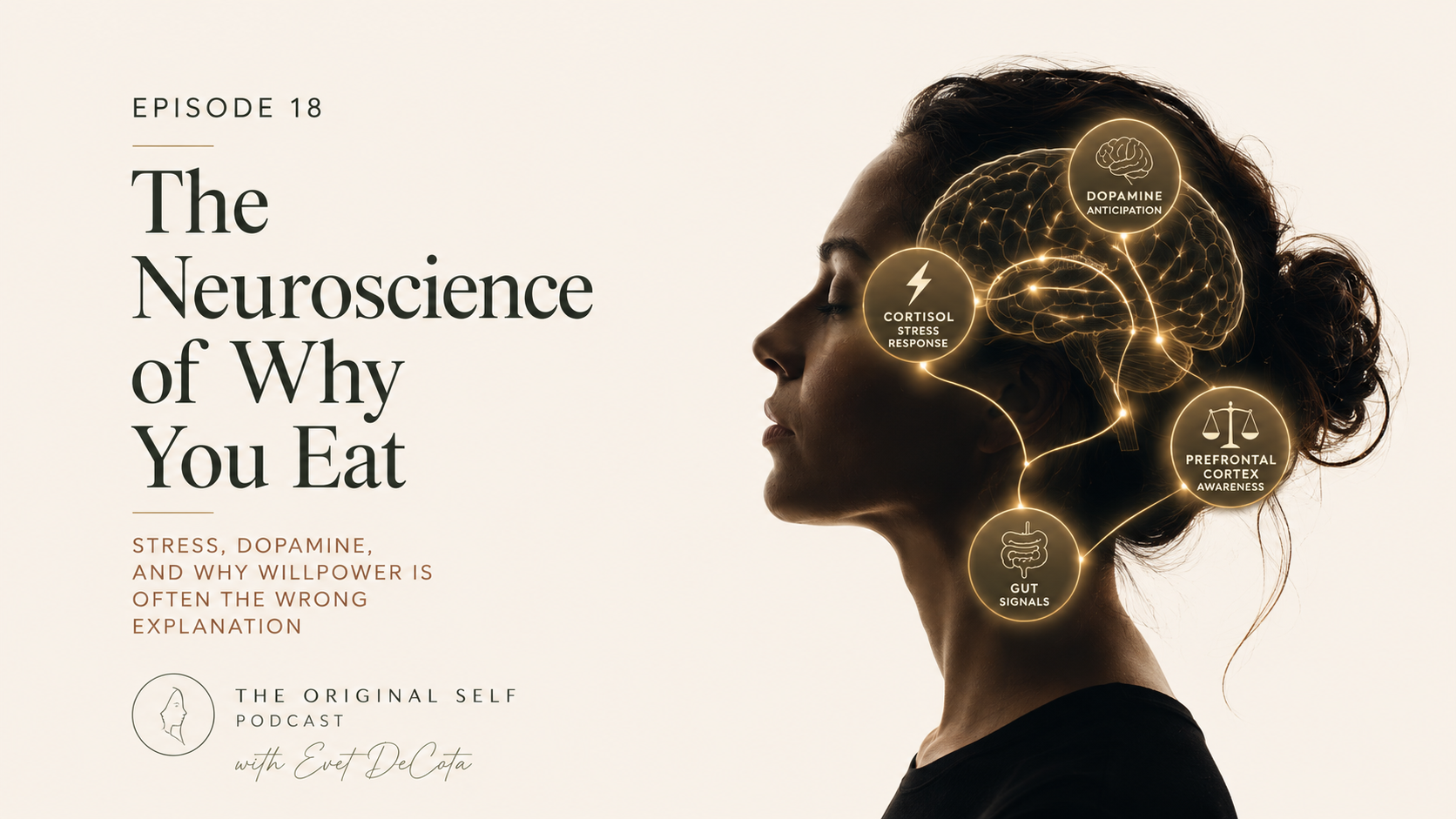
The Neuroscience of Why You Eat: Stress, Dopamine & Why Willpower Is Often the Wrong Explanation
Why do we reach for food even when we're not physically hungry? In this episode of The Original Self Podcast, psychology-informed life coach Evet DeCota explores the neuroscience behind eating behavior. Discover how dopamine, cortisol, the prefrontal cortex, and the gut-brain axis influence cravings, stress eating, and decision-making. Learn why willpower is often the wrong explanation and how understanding your brain can help you approach food with greater awareness and self-compassion.
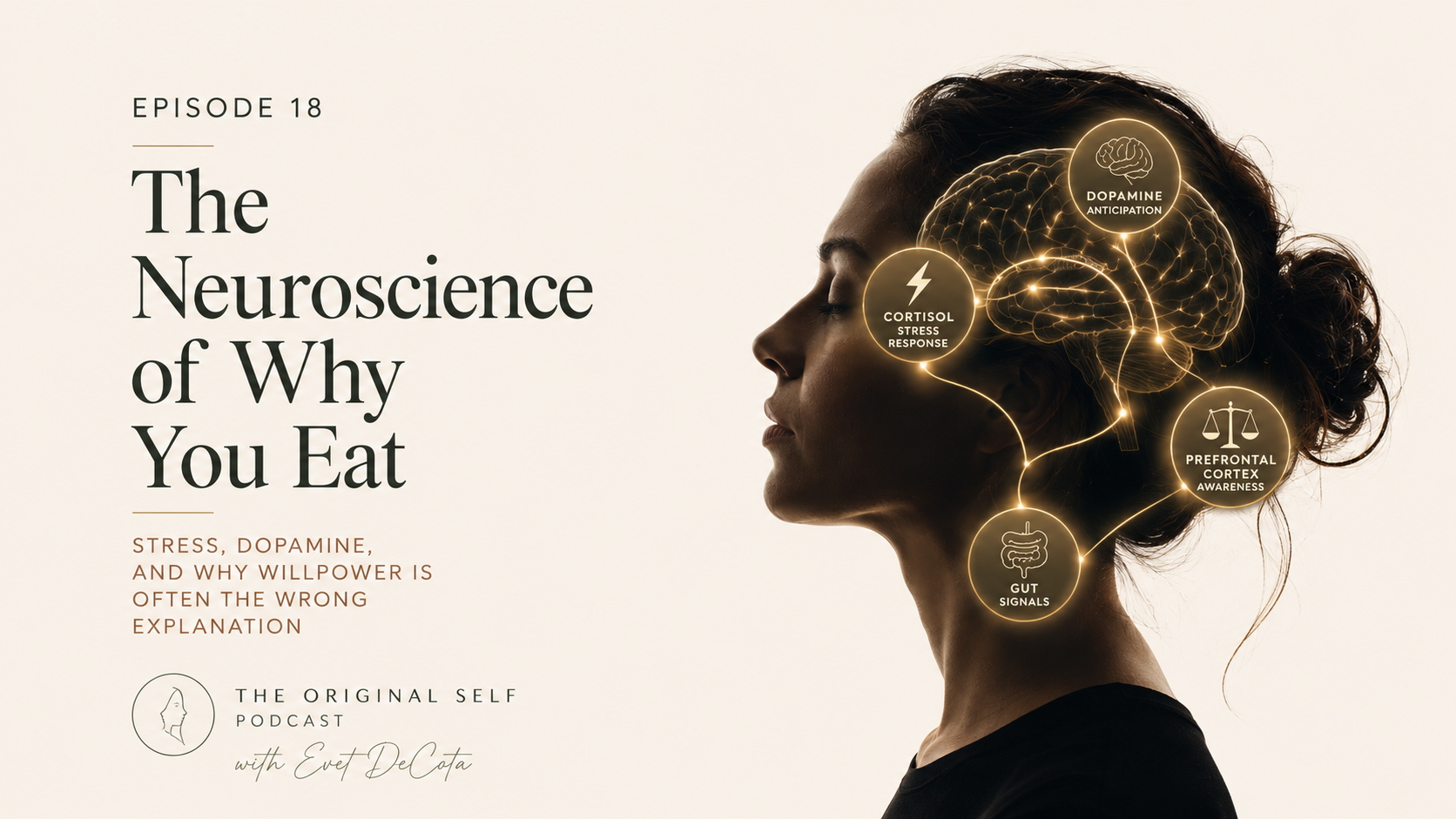
Opening
Welcome to The Original Self Podcast. I'm Evet DeCota, owner of DeCota Life Coaching and a psychology-informed life coach exploring resilience, mindset, and the courage to become your authentic self. This is a space for honest conversations about growth, identity, relationships, and all the messy moments in between that shape who we become.
Between the salon chair and coaching sessions, I've watched people move through life in patterns they rarely notice. Patterns that are subtle, familiar, and incredibly hard to see from the inside.
Last time, in Episode 17, we talked about food noise and ended with the question: if the system was built to hijack your appetite, what does that look like inside the brain? Three episodes in, we looked outward; now we turn inward to Episode 18: The Neuroscience of Why You Eat.
The Wrong Explanation
Hello, and welcome back
Have you ever noticed that your decision to eat often feels like it happens after the fact? You reach for something. You open it. You take a bite. And only then does awareness catch up and say, "Wait, wasn't I trying to eat differently today?"
It's as though there was a conversation happening somewhere below conscious awareness, and by the time you joined it, the vote had already been taken. The story isn’t that we made a bad decision; it’s that the decision was surprisingly late.
The explanation of not having enough willpower is a familiar one that most of us reach for. We ran out of something, or we failed to hold the line. And that explanation carries real moral weight, because it’s an implication about who we are as people.
I want to pull that explanation apart today. Not to let us off the hook for everything, but because the story we’ve been telling ourselves about what happened is incomplete.
What looks like brain failure is often the brain doing exactly what it’s built to do under specific conditions. Understanding those conditions shifts the conversation from blame to biology. And biology is something we can actually work with.
What Dopamine Is Actually Doing
Dopamine is constantly mentioned in conversation about food and cravings, and almost always in a way that undersells what it actually does.
In Episode 16, The Engineered Plate, I described it as anticipation —the wanting— and that’s accurate as far as it goes. But there’s a distinction in the research that changes the picture considerably.
Neuroscientist Kent Berridge spent years mapping what he called the Wanting System and the Liking System. Although they work together, they’re actually two different systems. The Wanting System— the craving, the pull, the urgency to pursue— is driven primarily by dopamine, while the Liking System— the actual pleasure experienced in the moment of eating— is driven by a separate opioid system. What’s fascinating is that these two systems can come completely apart.
The gap between wanting and liking is why you can crave something with genuine intensity, eat it, and still feel underwhelmed. It’s why you can keep eating past the point of enjoyment, searching for satisfaction that the food isn’t delivering. The Wanting System doesn’t consult the Liking System, and it doesn’t wait for a signal that the experience matched the anticipation before it fires again. It keeps reaching forward, and the food environment we live in—built around the bliss point and designed to hit multiple sensory systems at once—is highly effective at keeping the Wanting System activated long after the Liking System has moved on.
For me, this system goes crazy with pretzels, which is one of the reasons I rarely eat them anymore. The first few are genuinely good— the salt, the crunch, everything I wanted them to be— but then something shifts. The enjoyment fades, yet I keep reaching for the next one, almost as if my brain is trying to recreate the satisfaction of those first few bites.
By the time I stop, my mouth feels swollen from the salt, and I begin to feel physically ill. My body had to get that loud before the craving finally stands down. That’s not a pretzel problem or what I’ve heard called a “red flag food.” It’s my Wanting System continuing to search for something my Liking System had already moved on from.
What this means practically is that the question ‘why can’t I stop?’ often has a neurochemical answer that has nothing to do with desire, intention, or character. These systems weren’t designed to stop wanting the moment pleasure faded.
In a world of engineered hyper-palatability, that same persistence creates a gap that feels, from the inside, like weakness, but biologically, it’s something else entirely.
Stress, Cortisol, and The Gut
So let’s talk about stress, cortisol, and the other mechanisms that drive us toward food, whether we need it or not.
Most of us know that stress and eating are connected, but what we tend to miss is how targeted that connection really is. Stress doesn’t simply make us hungrier. It shifts our appetites toward foods that provide quick, concentrated energy.
When our brains experience stress, cortisol is released. Its job is to prepare us to respond to a threat, and one consequence of that response is a predictable preference for calorie-dense foods. It’s an ancient survival strategy, not a random lapse in judgment.
Most of us aren’t facing immediate physical threats. We’re dealing with deadlines, financial pressure, caregiving responsibilities, health concerns, and the constant demands of everyday life. Yet there’s a feedback loop embedded in that mechanism that makes it difficult to interrupt.
Here’s where the loop begins: Eating calorie-dense food under stress can temporarily lower cortisol because the brain interprets that incoming energy as a sign that resources are available and the immediate problem has been addressed. The relief is real. It’s not imagined, and it’s not an excuse. The next time stress appears, the brain is a little quicker to suggest the same solution that worked last time.
But I also need to point out what some of you may be thinking right now. You may know someone, or maybe it’s you, who loses their appetite when stressed. I have several friends who can barely eat anything when they are experiencing a very difficult event. If cortisol drives hunger toward calorie-dense food, why would stress produce the opposite response in some?
The first part of the answer is the type of stress you experience. Is it acute or chronic? In the immediate moment of acute stress, like a lion chasing you, the body’s first responder isn’t cortisol but adrenaline, also called epinephrine. Adrenaline’s primary purpose is to increase alertness and temporarily put other systems on hold, like suppressing your appetite almost completely. If something is really alarming, stopping to eat something is not usually a priority. Cortisol follows adrenaline and, in short bursts, can also dampen hunger. The shift toward appetite and calorie-dense cravings happens under chronic stress— the kind that doesn’t resolve or that hums in the background for weeks or months, keeping cortisol persistently elevated.
The second part of the answer is that people respond to stress differently. Some people’s stress systems remain more adrenaline-driven, even over time, keeping their appetites suppressed regardless of how long the stress lasts. There’s also a gut dimension to this. Anxiety creates genuine physical distress in the digestive system— nausea, tightness, and discomfort— which can quiet hunger signals before they ever reach conscious awareness.
The person who can’t eat when they’re anxious isn’t more disciplined than the person who reaches for food. Their nervous system is running a different program that neither of them chose.
The third system at play is the gut. We often think of the gut as where food is digested, but it’s also in constant communication with the brain through what is known as the gut-brain axis. About ninety percent of the body’s serotonin, a chemical messenger involved in regulating mood, appetite, and digestion, is produced there. The gut is also home to the microbiome, the trillions of bacteria and other microorganisms that are constantly communicating with the brain.
Research from the University of Pittsburgh suggests that gut microbes not only respond to what we eat but also influence what we want to eat next. Certain bacterial strains appear to promote cravings for the foods they need to thrive while also influencing ghrelin and leptin, the hormones that regulate hunger and fullness. When those signals become less reliable, the conversation between the gut and the brain becomes less accurate.
By now, you can probably see that a craving doesn’t come from just one place. Dopamine anticipates a reward, cortisol directs our appetite toward calorie-dense foods, and the gut sends its own signals about what it wants next.
The part of you that made a plan that morning isn’t the same system generating every craving later in the day. Yet from the inside, they can feel like the same voice. A craving emerges from a conversation between the brain, body, and the gut, and understanding that complexity changes the question entirely. Instead of asking, “What’s wrong with me?” we can begin asking, “What is my brain and body responding to right now?”
What strikes me about all of this is how quickly we turn a behavior into an identity. We don’t just say, “I eat when I’m stressed.” We say, “I’m the kind of person who has no self-control.” We take one moment of behavior and let it become a story about who we are. Science doesn’t erase that behavior, but it does change the story.
The Brakes, and What Happens to Them
So if all of these systems are influencing behavior, where does conscious choice enter the picture?
The prefrontal cortex is the part of the brain responsible for planning, weighing consequences, and putting the brakes on impulse. When it’s working well, it creates a pause between a craving and an action, giving us a chance to choose a different response.
The catch is that it’s also one of the first parts of the brain to struggle when we’re under pressure. Stress, poor sleep, and emotional exhaustion all make it less effective. At the same time, stress drives our brains toward calorie-dense foods. Those aren’t two separate problems. It’s a stress response that presses down on the accelerator while also weakening the brakes.
Under enough stress, the brain prioritizes immediate needs over long-term goals. The voice looking for relief gets louder, while the voice thinking about consequences gets quieter.
We actually understand this principle better than we realize. Think about your younger self. Most of us can look back at our teens and early twenties and immediately recognize decisions we wouldn’t make today. Some of us have lower back tattoos to remind us.
We accept that brain state influences behavior. Stress works similarly. The conditions change, and behavior changes with them.
The encouraging part is that the prefrontal cortex can be engaged deliberately, even if only for a moment. UCLA researcher Matthew Lieberman found that when people apply words to what they’re experiencing, the brain responds. Simply naming the feeling— “I’m having a craving right now”— quiets some of the brain’s more reactive systems while bringing the prefrontal cortex more fully online.
Imagine this: you’re sitting on the couch, watching TV, and as soon as the commercial comes on, you get up, walk into the kitchen, and open the refrigerator or pantry. You weren’t hungry a minute ago; you’re not even hungry now. Yet you are still standing in front of food.
Now imagine if you paused right before reaching for a pint of ice cream and said to yourself, “Interesting, I think I’m tired, bored, or stressed right now.” You may still grab the ice cream. You may not. The point is that for a brief moment, you saw the pattern instead of becoming the pattern.
The goal isn’t to win every craving battle; it’s to stop letting the same pathway win automatically. Every moment of awareness gives the brain another route to practice. Over time, that new route becomes easier to travel, while the old one slowly loses its grip. That’s the biology of habit change.
There was a version of you, before any of this became so complicated, who had a much simpler relationship with hunger and satisfaction. The same brain that learned those patterns can also learn different ones. It just needs different conditions and a little more understanding of what it’s actually responding to.
Closing
In the next episode, we’re going to move further back— before the stress patterns were established, before the neural pathways were carved, and before years of eating shaped the gut microbiome.
Episode 19 is: Born into It, and will examine what was already in place before you were old enough to make any choices about it. It’s about the epigenetics, the family food patterns, the inherited biology, and the psychological conditioning that arrived before you had any framework to question it.
If this episode answered the question of what the system does inside the brain, Episode 19 questions when it started.
Thank you for spending your time with me. If you’d like to learn more about working with me, you can find my contact information in the episode’s notes.
I’ll see you next time. Have a great day
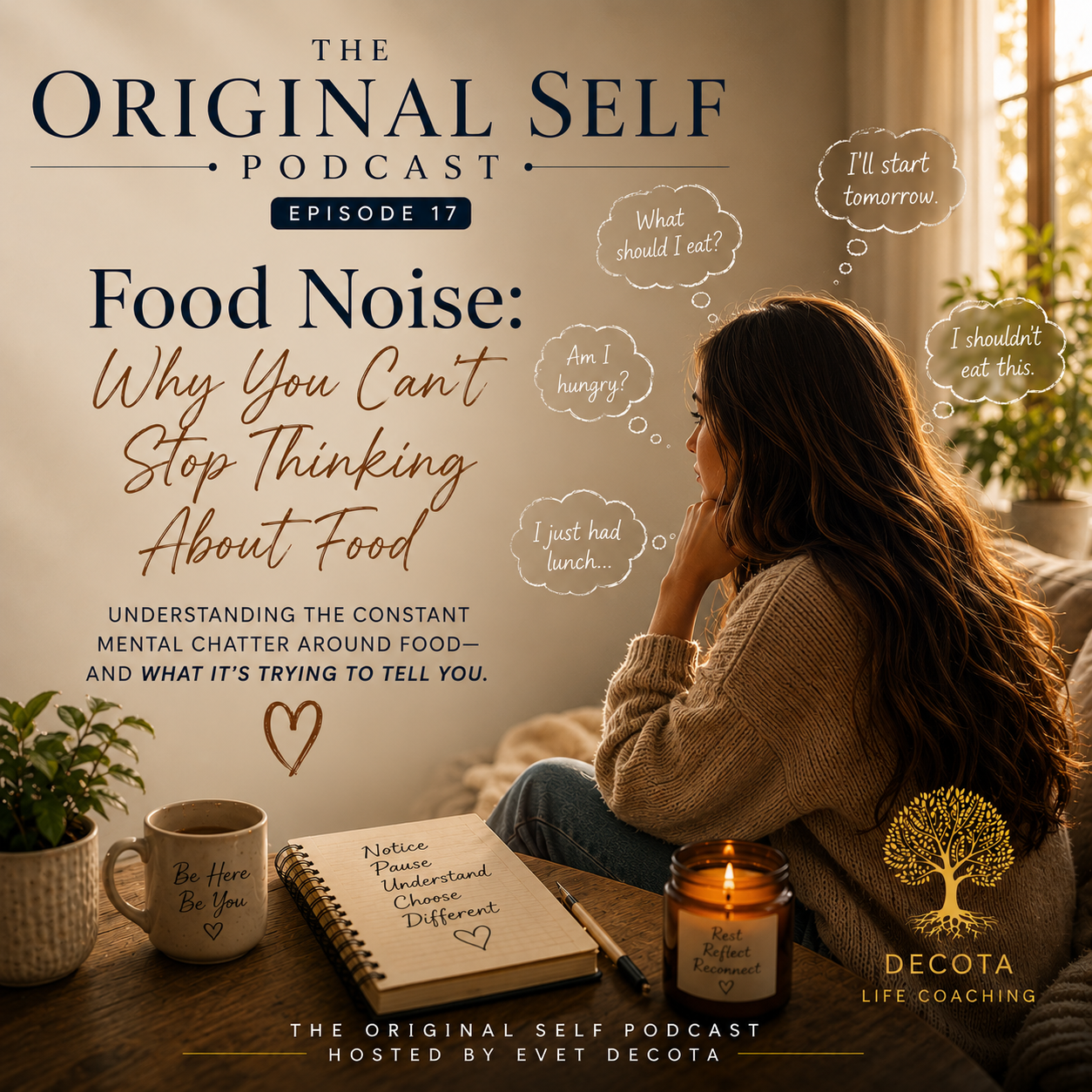
Food Noise: Why You Can’t Stop Thinking About Food
Millions of people started a medication and discovered something unexpected.
Not just weight loss. A quieting. The constant mental chatter around food — the planning, the cravings, the negotiating — got softer. Some described it like a chokehold finally releasing.
And the surprising part? Many realized for the first time that not everyone lives with that noise.
If that hits close to home — this episode is for you.
Episode 17 of The Original Self Podcast explores what food noise is, why it develops, what the food industry has to do with it — and what it means to want a different relationship with food than the one you've always had.
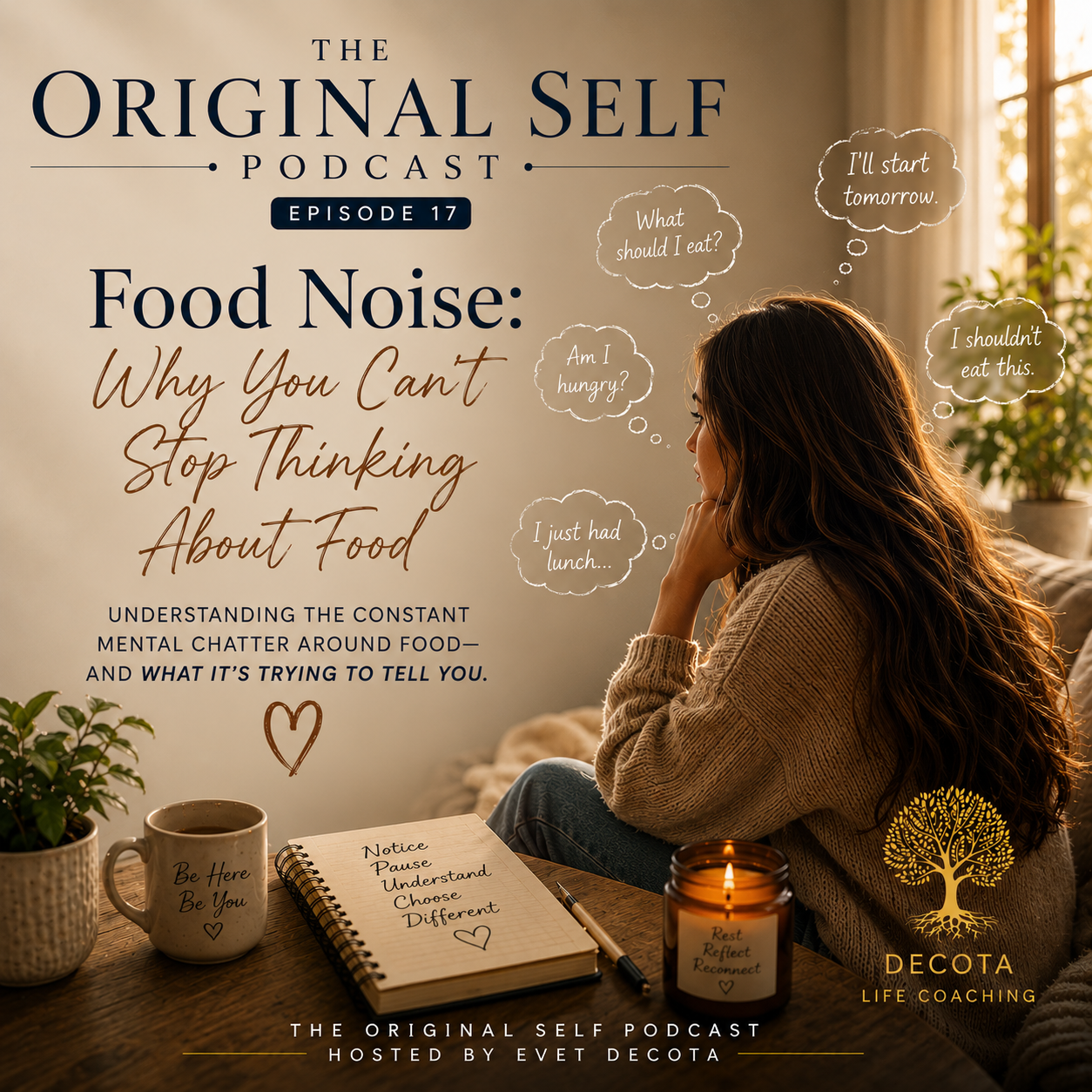
Welcome to The Original Self Podcast. I'm Evet DeCota, owner of DeCota Life Coaching and a psychology-informed life coach exploring resilience, mindset, and the courage to become your authentic self. This is a space for honest conversations about growth, identity, relationships, and the messy moments in between that shape who we become.
Between the salon chair and coaching sessions, I've watched people move through life in patterns they rarely notice. Patterns that are subtle, familiar, and incredibly hard to see from the inside.
Today’s episode begins with a simple question: How much time do you spend thinking about food? Most of us have never stopped to consider the answer. Today, I want to explore why that question matters and what it can reveal about the way food has come to occupy our attention.
This is Episode 17- Food Noise: Why You Can’t Stop Thinking About Food
When the Noise Got Quiet
Hello and welcome back.
In the last episode, we explored how hyper-palatable foods are engineered to capture our attention and keep us coming back for more. We discussed how the combination of sugar, fat, salt, flavor enhancers, and food technology can override the body’s natural systems of hunger and fullness. More importantly, we discussed the possibility that many of the struggles people experience around food are not evidence of weakness, but predictable responses to an environment designed to encourage consumption.
At the end of that episode, I mentioned the term food noise.
Over the last few years, that term has become increasingly common in conversations surrounding GLP-1 medications such as Ozempic, Wegovy, and Zepbound. People have described an unexpected experience when first starting these medications. While the headlines focus on weight loss, many users describe a quieting of the constant mental chatter around food.
What fascinated me was not the medication itself, but the language people used. Again and again, people who had never met one another described the same experiences. They talked about food taking up less space in their minds. They described feeling relief. Some realized, for the first time, that not everyone spends as much time thinking about food as they do. Others described it as though a radio that had been playing in the background for years had suddenly had the volume turned down. I describe it as finally being able to stop thinking about the four pieces of pizza left in the box simply because I’m no longer hungry.
Listening to those stories and feeling exactly the same way is what made me think: How much time do we actually spend thinking about food? Most of us have never stopped to measure it. We simply assume it’s normal.
That raises an interesting psychological question. If millions of people are suddenly discovering that food can occupy less mental space than they thought possible, what exactly was occupying the space in the first place? What is food noise? Where does it come from? Why do some people experience it more intensely than others?
And perhaps most importantly, what if this constant preoccupation with food is not simply an individual problem to solve, but a predictable response to the world we live in?
What Is Food Noise?
Before we talk about where food noise comes from, we need to understand what it actually is. Because food noise is not the same thing as hunger, and understanding that distinction may be one of the most important parts of this conversation.
Hunger is a biological signal. It’s your body’s way of communicating that it needs energy. Hunger can build gradually over time, and for most of human history, it served a practical purpose. It motivated us to seek food, eat enough to survive, and then move on with our lives.
Food noise is something different. It’s a mental preoccupation with food that can exist whether you’re physically hungry or not. It is the running commentary in the background of your day. It is the constant awareness of food, the planning, the bargaining, the anticipation, the cravings, and sometimes, and most of the time, if you live inside my head, it’s the guilt that accompanies it.
For some, food noise shows up as thinking about lunch while they are still eating breakfast. For others, it appears as the promise that tomorrow will be different. It can look like scrolling through recipes despite having no intention of cooking, or like when I watched the Food Network on most days, thinking that I was absorbing chef skills, but really I was only indulging my food noise.
It can also look like wandering into the kitchen when you’re not hungry or feeling distracted by thoughts of food when your attention is needed elsewhere. The experience varies from person to person, but the common thread is that food occupies more mental space than seems reasonable.
What’s interesting is that many people who experience food noise don’t necessarily expect it to disappear. It becomes part of the background of daily life. That is why so many people were surprised when the noise became quieter. For the first time, they experienced a different relationship with food and realized that the noise wasn’t as inevitable as they once believed.
Psychologists have long understood that our attention is influenced by more than biological need, because humans are highly responsive to the cues in their environment. We notice things that have been associated with reward, pleasure, comfort, and survival. Many people walking past a bakery may suddenly think about an almond croissant, despite having eaten an hour ago. Some watching television may find themselves craving a product they had no interest in before the commercial appeared. Think about the millions of dollars advertisers spend on Super Bowl commercials— McDonald’s, Domino’s, Snickers— and how DoorDash can deliver it to your door in under thirty minutes. The industry knows the power of how attention, memory, emotion, and reward interact.
Food is uniquely powerful because it sits at the intersection of biology and psychology. We need it to survive, but we also attach meaning to it. Over time, our brains become very efficient at linking food to emotional experiences. The result is that food begins to occupy mental territory extending far beyond simple nourishment.
Researchers have increasingly recognized that food noise appears to operate primarily within our hedonic hunger system. It’s often less about the body’s need for calories and nutrition and more about the brain’s anticipation of a rewarding experience. That distinction matters because it shifts the conversation away from the idea that people only eat because they’re hungry.
The more we learn about eating behavior, the more difficult it becomes to reduce it to a simple matter of choice. Food noise doesn’t emerge from a vacuum. It develops within a culture where food is always available, relentlessly advertised, and constantly competing for our attention. Every day we’re surrounded by cues designed to keep food on our minds, whether we’re hungry or not.
Yet despite all of that complexity, many people still treat food noise as a personal failing. They assume that their preoccupation with food means they’re flawed.
But perhaps the better question is: If so many people experience food noise, why are we treating it as an individual problem? What if it isn’t a reflection of personal weakness or poor choices? What if it is a predictable response to the environment we've created around food?
To answer those questions, we need to look at how food became more than food and how an entire industry learned to compete for one of the most valuable resources we have: our attention.
The Food Industry Didn’t Sell Food
If food noise is partly a product of the environment around us, then it's worth asking how that environment came to be.
Most of us think of food as something simple. We think of food as nourishment, fuel, or pleasure. We assume that food companies are primarily in the business of selling products people want to eat.
But over the last several decades, something changed.
Beginning in the 1980s, tobacco companies began purchasing food companies. Philip Morris acquired General Foods, and later Kraft, while R.J. Reynolds acquired Nabisco. These were not random acquisitions.
The goal was not only to sell food but to sell products people would continue to buy. The tobacco industry had already invested enormous resources in understanding what captured attention, created desire, and encouraged repeat behavior. Those same principles proved incredibly valuable in the food industry.
If this sounds familiar, it’s because we touched on it in the last episode when we discussed hyper-palatable foods and how they can override many of the body’s natural signals of hunger and fullness.
What these companies understood was that attention drives behavior. The longer a product occupies space in your mind, the more likely you are to buy it. The more often you buy it, the more profitable their product becomes. Food companies weren’t just competing for shelf space in grocery stores. They were competing for space in your mind.
For most of human history, obtaining food required effort. Growing it, hunting it, gathering it, preserving it, preparing it— food demanded time and energy. The flip side of that thought is that resisting food often requires effort today. That’s a remarkable shift.
Think about how food appears in modern life. It’s on television, social media, billboards, podcasts, streaming services, sporting events, and even the apps on our phones. A few taps on the app, and the food can be delivered to our doorsteps in less time than it takes to watch an episode of a TV show.
That helps explain why food noise is not simply an individual experience. It exists within an environment specifically designed to keep food visible, accessible, and competing for our attention.
There is a predictable outcome when an entire system becomes exceptionally skilled at driving consumption. Rising rates of obesity, type 2 diabetes, cardiovascular disease, and metabolic illness did not emerge by accident. And as those conditions became more common, another industry was preparing to profit from the consequences.
The Business of Appetite
As food became increasingly profitable, so did many of the health conditions associated with overconsumption. Obesity rates climbed, Type 2 diabetes became more common, and metabolic dysfunction became increasingly widespread.
Of course, no single food company caused these outcomes, and no single factor explains them. Human health is always more complicated than that— genetics, stress, sleep, socioeconomic factors, and lifestyle matter. When I look at my own family, I see all of those influences at work. Heart disease and Type 2 diabetes affected generation after generation, and it’s one of the reasons I wanted to create this series in the first place.
But it would also be difficult to ignore the role of an environment that encourages people to think about purchasing and consuming more food than at any other point in human history.
The pharmaceutical industry did not create food noise or hyper-palatable foods, but it found itself in a position to treat many of the consequences associated with them. Medications for high blood pressure, cholesterol, diabetes, and weight loss, plus an ever-growing list of treatments, became part of the modern healthcare landscape.
Then came GLP-1 medications.
While these drugs were originally developed for Type 2 diabetes, they quickly became part of a much larger conversation about weight, appetite, and food. What made them particularly interesting was not simply their effect on body weight but their effect on attention.
Again and again, people described a quieting of food noise. They talked about feeling less preoccupied with food. Less distracted by cravings. Less consumed by the constant mental negotiation around eating.
If you have food noise and you have never tried a GLP-1 medication, I would like to tell you about my experience.
For nearly four decades, I was a sheep, blindly following diet culture’s herd mentality. I counted points, logged calories in apps, and readied my restaurant menu order, even before walking through the doors. I clung to the hope that the next diet would finally unlock lasting health and happiness, and I tried to control my body by controlling food.
Over time, points, calories, and “good” and “bad” foods became a constant tug-of-war between control and chaos. I told myself it was discipline, but really it was just mental noise. I’ve been overweight for a long time. The weight didn’t come on from a hard year or a loss; it accumulated through seasons of stress, boredom, and the relentless background chatter in my brain. Thinking about food, planning it, avoiding it, and negotiating with it built into a cacophony that never seemed to quiet. For years, that was simply my normal.
That cycle defined me. But then I learned everything I have been telling you in the last two episodes. I had to look honestly at the ultra-processed foods I was eating, the poor sleep I was normalizing, and the chronic inflammation I was living with. The real epiphany came when I understood that stress elevates cortisol, increasing cravings and fat storage, and I finally realized that my body wasn’t broken but adaptive.
Then a prescription for a GLP-1 entered my world, and the background chatter of food noise stopped. It felt like winning the lottery or discovering a cure. If that sounds hyperbolic, trust me: when you’ve lived with constant food noise for decades, its silence feels miraculous, spacious, and calm. I felt “normal,” whatever that means.
And for many people, it was the first time they experienced the kind of freedom they had hoped for most of their lives. The constant mental chatter around food became quiet. Cravings no longer demanded the same attention. The negotiating, the planning, and the guilt began to loosen their grip. For me, it felt as though a chokehold I had lived with for decades had finally been released. I could breathe easily. It was life-changing.
GLP-1s have improved health markers, reduced disease risk, and, in some cases, even reduced interest in behaviors such as smoking, alcohol use, and gambling. Researchers are still learning exactly why this happens, but it appears these medications influence some of the same reward pathways involved in craving and anticipation. For many people, the result is a quieter relationship not only with food, but with reward itself.
The popularity of these medications has revealed that the conversation about obesity has never been only about weight. It’s also about appetite, attention, reward, environment, and the stories we tell ourselves about self-control.
Perhaps the most interesting thing GLP-1 medications have done is force us to recognize the nature of the problem itself.
If millions of people have suddenly discovered that the noise has quieted, then maybe the question we should ask is: why was the noise so loud to begin with?
The Question Nobody Is Asking
For decades, the conversation about weight has revolved around a single question: How do I lose it?
Entire industries have been built around answering that question. Diet books, fitness programs, apps, influencers, and even healthcare providers have focused on helping people reduce a number on a scale.
Success is often measured in pounds lost, calories counted, clothing sizes, and before-and-after photos. Yet after everything we've discussed in this series, I can't help but wonder if we've been asking the wrong question all along.
What if the most important question isn't how much weight you want to lose? What if the more meaningful question is what kind of relationship you want to have with food? Those are not the same things. One focuses on an outcome, while the other focuses on an experience. One is concerned with changing a body, while the other is concerned with changing the way we live inside that body every day.
When we talk about food noise, we rarely describe a desire to become obsessed with nutrition, calories, or weight loss. What we describe is the feeling of carrying an extra mental burden. It’s the realization that an extraordinary amount of attention has been devoted to food, weight, dieting, and body image for years, sometimes decades.
That’s what makes food noise such an important concept. It shifts the conversation away from weight and toward attention. The real cost of food noise is not simply what it may do to our waistline or our health markers, but to the amount of mental space it occupies. Over time, that mental occupation becomes so familiar that we stop noticing it, even as it crowds out other things that matter just as much, if not more.
One of the most interesting things people describe when food noise becomes quieter is not simply eating less, but they realize they have more room. More room to focus on work, relationships, hobbies, goals, and experiences that have nothing to do with food. Many describe feeling present in a way they haven't felt for years.
Perhaps that is why this conversation matters. Food noise isn't only about food. It's about attention, and wherever our attention goes, a piece of our life goes with it. We become what we repeatedly attend to.
Before the Rules
I've learned that awareness rarely changes our lives in a single dramatic moment. More often, it changes the questions we ask.
For years, many of us have approached food as a problem to solve. We searched for the right diet, the right plan, the right amount of willpower, believing that if we could just find the missing piece, everything would finally fall into place. But food noise invites a different conversation.
Instead of asking how to control food, we might begin by asking what role we want food to play in our lives. Instead of viewing every craving as a failure and every indulgence as a setback, we can become curious about the forces that influence our choices. Curiosity often takes us farther than criticism ever will.
Once we recognize the systems, environments, habits, and patterns shaping our relationship with food, we are no longer operating entirely on autopilot. We may not control every influence around us, but we can begin making decisions with a clearer understanding of what we're responding to and why.
We stop asking, "What's wrong with me?" and start asking better questions. Questions rooted in understanding rather than shame.
And that shift in questioning brings me back to where this series began.
Before the points, the calories, the apps, the diets, and the endless advice about what we should and shouldn't eat, eating was much simpler. There was hunger. There was fullness. There was pleasure. There was nourishment.
Over time, many of us stopped trusting those signals. Food became tangled up with stress, comfort, identity, reward, expectations, and rules. Somewhere along the way, eating became far more complicated, and we became disconnected from ourselves.
What I hope you take from this episode, and from this series so far, is not a new set of rules. The world has plenty of rules about food. What it often lacks is understanding. Understanding that many of the struggles we carry around food are not signs of weakness, but human responses to complex influences that most of us rarely stop to examine.
Awareness doesn't solve every problem. It doesn't magically remove cravings, erase habits, or make healthy choices effortless. What it does provide is perspective. And perspective has a way of changing the conversation we have with ourselves.
There was a version of you — before the noise, before the rules, before food became something to negotiate with every single day — who knew how to eat. Who trusted hunger and recognized fullness and didn't spend cognitive energy bargaining with oneself over dinner.
That person isn't gone. They’ve just had a lot of noise layered over them.
And understanding — real understanding, not another rule — is how we begin to find our way back.
Close
In the next episode, we're going to move from the outside in. If the system was built to hijack your appetite, what does that actually look like inside your brain? Episode 18 looks at the neuroscience of why you eat. We will take a deeper dive into dopamine, stress chemistry, and the real emotional grip that willpower has on us.
That’s next on The Original Self Podcast.
Thank you for spending this time with me. If you’d like to learn more about working with me, you’ll find information in the episode notes.
Until next time, take good care of yourself.
The Engineered Plate: How Hyper-Palatable Foods Are Designed to Defeat You
If you have ever eaten past fullness and blamed yourself, this episode of The Original Self Podcast will change the way you think about food, willpower, and self-control forever. Psychology-informed life coach Evet DeCota breaks down the neuroscience behind hyper-palatable foods, why ultra-processed food is scientifically engineered to override your brain's stop signals, and why willpower was never designed to compete against a billion-dollar system built to defeat it. This is the food and body image conversation that puts the responsibility where it actually belongs.
Welcome to The Original Self Podcast. I'm Evet DeCota, owner of DeCota Life Coaching and a psychology-informed life coach exploring resilience, mindset, and the courage to become your authentic self. This is a space for honest conversations about growth, identity, relationships, and the messy moments in between that shape who we become.
Between the salon chair and coaching sessions, I've watched people move through life in patterns they rarely notice. Patterns that are subtle, familiar, and incredibly hard to see from the inside.
Today’s episode is about something I hear constantly from clients and honestly from myself. Most of us have been told the same story about food. If you can’t stop eating it, you lack discipline. If you gain weight, you don’t have enough willpower. If you keep reaching for the same foods over and over again, the problem must be you. Today I want to challenge that story. This is Episode 16- The Engineered Plate: How Hyper-Palatable Foods Are Designed to Defeat You.
The Myth of Weak Willpower
Welcome back. Last time, I introduced you to a series I’ve been building for a while, one that uses the lens of psychology to examine something we all do every single day, and yet rarely understand as deeply as we think we do. I told you in the introduction to Before The Rules, A Psychology of Food Series, Episode 15, that this series isn’t really about food. It’s about how we lose ourselves around it and how we find our way back.
And I promised we’d start there, with the self-blame that follows so many of us into the kitchen every single day. So, let’s start with the collective you.
Think about the last time you told yourself you’d have just a few Doritos, one brown butter chocolate chip cookie with sea salt. Or that you’d stop eating the popcorn you made after this TV show episode and not eat anything else tonight. But you didn’t stop. And somewhere in the aftermath, maybe in that moment of sitting with an empty bag, or on the drive home from a drive-through you hadn’t planned to stop at, there was a feeling. Not just fullness. Something more uncomfortable than that. A specific kind of self-blame that so many of us know intimately. Even if we’ve never quite named it aloud.
Most people interpret that feeling as evidence of a personal failing. I’m weak. I have no discipline. Other people seem to manage this just fine, so what’s wrong with me? That story is so familiar, so deeply embedded in the way we talk about our bodies, eating, and self-control, that it rarely gets questioned. We just accept it as truth and carry the weight, shame, and defeat of it everywhere we go.
But here is the question I asked myself six years ago that changed the entire direction of my motivation, goals, and, honestly, the way I understand myself. What if the problem isn’t that you’re broken? What if the environment is working exactly as intended, and you were never supposed to be able to easily resist it?
Because here’s what I’ve come to understand through years of psychology study, through my own research, and through watching clients, friends, and myself navigate this: willpower is real, but not infinite. It was never designed to compete alone, against a system built with billions of dollars and decades of neuroscience specifically designed to override it.
When Food Became a Product
To understand where we are today, it helps to understand how we got here.
There was a moment in American history —from astronauts in space eating and drinking powdered foods, through the 60s and 70s explosion of TV dinners and canned everything, to the 80s invention of the microwave, and when the relationship between humans and what they ate began to shift fundamentally. Before that, most people ate what grew, what was prepared, and what was available to them. The food was simple, the flavors were straightforward, and your body’s natural signals of hunger, fullness, and satisfaction largely guided the experience.
Then food became an industry. And we all know that industries compete. They compete for shelf space, for market share, for your attention and your loyalty, and the industry that wins the competition is the one that receives the most of your repeated purchases. Those winners didn’t win by accident; they won by science.
A psychophysicist, Howard Moskowitz, discovered it first by testing something deceptively simple. At what point does sweetness stop being pleasurable? How much sugar is too much before enjoyment starts to fall away? He called that peak— where something is enjoyed the most— the Bliss Point, and his findings changed the food industry forever. He found that pleasure follows a curve. As sugar increases, enjoyment rises, but only up to a point. Then it drops.
And once the food industry understood that a bliss point could be engineered, not just for sugar, but for the precise combination of salt, sugar, and fat simultaneously, everything changed.
Brands like Prego, Pepsi, and Dr. Pepper used multivariate analysis to maximize their product’s appeal to consumers, turning them into dominant forces on supermarket shelves. That R & D, that scientific experiment, is what birthed the hyper-palatable or ultra-processed food industry as we know it today.
What followed was an arms race of palatability. Companies began spending enormous resources not just to make food taste good, but to make it taste in a way that the brain couldn’t easily walk away from. Understanding the why requires a brief detour into neuroscience, so I can show you how any willpower fight we think we can muster completely falls apart.
The Psychology of Hyper-Palatability
The brain regulates eating in two ways — the homeostatic pathway, which determines the body's energy needs, and when we run low, a hunger signal is sent out. It’s also the system that tells us when we are full. It is practical and functional when it’s not been messed with.
The other system is the hedonic pathway or the reward system. It operates on pleasure and motivation, not nutritional need. It has no concern for whether your body needs more fuel; its only focus is on what feels good.
Usually, these two systems exist in harmony. But hyper-palatable foods- engineered to hit that bliss point— activate the hedonic pathways so strongly that they override the homeostatic ones over and over.
So even when your body knows it’s had enough, your reward system has yet to reach satisfaction, and so you keep eating those chips, that cookie. The biology of the brain was built for a world that we no longer live in.
Then there’s dopamine. It’s often called the feel-good chemical, but I believe that phrase undersells what it actually does. Dopamine is less about pleasure and more about anticipation—the wanting.
Research from Harvard’s nutrition department has shown that the expectation of a reward stimulates more dopamine activity than the reward itself. And the crazy part is that if the reward exceeds the dopamine response, if it’s even larger than expected, our motivation for the reward drives us to seek the experience again. Think about the smell of something cooking in your favorite restaurant as you walk past, the crinkle of a bag of your favorite snack in someone else’s hands, or even the image of a particular food—they all trigger dopamine before you take a single bite. That is ancient neurology responding to signals that it’s never resisted.
One of the most elegant biological mechanisms we have is called sensory-specific satiety, and it’s very easily exploited by industries selling the drug of hyper-palatable foods. The way it works is that as you eat a particular food, the pleasure you get from that specific flavor gradually declines. Your brain gets bored with it, satisfaction drops, and the drive to continue fades until you stop eating.
But when a product is engineered to contain multiple distinct flavor compounds— fat hitting one receptor, salt another, sugar hitting more receptors, and then layered artificial enhancers throughout, the sensory-specific satiety can not perform. Before one element reaches its satisfaction point, the next one is pulling you forward.
The finish line keeps moving, and companies like McDonald’s know it. McDonald’s puts added sugar in far more products than most people realize including buns, sauces, and even their salads. A Quarter Pounder with cheese isn’t an accident. It’s a scientifically calibrated combination of fat, salt, and sugar designed to light up the hedonic pathway, bypass the signals that would normally tell you to stop eating, and flood the brain with enough dopamine that the craving reactivates the next time you see those golden arches—or even a commercial. You’re not weak; you’ve just been studied by companies that will stop at nothing to make that almighty dollar.
About six years ago, I found myself in a pattern I couldn’t quite explain. After work, on weekends, sometimes when I wasn’t even particularly hungry— I was pulling into McDonald’s. Not because I’d decided to. Not because I was craving something specific. I would come back to awareness already in the drive-through line, wondering how I’d gotten there, like some part of my brain had decided before I was even consulted, like I was in a mind-control experiment. Once I learned how those foods are engineered, the more I understood how powerless I was against them.
Why Smart People Get Hooked Too
One of the questions that launched my academic research was: Why do intelligent, disciplined, accomplished people struggle so much around food? Not people who are uninformed or careless, but people who have built careers, raised families, navigated genuine complexity in their lives—and still find themselves feeling completely powerless in front of a bag of something they didn’t intend to eat.
Some of it comes down to awareness. Many of us move through the day on autopilot, eating without ever stopping to ask what’s actually driving it. But even for the people who are paying attention, the struggle is still real, and that’s where Roy Baumeister’s research on self-control becomes so important.
Baumeister found that self-regulation functions like a muscle— it can be used, and it can be depleted. Every act of self-control draws from the same limited pool of mental energy, whether you’re managing an emotion, pushing through a difficult task, or resisting the cookies someone left in the break room— those cookies are a daily occurrence in the salon break room, and I have a love/hate relationship with them.
Baumeister ran an experiment where participants who had spent energy resisting chocolate chip cookies gave up on a difficult puzzle eight minutes sooner compared to the nineteen minutes people who didn’t encounter resisting cookies. They weren’t more capable; they just hadn’t used up their self-regulatory resources yet.
The reason I’m telling you about this research is that if you think about yourself by ten o’clock at night, after a full day of decisions, demands, and emotional management, you are not the same person who set an intention that morning. The prefrontal cortex, which plans, exercises self-control, and engages in long-term thinking, is running on less. And that’s precisely why you find yourself tiredly standing in the middle of your kitchen or pressing buy on the food app, grabbing the engineered food without a second thought.
As part of my psychology research at Dominican University of California, I studied the relationship between stress, impulsivity, and hyper-palatable food consumption. What I expected to find, and what I did find, was that stress increases HPF consumption. But the finding that surprised me most was that consumption rates in stressful scenarios and non-stressful scenarios were nearly identical. People weren’t just reaching for these foods because they were stressed. They were reaching for them because of fatigue, boredom, habit, and many times at night. The foods themselves had become the path of least resistance regardless of emotional state. And impulsivity, not stress, turned out to be the stronger independent predictor of how much someone consumed.
When I was growing up, we had what we called the junk drawer. It was filled with cookies, candy, chips, and all the foods we now know are hyper-palatable. We weren’t allowed to eat from it whenever we wanted, but it was always there. Sometimes we’d ask. Sometimes we’d sneak.
Looking back, what’s interesting isn’t that the food was there. It’s that nobody thought twice about it. It was normal. Nobody was trying to harm us. Nobody was having conversations about food manipulation, dopamine, or ultra-processed foods. It was just food, at least as far as we understood.
I think that’s important because so many of us inherited our relationship with eating before we were old enough to understand what we were inheriting. The food was normal. The habits were normal. The constant presence of highly rewarding snacks was normal. We didn’t choose that environment. We grew up inside it. And when something has always been normal, it’s incredibly difficult to recognize how much influence it’s still having on you decades later.
This matters enormously for how we think about self-blame. Intelligence doesn’t protect you from the hedonic pathway. Success doesn’t exempt you from decision fatigue. Discipline is a resource, and resources run out. When your capacity for resistance is low and your environment is deliberately constructed to exploit that exact moment, the outcome isn’t a character flaw; it’s math.
The Real Cost
We tend to talk about the consequences of HPFs almost exclusively in terms of weight. And the physical health implications are real and documented. The research connecting ultra-processed food consumption to heart disease, type 2 diabetes, and metabolic disorders like high blood pressure is substantial.
But another cost is the mental overhead. It’s the constant low-level negotiation that happens around eating when you’ve lost trust in your own responses— am I actually hungry or am I just bored, am I eating because I want this or because I can’t stop, why can I be disciplined in every other area of my life and not here? I have had these thoughts so many times in my life that I’ve lost count. I smoked cigarettes for over 13 years, at least a pack a day, and I was able to quit smoking and have never had another cigarette again for over twenty-five years. Not once have I taken a drag or even thought about smoking again.
Why was I able to conquer that compulsion, yet have struggled with food cravings and noise almost my entire life? I think the answer is simpler than I wanted it to be. I don’t need cigarettes to stay alive. I can walk away from them completely and never look back. But I can’t abstain from eating. Nobody can. And when the very thing you’re trying to navigate is also the thing your body requires to survive, willpower becomes an almost impossible standard to hold yourself to.
I’ve done it, at times for a few weeks to even a few years, but I always revert. Add to that a lifetime of processed foods that rewired the signals my natural biology was supposed to rely on, and a very likely addiction to sugar that started before I was old enough to question what I was eating, and the deck was never stacked in my favor.
And that internal tug of war never really goes away. It shows up as intrusive thoughts about food that occupy real cognitive space. The shame that accumulates quietly and then surfaces in the least expected moments— in a dressing room, looking at a photo of yourself, or in a conversation you weren’t expecting to have knocks us off balance.
The fundamental disconnection from your own body is the real injury lying underneath these questions. When your body overrides signals enough times because the food you eat is specifically designed to do so, you are unable to hear those signals clearly. It makes you stop trusting hunger or fullness. You begin to experience your own biology as the enemy rather than as information. The difficulty of spending years at war with your body makes the idea of listening to feel truly unnerving.
It creates a distrust of self because you can change what you eat in a week, but rebuilding a relationship with your own body takes considerably longer. I believe it starts with understanding what happened to create the distance in the first place.
Returning Awareness
If you are feeling angry, annoyed, or disappointed at the companies that sell HPFs, I completely understand the feeling, but that’s not my intent for this episode. It will not end with me speaking about a new plan that will be a miracle, or a list of foods to avoid, or a protocol to follow.
I’m interested in the meaningful difference between making a choice and having a choice made for us. Most of us move through our relationship with food without ever clearly seeing which of those is happening. We experience a craving and interpret it as desire, without knowing that the craving was activated by dopamine responding to engineered anticipation. We eat past fullness and call it weakness, without knowing that sensory-specific satiety was circumvented by design. We resist all day and collapse at night and decide we have no willpower, without knowing that willpower is a finite resource that was steadily drawn down by everything else the day asked of us.
It’s also worth noting that this conversation is beginning to move beyond individual responsibility and into public policy. Researchers, physicians, and policymakers are increasingly asking whether it makes sense to place the entire burden on consumers when so much of the modern food environment has been deliberately engineered to drive consumption.
Questions are being raised about food labeling, advertising directed at children, the availability of ultra-processed foods in schools, and whether consumers are receiving enough information to make informed decisions about what they’re eating. Some countries have already introduced warning labels and restrictions on certain forms of marketing. Others are debating whether highly processed foods should be regulated more like products that carry known health risks, like tobacco and alcohol.
Regardless of where those conversations ultimately lead, the fact that they are happening at all represents a huge shift. For decades, the dominant message was simple: if you’re struggling, the problem is you. But when governments, researchers, and public health organizations begin asking questions about the environment itself, it suggests we’re starting to recognize that human behavior doesn’t happen in a vacuum. The choices we make are always influenced by the systems we live inside.
Understanding the system doesn’t excuse us from participating in our lives. It doesn’t remove agency. But it does give us the ability to see clearly. When we see clearly, we finally begin to ask the right questions. It’s not “what’s wrong with me,” but “what is actually happening here?” Not “why can’t I control myself,” but “what am I really responding to in this moment?”
That shift, from self-blame to curiosity, is where the awareness work begins. It may be uncomfortable, but curiosity requires slowing down in moments when the pull to just eat on autopilot is very strong. But it’s honest, and it’s the beginning of coming back to yourself.
What I’d like to leave you with today is simple. Before you make your next food decision, just this once, pause long enough to notice what’s happening. Not to judge it or to override it through sheer force of will. Just notice: Are you hungry? Are you tired? Is the pull to eat HPFs coming from inside you or from something in the environment? There is no perfect answer; you just have to become curious enough to look.
There was a version of you, before all of this, who knew how to eat. Who trusted hunger and recognized fullness and didn’t spend cognitive energy negotiating with that box of See’s Candy, that pint of Cherry Garcia, or that cold slice of pepperoni in the middle of the night.
The work of this series isn’t to turn you into someone new; it’s to help you remember who that person was, and to slowly start, without judgment, to find your way back.
Closing
In the next episode, we’re going deeper into one of the most misunderstood experiences in our relationship with eating— food noise. It’s that constant mental chatter about what you should eat, what you shouldn’t have eaten, what you’re going to eat later, and whether any of it makes you a good or bad person.
We’ll talk about where it comes from, why some people experience it far more intensely than others, and what it actually means when the noise gets loud. Look for Episode 17- Food Noise: Why You Can’t Stop Thinking About Food’
That’s next time on The Original Self Podcast. Until then, thank you for being here. If today’s conversation resonated with you and you feel ready to explore your own growth, you can learn more about working with me in the episode notes.
I’ll see you next time.

Before The Rules: An Introduction to A Psychology of Food Series
This introductory episode launches Before the Rules, a psychology of food series exploring how food became tied to identity, self-worth, culture, biology, and belonging. Rather than asking what we should eat, Evet DeCota invites listeners to consider a deeper question: Who were you before diet culture, food marketing, shame, and food rules told you who to be around food?

Opening
Welcome to The Original Self Podcast. I'm Evet DeCota, owner of DeCota Life Coaching and a psychology-informed life coach exploring resilience, mindset, and the courage to become your authentic self. This is a space for honest conversations about growth, identity, relationships, and the messy moments in between that shape who we become.
Between the salon chair and coaching sessions, I've watched people move through life in patterns they rarely notice. Patterns that are subtle, familiar, and incredibly hard to see from the inside.
Today’s episode is the beginning of something a little different. Over the next several weeks, I’m going to talk about food in many different ways. The more I study the psychology behind eating, the more I realize this isn’t really a story about food. It’s a story about how we lose ourselves around food and how we find our way back.
This is Episode 15- Before the Rules: An Introduction to a Psychology of Food Series.
The Lens
Welcome back. As I said in the introduction, this is the beginning of a series on the psychology of food. We will talk about food, but not in the way that you usually hear about it or perhaps how you might expect.
This series is not about dieting, weight loss, meal plans, macros, supplements, or the latest nutrition trend. It’s about identity.
It’s about the stories we’ve been told, the systems we’ve been raised inside, the biology we’ve inherited, and the relationships many of us have spent decades trying to fix without ever fully understanding where they came from.
And at the center of every conversation in this series is one question:
Who were you before you were told how to be around food?
Who were you before you were introduced to diet culture?
Before food marketing?
Before food shame?
Before the rules?
Because I don’t believe most people have a food problem.
I believe most people have been living inside a food environment that’s shaped their thoughts, beliefs, cravings, fears, and behaviors for so long that they’ve forgotten where those influences end and where they begin.
And as a side note, that includes me.
At 56 years old, I’ve spent a lifetime being tossed around in a tornado of food rules, food fears, food trends, and all the unconscious messages that come with them. I’m not standing outside this conversation looking in. I’ve lived inside it my entire life, and, like many of you, I’m still sorting through it.
Which brings me to the question that started this entire series.
Why I’m Doing This
So, why is this series important?
Food has always fascinated me, not because I’ve had all the answers, but because I’ve watched so many people struggle with it. For nearly four decades, I’ve spent my days behind a salon chair listening to people talk about their lives.
I’ve listened to conversations about marriages, careers, children, grief, aging, health, confidence, and self-worth. And woven through almost all of those conversations, in one form or another, has been food.
Women promising themselves they’ll be “good” this week. People talking about foods they aren’t allowed to eat, and calling it a “cheat day” when they do. Mothers worrying about what their daughters think of their bodies. Daughters absorbing messages they never consciously agreed to carry. Successful, intelligent, accomplished people feeling completely defeated by something as ordinary as lunch.
Over the years, I noticed that people who struggled most with food were rarely lacking information. Most knew what carbohydrates were. They knew vegetables were healthy, that exercise mattered, and most of the nutritional facts about the food they ate.
Yet many of them still felt trapped, and that observation followed me into my psychology studies.
When I returned to college and eventually completed my psychology degree, I became increasingly interested in why we eat the way we eat.
Not just nutritionally, but psychologically, emotionally, socially, and culturally.
The deeper I looked, the more I realized that food is never just food. Food is belonging, comfort, identity, memory, reward, grief, stress, celebration, and love.
And when we reduce all of that complexity down to calories and willpower, we miss the story entirely. That realization eventually became part of my academic work, my coaching work, and now this series.
The more I learned, the less interested I became in asking, “Why can’t we control ourselves?”
I became more interested in “What exactly are people trying to control themselves against?”
The Question That Changed Everything
The question that changed everything for me was surprisingly simple. Why do intelligent and educated people struggle so much around food?
Not uninformed people or careless ones, but intelligent, thoughtful, and disciplined people.
People who have successfully built careers, raised families, earned degrees, managed businesses, and overcome extraordinary challenges. Why do so many of them still feel powerless around food?
If information solved the problem, we would have solved it by now. We live in the most informed generation in human history. We have podcasts, books, documentaries, apps, nutrition labels, health influencers, wearable devices, and endless access to information.
Disordered eating, body dissatisfaction, and food confusion continue to grow. At some point, we have to ask whether information was ever the real problem.
What if the struggle isn’t happening because people don’t know enough? What if the struggle exists because we’ve been taught to understand food through the wrong lens entirely? What if the question isn’t, “What’s wrong with me?” but “What happened to me?”
That question changes everything. Because it shifts us from blame to curiosity. And curiosity is where healing begins.
What This Series Is Really About
This series is organized into three parts. The first is called The System.
These episodes look outward, exploring how the modern food environment was built, how food companies learned to shape behavior, how children became marketing targets, and how convenience, consumption, and profit became deeply woven into everyday eating.
These are the episodes that answer the question: What happened around us?
The second part is called The Body.
These episodes look inward, exploring the gut-brain connection and reward pathways. We explore hormones and menopause, and the many biological systems that influence our relationship with food. We’ll talk about cravings, appetite, alcohol, metabolism, and why our bodies often respond in ways that have far more to do with biology than willpower.
These episodes answer the question: What is happening inside us?
And then the final part is called The Self.
This is where everything comes together. We’ll discuss body image, self-worth, and intuitive eating. We’ll move on to why we experience food guilt and perfectionism and explore the rare topic of masculinity and food. Lastly, we will explore food as self-care and the complicated ways food becomes tied to identity.
These episodes answer the question: Who am I underneath all of this?
The System. The Body. The Self. Three layers leading to a journey back toward understanding ourselves.
The Original Self
Every episode in this series returns to the same place: the authentic self that existed before all the noise.
Before food became a moral issue. Before eating became a performance. Before every meal carried anxiety, judgment, guilt, or negotiation. Before food became something to fear.
Children are born knowing how to eat. They know hunger, fullness, curiosity, and satisfaction.
Then the world begins talking. At a young age, we are bombarded with advertisements, diets, family messages, the newest health trends — what’s dangerous and what’s healthy- until that science is disproved.
We are alarmed by the rules, the fears and the shame that follow a diagnosis or a weight gain, and in some cases a weight loss when we can’t afford to lose anymore.
We are exhausted by the constant expectations that society — and often we ourselves — place on food. Rather than increasing awareness, those expectations make it harder to recognize and trust our own signals.
We become disconnected from trust, our bodies, and from ourselves.
This series is not about becoming perfect, disciplined, smaller, or becoming someone new.
It’s about uncovering the person who existed before all of that conditioning arrived. It’s about returning to the question:
Who were you before you were told how to be around food?
Before the rules. Before the shame. Before all the noise.
There was a version of you that knew how to eat. Your original self.
Closing
In our next episode, we’re starting with the food itself.
We’ll explore how hyper-palatable foods were engineered, why they affect the brain the way they do, and why the struggle so many people experience with food has nothing to do with willpower like they’ve been led to believe.
That’s next time in Episode 16:
The Engineered Plate: How Hyper-Palatable Foods Are Designed to Defeat You.
But until then, I’d like to leave you with a thought.
Before the food industry. Before the diets. Before the shame. Before the rules dictated to us.
There was a version of you that knew how to eat, how to trust your body, and how to respond to hunger without fear.
The goal isn’t to become someone new.
It’s to remember who you were before all of this told you who to be.
Thank you for being here at the beginning of this journey, and thank you for listening to The Original Self Podcast. If today’s conversation resonated with you and you feel ready to explore your own growth, you can learn more about working with me in the episode notes of this podcast.
I’ll see you next time.
The Fullest Empty Life:Why You’re Always Busy but Never Fulfilled
If you feel constantly busy but still somehow empty, this episode of The Original Self Podcast is exactly what you need to hear. Psychology-informed life coach Evet DeCota unpacks why busyness has become an anxiety response, what neuroscience reveals about the unscheduled time we keep destroying, and how to stop performing your life long enough to actually live it. This is the burnout and fulfillment conversation no one is having honestly — and it starts here.
Chapter One-Opening
Welcome to The Original Self Podcast. I'm Evet DeCota, owner of DeCota Life Coaching and a psychology-informed life coach exploring resilience, mindset, and the courage to become your authentic self. This is a space for honest conversations about growth, identity, relationships, and the messy moments in between that shape who we become.
Between the salon chair and coaching sessions, I've watched people move through life in patterns they rarely notice. Patterns that are subtle, familiar, and incredibly hard to see from the inside.
Today we're talking about time. Not how to manage or optimize it. But how busyness became an identity, stillness became uncomfortable, and somewhere in between, we stopped actually living our days and just hoped to get through them. This is Episode 13: The Fullest Empty Life |Why You’re Always Busy but Never Fulfilled.
Chapter Two- Personal Reflection
Let’s start with what I’ve witnessed from behind the chair.
Busyness is something I know personally. I work full time in the salon, and on most nights and days off, I’m building my coaching business. I was thinking about this as I watched a salon client who was unable to be fully present during her appointment.
She booked a full appointment for highlights, color, haircut, and blow-dry- typically a 2+ hour appointment. From the moment she sat in my chair, her laptop was open, and her phone was face up on the station. Every few minutes, it would light up, and she’d lean forward to grab it —mid color, mid cut — and I’d have to readjust the cape or move my tray and body around the chair to get to where I needed to be. Each time she was on the phone, she would look up at me and mouth ‘sorry, one more minute.’
The minute never ended until the appointment was over.
When I finished, I had to ask her if she liked her hair. That’s how I knew she hadn’t looked in the mirror once. She finally glanced up, laughed this tired laugh, and said, ‘Yes, of course.’ I smiled and booked her next appointment, but I couldn’t shake it. She hadn’t relaxed for a single minute. A service she’d scheduled, paid for, and shown up for had become just another box checked off.
The silence she didn’t receive, I got. Not talking gave me something I didn’t expect. My mind went somewhere quieter. It was a break from being on all the time.
She came in for the rest, and I’m the one who walked away with it.
And it left me wondering how many of us are showing up for our own lives without ever really arriving.
Chapter Three- The Paradox — Busy as Armor
Those questions don’t have simple answers because the problem isn’t just personal. It’s cultural, and it runs a lot deeper than one busy client in a salon chair.
Cultural Diagnosis
We live in a culture that has conflated activity with meaning. The calendar is full; therefore, life is full. There’s a psychological concept worth naming here: Action Bias, the deeply human tendency to prefer doing something over doing nothing, even when doing nothing is the smarter choice. Studies on soccer goalkeepers show they dive left or right on penalty kicks almost every time, even though statistically, staying in the center saves more goals.
We struggle with stillness. Not because we’re lazy or undisciplined, but because we’ve absorbed a cultural message that equates motion with worth. If you’re not moving, you’re not contributing. If you’re not contributing, what exactly are you? Stillness doesn’t just feel uncomfortable. It can feel like failure.
I received that message loud and clear as a young girl. My parents were always moving. From morning until evening, they did what needed to be done before they even considered relaxing. If there was time left over, we went to the beach, the carnival, or played games together. They would even judge my brother’s and my latest Dance Fever routines. The message wasn’t spoken outright, but it was clear: don’t sit around. Move. Keep going.
The Status Angle
And here’s the thing: culture doesn’t just allow this. It rewards it.
Researcher Silvia Bellezza at Columbia found that Americans often view busyness as a status symbol. In parts of Italy, leisure can signal success — dolce far niente — the sweetness of doing nothing. My family came from Italy, but whatever sweetness existed was quickly soured by the hustle.
I’ve noticed this belief across cultures. Many immigrant families arrive in America carrying a powerful work ethic born from sacrifice. Once here, that sacrifice often merges with a uniquely American idea: that busyness equals worth. Before long, productivity becomes a measure not just of success, but of value.
Exhaustion becomes a flex. “I’m so busy” is worn almost like a badge of honor. We’ve made a virtue out of depletion. But beneath all of that cultural conditioning lies something much more personal. The psychological reality behind many overscheduled lives is avoidance.
Busyness As Anxiety Management
It’s experiential avoidance, to be exact — the way we fill every hour specifically to avoid contact with uncomfortable internal experiences. Grief. Loneliness. Uncertainty. The silent dread that you might not be living the life you want. A packed schedule keeps those feelings just far enough away that you never have to face them directly. For many people, busyness isn’t ambition; it’s a coping mechanism.
I experienced this firsthand when California mandated the closure of salons and spas for nearly six months during the pandemic. I went from constant human contact and days scheduled to the minute to what felt like solitary confinement, layered on top of grief from my mom’s passing just months before.
After three weeks, everything I had pushed down came rushing to the surface. The busyness was gone. There was nothing left to distract me.
And once the distraction disappeared, I could finally see what it was doing for me. It wasn’t just managing the grief. It was managing uncertainty, loneliness, and the need for control.
There’s another reason we stay busy that doesn’t get talked about enough: control.
In a world that feels increasingly unpredictable, crossing things off a list gives us a temporary sense of order. I did this. I finished that. I am on top of things. It doesn’t matter that the list never ends. The act of doing makes us feel like we have some say in how life unfolds.
And when life becomes genuinely uncertain — a diagnosis, a loss, a relationship falling apart — our lists often get longer. As long as we’re doing, we don’t have to sit with what we can’t control.
One of my friends always needs plans for the weekend. She’s told me that without something to look forward to, she feels down. Maybe she simply loves connection and fun. But it also might be avoidance. The unscheduled weekend isn’t just empty time. For some of us, it’s an invitation to feel things we’ve been outrunning all week.
And maybe that’s why I’ve always kept so many balls in the air. I built a salon from a four-wall dump into a beautiful, thriving business. Years later, I dismantled it and created a studio salon. I went to school full-time while working full-time.
I wanted everything those pursuits represented, and I earned every reward they gave me. But I also know that some of the motion served another purpose. There were feelings I didn’t fully know how to process, so I just kept moving instead.
The continual moving has a cost that goes deeper than exhaustion. It reaches all the way into who we think we are.
The Identity Piece
Think about when someone at a party asks, ‘So what do you do?’
Notice that we don’t ask ‘who are you?’ or ‘what do you love?’ We go straight to function.
Psychologists call this Role Identity Fusion — the merging of self-concept with productive function. When busyness becomes identity, stillness becomes an existential threat. It’s not just that you’re bored when you stop. It’s that you’re no longer sure who you are.
A few years ago, I started asking new clients, ‘What do you do when you’re not getting your hair done?’
You’d be surprised how many people pause, really pause. Some laugh nervously. Some say, ‘I don’t know’ with a kind of sad honesty. A few look confused.
That pause tells me everything. Somewhere along the way, many of us handed our identity over to what we produce.
Sit still long enough in this culture, and someone will read it as laziness. Or worse, as evidence that something is wrong with you. At its most insidious, doing nothing becomes unworthiness.
I know this one from the inside.
I don’t struggle with laziness. What I struggle with is stopping.
Most nights after work and on my days off, I’m building something — my coaching business, this podcast, the next project on the list. I’m almost always moving toward the next thing.
Sometimes I stop long enough to binge a series instead of starting any of it. I used to judge myself for that, but now I see it differently. It’s not laziness; it’s my nervous system finally waving a white flag. It’s avoidance showing up in a different costume. For people like me, stillness often has to sneak in through the back door.
I think about someone who figured this out long before I did.
I have a friend who is both an accomplished artist and musician. Years ago, another friend asked her why she only taught music lessons two days a week when she could easily teach more.
Her answer stopped the table.
She said she needed to set aside time to walk in nature, be with her family, and daydream. Just that. Daydream.
It was so honest and so confident that it made me realize something sad about myself. I had stopped doing all of those things. Looking up at clouds. Sitting still. Watching what I can only describe as Squirrel du Soleil —squirrels launching themselves through walnut trees as if they were performing for an audience.
My musician friend understood something intuitively that neuropsychiatrist Daniel Siegel later put into words.
In IntraConnected: MWe (Me + We), Siegel argues that we’re taught to see ourselves as isolated individuals defined by what we produce, achieve, and accomplish. But humans are more than a separate Me. We are also part of a larger We —connected to other people, our communities, and the world around us.
Why does that matter?
Because when every hour is devoted to productivity, we end up living only the ‘Me’ side of ourselves. The pauses, the daydreams, the walks, the moments that look unproductive on paper — that's where the ‘We’ side lives. It’s where we connect, reflect, and actually make meaning of our lives.
Busyness doesn't just exhaust us. It cuts us off from the fullest version of who we are.
And most of us don't even realize what we've given up.
So what exactly have we given up?
Let’s get specific.
Chapter 4- What Got Stolen —The Mind’s Hidden Work
The Default Mode Network
This is where neuroscience gets genuinely interesting.
When your brain isn’t focused on a task, it doesn’t shut down. It activates what’s called the Default Mode Network. This is where the brain processes emotions, consolidates memories, makes connections between ideas, and builds a coherent sense of self over time.
In other words, some of the most important work your brain does happens when it appears to be doing nothing.
When I was fifteen, I woke up one night and looked out the window at a full moon. I sat there long enough for my brain to quiet and begin moving in a different direction. Within ten minutes, I had written a sonnet. Not because I was trying to. Because I had stopped doing everything else, and my mind finally had room to go somewhere beautiful.
I don’t think I could do that today. Not because I’ve lost the ability, but because I’ve lost the conditions.
The fifteen-year-old who wrote the poem had something I’ve slowly given away: unstructured time with no agenda and no device telling her where to look next. That’s not nostalgia. It’s neuroscience. The Default Mode Network needs stillness to activate, and we’ve engineered stillness almost completely out of our lives.
It happened gradually, and we called every step of it progress.
What the Gaps Used to Give Us
Think about where you’ve had your best ideas. Most people don’t say ‘at my desk.’ They say the shower, a walk, a long drive, or just before sleep.
Those are Default Mode Network moments.
The architecture of daily life used to create these moments automatically. Waiting rooms with nothing to read. Commutes with no signal. Slow Sunday afternoons with nowhere to be. No one called those moments valuable, but they were doing something essential. They helped us process our experiences, tie loose ends, and let our minds wander far enough to come back with something worth keeping.
We gradually replaced those spaces with things that felt like upgrades. Waiting rooms now have Wi-Fi. Commutes stream podcasts and music. Sunday afternoons have endless entertainment.
Every gap filled, every pause covered.
And the brain that depended on those gaps stopped getting what it needed.
What Phones Actually Did
The smartphone didn’t just fill the remaining gaps. It made having gaps feel uncomfortable.
Apple’s Screen Time data found that Americans pick up their phones about 96 times a day. That’s once every ten minutes. Pew Research found most people check their phones within minutes of waking.
I’m guilty of it myself.
Sometimes I wake up in the middle of the night, reach for my phone, and immediately start listening to political podcasts. As you can imagine, that does wonders for relaxation.
I watch people at restaurants and family dinner tables with their phones sitting beside them, waiting for the next interruption. Eyes drift downward instead of toward each other. Conversations become fragmented, and attention gets divided across the table.
In my own life, I barely read books anymore. I used to love reading. Somewhere along the way, social media and streaming started occupying the space that books once filled. The same thing happened with music. Music used to be woven into every day of my life. I’ve made a conscious effort to bring it back, and I notice the difference immediately.
Reading and listening to music create exactly the kind of wandering mental space that feeds the Default Mode Network.
But the deeper issue isn’t distraction. It’s interruption.
Researcher Gloria Mark found that it can take more than twenty minutes to fully regain focus after an interruption. Most of us interrupt ourselves constantly. We rarely experience sustained attention.
In fact, to write and record this podcast, I put my phone on airplane mode. Otherwise, it would never get finished.
The phone has made restlessness feel normal. We have become uncomfortable with our own inner experience. The phone becomes the relief valve, and every time we reach for it, we reinforce the idea that stillness is something to escape.
The Grief and Joy Piece
There's something even more tender underneath all of this.
The unscheduled moments aren't just where we have our best ideas. They're where we actually feel our lives.
Grief needs space to move through us. Joy requires us to slow down enough to register it. Some of the most important emotional experiences of being human — gratitude, wonder, love, mourning — happen in the pauses.
When we fill every pause, we don't just stay busy.
We stay slightly numb.
Brené Brown writes about this in Atlas of the Heart. She describes what she calls foreboding joy — the tendency to brace against good moments because fully feeling them feels vulnerable.
But the most important thing she says is: we cannot selectively numb emotion.
When we numb grief, loneliness, and fear, we also numb joy, gratitude, and connection. The busyness that protects us from feeling bad also prevents us from fully feeling good.
This is where Tricia Hersey's work becomes important.
Hersey, founder of The Nap Ministry, argues that rest is not a luxury or a reward for productivity. It’s a human need.
And what I love most about her definition of rest is that it isn’t limited to sleep.
Rest can be creativity. Laughter. Time with people you love. Seeking out beauty. Learning something simply because it interests you. Watching squirrels launch themselves through walnut trees on a Tuesday afternoon.
All of it counts.
All of it restores.
When I stop — really stop — it doesn't always feel like relief. Sometimes I feel lonely or sad. Sometimes I feel like I have nothing to look forward to.
I've sat with that long enough now to understand what it means.
It means the stillness is working.
Not because it feels good, but because it's finally allowing the feelings that motion was managing to come forward.
And as uncomfortable as that can be, it's also the only way through.
Rest isn't the absence of productivity.
It's the presence of yourself.
Chapter 5- The Reframe, Getting Back into Your Own Life
We need to completely invert the way we talk about wasting time. Because I don’t think most of us actually know what it means anymore.
Staring out a window is not a waste of time. Sitting outside listening to nature is not a waste of time. Playing with the dogs is not a waste of time. Putting on newly released music on a Friday evening and simply listening — not cooking to it, not cleaning to it, just listening — is not a waste of time.
These are the moments the Default Mode Network has been waiting for all week. These are the moments Tricia Hersey is talking about when she says rest is a human right. These are the moments Brené Brown means when she reminds us that we have to stop numbing long enough to actually feel our lives.
Scrolling, on the other hand — mindless, reflexive, filling-the-gap scrolling — is usually the real-time waste.
And I say usually because I want to be fair.
Sometimes I find a TED Talk that changes the way I think. Sometimes I fall down the rabbit hole of dog grooming videos that make me laugh. Sometimes I find a hair video that sparks creativity.
The difference isn’t the platform.
The difference is intention.
Did you choose it, or did you simply fall into it?
Presence, for me, can be as simple as standing in the shower and listening to the sound of the running water. It can be listening to my client — not just to the words, but to the tone underneath them. It can be noticing my mind has finally grown quiet. It can be eating something because it nourishes me, not out of emotion.
I’m still learning that last one.
Here’s the reframe: presence is the product.
Not the thing you produce while you’re present. The presence itself.
The difference between wasting time and spending it isn’t activity versus inactivity. It’s whether you are actually inside your own experience or running from it.
One leaves you emptier than you started.
The other gives you something back.
Being Mode vs. Doing Mode
We’ve been measuring the wrong thing all along.
A framework from Mindfulness-Based Cognitive Therapy helps explain.
It’s the distinction between two mental modes: Doing mode and Being mode.
Doing mode is goal-oriented, future-focused, and constantly evaluating the gap between where you are and where you want to be. It’s the mode I’m in when I run my salon, build my business, record podcasts, answer emails, and get everything done on my work to-do list. It’s essential. Without it, nothing gets built, finished, or moved forward.
The problem isn’t Doing mode itself. The problem is that many of us have forgotten there’s another option.
The Being mode is different.
It’s present. Experiential. Not measuring, not evaluating, or planning.
It’s the shower. The music. My client’s voice. The squirrels launching themselves through the walnut trees while nature does the rest of the talking.
I notice Doing mode in my body before I notice it in my mind.
Almost every day I catch myself taking a deep breath — not intentionally, but because I realize I’ve been holding my breath, or breathing so shallowly that my body finally takes over and demands more.
That breath feels like my nervous system tapping me on the shoulder and saying,
“Hey, you’ve been gone for a while. Come back.”
Being mode feels good.
My mind gets quieter. My body relaxes. I settle.
And yet, I still default back to Doing mode the moment there’s something on the list.
Researchers Lyddy and Good describe two related experiences they call Entanglement and Disentanglement.
Entanglement happens when we become completely absorbed in Doing mode. The inner observer goes offline. We react, execute, and produce without noticing ourselves doing it.
Sound familiar? That’s most of us, most of the time.
Disentanglement is different.
You’re still doing the work. You’re still moving through the day. But a quieter layer of awareness remains present underneath it all. It’s basically two parallel layers of the mind.
You notice yourself.
You notice the breath.
You notice the moment.
The awareness is available to almost anyone. It’s not a personality type. It’s a practice. The more often you return to Being mode, the easier it becomes to access.
You don’t need an hour of meditation or a retreat in the mountains.
You simply need practice in tolerating the pause long enough for awareness to return.
That’s the whole practice.
Attention As a Resource
The philosopher William James wrote in 1890 that the ability to voluntarily bring back wandering attention over and over again is the very root of judgment, character, and will.
Today, we call that attentional control.
Like any resource, it can be depleted with overuse and replenished with rest.
When our attention is constantly fragmented by notifications, scrolling, podcasts, and interruptions, we slowly lose the ability to choose where our minds go.
Eventually, our attention belongs to whoever is competing for it most aggressively.
So, what do we do?
We don’t need to delete apps or become monks.
But we could try a small experiment.
Once this week, create a block of time with no agenda, no productivity goal, and no self-improvement project attached to it.
Go for a walk without listening to anything.
Sit with your coffee and do nothing else.
Let yourself be bored on purpose.
Then pay attention to what surfaces.
Coming Back to Yourself
Remember Siegel's MWe — the idea that Me and We were never meant to be separate?
The productive self. The scheduled self. The self whose worth seems tied to performance.
That isn’t the whole self. It’s only the part we’ve been trained to display.
The rest of you lives in the pauses. Siegel calls it integration. You can't integrate a self that never stops performing. The empty moment isn’t a threat; it’s where the rest of you lives.
I know sitting in stillness can feel frightening, but it won’t break you.
When I finally slowed down, the loneliness came forward. The grief came forward. The questions I'd been too busy to ask came forward.
It wasn't comfortable. But it didn't break me.
In fact, it gave me something back. Stillness takes courage. And like any muscle, it grows stronger with use. Eventually, you stop tolerating the stillness and begin to crave what it gives you.
I am worthy of rest. Not after the list is finished —now. Because the list is never finished.
I’m worthy now.
As I am.
And so are you.
You can't get back the time that's already gone. But you can step back into the time you still have.
Not to optimize it. Not to improve it. Simply to live inside it. To become the MWe you already are.
That's The Fullest Empty Life. And it was yours the whole time.
Thank you for listening to The Original Self Podcast. If today’s conversation resonated with you and you feel ready to explore your own growth, you can learn more about working with me in the episode notes of this podcast.
I’ll see you next time.
Part 2-The Witness True Crime Obsession Explained: What Happens When You Stop Watching and Walk into the Room
If you haven’t listened to Part 1 yet, start there. This episode will hit differently if you do.
In Part 1, we explored the psychology behind our true crime obsession — the science, the costs, and the ethical questions the genre almost never asks.
In Part 2, we go somewhere the research can’t take us. Into the room.
My guest Rhonda Gaines didn’t watch the Lori Vallow Daybell sentencing on a screen. She booked a trip to Idaho, walked into that courthouse, and sat in the room where a woman who murdered her own children received her sentence.
In this episode:
• What it’s actually like to walk into a courtroom and face the reality of a crime you’ve only ever seen on a screen
• What Rhonda saw in Lori Vallow Daybell’s face — and what she felt in the room with the victims’ families
• What the sentencing moment did to her — and what she carried home
This is the episode that puts a human face on everything Part 1 explained.
🎤 Hosted by Evet DeCota
📌 Part 1: True Crime Obsession Explained | The Psychology Behind Why You Can’t Stop Watching
00:00:00 Evet: Welcome to the original Self podcast. I’m Evet DeCota, owner of DeCota Life Coaching and a psychology-informed life coach. Exploring resilience, mindset, and the courage to become your authentic self. This is a space for honest conversations about growth, identity, relationships, and all the messy moments in between that shape. Who we become. Between the salon chair and coaching sessions, I’ve watched people move through life in patterns they rarely notice. Patterns that are subtle, familiar, and incredibly hard to see from the inside. Today, we’re talking about one of the most fascinating and under-examined patterns of our time, a pattern that most of us share and almost none of us question. This is Episode Twelve-Part 2: True Crime Obsession Explained | What Happens When You Stop Watching and Actually Walk into the Room.
Hello and welcome back. Last week in part one, we went into the deep psychology behind our true crime obsession, uh, the evolutionary science of morbid curiosity. Why women are specifically and rationally drawn to this genre, the dopamine loop that makes these stories impossible to put down. And finally, the costs that accumulate when we consume it without consciousness. If you haven’t listened to part one yet, I’d encourage you to start there. Uh. It will make everything you hear today land very differently for you.
Today we are going somewhere. That part one never took us not into that research, but into the actual room. My guest took the relationship with true crime further than most of us ever will. She didn’t watch the Lori Vallow Daybell sentencing on a screen. She got on a plane, booked a hotel, drove to the courthouse in Idaho, and sat in the room where a woman who murdered her own children received her sentence. What she found there, what it did to her, what it could not have prepared her for, is what this episode is about.
My guest today is Rhonda Gaines, a close friend of mine and someone I’ve known for forty-three years. Sharp, honest, and is someone who, like me, has always been drawn to the more complicated corners of the human mind and human behaviors.
My fascination with her going to this case —what compels a person to cross that line from follower to witness? What do you find when the documentary is gone and the music stops? It’s just a room full of people and the unmediated reality of what one human being did to two others who called her mom.
I asked Rhonda to come on today because I think the answer to those questions gets at the heart of everything we’re exploring in this episode. I think what she experienced in that room is something that no podcast, no docuseries, and obviously no Reddit thread could have given her or us without her going.
Evet: Yeah. Hi, Rhonda.
00:04:01 Rhonda: That’s. Hello.
00:04:03 Evet: I’m so excited that you’re here right now.
00:04:05 Rhonda: I’m excited to be here too. Thank you so much for having me on your show.
00:04:10 Evet: Yes, it’s very exciting. All right, so let’s just start at the very beginning. When did you first hear about the Lori Vallow Daybell case, and what exactly was the crime? I’d like you to tell us everything. Like what? Got your what got its hooks in you.
00:04:29 Rhonda: Let’s see. Okay. Well, the very first time I heard about this case was in the Costco parking lot at Vintage Oaks in Novato, California. I ran into a girl from high school randomly. Her name is Sonia Landy. I don’t know if you remember her. She’s a hoot. No, she had a really, like, uncanny ability of just. She. She made her approach. I’ve probably seen her in about. I’d maybe seen her in like twenty-four, twenty-five years. Maybe it was the last time I’d seen her. She approached me as if that had been a few minutes ago. Rhonda. Rhonda and she just saying hi. She wants to know how everybody is. What have I been doing? And I’m just kind of like quickly summarizing twenty-five years for her real quick. And then she wants to know if I’ve heard of the Lori Vallow Daybell case.
00:05:18 Evet: That’s random.
00:05:19 Rhonda: It was pretty random. It was pretty, pretty random. I hadn’t heard of it, and I was in it was such a halfway crazy conversation anyway. Costco parking lot. Sonia Landy. So much time has gone by. Sonia. What the fuck are you talking about? And so she just started to kind of go on about this really nutty case she was following. She was like, It’s all over Facebook. There’s groups, there’s all this, whatever. There’s these missing kids. There’s these missing kids out of Idaho. Everybody’s looking for them. Their mom’s not saying where they are. And I thought, oh, okay, that’s a trip. But I mean, it wasn’t I didn’t I didn’t pursue it. I didn’t pursue it. It was just a weird little interaction that we had. I went on the following November, I think this was over the summer that I ran into her. And then in November twenty-twenty-three, I was at my cousin’s wedding in Mexico, and it was this beautiful wedding. And I so don’t drink alcohol. And the kids were partying so hard and having fun and just whatever. Me and my sober husband just kind of made our way back to our little cabana. And we were, we were just kind of looking at the phones as the old folks do in bed. And I just stumbled upon this funny, like, little Spotify thing by these two sisters out of Idaho, and they called themselves the Psychic Sisters, and they had a podcast, and they were covering this case. This was happening in their town. So all this shit from this case was going down in their little town, and these ladies were so awesome and so down home, and I found them so randomly. They were like in their forties. They were extremely overweight potato people. They were really just like, you’re not gonna believe what blew into Rexburg this week. They just they were beside themselves with the media presence, and just it was insanity.
00:07:19 Evet: So they’re, um, just absolute all in ness made you go, what’s going on here? Like I need to know more.
00:07:26 Rhonda: Really interesting story. They started telling the story in a way that just like two sort of Idaho housewife hens can kind of tell it, right? Like you’re drinking some ice tea, you’re listening up. They’re laying down the facts of this case. So the facts of this case are so tweaked. It’s it involves a cult like religion that is, uh, kind of created by this weird prophet that lives in their town. Uh, he’s an author of kind of doomsday books. He’s a self-published guy. Um, they, they just live in a, and he’s kind of, it’s a filtered, I’d say, uh, not a filtered, but a, um, like the FLDS is a fragment of the Mormon faith. So he starts calling his little, his little part of the Mormon faith, the church of the firstborn. And it has things to do with really old-school Mormonism, like atonement, like blood atonement. Um. What is it called again when you marry like a bunch of people? Sorry, I’m getting a little bit of brain fog at the moment, polygamy and things of that nature. So just kind of weird beliefs. He believes that he was, you know, um, kind of John, John the Baptist, in a past life. And he’s got all these past life things, and he starts telling women, you know, Hey, we were like married before, and you were or this biblical person, and I was that biblical person kind of starts getting this little group together. And it’s mostly these Mormon housewives that are just feeling really moved by the spirit, even though they’re really wanting, they’re wanting to hear more about how sexy they were when they were biblically with Chad Daybell in a previous life. Pretty gross.
00:09:14 Evet: Yeah. So gross is another way to describe it.
00:09:17 Rhonda: So it’s kind of a culty, just religion thing. They form like a group, but what it comes down to is they end up the two of them get together and murder his wife, murder her husband, and then her children.
00:09:33 Evet: I didn’t know that. Yeah, I didn’t know that.
00:09:35 Rhonda: Yeah. No, there’s there’s more than just the kids. They got rid of the spouses, too. They had. Excuse me. Insurance. I don’t talk my throat dry. They had insurance on everybody. She was I mean, it was it was a money thing. They were saying they were putting, you know, pulling all their money together for this church that they were creating. And, and he convinced them that the world was ending. And so, like, nobody was going to be looking for them because, like, all these bad earthquakes were going to be happening, floods, fires, etcetera. End of days. He was this doomsday guy that preppers the whole nine. It’s it’s it’s such a. But here’s the thing, Yvette. At the end of the day, like you can look at all these variables, right? Growing up in a tight culture that is Mormonism. This is what they grew up around. It was very provincial, totally sheltered environment. Yes. Okay. So they’ve they’ve got this set of beliefs. She’s a mom.
00:10:35 Evet: Yeah.
00:10:36 Rhonda: She’s a mom. I, that’s where I couldn’t it never from the beginning when when Sonia Landy in the parking lot told me they can’t find the kids and the mom’s not saying where they are. So right away I went, oh well, the kids are okay. The mom just doesn’t want to say where they are, right?
00:10:57 Evet: Because because you can’t imagine something like that.
00:11:00 Rhonda: And this isn’t like, you know, the kind of case where you’ve got a mom that’s like strung out on drugs, there’s abandonment, there’s negligence, she’s out of her head and the kids end up in foster care there. It wasn’t like, I don’t really know where my kids are at because I’m so out of my head. This was a soccer mom. This was a attractive woman. This was a married woman. She had three children. She grew up with strong family connections, strong community connection. She was big in her church. She was a gospel singer. She had been on Wheel of Fortune. She had been in the Miss Texas.
00:11:40 Evet: Did she win?
00:11:41 Rhonda: She won some money on Wheel of Fortune.
00:11:43 Evet: Did she?
00:11:44 Rhonda: She did not know. She did not. I think she I don’t even know that she was a runner up, but she was in Miss Texas. Strange correlations in the world of killers and Wheel of Fortune. That might be a later episode.
00:11:57 Evet: But I don’t know this. I would have to investigate this. Okay, so.
00:12:04 Rhonda: This was a woman that you see on a normal weekend with her family out at the store, out at the park, out at the ball game. Carton the kids around doing the school drop off. You know, this this nothing made sense. Nothing made sense. And that is what piqued my interest. Now, when November hit and I was at that wedding, started tuning it again. They had just found the kids.
00:12:31 Evet: Oh, okay.
00:12:32 Rhonda: And so now they knew they were dead.
00:12:36 Evet: And those kids, if I remember correctly, were in a grave in the backyard of her husband’s.
00:12:43 Rhonda: Yeah. Her new husband.
00:12:44 Evet: Her new.
00:12:44 Rhonda: Husband. They’d offed their spouses, married each other, right? The kids were buried on his property. Yes. Okay. She the daughter? The, um. Who was? I guess she was fifteen at the time. Yeah. Was, uh, badly burned and dismembered. And they couldn’t tell even how she had died.
00:13:04 Evet: Oh my God.
00:13:05 Rhonda: The the the little boy who seven forever, uh, was in pajamas. He was in a, in a garbage bag that was then wrapped like, um, this duct tape all around it. Mummified with with duct tape all around.
00:13:26 Evet: So crazy.
00:13:27 Rhonda: And they had been there for since September. The year previous.
00:13:32 Evet: Oh.
00:13:33 Rhonda: So they’d been missing for a long time that she had been. They’d they’d asked her to show proof of life of the kids. She did not. That’s when they had to arrest her. At that time, it was for abandonment because she wasn’t saying where they were.
00:13:48 Evet: And she was in Hawaii, right. She was in Hawaii.
00:13:50 Rhonda: That’s where they had planned to move. They just split. They she has another living son. They didn’t tell him where they were going. He’s an adult. Right. Um, and he has five children that are adults. And they split on them and just came to Hawaii.
00:14:03 Evet: The husband, the husband had five children. Okay.
00:14:06 Rhonda: Yeah. So he kills her mom and they all stand by him now it’s.
00:14:10 Evet: Oh, well, that’s another fun topic.
00:14:12 Rhonda: It’s it’s it’s it’s a crazy story. It’s so crazy. And there’s even, even so much more that has to do with they collected money on them when they were missing before people knew they were missing.
00:14:25 Evet: Like they were getting a GoFundMe.
00:14:26 Rhonda: They were getting SSI. I know it was from their father’s death. They were receiving benefits from that. And also the child was the younger son was autistic and receiving state benefits. So she was collecting about four thousand dollars a month on her dead children just to live on. And then they had received insurance money from her husband’s death. Or no, that was the thing. How they started, how it started unraveling is he had actually saw that she’d gone on the computer and tried to fuck around with the insurance. So he actually he put it for his sister to get it.
00:15:02 Evet: The the son did that. Um, her.
00:15:05 Rhonda: Husband.
00:15:05 Evet: Her husband did that. And the husband she killed. Uh huh. Oh.
00:15:09 Rhonda: So he died and the sister got it. And the sister’s like, um. I feel like you killed Charles.
00:15:15 Evet: Oh, wow.
00:15:16 Rhonda: Yeah.
00:15:17 Evet: Oh my God. Okay, so a lot of people follow cases obsessively, right? I mean, I hear my salon clients talk about it. I hear my girlfriends talk about it. At what point did you go from online to deciding, I’m going to this trial? I’m gonna get on a plane, like I said earlier, and I’m going to go to Idaho and go to this trial.
00:15:43 Rhonda: I think there were a lot of parts to that question at the time. I do remember when I booked the flight and the hotel room, I was, uh, I was angry at my family. We were driving home from Oregon and we’d been on a little family trip. That was really fun. And of course, I can’t remember. I was really annoyed and I was like, I’m fucking myself. Another goddamn trip. And I, I’d had that thought that it’d be cool to go see it, you know, and I was, you know, hoping that it was going to be televised and that I’d have the opportunity to do it that way. Well, then it came out that they were going to play audio of the day of that day’s court later in the day. And it was kind of like, oh, well, I was grateful for whatever insight I was going to get, but I also really wanted to see. I wanted to see the testimony. I wanted to see her. I wanted to know. I wanted to know because there was a lot of. She was basically saying, I know nothing, I did nothing. This is crazy. This is a. Whatever I needed to know. I had to know.
00:16:56 Evet: So she she pled not guilty the entire time. And I never did a thing.
00:17:00 Rhonda: She’s got five life sentences, right? She’s. She been to three different trials the last two. She represented herself. Oh, she’s. This woman is a hoot and holler.
00:17:11 Evet: Does she have a law degree? No, no. Okay, okay.
00:17:14 Rhonda: She’s got a very high degree of narcissistic traits.
00:17:20 Evet: Yeah, yeah.
00:17:20 Rhonda: Yeah, that, uh, and very histrionic. Yeah. And also, she was when she was tested, it was like an obsessive degree of religiosity.
00:17:31 Evet: Okay.
00:17:31 Rhonda: Delusional schizoid thinking.
00:17:33 Evet: Sure, sure.
00:17:34 Rhonda: So that was her final, you know, final, final. I didn’t know these words in my mind. I’m just thinking she either really didn’t do anything.
00:17:43 Evet: Okay.
00:17:45 Rhonda: She did something and she cannot face it. And it’s completely.
00:17:51 Evet: Blocked. Yeah.
00:17:52 Rhonda: Or she knows what she’s doing.
00:17:54 Evet: Yeah. I’m going to go with number three.
00:17:55 Rhonda: That’s what it was.
00:17:56 Evet: Yeah.
00:17:57 Rhonda: But you know what? If that was hard that I, I, I kind of wanted to sit in presence with that I did. It was wild to me because I, I had, I just followed cases of, of, uh, domestic violence or, or abandonment, neglect, things like that, trauma based things that happen in families. This was so different. This was something so evil.
00:18:19 Evet: Yeah.
00:18:19 Rhonda: This was evil.
00:18:21 Evet: Totally.
00:18:21 Rhonda: And it was also something that I don’t think. I think it’s awakened. I don’t think that this just pops up one day. I think that that this woman was running with this her whole life. And, and kind of with knowing this about her now and looking back through her history, it’s quite interesting.
00:18:44 Evet: So when you said awakened, you just mean for her. You don’t, do you? Do you mean it came to life?
00:18:50 Rhonda: I think, oh no, God.
00:18:52 Evet: I.
00:18:52 Rhonda: Really don’t. I, and I really I really hope not. But end of the day, I don’t know. I, I don’t know that I, I, I just feel that. Meeting this man and kind of just where she was. So she was fired up on religion. She’s been reading his books, he writes all these doomsday books and, and, and stories and talks about the future. She’s dreaming of some kind of an apocalypse where she’s one of the chosen ones. Because in this story of their religion, there’s one hundred and forty four thousand chosen ones that will remain and they’re going to repopulate the earth, right? So she was feeling pretty big for her britches, you know, pretty sure she was one of these. I know I’m not. I’m not even in the bottom. Whatever it is. Are you serious? Repopulate the earth. Send me back to space. I don’t want no part of it. I want no part of it.
00:19:49 Evet: Beam me up.
00:19:49 Rhonda: Like we’re going to restructure this. No.
00:19:51 Evet: Thank you. Exactly. So maybe she was idolizing Daybell at first, but then, because she was part of the scenario, all of her past lives and he really kissed her up. Yeah.
00:20:05 Rhonda: He asked her up into.
00:20:07 Evet: Yeah.
00:20:07 Rhonda: You’re definitely part of this new earth, right? That is coming. But also together we are stronger. And what we need to do is get obstacles out of the way. And so they, they would call them kind of zombies. They needed to make it like, ooh, they’re, they’re, they’re possessed. Yeah. So the kids were showing signs of being possessed by demons and such. So they, they, that’s what they needed to call it and, and to murder these people. But, you know, Interesting.
00:20:37 Evet: Um. So I think I got what you’re you hoped to get. Like you wanted to look at her. You wanted to just check her out, right? Like, yeah.
00:20:48 Rhonda: I wanted to be there. And I wanted to see her reactions, her responses, her expressions. I like studying like you. I enjoy behavior, I enjoy microexpressions, I enjoy tone, cadence, the whole thing. I want to be there.
00:21:02 Evet: And I think you’re a big empath. I know we both are. And I think sometimes we know things before it ever comes to the to light. Right. And so I, I would think I’m putting words in your mouth that that was another reason why you’d be there just to like just to feel this.
00:21:21 Rhonda: I wanted to know. And it probably, I think I knew that I would feel the certainty. Exactly. And there was a lot hanging there. But when I said before, like, hey, I think there were so many reasons, like I, you know, in the moment of a spontaneous. Well, I’m going to take a little trip by myself. I know that that was in there. Yeah. And then I do have a friend that lives in Idaho. I thought it’d be fun to see her one night. Okay. And we did. We had dinner and talked and stuff. I’ve never gone anywhere by myself like that on a plane to a different, you know, thing for no reason other than to just explore something I find interesting. And I thought that that was pretty fucking liberating, I’ll tell you.
00:21:58 Evet: I think it’s super cool. Yeah.
00:21:59 Rhonda: I had these, like, little Italian shoes. Okay. So I bought clothes for court. That was something else that I felt strongly about. I wanted to dress and I wanted to look like I belonged there. And so a couple of really fun things happened. Um, so I did, I had some, I had some nice slacks, I bought myself some Italian loafers. And I did have a, some pretty blouses, um, hairstyle. Of course I had everything going on the very first day that I got there, I put my little Italian loafers on and I wanted to go out and kind of get the lay of the land and just sort of see where I was, how close I was to the courthouse, all that stuff, where the food was. So I embarked on a walk and I got lost very quickly, um, in a major downtown area, which didn’t seem possible, but they have north, south, east, west type streets. Yes. Uh, need I say more?
00:22:51 Evet: No. So where’s the target? What corner is it on?
00:22:56 Rhonda: Then I have my phone and I’m, like, trying to do that. But then it’s saying like, you know, walk north like it’s doing the same thing. And I’m looking. How do you translate North. South. East, West. Yeah. Front back, left right. You can’t do it. It turns out you need some kind of a focal point. So that’s where I was having trouble locating a focal point.
00:23:20 Evet: Yes.
00:23:21 Rhonda: So I wandered around. Oh my God, Yvette, the blisters from these shoes. So I, I had to take off the loafers. And I had huge blisters all over my feet before I found my way back to the hotel. Rest of the trip. Every cute court outfit worn with cowboy boots. The only other shoes I had. It was horrible.
00:23:42 Evet: You were in Idaho, cowboy?
00:23:44 Rhonda: It’s not with a court outfit. And also the people in Idaho are not like that.
00:23:49 Evet: Oh, really?
00:23:50 Rhonda: Not in Boise. Very, very upstanding. Conservative, very white, but very friendly bunch.
00:23:58 Evet: That’s nice. Yes.
00:23:59 Rhonda: Very friendly bunch. Very warm. They found me very interesting. They liked me.
00:24:03 Evet: And.
00:24:03 Rhonda: I did. They did. They liked me in Idaho. I did make a couple of girlfriends.
00:24:07 Evet: That’s very nice.
00:24:08 Rhonda: I did, I made friends, we sat by each other, and then we would just giggle about what was happening, you know? But it was nice to have somebody next to you to be like, oh, oh my God, did you see what she just did?
00:24:18 Evet: Right. Okay. So so now you’re in the courthouse or in the courtroom is what I’m trying to say. What did it look and feel like when you realize, okay, I’m no longer watching this on television. I’m no longer listening to this. I’m actually in it. There she is. What did that feel like?
00:24:41 Rhonda: It felt like I was supposed to be there and that it was meant to happen. I felt comfortable there. I just I was on time every day. I wasn’t bored, I listened, I enjoyed talking to people on the breaks. And at the lunch I met a lot of my favorite podcasters that I’d been listening to leading up to this point. And I felt that was wonderful because I just love knowing you’ve got like pals and people that think like you, like all over the place, you know, just everywhere. It’s kind of cool.
00:25:14 Evet: We’re the podcasters, mostly women. Yes, yes, yes. That’s interesting.
00:25:18 Rhonda: There were, uh, two that I met that were one that I don’t actually, uh, it’s interesting because she’s kind of fallen off as being, um, kind of a credible podcaster, so I don’t listen to her anymore. But but my other friend Gigi, I listened to religiously. I like Gigi, Gigi.
00:25:38 Evet: Um, okay, so Lori comes in.
00:25:41 Rhonda: Lori comes in.
00:25:44 Evet: Tell me what that was like when you first started. I know you said you’re comfortable and all that stuff, but now she comes in and to me, what she’s been accused of, like you said, is pure evil. Yeah. And so I imagine that I might have been uncomfortable, that I might have felt a little bit nervous. But how did that like when you saw her, like, there she is. What went through your mind?
00:26:11 Rhonda: I think I kind of it kind of slowed down. I think that it kind of was a little bit suspended. Like, ah, but you, I even from the jump, there’s a reptilian quality to her.
00:26:30 Evet: Tell me more about that.
00:26:32 Rhonda: The way she looks around the room is predatory.
00:26:35 Evet: Oh, yeah.
00:26:36 Rhonda: Yeah. There, there. There’s just a way of a gaze. There’s a there’s a way of fixing your gaze. There’s a way of looking around to see who’s there. And then there’s a way of kind of checking yourself against who’s there. I felt that way. I felt her attention go around that way.
00:26:57 Evet: That’s that’s very interesting. Because when you were saying before, like, you know, maybe the schizoid or narcissistic or all of the above. I was thinking about how she was a, you know, infamous on Wheel of Fortune and she was in the Miss Texas pageant. And all of that is a lot of look at me. Look at me. Yeah. And now she was the she was in a situation, the ultimate look at me situation. Right. So then finding how she’s looking at the room, like you said, like who she’s up against? That’s right. That’s a very interesting character.
00:27:38 Rhonda: And it just does feel kind of I mean, it did her her gaze was, I would describe as predatory.
00:27:46 Evet: Oh that’s crazy.
00:27:47 Rhonda: Um, yeah. And and cold.
00:27:49 Evet: Yeah. Okay.
00:27:50 Rhonda: So it was, it was a, a presence. And also, I think what it turned into for me was just a lot of frustration because this person won’t ever tell the truth. And that’s what it, that’s what it, that’s what you come to reckon. Like I, I started to recognize that what I wanted, what you want is you want to know what. Why? Yeah. You want to know what happened to you?
00:28:15 Evet: Oh, yeah. I mean, that’s the whole reason.
00:28:17 Rhonda: Yeah. How did this happen to you? Yeah. What moment did you snap? Was it a thousand cuts? How did you get there? Right. Because I I, I can’t get there like I, I wouldn’t get there. Exactly. Now I feel safe in saying that I don’t understand it, but in a sense, you almost feel like is it maybe I’m safer watching her from over here knowing I’m never going to do this. Like she, in a sense, has taken this on for everybody. I can watch you for way over here. Right. I can see a horror show. I’m not a part of this, but I still have to explore how nuts this is.
00:29:03 Evet: Yeah.
00:29:03 Rhonda: Yeah. So I it’s it’s pretty baffling. I, I don’t know why that and in that case in particular struck me like no other. There’s a few more I’m getting into deep diving. Yeah. And they all are women. They’re all women that kill.
00:29:18 Evet: Right. Which is unusual. And so I think as you know, making up over seventy percent of true crime viewers as women. When we see women that kill. It’s always very interesting to me because I, I, we obviously have that trait in us, but I always think of it more as like self-defense, right? And so when you realize like, you killed your babies, you killed your ex-husband and his ex-wife, like, because of Jesus, like, I mean, it doesn’t make any sense to me. Right. But I mean, the world doesn’t make sense sometimes, right? So. Okay, I have another question. The victim’s family, uh, maybe a mom. You said another son that Lori had. You said he had, uh, Daybell had five kids. Yeah. Were they in the courtroom.
00:30:20 Rhonda: When I know they were not.
00:30:22 Evet: Okay.
00:30:23 Rhonda: Uh, they were not, because they were all going to be testifying. I see. And so they’re not allowed to be present. So after they testified, they could be. I was there for a week, like I watched five days of trial. Okay. So, um, in the days that I was there. No.
00:30:37 Evet: Okay. And you didn’t see them?
00:30:38 Rhonda: Well, actually, the grandma and grandpa were the grandma and the grandpa. Whose grandmother? Um, it was the grandma and grandpa of the kids.
00:30:47 Evet: But whose parent? Lori. Or it was.
00:30:49 Rhonda: Actually, his sister. His her husband’s sister, the one that he had left the money to. This is where the story gets a little bit confusing. Not for somebody like you, but think of it, I.
00:31:02 Evet: Feel.
00:31:02 Rhonda: Just like. Think of it. Well, I’ll put it to you this way. Okay. There was a a young couple that had a baby, but they were addicted to drugs, so they adopted their baby to, uh, the guy’s uncle. Right. So say. Okay, that uncle happened to be. That was Charles, her husband. Okay, so the kids who had the baby that was his sister’s kids.
00:31:27 Evet: His niece and nephew or his niece.
00:31:29 Rhonda: That was that. That was there. Yeah. Okay. So it was like his sister who was like in her sixties. Her son had a kid.
00:31:36 Evet: Oh, that’s the grandparents.
00:31:37 Rhonda: And then so they felt like they couldn’t raise the kid. But Charles had a young family already, so he adopted JJ into their family. So that was actually her grandchild.
00:31:47 Evet: I got it.
00:31:47 Rhonda: Now. And it was Charles’s nephew. Okay. But they adopted him as their son. Got it. So?
00:31:54 Evet: So that’s.
00:31:54 Rhonda: And he was like a little autistic boy.
00:31:56 Evet: Yeah. So when you did you look at them? Did you like see how. Oh, yeah. Yeah. And how were they.
00:32:04 Rhonda: Well they’re. Oh my God. These Larry and um, and Kay are so strong and so close and very tight knit with their family. Yeah. They are like, she’s like a strong Catholic Background. They’re just total salt of the earth they live in, um, like poor Charles, like Louisiana. Um, and they’re just really down to earth. Really, really sweet people. Totally southern. Very gracious. Yeah. Yeah.
00:32:40 Evet: Well all right.
00:32:42 Rhonda: And the press loved them. They spoke with them outside all the time. Okay. The grandpa’s like a total sweetie. Kind of funny.
00:32:49 Evet: Yeah.
00:32:50 Rhonda: Personality. And everybody really liked them a lot.
00:32:54 Evet: So I’ve watched a few court trials. Right. And, um, it always seems, you know, like you watch the reenactment and it’s so dramatic. Right? But what was the atmosphere like in the courtroom? Was it just. Question, answer objection. Like, you know, was it did it ever get dramatic?
00:33:16 Rhonda: Definitely, definitely. I was there on one day. That was very dramatic. But I think for the most part, It’s just it’s fairly dry. Yeah. In this case, the, uh, defense lawyer was pretty salty. Um, and the prosecution was pretty smart, and so there was like some little fun sparks at times, but for the most part, fairly dry. Yeah. Nothing. Nothing exciting. But really the most fascinating was just getting to learn more information, because it had been a few years for this to get to trial. And you don’t, you know, you get to only learn so many things that are in the indictment, but you don’t know a lot of the of the evidence. And so it was learning a lot of evidence, and that kept you very engaged with the testimony. There was one woman one day and she revealed something that hadn’t been revealed, and that the defense lawyer was not prepared for and had never heard before and was totally pissed off that she said. And, um, that had to do with the conversation that she’d had with Laurie that where Lori had described that she was going to hurt her and, you know, she was threatening her, essentially. But that had never been mentioned before. Right. The defense lawyer, he fucking yelled at her. He’s just like, why would you say that? You have never said that before. No, no, no no no, she cried everything. So it’s true. It’s true. But me and my little friend that I made looked at each other. Oh my God.
00:34:44 Evet: So okay. The kids names were JJ and Tylee. Tyler. Tyler. Tyler. Tyler. Okay. Did you see images of them?
00:34:55 Rhonda: No, I was not there that week.
00:34:57 Evet: It was not.
00:34:57 Rhonda: There. No. And I wouldn’t go on a week where that’s that that would stick with me. And I know myself well enough. I could maybe I can watch, like, scary movies and stuff, but like a real like this is a real photo of a real child. No. No way.
00:35:10 Evet: Okay.
00:35:11 Rhonda: No, I wouldn’t, I wouldn’t show up for that. So you can. And I believe that that day, the family also didn’t come. Yeah, you know what I mean. So. No, that that wasn’t happening the week I was there.
00:35:21 Evet: But when you heard about this and then they were, I would assume that they were talking about these children being murdered. They did being in the courtroom, did it make Tylee and JJ more real, even more real? Like these were real children? Oh, yeah. Yeah.
00:35:42 Rhonda: Oh, God. Yeah. They were so real already because so many photos, so many like little video clips of them. Yeah. So many other family members talking about them. The search had gone on for them for almost a year. Yeah. It was, it was like you, you did. And, and a lot of history about them and learning about them, their school, their personalities, what they liked. And so you felt like you already they were real children that you could totally feel like you knew already. And so the, the thoughts of like their last moments or whatever really happened isn’t something I can really contemplate, right?
00:36:21 Evet: Absolutely. It’s it’s it’s too much. I would say.
00:36:24 Rhonda: Just more the that the blessing that it’s over.
00:36:26 Evet: Yeah, absolutely. Um, there’s a moment in a lot of true crime coverage where the perpetrator becomes almost the protagonist. And, you know, obviously the story centers on them, their psychology, their choices. Did that shift at all when you were sitting in the room? Like, did like what came up about her that like, oh, this is for me. This is why I did it or. I guess I’m saying, was there like a defense? Uh, the defense attorney saying like, oh, well, you know, she was beaten her whole life. You know, I’m making something up, but that kind of.
00:37:11 Rhonda: No, really her, her, her defense attorney. And especially when he gave his closing argument as well. He shed tears. His, uh. He really believed that she was someone that loved Jesus and that she really believed everything that Chad Daybell had told her that she was. That it was the right thing to do, that the children were being tormented and that they were dead anyway and taken over. And they they were releasing their spirits by killing them. And, uh, you know, whatever they needed to tell themselves. I think that she got into a loop with it. She has to say she has to. I don’t know if she can actually believe that, but I believe that that’s what she has to keep saying. Yeah. And that’s what she’s not changed her story. Well, actually she did. She changed her where she she said more than she tried to make it sound to her son, her surviving son, on a phone call. She tried to tell him that the daughter had killed the little boy and then killed herself, and that Laurie, to save her daughter’s reputation, took the hit. And, uh.
00:38:30 Evet: And therefore.
00:38:30 Rhonda: They.
00:38:30 Evet: Just got the story centers on her. Exactly. There we go.
00:38:34 Rhonda: Yeah. She she she was the victim and the hero.
00:38:37 Evet: Yeah. Exactly. Yeah. There we go. Yeah. Wow. Um.
00:38:43 Rhonda: And I’m happy to say at this point now, I mean, what is true about it is it did run its course. I, I mean, I, I was totally intrigued and captivated. I learned all about it until I got to the point where I realized there’s things I’m not going to understand. And that’s fine. Right. There’s things in life I’m not going to. But the awareness that that exists is a little bit challenging because It’s you know, I don’t ever think that about anyone I meet. Right. And I never would have thought that about her. She’s somebody probably would have been, you know, we would have seen her around town. Right. You know what I mean? Maybe not if she was in the whole, like, religious deal or whatever, but she’d get her hair cut from you.
00:39:33 Evet: God, I hope not. Well, she.
00:39:34 Rhonda: She was a hairstylist. Evet. She was. She was. Yeah.
00:39:37 Evet: You know, a different bunch.
00:39:40 Rhonda: She was a hair girl. Yeah.
00:39:42 Evet: Okay. Wait, so you were not there for the sentencing? No. But did you watch? Listen to it. Watch it.
00:39:50 Rhonda: It did show the sentencing on TV.
00:39:51 Evet: Oh, so you did watch it? Yeah. Okay. So what do you remember most vividly about the sentencing? Because I did not.
00:39:58 Rhonda: She seemed unmoved and emotionless.
00:40:01 Evet: She just took it.
00:40:02 Rhonda: No tears. No. No change of facial expression, no nothing.
00:40:09 Evet: What about in the courtroom?
00:40:11 Rhonda: She never cried.
00:40:12 Evet: No. The reactions of others.
00:40:15 Rhonda: There she had a big reaction when that one girl said something that hadn’t been spoken before.
00:40:20 Evet: Right? No, but I mean, when she was being sentenced.
00:40:22 Rhonda: Oh, when she was being sentenced.
00:40:24 Evet: No, it was quite.
00:40:25 Rhonda: No.
00:40:26 Evet: Interesting. Nothing.
00:40:27 Rhonda: She will not. She you you get that feeling. It’s that prideful feeling. She’s not going to give it to you.
00:40:34 Evet: Yeah. Yeah. Well, like you said, predatory. Right. She’s watching the reactions.
00:40:39 Rhonda: Yeah. She’s she’s she’s not. And she went on to do a couple of like little interviews in the jail, one by East Idaho News and another by Arizona family. And in both she’s I mean it it it is a sketch in in probably that I can’t say narcissistic or histrionic. I can’t, but I can say, you’re going to see what I’m talking about if you watch those interviews, it’s pretty nuts, especially if you like body language. Sure. Yeah.
00:41:11 Evet: Yeah. It’s very revealing.
00:41:12 Rhonda: It’s it’s it’s a lot. Wow. It’s a lot.
00:41:16 Evet: So did what? Lori didn’t say anything in the courtroom when she was being sentenced. Not a thing. Did she get.
00:41:24 Rhonda: Well? She did make an allocution, not an allocution. But, like, you know, you can make a statement before he delivers.
00:41:30 Evet: I was just going to ask you that.
00:41:31 Rhonda: And that is. Yes she did.
00:41:32 Evet: Okay.
00:41:33 Rhonda: She did. Again, just claiming innocence. Yes. And kind of making it. She’s like accidental this and that is not you know she tried to everything. She had an answer for everything.
00:41:44 Evet: Yeah.
00:41:45 Rhonda: For eight million zillion things. Here’s a reason why, you know, no matter what anybody else says. See, I just couldn’t. I mean, here’s the thing. I just worst criminal ever. I’d immediately say everything I did because I’d be, like, so ashamed.
00:42:04 Evet: And horrified.
00:42:05 Rhonda: We’re bad liars, and I want the whole thing to just be over with. And I’d be like, blah. Yeah. And then just like, whatever, like, help me put the cuffs on, make this change. Turn me into something else. I hate this. Yeah. I, I’d be so horrified. I just would. Yeah. Every time I try to lie about something, like, like, even if it’s small, I always have somebody go, are you lying? They can tell. They know you. They can just tell because it’s not worth it. Wrong. Yeah. And it’s just, you know it and it’s not worth it. It’s not who gives a shit? No, but I, I have not killed somebody, so it doesn’t matter. Okay. But I’m telling you, if I did, I’d be the first. You’d still say so. I’d be like, hey, man, I just I cannot unburden me, right? I’ve gotta unburden myself right now. Oh. All right. So flying back from the Idaho. What did it feel like? Like, not what you were thinking. What did it feel like? Like, like just a, like a really cool, interesting experience that I would love to do again. Okay, yeah, I’ll definitely do it again when I feel, you know, really connected to something. And it was also I had to do with like, I kind of, and I’ve run this past Alan also, and he likes the idea of like, because we were thinking of going to Arizona because for her last trial and just make a little, how do the five days of trial and like, if you wanted to come in the day, you could, or if you wanted to go do something else and then we could just play at night or whatever, have fun with it, you know? So there’s some place like Florida is a great place to see, uh, to see court cases. They’re there, they’re plentiful, they are very plentiful and they’re interesting. And they’re many, many, many women involved in the crime community in Florida. Yes. I feel like, um, of, of the true crime that I’ve watched, I don’t know, I can’t give you a full percentage, a real percentage, but I’m going to go with like ninety percent or so. Usually in Florida, but they’ve got their sunshine laws, so they show everything they show. That’s why. So we get to see it doesn’t mean it’s not happening in other places. Sure. We’re just not. But we do. We also feel like it’s true. There is more there, though. Come on. All right. Is there anything you wish you had known before going there? I mean, it sounds like it was an overall good experience for you, but just probably walking shoes, back up shoes. I would say that that was the major kink that the very first day my outfits were going to look bad for the week. I could have cried. I, I, everyone, everyone chosen with care. And now and then just with the boots and then. Okay. I told my aunts, hey, I got all the, you know, cute outfits. She’s like, I want to see a picture of you on your way to court every morning. And I said, all right. So every morning and not take a picture in that mirror, full length mirror in the room and with the boots and everything. And then finally, by Friday, she’s on. Did you bring any other shoes?
00:45:23 Evet: Those shoes and those blisters. I like that, that’s what we’re taking away. All right. Um, last question for you.
00:45:32 Rhonda: Where have I heard that before?
00:45:34 Evet: I know it’s usually a lie. We’re spending this whole episode asking why we’re drawn to these stories. Right?
00:45:43 Rhonda: Right.
00:45:44 Evet: Especially why women are. Right. And after everything you have been through, seen and heard in this case. What do you think it’s really about? Why? Why did we go there?
00:46:01 Rhonda: I do believe that it is exploring a darker side of ourselves through another person. I think that we recognize human frailties and faults and conditions and and we can watch them play out and we can judge it from far away or break it apart. And it’s just easier because it’s not personal. But it doesn’t mean that you’re not learning like, wow, you know, this stuff exists. But I don’t know. That I fear these things in myself. I honestly, I just don’t think that I see them. Right. You know, and I, I haven’t had an opportunity to be like, let’s see now, I’ve never explored, um, welfare fraud using my children. I mean, this is a thought that’s never occurred to me. Where did that come from? Like what happened? What? It’s just it’s very it’s. She. They also her husband made good money and a lot of the things that she did were. So she was. Yeah. It didn’t it didn’t seem to make sense.
00:47:15 Evet: Yeah. Do you think that we are attracted to true crime? As you know, I was saying on part one of this, the cautionary you know, women are taught to walk with their keys in between their fingers and don’t go running at night. And, you know, when you get the hairs standing up on the back of your neck, move, get out, get out of the elevator, like whatever it is, if somebody comes in and you feel that way, do you think that we are so interested in this, besides the fact that we like the human psyche and human behavior, is it a cautionary? Warning? I don’t pay attention, ladies.
00:47:55 Rhonda: I mean, I guess it could be I, I don’t know because I don’t really think that way. It just I don’t think it’s really changed me like that because like I said, I feel like if I met her in some out of context way, I would not think anything too much of it. And I can do consider myself an empath, but I’m only picking up things that are on my radar. I only pick up what I kind of am attuned to. Sure. And I don’t think I’m attuned to that way of thinking.
00:48:23 Evet: Absolutely not. Absolutely not. But I do think that you are. Keen enough to see something’s different, right? You may not know what it is, but.
00:48:36 Rhonda: I think I think you would over a longer period. I think that you’d need a little bit more interaction and a little bit more context. But, um, you know, I’d probably get there with her. I’d be like, something’s going on. Okay.
00:48:50 Evet: Yeah, something’s going on there.
00:48:51 Rhonda: But I’d love to hear about the Wheel of Fortune. I’d love to hear about it. Oh, yeah. Tell me your stories, you know.
00:48:56 Evet: Yeah, I’d like to.
00:48:58 Evet: I’m going to explore that more after this. Um, thank you so much for being here today.
00:49:03 Rhonda: Wow.
00:49:03 Evet: It was, uh, I don’t know. I really you’re the only person I know that’s ever done that. And I know there’s more. You just told me how you made friends there, but I did find it very interesting. And now it’s definitely more clear as to why you went there. And I hope that it helps.
00:49:20 Rhonda: Anybody has an opportunity. If you’ve felt a little interested in something, it’s also a really cool way to learn more about like, just the justice system and what a regular court looks like. Yeah. Pretty interesting. Yeah. But I’m kind of a nerd in that sense.
00:49:33 Evet: You’re not a nerd. You’re very cool, very pretty, very cool. Okay. Thank you so much.
00:49:37 Rhonda: Radio pretty. You’re very welcome.
00:49:41 Evet: Well, thanks to Rhonda for going, for coming back and for being willing to tell us what she found out.
What strikes me most, just sitting here and thinking about what she shared is how different it is, the room versus the screen. The research we talked about in part one describes what true crime does to our brains in the abstract.
But Rhonda just showed us what it looks like when the abstraction falls away and you’re sitting ten feet from the reality of it, the empathy that we build watching these stories, or the hatred from a distance is, is very real.
But what Rhonda experienced in that courtroom in the same air as the perpetrator, it’s a different order of things entirely. It’s a reminder that maybe behind every case we consume, there are real people still living inside of it long after we’ve moved on to another episode.
If this two part episode has done anything, I hope it’s made you a little more conscious of that. Not guilty. Just aware there’s a difference because of that, I think more than any specific habit, is the work of the original self. Choosing what you let in, knowing why, and staying honest about what it costs you.
If something in these two episodes stirred anything in you- a recognition, a question, something you want to look at more honestly- I’d love to speak with you. That’s the work I do.
You can find me at decotalifecoaching.com, but until next time, keep coming back to yourself. Thank you for listening.