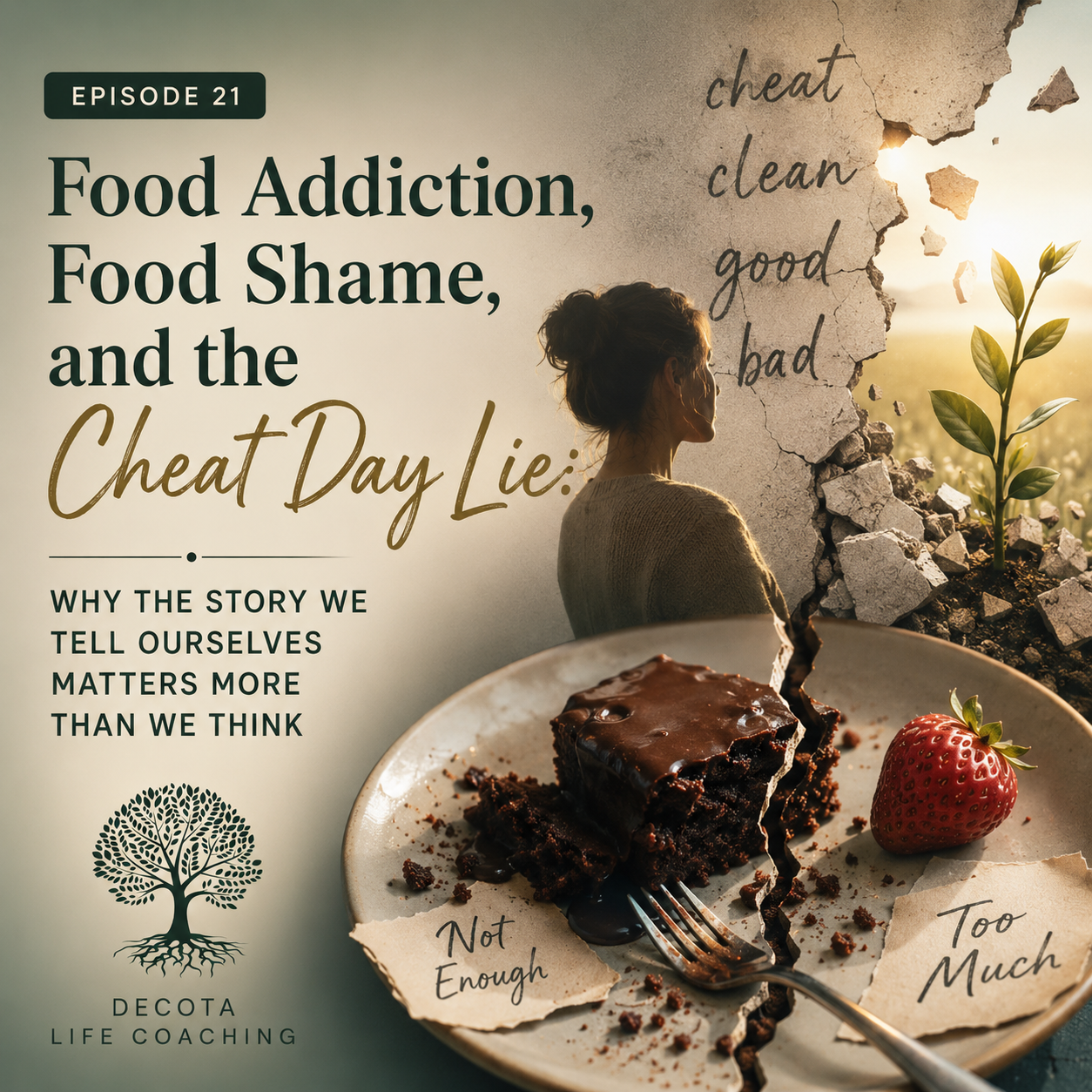
Food Addiction, Food Shame, & the Cheat Day Lie
Open
Welcome to The Original Self Podcast. I'm Evet DeCota, owner of DeCota Life Coaching and a psychology-informed life coach exploring resilience, mindset, and the courage to become your authentic self. This is a space for honest conversations about growth, identity, relationships, and all the messy moments in between that shape who we become.
Between the salon chair and coaching sessions, I've watched people move through life in patterns they rarely notice. Patterns that are subtle, familiar, and incredibly hard to see from the inside.
Last time, in Episode 20, we talked about what your body is doing during menopause, the shifting hormones, the changing hunger signals, the cravings that seem to arrive right on schedule every evening. We closed with a question worth sitting with. What if the story isn't about what's wrong with your body, but about what your body is renegotiating? Today, we carry that same question to a place that's harder to reach. We've spent five episodes looking at the system around us and the body underneath us. Now we turn toward the self, and toward the words we've been using about what we eat. Welcome to Episode 21: Food Addiction, Food Shame, and the Cheat Day Lie.
Is It Addiction?
Let’s start with the question many of you have probably asked yourselves at some point, usually somewhere between the third and fourth slice.
Am I addicted to food?
It’s not a small question, and for a long time, the scientific community couldn’t agree on how to answer it. But that’s starting to change.
Late in 2025, an international group of researchers and clinicians who study this area completed the Delphi process, which was essentially a structured way of getting experts to work toward agreement on a contested question. They proposed the name Ultra-Processed Food Use Disorder and concluded that this pattern behaves primarily like a substance use disorder rather than just a behavioral habit. One researcher suggested that this disorder should be included in future editions of the psychiatric diagnostic manual.
The tool most often used to study this disorder is called the Yale Food Addiction Scale. It takes the eleven criteria used to diagnose substance use disorders, things like loss of control, cravings, withdrawal, and continuing to use something despite real consequences, and applies those same criteria to eating.
Using this measure, researchers estimate that around 14% of adults meet criteria that would qualify as a substance use disorder if we were talking about alcohol instead of food.
Not all researchers agree with this assessment, stating that more evidence is needed before formalizing a diagnosis. Other questions concern whether what we’re measuring is truly addiction or whether it’s a predictable response to an environment engineered for overconsumption, which is exactly what we spent Episodes 16 and 17 unpacking.
From that perspective, the issue isn’t addiction in the traditional sense. It’s a rational response to an irrational food supply.
One area getting more attention is withdrawal, which has traditionally been considered a core marker of addiction. Some early studies report withdrawal-like symptoms when people significantly reduce highly processed foods. Symptoms of irritability, fatigue, and mood changes presented during the first several days of reduction.
That evidence is still developing, and researchers are careful not to overstate it, but it’s part of why the substance use conversation has gained traction rather than disappeared.
This is how I think about it. Food isn’t alcohol, and it’s not cigarettes. You can quit drinking, and you can quit smoking, but you can’t quit eating.
For every model of addiction researchers have built, it assumes recovery involves some version of abstinence, putting the substance down for good. Food doesn’t allow for that, though; you have to sit back down at the table tomorrow and the day after that, for the rest of your life. That single fact is what makes this question so complicated.
I have said before that I quit smoking after smoking a pack or more per day for 13 years and have never looked back. It was very hard to quit, and I always say I will never smoke again because I’m never quitting again. With that said, the sugar and hyper-palatable food pull is a constant for me. For my entire life. I barely drink alcohol, don’t smoke, and try to eat foods that are nourishing, but I’m always thinking about that sugar.
I’ve gone to nutritionists, thinking that yet another plan mapped out for me will solve the problem. I have seen a food therapist in hopes that something deep inside me needs nourishing and would solve my cravings. I have gone to food retreats where I have meditated and participated in exercises that tried to make me realize that it’s not hunger; it’s the soul crying out for more. None of it worked
And that’s what fascinates me. Some of the strongest, most resilient people I know have rebuilt entire lives after unimaginable loss, but still describe feeling powerless around certain foods.
It’s not a lack of discipline. It’s trying to rebuild a relationship with something we have to interact with all the time. That’s a completely different challenge, and that is why this research matters beyond the label itself.
Researchers are now developing screening tools clinicians can use in ordinary medical visits, the kind of questionnaire a doctor might hand you alongside the usual intake paperwork.
Early findings suggest a meaningful overlap between this pattern and conditions like type two diabetes, where the two may make each other harder to manage.
So this isn’t just an abstract academic argument. It’s shaping how treatment gets built, even before diagnostic manuals catch up.
But whatever label eventually sticks, a diagnosis is not a life sentence but a way to understand and move forward with the information you have. Recognizing yourself in these patterns is information about the mechanisms, not anything to do with your worth.
The name we give that experience may continue to evolve. Researchers may keep debating whether addiction is the right framework. Whether another explanation fits better, or where this belongs in the future of treatment.
But while the science works through the language, millions of people are living with the experience. And whatever we eventually call it, turning that experience into a judgment about ourselves creates shame and helps no one.
Because the purpose of understanding the mechanism was never to assign ourselves another label to carry. It was to finally have enough information to put one down.
The Binge-Restrict Cycle
There’s a pattern so many of us know intimately, even if we never had a name for it. Many people experience it as a personal struggle they can’t quite understand, but research shows it follows a predictable cycle. It’s called the binge-restrict cycle, and it moves through four stages.
The first stage is restriction. It may be skipping meals, cutting out entire food groups, counting every calorie, or building a long list of rules about what you’re allowed to eat and when.
From the outside, and often from the inside too, this phase feels like discipline and like it’s working. That’s part of what makes this cycle so difficult to recognize. Restriction usually doesn’t feel like the beginning of the problem. It feels like the moment you finally decided to solve one.
It comes with a sense of control, a plan, and that familiar thought: this is the thing that is finally going to work.
I can say honestly, I have tried every one of these restrictions countless times throughout my life.
The second stage is craving. Restriction can send messages to your brain and body that something important is unavailable. And your body responds to scarcity by turning up the volume on hunger and repeatedly pulling your attention toward food.
But craving is different from hunger, because hunger is the body asking for energy. Craving is targeted and specific. It’s the food you decided was off-limits that suddenly seems to be everywhere.
You notice it more, you think about it more, and you start negotiating with yourself around it.
Maybe I’ll just have one. Maybe I’ll wait until the weekend. Maybe I’ll get it out of the house so I don’t have to think about it anymore. The more attention the brain gives something, the more important that thing starts to feel. The food hasn’t changed, but your relationship with the food has.
This is an ancient survival system responding the way it was designed to respond. For most of human history, directing attention to something scarce helped keep us alive. The problem is that today, that same system is responding in an environment where restriction and abundance can coexist at the same time.
The third stage is the binge itself. This is the point where the tension that has been building finally breaks. It often looks like eating past fullness, eating quickly, or eating the very foods that were restricted in the first place.
And for many people, this stage feels confusing because it doesn’t always feel like a conscious decision. It can feel like something switches from thinking about the food to needing the food.
The same food that was avoided for days or weeks suddenly becomes the thing your brain is pushing you toward. And once the rule is broken, another thought enters the conversation: “Well, I already messed up today, so I might as well eat more or whatever I want.”
That thought alone can turn a moment of eating into something much bigger.
The fourth stage is guilt. The problem with guilt is that it doesn’t usually end the cycle. It often becomes the reason for the next round of restrictions, reinforcing the very pattern you were trying to escape.
There’s also a physical layer beyond the psychological pull. Research suggests that long-standing binge-restrict patterns can affect things like hunger hormone regulation and insulin sensitivity. That cycle can leave a physiological imprint, where the body adapts to an unpredictable food supply, the same way it would if scarcity of all food were real instead of self-imposed.
The cycle doesn’t stay contained to appetite either. Restriction and the anxiety it produces can disrupt sleep, whether that’s from being too hungry to settle at night or from the physical discomfort that follows a binge.
Poor sleep then feeds back into the whole system, since we already know from Episode 18 that a tired prefrontal cortex is a weaker brake.
Mood follows a similar pattern. Research on this cycle consistently links it with higher rates of anxiety and low mood, not as a completely separate issue running alongside eating, but as part of the same interconnected system.
Nutrition itself plays a role in the brain’s emotional centers, so when intake becomes uncertain, mood often becomes unpredictable right along with it.
The pull toward the very thing you tried to avoid is something researchers have studied. It’s sometimes called the forbidden fruit effect, and it describes how foods can become more appealing and take up more mental space simply because they’ve been restricted, independent of how the food actually tastes.
That restriction changes the food relationship. I’m sure that many of our experiences involve putting a food on the “nope, I can’t eat that food” list, and then your brain begins to find every reason to think about it. Or even better, every commercial or cooking show you watch shows that specific food that you sent to the no-fly zone.
Picture the food or an entire group of food that makes this scenario sound familiar.
In this scenario, I’ll decide Monday morning that carbs like pasta are officially off the table for the week or completely off the table forever, and I’m sure that will totally work out for me. By Wednesday evening, I’d thought about the Orecchiette Il Davide from my favorite restaurant around the corner more times than you can count, despite not having thought about it once the week before, when it was allowed in my mind.
That’s the forbidden fruit effect showing up in everyday life. I once read an article by author Geneen Roth called Kindness and Calories. She told the story of a mother whose daughter always snuck sweets and was gaining weight. The mother was very concerned, having been an overweight child herself, and to prevent the same results for her child, took the sweets away from her and admonished her about her weight. Roth suggested something that probably felt completely counterintuitive: fill a pillowcase with M&M’s, and whenever it got even a quarter empty, fill it back up again. She also suggested that the mother stop making ill remarks about her daughter’s body. At first, the young girl carried the pillowcase everywhere. Then, slowly, something changed. When the candy stopped being scarce, it stopped holding the same power.
If you’ve lived this cycle, and I’d guess many of you have, I just want to say diet culture markets restriction as the solution to exactly the problem restriction helps create. The advice is almost always to restrict harder, follow more rules, and eliminate more categories.
And because restriction can produce short-term results- weight loss in the first few weeks, a sense of control in the moment- it looks like it’s working right up until the body’s response catches up with it.
Most people never connect their own binge back to the restriction that came before it; I know I didn’t. We just experience the binge as more evidence for the belief that we can’t be trusted around food, and then we reach for more restriction to correct it. That’s the loop closing on itself.
Can we start to question the rules we were handed and the ones we eventually placed on ourselves? Because maybe the way out of the cycle was never another rule. Maybe it starts with understanding why the rules had so much power in the first place.
The Cheat Day Lie
If the binge-restrict cycle is the mechanism, the cheat day is the mechanism with a calendar attached to it.
Plan the restriction for six days, plan the loss of restraint for the seventh, and call it balance.
Words like cheat, clean, good, and bad don’t just describe food. Over time, they can start describing how we see ourselves. A cheat day implies that eating a food you enjoy is something you get away with, something that requires an exception to be granted.
Many dieticians and eating disorder clinicians point out that moralizing food this way can increase guilt, shame, and how much mental space food takes up. This is the opposite of what anyone wants from a system that’s supposed to make eating easier.
But notice what this language does to the rest of our week.
If Saturday is the “cheat” day when you are allowed to enjoy food, then Monday through Friday become the days you’re supposed to earn it.
That’s a lot of days spent turning an ordinary food choice into something loaded with rules, negotiation, and meaning. And as we just learned, restriction sets up the next binge; the cheat day doesn’t always prove to be the release valve it’s marketed as.
It can become another version of the same cycle, except this time the rules are organized around a calendar.
I’ve done this for decades. I can remember ending a day and mentally reviewing everything I ate. If it were on paper, I would have needed to use a red pen to mark every lapse in judgment I thought I had made.
Red marks if I didn’t stay on track, if I messed up and forgot to count the Wint-O-Green mint I shoved in my mouth after drinking coffee. I would assess whether today’s food intake made for a good day or a bad day. It was exhausting, and it took me a long time to notice that the scorecard itself, not the dessert, was the thing that was causing the stress, judgment, and ultimately, the damage to me.
There’s another side to this conversation. Some researchers have found that including enjoyable foods intentionally can help people feel more satisfied and maintain a way of eating that works for them in the long term.
But I don’t think that finding cancels out everything we just covered. I think it points to something more specific.
The difference isn’t whether you planned the food; it’s the meaning attached to it. A cheat day is planned, but there’s a big difference between deciding you’d like pasta on Friday because you enjoy pasta and declaring Friday the only day you’re allowed to have pasta because every other day it represents failure. It’s the moral language wrapped around allowed and not allowed.
Looking at cultures where food is approached with more flexibility offers a different way to think about our relationship with eating. Pasta isn’t saved for Saturday. Dessert isn’t treated like contraband. Food is woven through life rather than rationed out on a schedule, and cravings tend to soften, not disappear entirely, once a food stops being treated as a rare treat you have to earn.
Letting go of the moral scorecard entirely reduces the weight of forbidden foods, and that means there is less for the binge-restrict cycle to hold on to. It means the structure stops being built around morality and starts being built on what actually helps you feel good in your mind and body.
From Blame to Curiosity
Let’s bring these three threads together.
The biologically driven addiction process is still being studied: the way the body responds to scarcity, whether that scarcity comes from the outside world or from the rules we’ve created for ourselves, and the moral weight we assign to foods that eventually gets turned inward.
Not one of those three issues changes by adding another layer of judgment.
That’s the piece I want us to really focus on.
The shift happens when we trade shame for curiosity. When we stop asking, “What’s wrong with me? and start asking different questions.
What pattern keeps repeating?
What rules did I inherit that I never stopped to question?
And then maybe we finally reach that discovery moment of “No wonder it has all felt so confusing.”
Because understanding the pieces is what starts to calm the chaos.
What’s easy to miss in all of this is that curiosity isn’t the same as permissiveness, and it’s not the same as giving up on caring for yourself.
It means we stop using shame as a strategy.
Asking “what is happening here?” is still an act of care, often a more reflective one, because it gives you something you can actually work with.
Where blame keeps you stuck repeating the same conversation with yourself, curiosity helps you understand the conversation you’ve been trying to have.
And that understanding is where we can finally start asking the next question: what is the behavior trying to do for us?
Close
There was a version of you, long before you learned which foods were supposed to be good or bad, who had a different relationship with eating.
No scorecard, no cheat days, no chapters of rules to memorize.
That version of you hasn’t disappeared. It just got layered over the same way we’ve talked about in every episode of this series. By systems, by biology trying to protect you, and now by a vocabulary that turned eating into a moral report card.
If there’s one thing I hope you carry out of this episode, it’s permission to retire a few words.
Cheat. Clean. Good. Bad. They were never accurate food descriptions to begin with, nor were they accurate descriptions of you. Changing the way we talk about food is also an opportunity to change the way we talk about ourselves.
In the next and final episode of this series, we’re going to talk about what happens after we understand the rules. How do we tell the difference between a body asking for food and an emotion asking for comfort? How do we rebuild trust with ourselves after years of second-guessing?
Episode 22 is Coming Home: Learning to Trust Yourself Again
Thank you for spending this time with me. If you'd like to learn more about working with me, my contact information is in the episode's notes.
I'll see you next time. Have a great day.