Opening
Welcome to The Original Self Podcast. I'm Evet DeCota, owner of DeCota Life Coaching and a psychology-informed life coach exploring resilience, mindset, and the courage to become your authentic self. This is a space for honest conversations about growth, identity, relationships, and the messy moments in between that shape who we become.
Between the salon chair and coaching sessions, I've watched people move through life in patterns they rarely notice. Patterns that are subtle, familiar, and incredibly hard to see from the inside.
Today’s episode is the beginning of something a little different. Over the next several weeks, I’m going to talk about food in many different ways. The more I study the psychology behind eating, the more I realize this isn’t really a story about food. It’s a story about how we lose ourselves around food and how we find our way back.
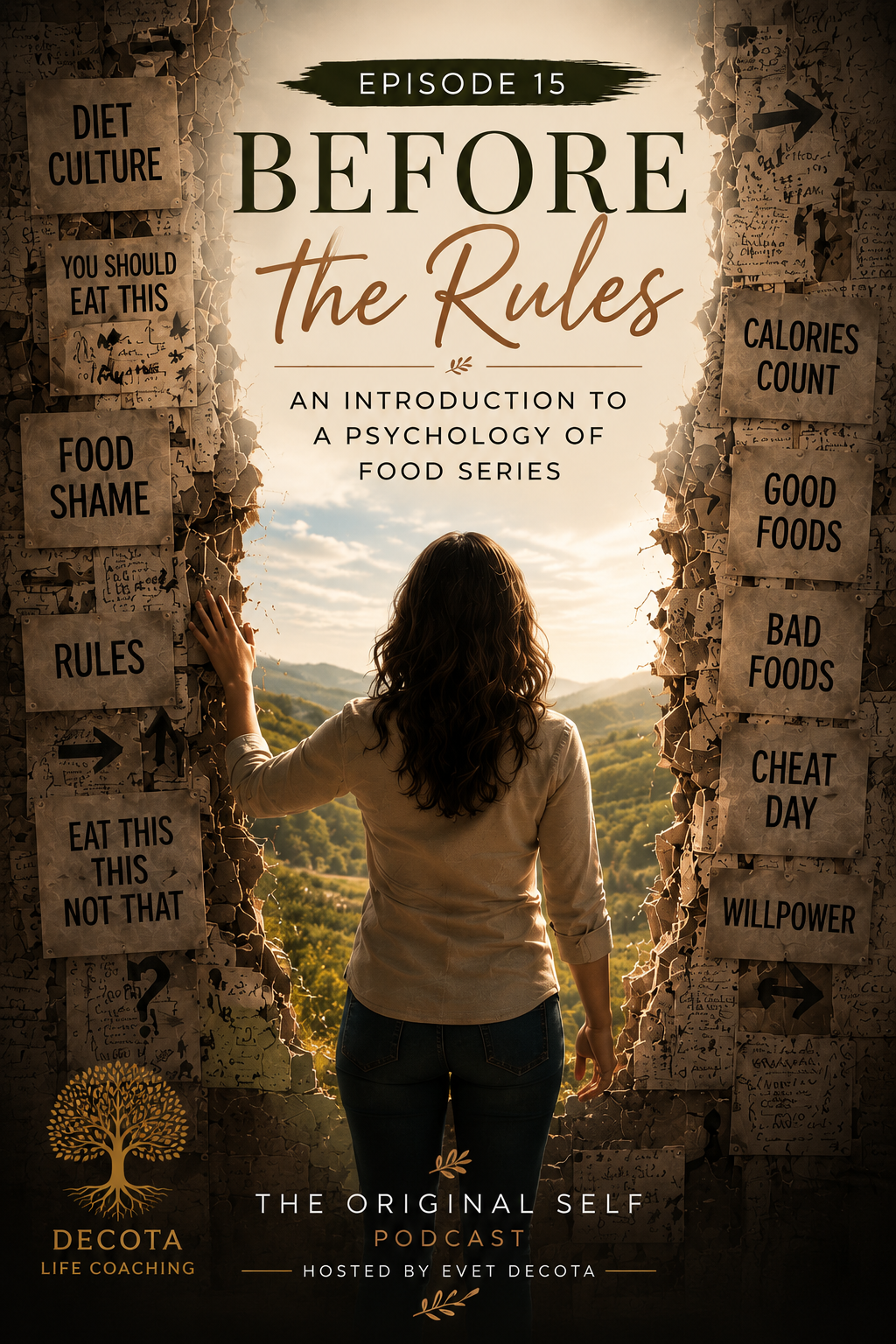
This is Episode 15- Before the Rules: An Introduction to a Psychology of Food Series.
The Lens
Welcome back. As I said in the introduction, this is the beginning of a series on the psychology of food. We will talk about food, but not in the way that you usually hear about it or perhaps how you might expect.
This series is not about dieting, weight loss, meal plans, macros, supplements, or the latest nutrition trend. It’s about identity.
It’s about the stories we’ve been told, the systems we’ve been raised inside, the biology we’ve inherited, and the relationships many of us have spent decades trying to fix without ever fully understanding where they came from.
And at the center of every conversation in this series is one question:
Who were you before you were told how to be around food?
Who were you before you were introduced to diet culture?
Before food marketing?
Before food shame?
Before the rules?
Because I don’t believe most people have a food problem.
I believe most people have been living inside a food environment that’s shaped their thoughts, beliefs, cravings, fears, and behaviors for so long that they’ve forgotten where those influences end and where they begin.
And as a side note, that includes me.
At 56 years old, I’ve spent a lifetime being tossed around in a tornado of food rules, food fears, food trends, and all the unconscious messages that come with them. I’m not standing outside this conversation looking in. I’ve lived inside it my entire life, and, like many of you, I’m still sorting through it.
Which brings me to the question that started this entire series.
Why I’m Doing This
So, why is this series important?
Food has always fascinated me, not because I’ve had all the answers, but because I’ve watched so many people struggle with it. For nearly four decades, I’ve spent my days behind a salon chair listening to people talk about their lives.
I’ve listened to conversations about marriages, careers, children, grief, aging, health, confidence, and self-worth. And woven through almost all of those conversations, in one form or another, has been food.
Women promising themselves they’ll be “good” this week. People talking about foods they aren’t allowed to eat, and calling it a “cheat day” when they do. Mothers worrying about what their daughters think of their bodies. Daughters absorbing messages they never consciously agreed to carry. Successful, intelligent, accomplished people feeling completely defeated by something as ordinary as lunch.
Over the years, I noticed that people who struggled most with food were rarely lacking information. Most knew what carbohydrates were. They knew vegetables were healthy, that exercise mattered, and most of the nutritional facts about the food they ate.
Yet many of them still felt trapped, and that observation followed me into my psychology studies.
When I returned to college and eventually completed my psychology degree, I became increasingly interested in why we eat the way we eat.
Not just nutritionally, but psychologically, emotionally, socially, and culturally.
The deeper I looked, the more I realized that food is never just food. Food is belonging, comfort, identity, memory, reward, grief, stress, celebration, and love.
And when we reduce all of that complexity down to calories and willpower, we miss the story entirely. That realization eventually became part of my academic work, my coaching work, and now this series.
The more I learned, the less interested I became in asking, “Why can’t we control ourselves?”
I became more interested in “What exactly are people trying to control themselves against?”
The Question That Changed Everything
The question that changed everything for me was surprisingly simple. Why do intelligent and educated people struggle so much around food?
Not uninformed people or careless ones, but intelligent, thoughtful, and disciplined people.
People who have successfully built careers, raised families, earned degrees, managed businesses, and overcome extraordinary challenges. Why do so many of them still feel powerless around food?
If information solved the problem, we would have solved it by now. We live in the most informed generation in human history. We have podcasts, books, documentaries, apps, nutrition labels, health influencers, wearable devices, and endless access to information.
Disordered eating, body dissatisfaction, and food confusion continue to grow. At some point, we have to ask whether information was ever the real problem.
What if the struggle isn’t happening because people don’t know enough? What if the struggle exists because we’ve been taught to understand food through the wrong lens entirely? What if the question isn’t, “What’s wrong with me?” but “What happened to me?”
That question changes everything. Because it shifts us from blame to curiosity. And curiosity is where healing begins.
What This Series Is Really About
This series is organized into three parts. The first is called The System.
These episodes look outward, exploring how the modern food environment was built, how food companies learned to shape behavior, how children became marketing targets, and how convenience, consumption, and profit became deeply woven into everyday eating.
These are the episodes that answer the question: What happened around us?
The second part is called The Body.
These episodes look inward, exploring the gut-brain connection and reward pathways. We explore hormones and menopause, and the many biological systems that influence our relationship with food. We’ll talk about cravings, appetite, alcohol, metabolism, and why our bodies often respond in ways that have far more to do with biology than willpower.
These episodes answer the question: What is happening inside us?
And then the final part is called The Self.
This is where everything comes together. We’ll discuss body image, self-worth, and intuitive eating. We’ll move on to why we experience food guilt and perfectionism and explore the rare topic of masculinity and food. Lastly, we will explore food as self-care and the complicated ways food becomes tied to identity.
These episodes answer the question: Who am I underneath all of this?
The System. The Body. The Self. Three layers leading to a journey back toward understanding ourselves.
The Original Self
Every episode in this series returns to the same place: the authentic self that existed before all the noise.
Before food became a moral issue. Before eating became a performance. Before every meal carried anxiety, judgment, guilt, or negotiation. Before food became something to fear.
Children are born knowing how to eat. They know hunger, fullness, curiosity, and satisfaction.
Then the world begins talking. At a young age, we are bombarded with advertisements, diets, family messages, the newest health trends — what’s dangerous and what’s healthy- until that science is disproved.
We are alarmed by the rules, the fears and the shame that follow a diagnosis or a weight gain, and in some cases a weight loss when we can’t afford to lose anymore.
We are exhausted by the constant expectations that society — and often we ourselves — place on food. Rather than increasing awareness, those expectations make it harder to recognize and trust our own signals.
We become disconnected from trust, our bodies, and from ourselves.
This series is not about becoming perfect, disciplined, smaller, or becoming someone new.
It’s about uncovering the person who existed before all of that conditioning arrived. It’s about returning to the question:
Who were you before you were told how to be around food?
Before the rules. Before the shame. Before all the noise.
There was a version of you that knew how to eat. Your original self.
Closing
In our next episode, we’re starting with the food itself.
We’ll explore how hyper-palatable foods were engineered, why they affect the brain the way they do, and why the struggle so many people experience with food has nothing to do with willpower like they’ve been led to believe.
That’s next time in Episode 16:
The Engineered Plate: How Hyper-Palatable Foods Are Designed to Defeat You.
But until then, I’d like to leave you with a thought.
Before the food industry. Before the diets. Before the shame. Before the rules dictated to us.
There was a version of you that knew how to eat, how to trust your body, and how to respond to hunger without fear.
The goal isn’t to become someone new.
It’s to remember who you were before all of this told you who to be.
Thank you for being here at the beginning of this journey, and thank you for listening to The Original Self Podcast. If today’s conversation resonated with you and you feel ready to explore your own growth, you can learn more about working with me in the episode notes of this podcast.
I’ll see you next time.