The Engineered Plate: How Hyper-Palatable Foods Are Designed to Defeat You
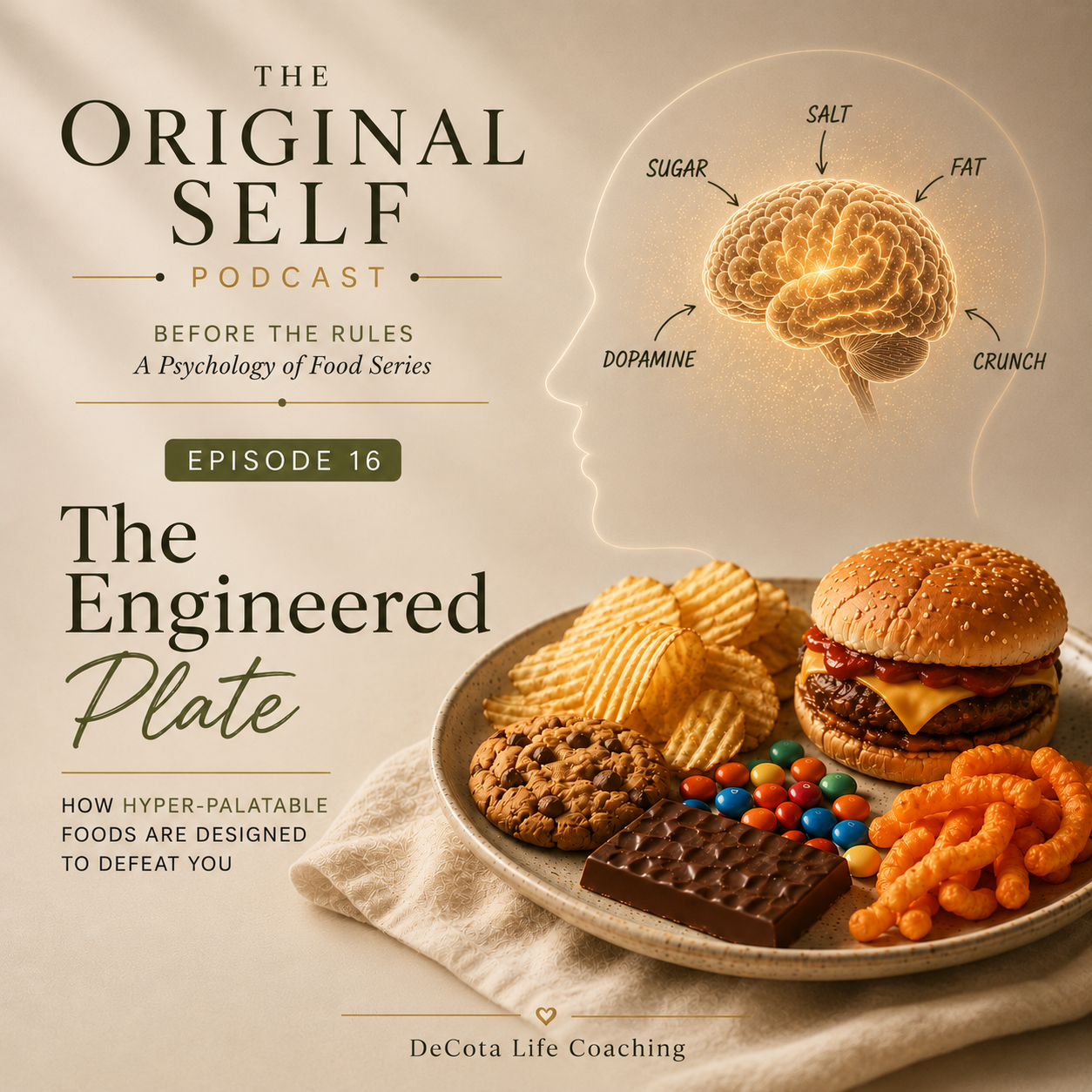
Welcome to The Original Self Podcast. I'm Evet DeCota, owner of DeCota Life Coaching and a psychology-informed life coach exploring resilience, mindset, and the courage to become your authentic self. This is a space for honest conversations about growth, identity, relationships, and the messy moments in between that shape who we become.
Between the salon chair and coaching sessions, I've watched people move through life in patterns they rarely notice. Patterns that are subtle, familiar, and incredibly hard to see from the inside.
Today’s episode is about something I hear constantly from clients and honestly from myself. Most of us have been told the same story about food. If you can’t stop eating it, you lack discipline. If you gain weight, you don’t have enough willpower. If you keep reaching for the same foods over and over again, the problem must be you. Today I want to challenge that story. This is Episode 16- The Engineered Plate: How Hyper-Palatable Foods Are Designed to Defeat You.
The Myth of Weak Willpower
Welcome back. Last time, I introduced you to a series I’ve been building for a while, one that uses the lens of psychology to examine something we all do every single day, and yet rarely understand as deeply as we think we do. I told you in the introduction to Before The Rules, A Psychology of Food Series, Episode 15, that this series isn’t really about food. It’s about how we lose ourselves around it and how we find our way back.
And I promised we’d start there, with the self-blame that follows so many of us into the kitchen every single day. So, let’s start with the collective you.
Think about the last time you told yourself you’d have just a few Doritos, one brown butter chocolate chip cookie with sea salt. Or that you’d stop eating the popcorn you made after this TV show episode and not eat anything else tonight. But you didn’t stop. And somewhere in the aftermath, maybe in that moment of sitting with an empty bag, or on the drive home from a drive-through you hadn’t planned to stop at, there was a feeling. Not just fullness. Something more uncomfortable than that. A specific kind of self-blame that so many of us know intimately. Even if we’ve never quite named it aloud.
Most people interpret that feeling as evidence of a personal failing. I’m weak. I have no discipline. Other people seem to manage this just fine, so what’s wrong with me? That story is so familiar, so deeply embedded in the way we talk about our bodies, eating, and self-control, that it rarely gets questioned. We just accept it as truth and carry the weight, shame, and defeat of it everywhere we go.
But here is the question I asked myself six years ago that changed the entire direction of my motivation, goals, and, honestly, the way I understand myself. What if the problem isn’t that you’re broken? What if the environment is working exactly as intended, and you were never supposed to be able to easily resist it?
Because here’s what I’ve come to understand through years of psychology study, through my own research, and through watching clients, friends, and myself navigate this: willpower is real, but not infinite. It was never designed to compete alone, against a system built with billions of dollars and decades of neuroscience specifically designed to override it.
When Food Became a Product
To understand where we are today, it helps to understand how we got here.
There was a moment in American history —from astronauts in space eating and drinking powdered foods, through the 60s and 70s explosion of TV dinners and canned everything, to the 80s invention of the microwave, and when the relationship between humans and what they ate began to shift fundamentally. Before that, most people ate what grew, what was prepared, and what was available to them. The food was simple, the flavors were straightforward, and your body’s natural signals of hunger, fullness, and satisfaction largely guided the experience.
Then food became an industry. And we all know that industries compete. They compete for shelf space, for market share, for your attention and your loyalty, and the industry that wins the competition is the one that receives the most of your repeated purchases. Those winners didn’t win by accident; they won by science.
A psychophysicist, Howard Moskowitz, discovered it first by testing something deceptively simple. At what point does sweetness stop being pleasurable? How much sugar is too much before enjoyment starts to fall away? He called that peak— where something is enjoyed the most— the Bliss Point, and his findings changed the food industry forever. He found that pleasure follows a curve. As sugar increases, enjoyment rises, but only up to a point. Then it drops.
And once the food industry understood that a bliss point could be engineered, not just for sugar, but for the precise combination of salt, sugar, and fat simultaneously, everything changed.
Brands like Prego, Pepsi, and Dr. Pepper used multivariate analysis to maximize their product’s appeal to consumers, turning them into dominant forces on supermarket shelves. That R & D, that scientific experiment, is what birthed the hyper-palatable or ultra-processed food industry as we know it today.
What followed was an arms race of palatability. Companies began spending enormous resources not just to make food taste good, but to make it taste in a way that the brain couldn’t easily walk away from. Understanding the why requires a brief detour into neuroscience, so I can show you how any willpower fight we think we can muster completely falls apart.
The Psychology of Hyper-Palatability
The brain regulates eating in two ways — the homeostatic pathway, which determines the body's energy needs, and when we run low, a hunger signal is sent out. It’s also the system that tells us when we are full. It is practical and functional when it’s not been messed with.
The other system is the hedonic pathway or the reward system. It operates on pleasure and motivation, not nutritional need. It has no concern for whether your body needs more fuel; its only focus is on what feels good.
Usually, these two systems exist in harmony. But hyper-palatable foods- engineered to hit that bliss point— activate the hedonic pathways so strongly that they override the homeostatic ones over and over.
So even when your body knows it’s had enough, your reward system has yet to reach satisfaction, and so you keep eating those chips, that cookie. The biology of the brain was built for a world that we no longer live in.
Then there’s dopamine. It’s often called the feel-good chemical, but I believe that phrase undersells what it actually does. Dopamine is less about pleasure and more about anticipation—the wanting.
Research from Harvard’s nutrition department has shown that the expectation of a reward stimulates more dopamine activity than the reward itself. And the crazy part is that if the reward exceeds the dopamine response, if it’s even larger than expected, our motivation for the reward drives us to seek the experience again. Think about the smell of something cooking in your favorite restaurant as you walk past, the crinkle of a bag of your favorite snack in someone else’s hands, or even the image of a particular food—they all trigger dopamine before you take a single bite. That is ancient neurology responding to signals that it’s never resisted.
One of the most elegant biological mechanisms we have is called sensory-specific satiety, and it’s very easily exploited by industries selling the drug of hyper-palatable foods. The way it works is that as you eat a particular food, the pleasure you get from that specific flavor gradually declines. Your brain gets bored with it, satisfaction drops, and the drive to continue fades until you stop eating.
But when a product is engineered to contain multiple distinct flavor compounds— fat hitting one receptor, salt another, sugar hitting more receptors, and then layered artificial enhancers throughout, the sensory-specific satiety can not perform. Before one element reaches its satisfaction point, the next one is pulling you forward.
The finish line keeps moving, and companies like McDonald’s know it. McDonald’s puts added sugar in far more products than most people realize including buns, sauces, and even their salads. A Quarter Pounder with cheese isn’t an accident. It’s a scientifically calibrated combination of fat, salt, and sugar designed to light up the hedonic pathway, bypass the signals that would normally tell you to stop eating, and flood the brain with enough dopamine that the craving reactivates the next time you see those golden arches—or even a commercial. You’re not weak; you’ve just been studied by companies that will stop at nothing to make that almighty dollar.
About six years ago, I found myself in a pattern I couldn’t quite explain. After work, on weekends, sometimes when I wasn’t even particularly hungry— I was pulling into McDonald’s. Not because I’d decided to. Not because I was craving something specific. I would come back to awareness already in the drive-through line, wondering how I’d gotten there, like some part of my brain had decided before I was even consulted, like I was in a mind-control experiment. Once I learned how those foods are engineered, the more I understood how powerless I was against them.
Why Smart People Get Hooked Too
One of the questions that launched my academic research was: Why do intelligent, disciplined, accomplished people struggle so much around food? Not people who are uninformed or careless, but people who have built careers, raised families, navigated genuine complexity in their lives—and still find themselves feeling completely powerless in front of a bag of something they didn’t intend to eat.
Some of it comes down to awareness. Many of us move through the day on autopilot, eating without ever stopping to ask what’s actually driving it. But even for the people who are paying attention, the struggle is still real, and that’s where Roy Baumeister’s research on self-control becomes so important.
Baumeister found that self-regulation functions like a muscle— it can be used, and it can be depleted. Every act of self-control draws from the same limited pool of mental energy, whether you’re managing an emotion, pushing through a difficult task, or resisting the cookies someone left in the break room— those cookies are a daily occurrence in the salon break room, and I have a love/hate relationship with them.
Baumeister ran an experiment where participants who had spent energy resisting chocolate chip cookies gave up on a difficult puzzle eight minutes sooner compared to the nineteen minutes people who didn’t encounter resisting cookies. They weren’t more capable; they just hadn’t used up their self-regulatory resources yet.
The reason I’m telling you about this research is that if you think about yourself by ten o’clock at night, after a full day of decisions, demands, and emotional management, you are not the same person who set an intention that morning. The prefrontal cortex, which plans, exercises self-control, and engages in long-term thinking, is running on less. And that’s precisely why you find yourself tiredly standing in the middle of your kitchen or pressing buy on the food app, grabbing the engineered food without a second thought.
As part of my psychology research at Dominican University of California, I studied the relationship between stress, impulsivity, and hyper-palatable food consumption. What I expected to find, and what I did find, was that stress increases HPF consumption. But the finding that surprised me most was that consumption rates in stressful scenarios and non-stressful scenarios were nearly identical. People weren’t just reaching for these foods because they were stressed. They were reaching for them because of fatigue, boredom, habit, and many times at night. The foods themselves had become the path of least resistance regardless of emotional state. And impulsivity, not stress, turned out to be the stronger independent predictor of how much someone consumed.
When I was growing up, we had what we called the junk drawer. It was filled with cookies, candy, chips, and all the foods we now know are hyper-palatable. We weren’t allowed to eat from it whenever we wanted, but it was always there. Sometimes we’d ask. Sometimes we’d sneak.
Looking back, what’s interesting isn’t that the food was there. It’s that nobody thought twice about it. It was normal. Nobody was trying to harm us. Nobody was having conversations about food manipulation, dopamine, or ultra-processed foods. It was just food, at least as far as we understood.
I think that’s important because so many of us inherited our relationship with eating before we were old enough to understand what we were inheriting. The food was normal. The habits were normal. The constant presence of highly rewarding snacks was normal. We didn’t choose that environment. We grew up inside it. And when something has always been normal, it’s incredibly difficult to recognize how much influence it’s still having on you decades later.
This matters enormously for how we think about self-blame. Intelligence doesn’t protect you from the hedonic pathway. Success doesn’t exempt you from decision fatigue. Discipline is a resource, and resources run out. When your capacity for resistance is low and your environment is deliberately constructed to exploit that exact moment, the outcome isn’t a character flaw; it’s math.
The Real Cost
We tend to talk about the consequences of HPFs almost exclusively in terms of weight. And the physical health implications are real and documented. The research connecting ultra-processed food consumption to heart disease, type 2 diabetes, and metabolic disorders like high blood pressure is substantial.
But another cost is the mental overhead. It’s the constant low-level negotiation that happens around eating when you’ve lost trust in your own responses— am I actually hungry or am I just bored, am I eating because I want this or because I can’t stop, why can I be disciplined in every other area of my life and not here? I have had these thoughts so many times in my life that I’ve lost count. I smoked cigarettes for over 13 years, at least a pack a day, and I was able to quit smoking and have never had another cigarette again for over twenty-five years. Not once have I taken a drag or even thought about smoking again.
Why was I able to conquer that compulsion, yet have struggled with food cravings and noise almost my entire life? I think the answer is simpler than I wanted it to be. I don’t need cigarettes to stay alive. I can walk away from them completely and never look back. But I can’t abstain from eating. Nobody can. And when the very thing you’re trying to navigate is also the thing your body requires to survive, willpower becomes an almost impossible standard to hold yourself to.
I’ve done it, at times for a few weeks to even a few years, but I always revert. Add to that a lifetime of processed foods that rewired the signals my natural biology was supposed to rely on, and a very likely addiction to sugar that started before I was old enough to question what I was eating, and the deck was never stacked in my favor.
And that internal tug of war never really goes away. It shows up as intrusive thoughts about food that occupy real cognitive space. The shame that accumulates quietly and then surfaces in the least expected moments— in a dressing room, looking at a photo of yourself, or in a conversation you weren’t expecting to have knocks us off balance.
The fundamental disconnection from your own body is the real injury lying underneath these questions. When your body overrides signals enough times because the food you eat is specifically designed to do so, you are unable to hear those signals clearly. It makes you stop trusting hunger or fullness. You begin to experience your own biology as the enemy rather than as information. The difficulty of spending years at war with your body makes the idea of listening to feel truly unnerving.
It creates a distrust of self because you can change what you eat in a week, but rebuilding a relationship with your own body takes considerably longer. I believe it starts with understanding what happened to create the distance in the first place.
Returning Awareness
If you are feeling angry, annoyed, or disappointed at the companies that sell HPFs, I completely understand the feeling, but that’s not my intent for this episode. It will not end with me speaking about a new plan that will be a miracle, or a list of foods to avoid, or a protocol to follow.
I’m interested in the meaningful difference between making a choice and having a choice made for us. Most of us move through our relationship with food without ever clearly seeing which of those is happening. We experience a craving and interpret it as desire, without knowing that the craving was activated by dopamine responding to engineered anticipation. We eat past fullness and call it weakness, without knowing that sensory-specific satiety was circumvented by design. We resist all day and collapse at night and decide we have no willpower, without knowing that willpower is a finite resource that was steadily drawn down by everything else the day asked of us.
It’s also worth noting that this conversation is beginning to move beyond individual responsibility and into public policy. Researchers, physicians, and policymakers are increasingly asking whether it makes sense to place the entire burden on consumers when so much of the modern food environment has been deliberately engineered to drive consumption.
Questions are being raised about food labeling, advertising directed at children, the availability of ultra-processed foods in schools, and whether consumers are receiving enough information to make informed decisions about what they’re eating. Some countries have already introduced warning labels and restrictions on certain forms of marketing. Others are debating whether highly processed foods should be regulated more like products that carry known health risks, like tobacco and alcohol.
Regardless of where those conversations ultimately lead, the fact that they are happening at all represents a huge shift. For decades, the dominant message was simple: if you’re struggling, the problem is you. But when governments, researchers, and public health organizations begin asking questions about the environment itself, it suggests we’re starting to recognize that human behavior doesn’t happen in a vacuum. The choices we make are always influenced by the systems we live inside.
Understanding the system doesn’t excuse us from participating in our lives. It doesn’t remove agency. But it does give us the ability to see clearly. When we see clearly, we finally begin to ask the right questions. It’s not “what’s wrong with me,” but “what is actually happening here?” Not “why can’t I control myself,” but “what am I really responding to in this moment?”
That shift, from self-blame to curiosity, is where the awareness work begins. It may be uncomfortable, but curiosity requires slowing down in moments when the pull to just eat on autopilot is very strong. But it’s honest, and it’s the beginning of coming back to yourself.
What I’d like to leave you with today is simple. Before you make your next food decision, just this once, pause long enough to notice what’s happening. Not to judge it or to override it through sheer force of will. Just notice: Are you hungry? Are you tired? Is the pull to eat HPFs coming from inside you or from something in the environment? There is no perfect answer; you just have to become curious enough to look.
There was a version of you, before all of this, who knew how to eat. Who trusted hunger and recognized fullness and didn’t spend cognitive energy negotiating with that box of See’s Candy, that pint of Cherry Garcia, or that cold slice of pepperoni in the middle of the night.
The work of this series isn’t to turn you into someone new; it’s to help you remember who that person was, and to slowly start, without judgment, to find your way back.
Closing
In the next episode, we’re going deeper into one of the most misunderstood experiences in our relationship with eating— food noise. It’s that constant mental chatter about what you should eat, what you shouldn’t have eaten, what you’re going to eat later, and whether any of it makes you a good or bad person.
We’ll talk about where it comes from, why some people experience it far more intensely than others, and what it actually means when the noise gets loud. Look for Episode 17- Food Noise: Why You Can’t Stop Thinking About Food’
That’s next time on The Original Self Podcast. Until then, thank you for being here. If today’s conversation resonated with you and you feel ready to explore your own growth, you can learn more about working with me in the episode notes.
I’ll see you next time.