Born into It: Where Your Relationship with Food Really Began
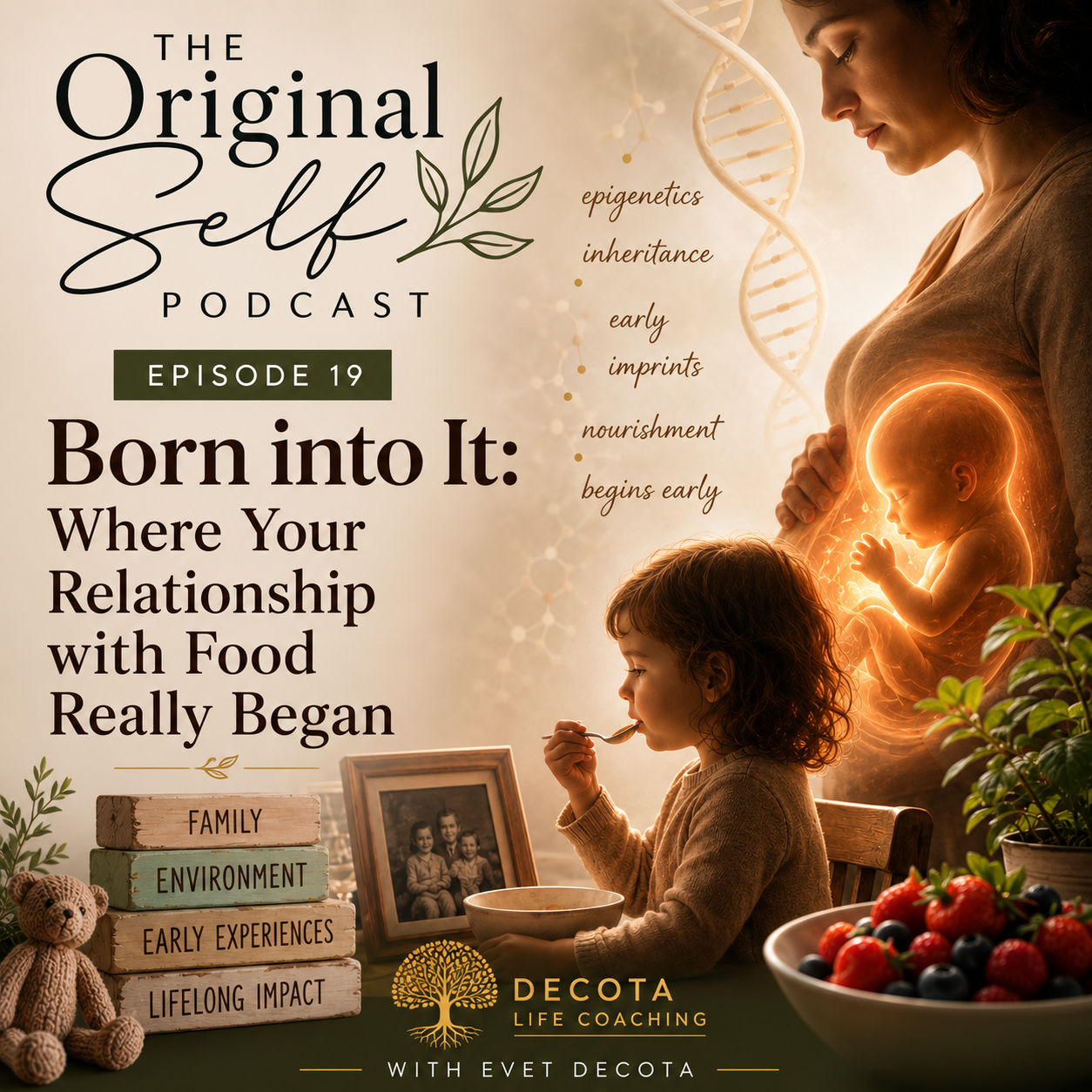
Welcome to The Original Self Podcast. I'm Evet DeCota, owner of DeCota Life Coaching and a psychology-informed life coach exploring resilience, mindset, and the courage to become your authentic self. This is a space for honest conversations about growth, identity, relationships, and all the messy moments in between that shape who we become.
Between the salon chair and coaching sessions, I've watched people move through life in patterns they rarely notice. Patterns that are subtle, familiar, and incredibly hard to see from the inside.
In the last episode, we explored what happens inside the brain and body when we eat. The more we looked beneath the surface, the more clearly we saw that eating is influenced by far more than hunger or willpower. Today, we’re going even deeper by exploring how our relationship with food began long before we ever thought about calories, carbohydrates, or healthy eating–before we had language, before we formed memories, and perhaps even before we were born. This is Episode 19: Born into It: Where Your Relationship with Food Really Began.
A Word Before We Begin
Hello, and welcome back.
Before I get into the science today, I want to note that this episode touches on pregnancy, breastfeeding, and early childhood feeding, but I am in no way suggesting blame. Not toward the mothers listening, and not toward the mothers who raised us.
Every mother in this episode’s story was living inside the same systems this series has described. The stress, the food environment, conflicting information, and often a lack of support. Nobody was choosing difficulty for their child, and the influences this episode explores were, in most cases, invisible to everyone involved.
That includes breastfeeding because everyone is different. Some mothers are unable to produce enough milk, and some can’t breastfeed at all, while others choose only to use formula. I will share remarkable research on breast milk. With that said, baby formula has fed healthy children for generations, and no one should ever feel upset about using formula over breast milk.
The goal of this episode isn’t guilt. It’s understanding. Because once we understand the full picture, we stop carrying around the feeling that this was somehow our fault.
Before You Were Born
Most of us can point to a moment we consider the beginning of our complicated relationship with food. Maybe it was the first diet that didn’t work or a comment someone made about our bodies. Or the first time we ate past fullness and then felt shame about it.
But what if none of those were the beginning of our complicated relationship with food?
Current research suggests that our first food preferences begin in the womb— not at the family table, in front of the television, or even in a high chair.
As early as the second trimester, the fetus can detect flavors from the mother’s diet through the amniotic fluid. Garlic, carrots, and vanilla— flavors from the mother’s diet pass into the fluid, which the fetus swallows, and those early exposures shape food preferences after birth. Studies found that infants whose mothers drank carrot juice regularly during pregnancy were more accepting of carrot-flavored foods than those with no prenatal exposure to that flavor.
That’s so fascinating. The fetus isn’t deciding that carrots taste good, but is fundamentally learning that these flavors belong in its world. This is one of the brain’s earliest acts of categorization. It’s not about preference— it’s about what feels familiar and safe.
It’s not only flavor that shapes the meaning but something far older.
When we think of inheritance, we usually think of eye color, height, curly or straight hair, etc. But biology also makes the body carry information about environments. Safe environments. Environments where there is scarcity. Or living in environments of chronic stress. We don’t carry that information as memories in the way we traditionally think of them; we carry it as biological adaptations that can influence how the next generation responds to the world.
Scientists call this epigenetics. It explores how life experiences can leave biological fingerprints that extend beyond a single generation. For example, during the final months of World War II, food rations in the Netherlands dropped to dangerously low levels. Researchers later discovered that children born to mothers who experienced this famine showed lasting metabolic changes that persisted for decades. They had higher rates of obesity, diabetes, and heart disease in adulthood because their developing bodies adapted to an environment of scarcity long before they ever chose their own.
Research on intergenerational trauma is similar. Stress and trauma can alter gene expression in ways that affect the next generation’s stress response, anxiety levels, and metabolic function. In practical terms, this means a child may inherit a nervous system that responds more intensely to stress, develops stronger cravings for calorie-dense foods during difficult times, or has a cortisol system that reacts more quickly. These aren’t certainties, but they are tendencies that can echo across generations.
When I first learned about this research, I couldn’t help but think of my own family and how things that had always felt separate began to feel connected. My mom struggled with anxiety during her difficult pregnancies and also battled bulimia at different points in her life. My grandmother grew up in extreme poverty, where food insecurity was a constant reality. Throughout her life, she cycled between bingeing and severe food restriction. Those weren’t simply individual experiences. They were part of a much longer story that stretched across generations.
I didn’t choose any of that, and I certainly didn’t cause it. Understanding that doesn’t erase my responsibility for the choices I make today, but it does replace shame with compassion. It reminds me that the story I inherited shaped me before I was ever old enough to understand it.
The First Year
In Episode 18, we talked about the gut microbiome— the trillions of bacteria and other microorganisms that constantly communicate with the brain, influence cravings, and help regulate the hormones that stimulate hunger and fullness. I want to go back one step further and ask: How does the microbiome develop in the first place?
One of the most fascinating discoveries in recent decades is that the microbiome begins to develop during our earliest days of life. During a vaginal birth, babies encounter their mother’s microbial community, while babies born by cesarean section first encounter microbes from the skin and surrounding environment. Researchers have shown that these different beginnings can shape the infant microbiome, influencing immune development, metabolism, and the ongoing conversation between the gut and the brain.
That doesn’t mean one child is destined for better health than another, or that birth alone determines the future. The microbiome continues to change throughout infancy and well into adulthood.
Another thing that affects the infant microbiome is early antibiotic use. While often medically necessary and lifesaving, it can reduce bacterial diversity. Research has linked these changes to a higher risk of obesity, allergies, and metabolic dysfunction later in life. The good news is that the microbiome remains adaptable throughout life, and our environment and lifestyle strengthen it. These early influences matter, but they don’t determine the rest of our story.
Scientific findings that breast milk is not a fixed formula are extraordinary. The milk changes or adjusts when an infant is fighting an infection. The milk will contain increased immune factors, white blood cells, and antibodies targeted to what the infant’s body needs at that specific moment. The mother’s body appears to be reading the infant’s biology and responding to it in real time, producing something closer to personalized medicine than to food.
Breast milk also contains complex sugars that the infant can’t digest but that feed specific beneficial bacteria in the infant’s gut. In other words, breast milk is feeding the microbiome as much as it’s feeding the infant. It’s building the ecosystem that will spend decades communicating with the brain.
And the flavors from the mother’s diet are present in the milk as well— continuing the flavor education that began in the womb, further shaping which tastes feel familiar, which feel safe, which feel like home.
Taken together, these findings reveal something remarkable about the body’s original intelligence. Long before we followed and broke diet rules, calorie-counted, or lived in a chaotic food environment, it adapted and responded with extraordinary precision. That intelligence hasn’t disappeared. It’s still there, waiting beneath years of conditioning, habits, and noise.
The Rituals
By the time we were old enough to sit at a family table, the conditioning was already well underway. Childhood added another layer, built through experience, repetition, and emotional learning.
Picture this.
It’s Saturday morning, and you’re in your pajamas. There’s no school today; your parents are still asleep, and you don’t have any chores yet. The house is quiet in the way it only is on weekend mornings. You turn on the TV just as your favorite cartoons begin.
Breakfast was a ritual, but Saturdays felt different. I’d pour myself a bowl of brightly colored Fruity Pebbles or Cap’n Crunch, usually the one with the peanut butter balls that reduced the roof of your mouth to raw pulp. We considered that a reasonable trade for the sugar rush, and it never stopped us from pouring another bowl next time. The cereal was usually accompanied by a piece of toasted Wonder Bread slathered in butter and jam, and a big glass of Tang, because somehow, we all believed that counted as orange juice.
While I was eating, I’d stare at the cereal pictures on the back of the box. There were mazes, word searches, and puzzles to solve, and if you were lucky, a prize hidden inside that somehow made the cereal taste better. Meanwhile, the cartoon characters on the television were entertaining, and the commercials between the cartoons all promised the same thing: this was fun, this was happiness. This was Saturday.
Looking back now, I don’t remember thinking about sugar. I remember excitement. Comfort. Safety. Belonging. My brain wasn’t just learning to like cereal; it was learning what joy tasted like.
Psychologists call that learning classical conditioning— the same learning process that allows a song to transport you back to high school or the smell of sunscreen to remember summers at the pool. When the brain repeatedly pairs an experience with a feeling, it begins to treat one as inseparable from the other. Cereal wasn’t just cereal; it was Saturday. It was freedom. It was safety, excitement, and belonging, all brightly colored in my bowl.
The cereal box itself was part of the conditioning. Research from Cornell University found that companies intentionally angled the gaze of cereal mascots such as Tony the Tiger, Toucan Sam, and the Trix Rabbit slightly downward to create direct eye contact with children standing in the grocery aisle. They weren’t just brand logos. They invited children to see them as familiar, trustworthy friends. Kids, whose brains were still developing the ability to recognize persuasion, often accepted them exactly that way.
But those childhood messages extended far beyond the cereal box.
Tang became synonymous with astronauts and vitamin C, making it seem healthy to millions of families in the seventies, even though it was essentially sugar with added vitamins. Flintstone vitamins, shaped like Fred and Barney, looked and tasted like candy, handed to us every morning as an act of loving parental care. Even cereal commercials reassured us that what we were eating was “part of a complete breakfast,” reinforcing the idea that these foods belonged in a healthy diet.
Nobody was trying to mislead their children. Parents bought Tang, Flintstones vitamins, and sugary cereals because they believed the advertising, health messaging, and culture of the time presented them as good choices.
The funny, not-so-funny thing is, years later, when I found myself super stressed, I reached for some of those same cereals. It wasn’t because I lacked willpower. My brain had spent years rehearsing that association between sugar and security since I was five years old.
Other food rituals from our childhood included birthday cake, ice cream after sports games, and buttered popcorn during family movie night. Pizza on Friday nights because the weekend had finally arrived, or fast food as a reward for good grades, or to soften a difficult day. Long before we understood nutrition, food had already become woven into celebrations, comfort, and belonging. Those rituals became emotional maps that many of us still follow today.
Research consistently shows that parents strongly shape their children’s relationship with food. What they eat, how they talk about food, and whether they use it as a reward or punishment all become lessons children carry into adulthood. Food in families is never just food.
The phrase “clean your plate; there are starving people in Africa” was not just our parents trying to make us eat what was in front of us; it was often from families living through food scarcity, and food waste had once been unthinkable. That survival logic became a family tradition. Treats given as comfort and food withheld as discipline were patterns that didn’t begin with our parents. They came from the generations before them, each passing along the emotional language of food to the next.
What You Inherited and What You Can Do with It
By now you may be thinking, if all of this begins before we’re even aware of it, then what hope is there?
The answer is: more than you might think.
Everything we’ve explored in this episode explains how your relationship with food began. It doesn’t write the rest of the story.
That intelligence hasn’t disappeared. The body continues to change. The same neuroplasticity that shaped the brain in the womb and throughout childhood remains active for the rest of our lives. The brain never loses its ability to form new associations, new patterns, and new responses. Neural pathways strengthen with repeated use, while those we no longer reinforce gradually grow quieter. That’s the biology of habit change we explored in Episode 18. Awareness creates new pathways, and with repetition, those pathways become easier to follow.
The microbiome also continues to evolve. It responds to diet, sleep, physical activity, and chronic stress. As it adapts, it can regain diversity over time, meaning the gut you inherited doesn’t have to be the gut you keep. great deal.
Our environment continues to influence epigenetic expression throughout life. The same mechanism that allowed stress and scarcity to alter gene expression can also respond to safety, nourishment, and reduced chronic stress. The inheritance is real, but it doesn’t determine the rest of your life.
Before we ever made choices about food, food was already shaping us. That isn't a reason for despair, but for compassion—toward yourself, the people who raised you, and the child who was absorbing the world exactly as a developing brain is designed to do.
Beneath all of that conditioning is the version of you who simply knew hunger and satisfaction, who ate because the body asked for food and stopped because the body had enough. That self hasn’t disappeared. It has simply become harder to hear.
You are responsible for the choices you make today, but not for the conditions under which those choices first developed. Understanding where those patterns came from is how we begin to find our way back to our original self.
Closing
In the next episode, we’re moving into new territory.
Episode 20 is Menopause, Metabolism, and the 8 PM Problem. We’ll explore what happens as the body changes through midlife, including hormones, circadian rhythms, evening hunger, and why so many people feel like the rules suddenly changed without anyone sending the memo.
Thank you for spending this time with me. If you'd like to learn more about working with me, you'll find my contact information in the episode notes.
Until next time, take care, and have a great day.