The Neuroscience of Why You Eat: Stress, Dopamine & Why Willpower Is Often the Wrong Explanation
Opening
Welcome to The Original Self Podcast. I'm Evet DeCota, owner of DeCota Life Coaching and a psychology-informed life coach exploring resilience, mindset, and the courage to become your authentic self. This is a space for honest conversations about growth, identity, relationships, and all the messy moments in between that shape who we become.
Between the salon chair and coaching sessions, I've watched people move through life in patterns they rarely notice. Patterns that are subtle, familiar, and incredibly hard to see from the inside.
Last time, in Episode 17, we talked about food noise and ended with the question: if the system was built to hijack your appetite, what does that look like inside the brain? Three episodes in, we looked outward; now we turn inward to Episode 18: The Neuroscience of Why You Eat.
The Wrong Explanation
Hello, and welcome back
Have you ever noticed that your decision to eat often feels like it happens after the fact? You reach for something. You open it. You take a bite. And only then does awareness catch up and say, "Wait, wasn't I trying to eat differently today?"
It's as though there was a conversation happening somewhere below conscious awareness, and by the time you joined it, the vote had already been taken. The story isn’t that we made a bad decision; it’s that the decision was surprisingly late.
The explanation of not having enough willpower is a familiar one that most of us reach for. We ran out of something, or we failed to hold the line. And that explanation carries real moral weight, because it’s an implication about who we are as people.
I want to pull that explanation apart today. Not to let us off the hook for everything, but because the story we’ve been telling ourselves about what happened is incomplete.
What looks like brain failure is often the brain doing exactly what it’s built to do under specific conditions. Understanding those conditions shifts the conversation from blame to biology. And biology is something we can actually work with.
What Dopamine Is Actually Doing
Dopamine is constantly mentioned in conversation about food and cravings, and almost always in a way that undersells what it actually does.
In Episode 16, The Engineered Plate, I described it as anticipation —the wanting— and that’s accurate as far as it goes. But there’s a distinction in the research that changes the picture considerably.
Neuroscientist Kent Berridge spent years mapping what he called the Wanting System and the Liking System. Although they work together, they’re actually two different systems. The Wanting System— the craving, the pull, the urgency to pursue— is driven primarily by dopamine, while the Liking System— the actual pleasure experienced in the moment of eating— is driven by a separate opioid system. What’s fascinating is that these two systems can come completely apart.
The gap between wanting and liking is why you can crave something with genuine intensity, eat it, and still feel underwhelmed. It’s why you can keep eating past the point of enjoyment, searching for satisfaction that the food isn’t delivering. The Wanting System doesn’t consult the Liking System, and it doesn’t wait for a signal that the experience matched the anticipation before it fires again. It keeps reaching forward, and the food environment we live in—built around the bliss point and designed to hit multiple sensory systems at once—is highly effective at keeping the Wanting System activated long after the Liking System has moved on.
For me, this system goes crazy with pretzels, which is one of the reasons I rarely eat them anymore. The first few are genuinely good— the salt, the crunch, everything I wanted them to be— but then something shifts. The enjoyment fades, yet I keep reaching for the next one, almost as if my brain is trying to recreate the satisfaction of those first few bites.
By the time I stop, my mouth feels swollen from the salt, and I begin to feel physically ill. My body had to get that loud before the craving finally stands down. That’s not a pretzel problem or what I’ve heard called a “red flag food.” It’s my Wanting System continuing to search for something my Liking System had already moved on from.
What this means practically is that the question ‘why can’t I stop?’ often has a neurochemical answer that has nothing to do with desire, intention, or character. These systems weren’t designed to stop wanting the moment pleasure faded.
In a world of engineered hyper-palatability, that same persistence creates a gap that feels, from the inside, like weakness, but biologically, it’s something else entirely.
Stress, Cortisol, and The Gut
So let’s talk about stress, cortisol, and the other mechanisms that drive us toward food, whether we need it or not.
Most of us know that stress and eating are connected, but what we tend to miss is how targeted that connection really is. Stress doesn’t simply make us hungrier. It shifts our appetites toward foods that provide quick, concentrated energy.
When our brains experience stress, cortisol is released. Its job is to prepare us to respond to a threat, and one consequence of that response is a predictable preference for calorie-dense foods. It’s an ancient survival strategy, not a random lapse in judgment.
Most of us aren’t facing immediate physical threats. We’re dealing with deadlines, financial pressure, caregiving responsibilities, health concerns, and the constant demands of everyday life. Yet there’s a feedback loop embedded in that mechanism that makes it difficult to interrupt.
Here’s where the loop begins: Eating calorie-dense food under stress can temporarily lower cortisol because the brain interprets that incoming energy as a sign that resources are available and the immediate problem has been addressed. The relief is real. It’s not imagined, and it’s not an excuse. The next time stress appears, the brain is a little quicker to suggest the same solution that worked last time.
But I also need to point out what some of you may be thinking right now. You may know someone, or maybe it’s you, who loses their appetite when stressed. I have several friends who can barely eat anything when they are experiencing a very difficult event. If cortisol drives hunger toward calorie-dense food, why would stress produce the opposite response in some?
The first part of the answer is the type of stress you experience. Is it acute or chronic? In the immediate moment of acute stress, like a lion chasing you, the body’s first responder isn’t cortisol but adrenaline, also called epinephrine. Adrenaline’s primary purpose is to increase alertness and temporarily put other systems on hold, like suppressing your appetite almost completely. If something is really alarming, stopping to eat something is not usually a priority. Cortisol follows adrenaline and, in short bursts, can also dampen hunger. The shift toward appetite and calorie-dense cravings happens under chronic stress— the kind that doesn’t resolve or that hums in the background for weeks or months, keeping cortisol persistently elevated.
The second part of the answer is that people respond to stress differently. Some people’s stress systems remain more adrenaline-driven, even over time, keeping their appetites suppressed regardless of how long the stress lasts. There’s also a gut dimension to this. Anxiety creates genuine physical distress in the digestive system— nausea, tightness, and discomfort— which can quiet hunger signals before they ever reach conscious awareness.
The person who can’t eat when they’re anxious isn’t more disciplined than the person who reaches for food. Their nervous system is running a different program that neither of them chose.
The third system at play is the gut. We often think of the gut as where food is digested, but it’s also in constant communication with the brain through what is known as the gut-brain axis. About ninety percent of the body’s serotonin, a chemical messenger involved in regulating mood, appetite, and digestion, is produced there. The gut is also home to the microbiome, the trillions of bacteria and other microorganisms that are constantly communicating with the brain.
Research from the University of Pittsburgh suggests that gut microbes not only respond to what we eat but also influence what we want to eat next. Certain bacterial strains appear to promote cravings for the foods they need to thrive while also influencing ghrelin and leptin, the hormones that regulate hunger and fullness. When those signals become less reliable, the conversation between the gut and the brain becomes less accurate.
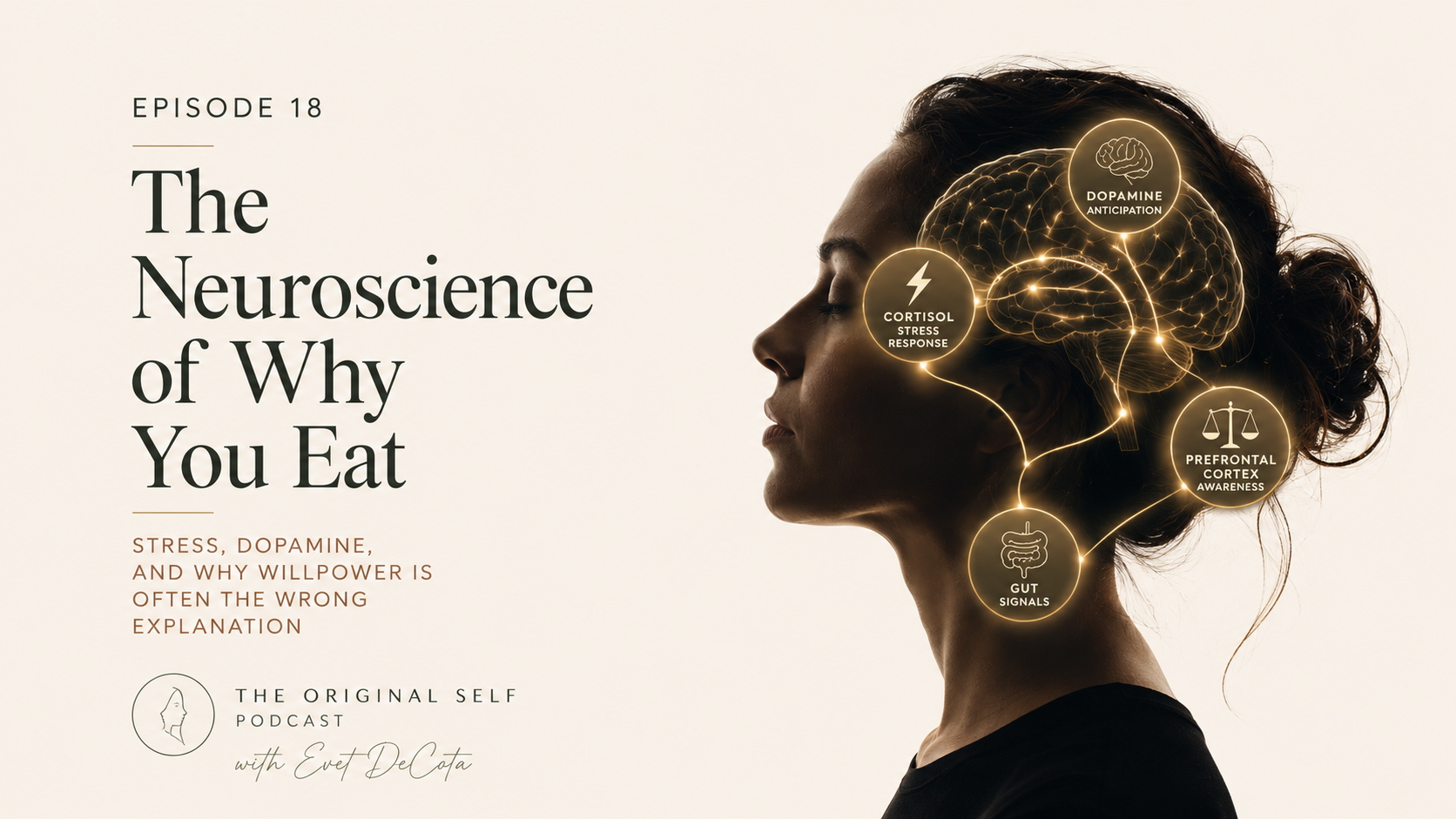
By now, you can probably see that a craving doesn’t come from just one place. Dopamine anticipates a reward, cortisol directs our appetite toward calorie-dense foods, and the gut sends its own signals about what it wants next.
The part of you that made a plan that morning isn’t the same system generating every craving later in the day. Yet from the inside, they can feel like the same voice. A craving emerges from a conversation between the brain, body, and the gut, and understanding that complexity changes the question entirely. Instead of asking, “What’s wrong with me?” we can begin asking, “What is my brain and body responding to right now?”
What strikes me about all of this is how quickly we turn a behavior into an identity. We don’t just say, “I eat when I’m stressed.” We say, “I’m the kind of person who has no self-control.” We take one moment of behavior and let it become a story about who we are. Science doesn’t erase that behavior, but it does change the story.
The Brakes, and What Happens to Them
So if all of these systems are influencing behavior, where does conscious choice enter the picture?
The prefrontal cortex is the part of the brain responsible for planning, weighing consequences, and putting the brakes on impulse. When it’s working well, it creates a pause between a craving and an action, giving us a chance to choose a different response.
The catch is that it’s also one of the first parts of the brain to struggle when we’re under pressure. Stress, poor sleep, and emotional exhaustion all make it less effective. At the same time, stress drives our brains toward calorie-dense foods. Those aren’t two separate problems. It’s a stress response that presses down on the accelerator while also weakening the brakes.
Under enough stress, the brain prioritizes immediate needs over long-term goals. The voice looking for relief gets louder, while the voice thinking about consequences gets quieter.
We actually understand this principle better than we realize. Think about your younger self. Most of us can look back at our teens and early twenties and immediately recognize decisions we wouldn’t make today. Some of us have lower back tattoos to remind us.
We accept that brain state influences behavior. Stress works similarly. The conditions change, and behavior changes with them.
The encouraging part is that the prefrontal cortex can be engaged deliberately, even if only for a moment. UCLA researcher Matthew Lieberman found that when people apply words to what they’re experiencing, the brain responds. Simply naming the feeling— “I’m having a craving right now”— quiets some of the brain’s more reactive systems while bringing the prefrontal cortex more fully online.
Imagine this: you’re sitting on the couch, watching TV, and as soon as the commercial comes on, you get up, walk into the kitchen, and open the refrigerator or pantry. You weren’t hungry a minute ago; you’re not even hungry now. Yet you are still standing in front of food.
Now imagine if you paused right before reaching for a pint of ice cream and said to yourself, “Interesting, I think I’m tired, bored, or stressed right now.” You may still grab the ice cream. You may not. The point is that for a brief moment, you saw the pattern instead of becoming the pattern.
The goal isn’t to win every craving battle; it’s to stop letting the same pathway win automatically. Every moment of awareness gives the brain another route to practice. Over time, that new route becomes easier to travel, while the old one slowly loses its grip. That’s the biology of habit change.
There was a version of you, before any of this became so complicated, who had a much simpler relationship with hunger and satisfaction. The same brain that learned those patterns can also learn different ones. It just needs different conditions and a little more understanding of what it’s actually responding to.
Closing
In the next episode, we’re going to move further back— before the stress patterns were established, before the neural pathways were carved, and before years of eating shaped the gut microbiome.
Episode 19 is: Born into It, and will examine what was already in place before you were old enough to make any choices about it. It’s about the epigenetics, the family food patterns, the inherited biology, and the psychological conditioning that arrived before you had any framework to question it.
If this episode answered the question of what the system does inside the brain, Episode 19 questions when it started.
Thank you for spending your time with me. If you’d like to learn more about working with me, you can find my contact information in the episode’s notes.
I’ll see you next time. Have a great day