The People We Carry
How Relationships Shape What We Notice
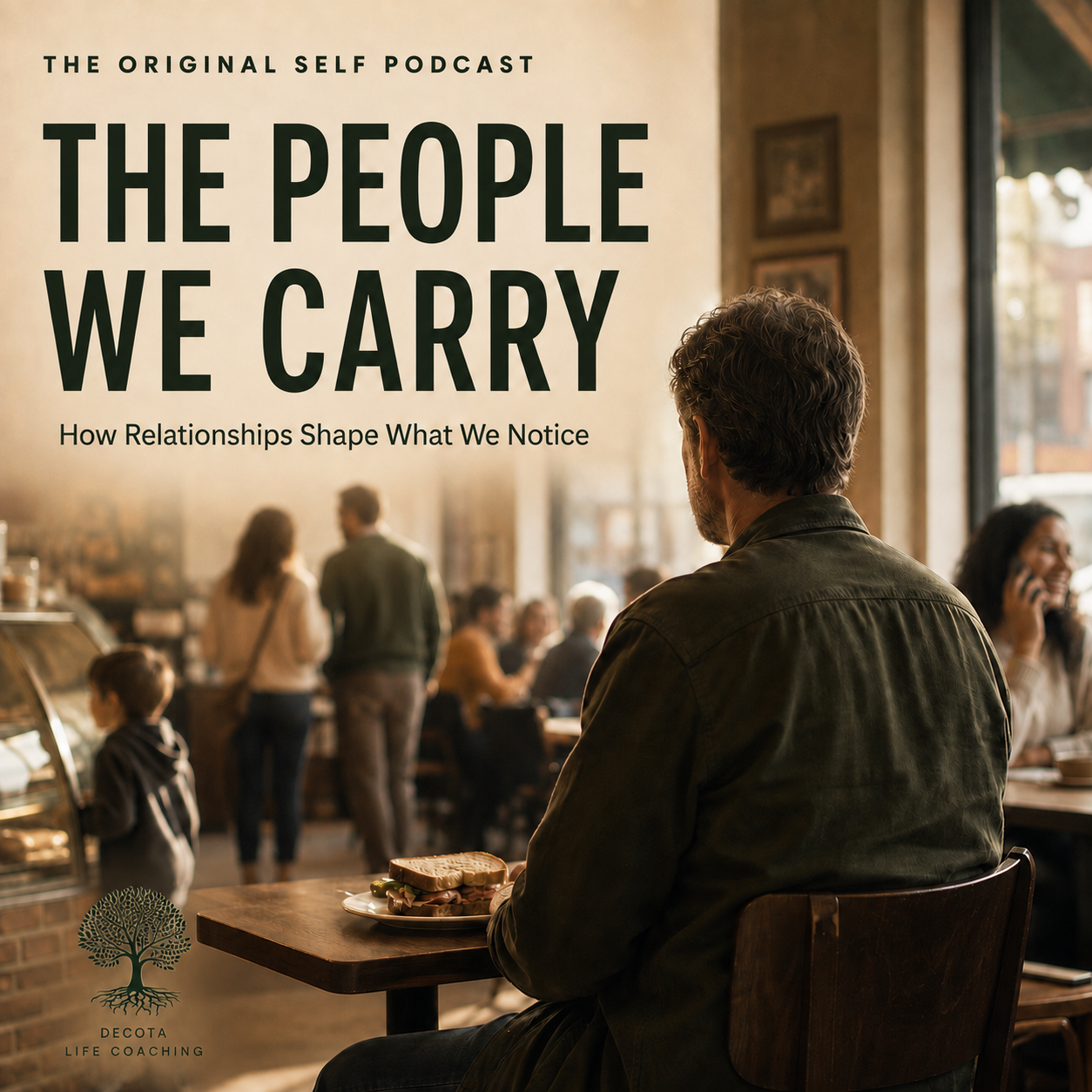
He told me he was alone at a small table in the back of the deli. A sandwich in front of him and no phone in his hand.
He takes a bite, chews slowly, and then sets the sandwich back down. Around him, the place is very full.
A couple’s quietly negotiating where to sit. A kid’s trying to convince someone that he needs a second cookie. And someone nearby is laughing way too loudly into their phone.
He’s not a part of any of it, but he’s paying attention to it all. He’s sitting there as if he has nowhere else to be. As if the sandwich, the noise, and the strangers are the whole afternoon.
And the whole afternoon is completely enough for him.
Hey everyone, it’s Evet.
After doing hair for decades and now working as a coach, I’ve learned that people
rarely leave us with only memories. Sometimes they leave us with a sentence that we might repeat to ourselves or sometimes they change what we actually pay attention to.
Sometimes their way of moving through the world becomes part of the way we move through ours. We carry people.
Their voices become part of our inner conversations, their questions interrupt our certainty, and their way of living shows us that there just might be another way to live.
Today, I want to explore how that happens through one person I’ve known and knew for many years. His name was Loren
And he taught me something about attention, time, and what it means to be fully inside your own life.
So I just want to start with two questions.
Who taught you how to notice your own life?
And what part of the way they lived has quietly become part of the way you live?
Evet's Substack is a reader-supported publication. To receive new posts and support my work, consider becoming a free or paid subscriber.
So the man in the deli was Loren. I cut his hair every six weeks for 16 years. And every time he came to the salon, he said the same thing to me.
“I can’t believe it’s already been six weeks.”
He wasn’t saying it to make conversation. He was genuinely surprised that time had escaped him.
I believe Loren was 6 ‘5”. He was gentle. Curious, funny, and one of the least hurried people I had ever known.
He wasn’t slow in the sense that he couldn’t get things done. He had gone to law school, built a career, raised a family. He had a full life.
He simply didn’t seem to stand outside his life with a stopwatch, or constantly judging whether the next thing should have already happened.
He was inside of his life. Nothing dramatic happening.
No stranger revealing the meaning of life over that pastrami sandwich. He just ate lunch. He watched the room. He enjoyed being there.
As he was telling me about this deli experience, I was picturing the deli, the sound, the people that were there. What stayed with me, though, was not the sandwich, which apparently he thoroughly enjoyed, but the fact that he had been present enough to even remember the sandwich and the experience.
This sounds so simple. But it raises a larger psychological question. Why do some people seem to inhabit an ordinary experience while the rest of us are already mentally halfway into the next one?
There are two psychologists, Matt Killingsworth and Daniel Gilbert. They studied that question by contacting people at random moments during their day and asking three things:
What were they doing?
What they were thinking about
How they felt in that moment.
They found 47 % of the time people’s minds were somewhere other than what they were doing.
Think about that. Nearly half of the sampled people sampled moments were being lived in one place and mentally occupied in another. They found that the mind wandered during pleasant, unpleasant, and neutral tasks.
And on average, people reported being less happy when their minds were wandering than when their attention was in with what they were doing.
That doesn’t mean that thinking about the past or planning the future is bad, right?
Those abilities are part of what makes us human. We completely need memory and imagination. Who wants to live without those two factors? I don’t.
But the problem begins when the mind is rarely where the body is.
For example, we’re having dinner, but rehearsing tomorrow’s conversation. We’re
on vacation, but planning how we’ll post about the vacation. Someone we care about is talking, but we’re composing our answer before they’ve finished.
I know this pattern very well. I can turn almost anything into a project. I can take a perfectly good day and begin organizing it or improving it and then evaluating it. I can be inside the experience, while still managing it from the control room in my head, basically.
Maybe you do it too.
Attention scans ahead, solves, anticipates, notices what’s missing. It keeps moving so we feel productive, even when there’s nowhere we need to go.
Loren seemed to have trained his attention differently. It wasn’t just the deli. It was how he interacted with most experiences in his life.
Loren’s attention training in positive psychology is called savoring.
It’s the capacity to attend to, appreciate, and regulate the positive feelings available in each experience.
It’s related to mindfulness, but they’re not identical.
Mindfulness asks us to notice what’s happening with openness and whether the experience is pleasant, unpleasant, or neutral.
Savoring focuses specifically on positive experience. It’s what we do when we allow something good to reach us. Without it, something good can happen without us ever fully receiving it.
Think about when someone compliments you. You immediately
explain why the compliment is not true. I do this often instead of just saying, “hey, thanks so much.”
Or we finish something difficult and instead of taking in the accomplishment that
we’ve done, we move the standard or bar, whatever, and begin criticizing how we could have done it better.
Even worse, what about when we’re laughing with someone that we’re super interested in and then that brain of yours that chatter, says, “this won’t last,” as if preparing for a loss will make it safer.
That’s the positive event happening while savoring is absent.
Positive psychologist Fred Bryant describes three ways we can relate
to positive experiences across time.
We can anticipate something good before it happens.
We can savor it while it’s happening.
We can reminisce after it’s over.
Loren seemed capable of all three.
Music was one way he did this. He seemed to know every song from every decade, but he especially loved The Grateful Dead. He loved that band so much that he and his best friends took the year off between college and law school to follow them around the world. I personally do not share this love of the band at all, yet he kept trying to convert me anyway.
Anyone who knows me knows I live for music and make it a daily part of my life. So our connection was strong on that front, just not what the Grateful did.
At one of our appointments, I was telling him about this harmony group that I was in and how when someone suggested we do a song by CSN, I didn’t know who that was. I had to look it up.
He was completely shocked that I didn’t know music by Crosby, Stills, and Nash. He started rattling off songs, and I knew maybe one of them. The look on his face was total bewilderment that I did not know this. And of course it totally made me laugh, right? He just couldn’t believe it.
The next day after our appointment, Loren showed up to my studio with a CD that he personally burned of the greatest hits from CSN. Because he felt life was too short for me not to know their great music.
That wasn’t the first time he made me a CD. And those small gestures encapsulate him. He would notice something that had pleased him, anticipate that it might please someone else, and then extend the experience by sharing it.
Loren was also a nature photographer. I mean, for real, no joking. His images were awesome in the true sense of the word. But what made his images even more powerful was that he paired the image with song lyrics when he would post it on social media.
The image didn’t need explanation. It was... I think he did it because it was a way that one beautiful experience reminded him of another. And he captured it. You’d read the lyrics and just know. Not only that’s what he felt, but it just made sense. It was as if he was gathering moments and then let them speak to each other.
Evet's Substack is a reader-supported publication. To receive new posts and support my work, consider becoming a free or paid subscriber.
His love for his family, it was limitless, even in the hardest of times. He didn’t
shy away from the vulnerability or difficulty ever.
Savoring is not about making life sentimental.
Loren could be completely opinionated. We both argued and championed the Golden State Warriors and whether Draymond Green’s antics that week were justified or not, right?
We discussed politics ad nauseum, and once we spent an entire hour-long
haircut discussing why we didn’t understand Taylor Swift’s music or her fame or the hysteria.
We just eventually succumbed to the fact that millions of teenage girls recognized something in her that didn’t belong to us. That’s how we rectified it and moved on.
We still didn’t like her music, but you know, growth has its limits.
The point is he could remain in a conversation long enough to become less certain of his opinion. He didn’t rush to win a point or prove that he was right. He seemed more interested in what might become visible if we just kept talking.
That’s another form of attention. Sometimes being present means noticing a sandwich or letting a question interrupt an easy answer.
During the pandemic, when the salons were closed and nobody knew when life would return to normal. I drove to Loren’s house and cut his hair in his carport. The haircut took, I don’t know, no longer than 20, 30 minutes. But it was funny because Loren found the lowest chair he could find because, you know, I couldn’t lower him down 12 inches. That’s, you know, necessary for me to reach the top of his head.
And he wanted to cut his hair in the garden, because it was so beautiful. But I don’t know, the ground was uneven, or there were stairs. I don’t remember. But I was still recovering from a hip replacement. So we stayed in the car park.
Afterward, we stayed for almost another hour just talking. And the practical purpose of the visit was over. But neither of us treated the remaining time as just disposable.
I think we sometimes think of savoring as it requires a meditation retreat, a sunset, or a perfectly quiet nervous system. It doesn’t.
It can happen in a carport with hair on the ground and the conversation that continues after its original purpose is finished. The experience doesn’t have to be extraordinary. We simply have to stop abandoning it before it’s over.
The other side of savoring is what I mentioned before: dampening a positive feeling.
Dampening is minimizing or disqualifying, basically mentally stepping away from something good. It can sound like modesty.
“It was no big deal”, or “Anybody could have done it.” “I just got lucky.”
Sometimes it could sound like protection. “Don’t get too excited. Something
will probably go wrong.” We’ve all said those things.
It can also look like constant movement.
If we leave quickly enough, we never have to feel how much it matters. I fully understand that impulse. Receiving joy completely can make us feel vulnerable because once we admit that something matters, we also admit that it can change or possibly end.
Staying slightly detached can feel like emotional insurance.
But refusing to enjoy something won’t prevent that loss, right?
It only means we experience a loss twice.
Once by not fully living in the moment, and then again, when the moment’s gone.
So we might as well take a chance, right?
The reframe of these thoughts and actions is not to slow down and appreciate every
second. That’s a completely impossible standard, and it creates judgment in many ways.
I think the reframe is much smaller.
Can I stay for one more beat? Can I let something good reach me before I explain it away? Or can I notice this ordinary moment is a part of my life and not an obstacle between me and my life?
I think that’s really important to recognize.
Loren died in his sleep two weeks after his birthday. He had seemingly been in good health, and there were no warning signs.
His wife called me herself to tell me.
She was speaking very quickly as though if she slowed down or paused for even a second, she wouldn’t be able to finish her sentence. I could barely speak from how shocked I was at the news, but I finally managed to tell her how sorry I was for her and the kids.
And then she said something that I so wasn’t prepared for.
She said, “I know you were his hairstylist, but he also considered you his friend. And I
think it’s so important for men to have female friends. Thank you for being his friend.”
That sentence broke me a few days later.
I was listening to another CD he had made me. It was the band Monsters of Folk and their song Ahead of the Curve.
I was listening to the chorus that said, I wrote this down,
I’m staying above the flat line.
I’m ahead of the curve.
Take a piece of the sunshine with me
On an all-night drive to another world.
It’s a perfect description of the wonderful human I knew and how I witnessed
he lived his life.
The psychology term savoring is often discussed as a way to deepen happiness.
But it also explains why certain ordinary details become so emotionally powerful after someone passes away.
Reminiscing is not simply replaying the past. It’s really allowing an experience
to produce meaning in the present. The handwritten label on a CD, it becomes more than just handwriting. His phrase, “I can’t believe it’s already been six weeks,” becomes more than a salon conversation.
And a story about a sandwich becomes evidence of how someone has lived their life.
For a while after he passed, I thought I saw Loren out of the corner of my eye, driving, walking down the street. And that sadness would overtake me again.
And it didn’t lift until after I went to the gathering of his celebration of life. I sat in
a room with about a hundred people, maybe a little less. I’m not sure. It was many, many people.
People who loved him. And I was lucky enough to hear about the man I had known every six weeks appear in story after story.
His warmth, his curiosity, humor, and generosity, all of which I experienced behind the chair, had reached everyone in that room in entirely different parts of his life.
His fellow deadheads got up and told funny stories of youthful debauchery on the road. Others shared song lyrics that captured his essence. His coworkers spoke about his generosity. One of his friends even threw Loren under the bus because he gifted him hundreds of cassettes from his music collection, none of which were labeled. It drew a lot of laughter in that room.
That day I realized I had thought of myself as the one providing the space in my salon. I was the hairstylist, listening to the stories, asking questions, right? Giving him a place to show up every six weeks.
What I didn’t understand until that day was that Loren was making space for me too. In that room, I realized he had done it for all of us.
He asked better questions than me and challenged my lazy opinions without humiliating me or anyone else. He brought music to me. He brought kindness. And appointment after appointment, he showed me that an ordinary life becomes way
more vivid when we’re willing to show up for it.
So even though I don’t have another six -week appointment with him, I do have his way of noticing.
Maybe that’s how people remain with us. Not only what we remember about them, but in what they taught us to see.
When I catch myself mentally halfway into tomorrow, I think of Loren sitting in the back of that deli, the sandwich in front of him and the noise of strangers around him. And I reflect on the lesson that he taught me, that an ordinary moment is not what we pass through while we’re waiting for life. It is our life.
That’s one of the ways we carry people.
I’m Evet DeCota. If this story resonated with you and
you’d like to reach out to me, you’ll find all my information in the episode’s notes.
Thank you for listening. Have a great day.