“Don’t I Look Cute?”
What Validation-Seeking Does to Relationships
00:00:00 Speaker 1:
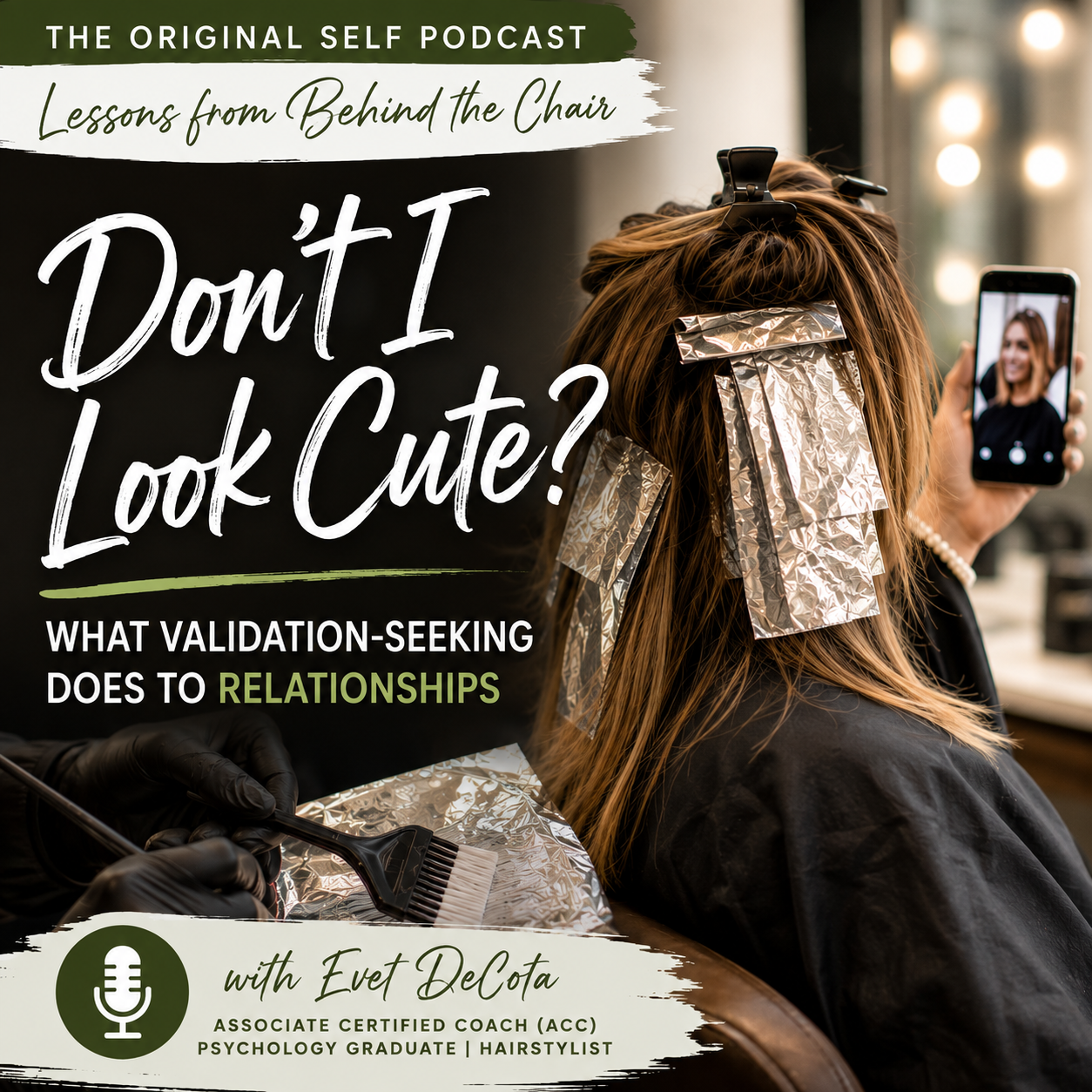
I have a foil in one hand and a bleach brush in the other, and she’s turning her head towards her phone. Don’t I look cute? I glance at the picture on her phone.
Meanwhile, the foil is still open. The bleach is sitting right next to the part of the hair that I don’t want it on, and I need to close up this foil before disaster strikes, and it forms a tiger spot.
So I do what I always do: a quick glance, and say “adorable.”
I go back to painting and closing up the foil, but she’s not done.
Another photo. A different angle. “Oh wait, look at this one.” I glance again. Two more seconds lost that I don’t have.
By photo number four through infinity. I truly start to like, think about my compensation if I were America’s Next Top Model judge.
Then I realized, no, that’s not on anymore. I wonder if Instagram would pay me.
All photos after the fourth one elicit responses such as “Gorgeous!” “Wow!” Always directed towards the vicinity of her phone because I’m not taking my eyes off of what I’m doing any longer.
She never notices that I stopped looking.
00:01:23 Speaker 2: Music - The Original Self podcast.
00:01:27 Speaker 1:
Hey, it’s Evet DeCota.
I’ve been standing behind a stylist chair for almost forty years now.
One of the very first rules a stylist learns in this business is that the appointment isn’t about you. It’s always about the client, their day, their story, their hair.
Of course, that’s the job. And honestly, it’s one of the things I love most about it because I’ve learned lots of things from people.
They tell me information, and I learn about their life. I love the whole thing when someone sits in my chair. I truly try to give them my full attention. But every once in a while I’ll have a client break social rules.
She might ask me about my weekend or what I’ve been up to, and the second I start to answer her, her attention is already somewhere else. Her phone, her reflection, her watch, whatever.
It’s like it wasn’t that she wanted my attention. It was that she wanted to be seen as giving me hers. Once I noticed this years ago, I couldn’t stop seeing it. It’s not just in the salon. I see it in a lot of places.
During every single appointment, before I even have the cape around her neck, this client will say the same thing to me. “Will you make me pretty today?” Every time. Like it’s brand new. Like I didn’t make her pretty the last thirty times I did her hair.
She is pretty, by the way.
I honestly don’t know whether she’s actually needing reassurance or whether she’s asking because it’s just part of our ritual. That is very possible.
Kind of like, “How are you?” “Fine.” Right?
When she says, “Will you make me look pretty today?” I usually retort with something sarcastic, but, you know, with a smile.
“No, I only do that on Tuesdays.”
She’ll laugh like it’s the first time she’s ever heard it. But that’s our relationship. And honestly, at this point, I think it’s as much my ritual as it is hers.
What most people who are not hairstylists, what they don’t realize is that a lot is going on in the salon that we have to pay attention to, as well as block out, in order to be as present as possible to the client in our chairs.
There is constant noise from nearby conversations. Uh, the high-pitched whine of a full-blast blow dryer while the stylist screams over it to, you know, have the client hear her.
And then meanwhile, people are speaking on, they have their phones on speakerphone. Someone else might be watching a YouTube video without earbuds, and then another client across the salon may be scrolling reels at full volume.
And over all of it, the salon playlist is pumping electronic music that somehow gets more irritating the longer the day goes on.
At the same time, you’re formulating color, carrying on a conversation, and cutting the most precise line of a haircut as if your life depended on it. It does.
And every few seconds, repositioning a client’s head because she keeps turning toward the mirror or her phone, or to look at you.
I know it sounds like I have a lot of grievances. I do.
But I wouldn’t trade it for anything; I swear I would not. It’s just that that’s a fraction of what’s going on in our heads while a client wants me to look at her phone mid-foil.
Eventually, the pictures stopped. At least I think they have. I’ve moved on to the next foil. I’m in my rhythm when I will hear one more time. “Wait, don’t I look cute in this one?” I look. “You look great.” And just when I think that now it’s finally done, she’ll say to me, “You’re such a great stylist.”
At first I used to think that she was complimenting me. Maybe she was. But then I started wondering if the compliment was really just the last sentence in a conversation that had been about her the whole time.
Was she really even asking about the pictures at all?
Psychology calls that external validation seeking. She’s proving that by all the photos, the different angles, and then repeating “Don’t I look cute?” It’s not really a question. All of that. The photos, everything.
They are bids for reassurance.
She’s not asking because she doesn’t know the answer. I think she’s asking because the reassurance fades almost as quickly as she receives it.
Psychologists call this self-objectification. And sometimes I wonder if part of her isn’t really sitting in the chair at all. Like maybe she stepped outside of the moment instead of simply enjoying getting her hair done. She’s actually watching herself have the experience.
That makes me a little sad, because I wonder how often she actually gets to enjoy feeling beautiful before she starts questioning it again.
Here’s the question I still don’t know the answer to.
Can reassurance become a substitute for self-trust? You guys answer that. Help me.
So another scenario that happens is she’ll ask, how’s your family doing? And because I think she’s actually interested, maybe I’ll start to tell her what’s going on with my nephew or something like that.
I’m maybe one sentence in, and I notice her eyes drift. Then comes the phone. Then she unlocks it, holds it up above her head for me to see, and asks, “How much more time should I add to the meter?”
Every time, decades of appointments, and every single time she does it after asking the question. And every time I stop talking.
Not because she asked me to, but because somehow the phone makes me feel like I’m interrupting. Isn’t that weird?
She asked the question, and somehow I end up feeling like the interruption.
That’s where my mind goes, I think. “Why’d you ask?” And then immediately, I’m making it about me.
Maybe she doesn’t really care.
Maybe I’m boring. Oh my God.
My brain can quickly fill in the blanks. I don’t even realize it. I interpreted her behavior through my own lens.
Researchers have a word for that. It’s called phubbing, which is phone and snubbing, using your phone in a way that makes the person you’re with feel less important than the screen.
But now, stepping away from that situation, I start to think about what shapes a real conversation.
Healthy conversations have a rhythm.
I ask, you answer.
I listen and stay with your answer.
And then it’s my turn. That’s conversational reciprocity, right?
It’s basically the backbone of every relationship we have.
Okay, maybe not with our pets. Unless you’re me and you answer for the dog in a voice I only reserve for animals. Did you like that? I know you did. That’s right. Tell me more.
Crazy.
The more I think about it, the more I realize that it’s not about phones, but about how uncomfortable most of us are with direct conversations.
The other day I was with a friend, and she told me that when she was in her early twenties, she worked as a hostess and later on as a server. She said that whenever a conflict arose- maybe a customer complained, a coworker upset her, anything, any scenario where she had to confront someone- she wouldn’t deal with it.
She would just leave. Like walk out, never come back. She never officially quit. She just disappeared.
We laughed about it, you know, at first, like she was laughing as she was telling me. But then I found myself later on that night being fascinated by that behavior. And then when I think about this story, I realize that some people would rather hold up a parking meter, pay app, than say, “Can we move a little faster today?”
But then there’s my other clients, the ones who sit down in the chair and say, do whatever you think. “Do the same thing you did last time; I loved it.”
They don’t spend their appointment wondering how they look or how they will eventually look. They spend their appointments telling me about their lives, what they’ve learned, what they’ve experienced. They tell me about their trips. A great book that they’re reading, or some documentary that they watch that they just know I’ll love.
Many times they ask how my family is and stay for the answer. They’re fully there. They’re fully present. And it’s not like they think they’re perfect or that they never need reassurance. Of course they do. We all do. They’re just not spending the majority of their appointment monitoring themselves.
The clients that are most comfortable in themselves rarely ask me, “Do I look okay?”
And as I said before, even though we’re taught from the very beginning that the appointment isn’t about us, hairstylists are still human. Most of us are.
There are unspoken rules that help conversations feel balanced, and relationships feel mutual. When those rules are broken, even in a small way. It can leave us feeling a little thrown. And I believe that’s usually why my reaction is like that.
Looking back, though, I don’t think she was ever asking me whether she looked cute for real. I think she was asking a much older question. “Am I okay?”
For a long time, that question exhausted me. It felt like being asked to hand over reassurance. I didn’t have an endless supply of it, but the more years that go by of me being a hairstylist, the more I start to think about what’s actually underneath all of this.
And I thought, a lot of people don’t get real one-on-one attention any longer. Not the sustained kind. Like someone fully facing you, not checking their screen, not halfway somewhere else.
There are a lot of places that you used to run into familiar faces: the gym, the coffee shop, especially the office. They have fewer people showing up consistently now. People are alone more, and even when they do connect, it can feel rushed or transactional.
So for many, sitting in my chair may be one of the only places left in their week where someone is entirely there with them; they’re present for them.
My quick judgment about this client at the time was probably, you know, she’s self-absorbed, but it may be that she’s just starved for connection. And my judgy little self has to think about that.
There may be even a part of her that doesn’t quite trust that anyone would look at her for free. So she has to keep asking for proof. When I consider that possibility, that judgment turns to tenderness; it turns to understanding, because I don’t know exactly where reassurance ends and Self-trust begins.
I’m not sure anyone does, but I know this much.
She leaves my chair every time, still asking the question, and I keep answering it. That’s my job. I’m not there to solve it. I’m just one person willing to say yes again and again for as long as it takes.
If this episode brought someone to mind for you, or maybe even brought something up in yourself, I hope you’ll stay curious about it.
If you’d like to continue the conversation, you’ll find all of my contact information in this episode’s notes.
I’m Evet DeCota. Thank you for listening, and I’ll talk with you next time.
00:16:14 Speaker 2: Music- The Original Self podcast.