Who You Were Before The World Told You Who To Be
The Original Self Podcast
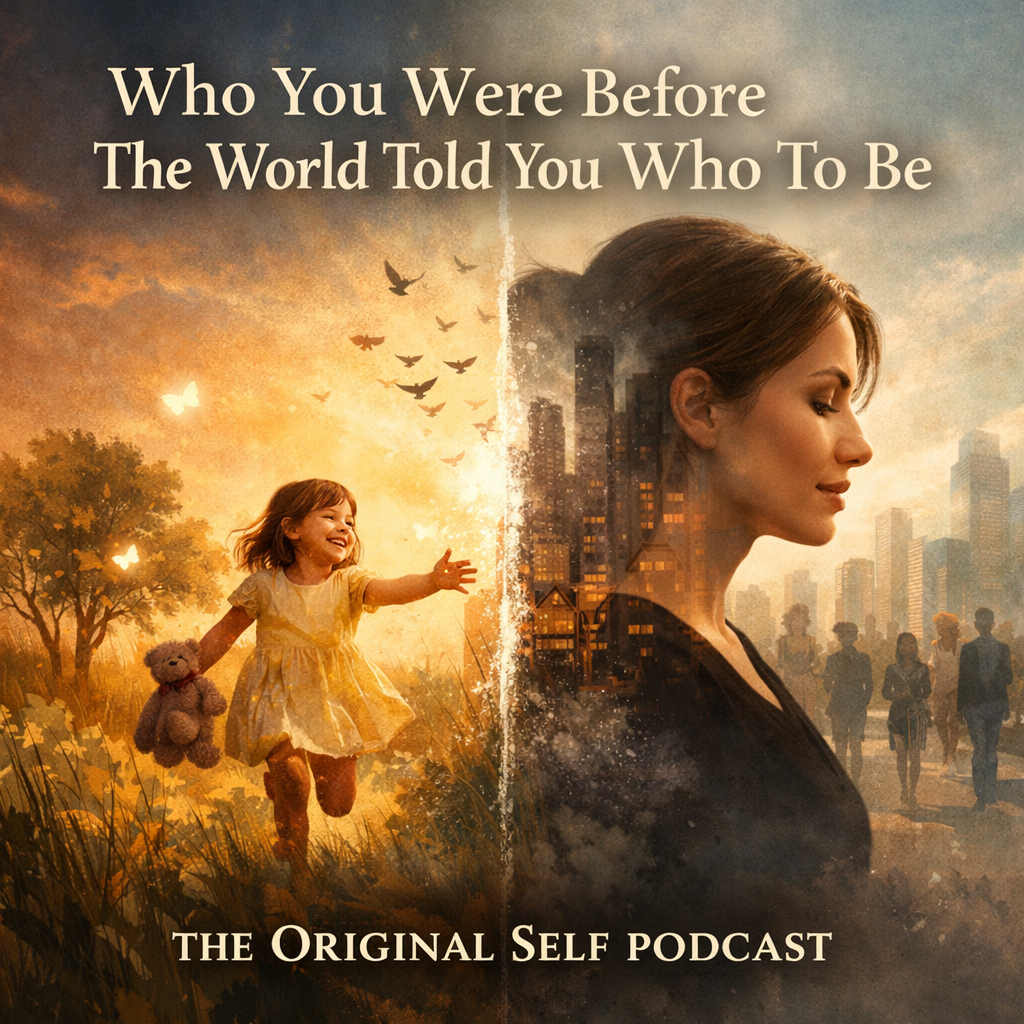
Welcome to The Original Self podcast. I’m Evet DeCota, owner of DeCota Life Coaching, and a psychology-informed life coach exploring resilience, mindset, and the courage to become your authentic self. It’s a space for honest conversations about growth, transition, identity, relationships, and all the messy, meaningful stuff in between that creates the small shifts that help move us forward. Whatever brought you here today, you’re in the right place
Today, we are talking about how, for many years, standing behind a salon chair and coaching individuals, I’ve noticed people rarely come in for just a hair service or one single topic. They come to me carrying doubts, fears, dreams, and questions about who they are becoming.
Over time, I’ve realized that beneath all the noise of expectations, criticism, and life’s pressures, there is a version of ourselves that still exists. Let’s explore Who You Were Before the World Told You Who to Be.
Earlier today, I was thinking about something people have said to me for most of my life: that I am a chameleon, someone who can adapt my behavior to other people’s personalities very quickly.
When I was younger, I used to think that was a talent that served me well as a hairstylist. Possessing pieces of many different traits allowed me to connect with a wide range of people and to appreciate the differences in personalities, cultures, perspectives, and the unspoken rules that shape how people move through the world, and it certainly can be.
But about 10 years ago, I noticed something that gave me pause. I realized that the benefits of adaptation did not always outweigh the masking of who I am authentically and what I might be losing in the process. The easier it was for me to shift to meet other people’s expectations, the less certain I felt about who I was underneath all of it. At different moments throughout the day, a quiet voice would interrupt my thoughts with questions I hadn’t seriously asked myself before: “Who are you?” “What actually matters to you?” and “Where are you in this narrative?” and over time, I realized that this experience wasn’t unique to me. And in many ways, it reflects something psychologists have been describing for decades
The psychologist Donald Winnicott had an idea of what he called the True Self, something I think of as the Original Self. Beneath the masks we wear, and the roles we play, remains a version of you that was never lost, only quieted. That is your original self, the part of you that existed before fear, before criticism, and before you learned to shrink yourself to fit into the expectations and boxes that people, culture, and society place around us.
For instance, even an infant will begin to change their behavior the moment a parent responds to them, positively or negatively. From the beginning, we are learning what’s expected of us. It’s not just taught by our parents, but by everyone we encounter and nearly every circumstance we move through. With each verbal, physical, or visual correction we absorb, a small piece of our Original Self quietly steps back. I think of it as a folder that’s moved to the back of the filing cabinet, a little further from reach each time.
So, what fills that filing cabinet? What are the forces doing the filing?
There are three that do the most work, and they often operate together so seamlessly that most of us never notice them as separate things. They are family, culture, and fear. And what makes them so powerful is that all three tend to do their deepest work on us before we are old enough to question them.
Let’s dissect how family affects us. Family is the first world a child ever knows. Before you have any frame of reference for who you are, your family is already communicating, through words, silences, reactions, and expectations, who you are supposed to become. Most families do not do this out of cruelty. They do it out of love, out of habit, and out of the unexamined beliefs they themselves inherited and never thought to question.
I have observed this across cultures and across generations in my work. The messages vary in their specifics but tend to rhyme with one another in their effect. For many women, the message arrived early and without discussion: you marry, you have children, you build your life around the people you love, and that is enough. Going further — going to college, building something of your own, wanting more than what was modeled for you — was either not encouraged or quietly discouraged, not because anyone wished them harm, but because that was the shape of the world they had been handed, and they were simply passing it along.
Religion adds another layer to this, and I want to be careful here because faith is a genuinely meaningful source of strength and purpose for many people. But there is a difference between a faith you have examined and chosen and a set of beliefs that were handed to you as a very small child, absorbed before you had the capacity to evaluate them. Many people spend years carrying a version of their religious upbringing that feels more like judgment than grace, more like a set of rules about who is acceptable and who is not, before they finally pause long enough to ask whether what they were taught actually reflects what they believe. That examination is not a betrayal of where they came from. It is part of the process of becoming who they actually are.
What all of these family messages share is that they arrive when we are too young to weigh them. A child cannot say, I appreciate your perspective, but I would like to form my own. They simply take it in. And what gets taken in early enough becomes the wallpaper of the self — so constant, so familiar, that most people never think to ask whether they chose it or whether it was chosen for them.
The second part that forms identity is culture. Culture operates the same way, only on a larger scale. If family is the first world, culture is the second one, and it moves in almost simultaneously. Culture tells us what is beautiful, what is valuable, what ambitions are reasonable for a person like us, and which ones are considered overreaching. It tells us, with remarkable consistency and very little apology, how much space we are allowed to take up.
For young people, the need to fit in is not vanity. It is closer to survival. At a certain age, belonging feels like a biological necessity, and the self gets shaped around that need in ways that are genuinely difficult to undo later. You learn which parts of yourself are welcome in the rooms you want to be in, and which parts make people uncomfortable. You learn to lead with the version of yourself that is acceptable and keep everything else somewhere quieter. And if you do this long enough, you can lose track of which version is actually you.
Youth is particularly vulnerable to this because the brain is still developing the capacity for the kind of self-reflection that would allow a young person to say, I am changing myself to belong here, and I want to notice that. Most young people do not have that yet. They are simply adapting, the way humans have always adapted, and the original self is filed a little further back with each adaptation.
Finally, there is fear, which I think is the most honest of the three, because at least fear does not pretend to be acting in your best interest, the way family and culture sometimes do. Fear is direct. It says: do not go there. Do not try that. Do not love that person or want that thing or step out of what is familiar, because something bad might happen if you do.
For me, fear arrived in some of its most formative shapes through loss. Losing people I loved deeply did something to the way I moved through the world that I did not fully understand until much later. Grief has a way of quietly tightening the radius of what feels safe. You become more careful. More protective. And sometimes, without realizing it, you start to make yourself smaller in ways that feel like wisdom but are actually just fear wearing a more acceptable coat.
Fear also arrives through the body, through hormones and aging, and the ways our physical experience shifts beneath us in ways we did not ask for and cannot fully control. The body is one of the places the original self lives most honestly, and when the body changes in ways that feel like loss, many of us respond by pulling back rather than leaning in. We quiet parts of ourselves that once felt natural, because they no longer seem to fit the version of ourselves, we think we are supposed to be at this stage of life.
I want to say something about that directly, because it is something I have lived. I have quieted the feminine part of myself over the years in ways I am only now beginning to examine honestly. Not because anyone told me to, at least not in so many words. But because somewhere along the way I absorbed the message that softness was vulnerability, that expressly feminine ways of moving through the world were less serious, less credible, less safe. And so I filed that part away too, the way we often do with parts of ourselves that we’ve been told, either directly or indirectly, don’t belong.
The original self does not disappear under the weight of family, culture, and fear. It waits. It gets quieter, and sometimes it gets very quiet, but it does not leave. And one of the things I have come to believe most deeply, both from my own life and from the work I do with others, is that the hunger to return to it never fully disappears either. It shows up as restlessness, as a feeling that something is missing even when everything looks fine, as a quiet voice asking questions you have been too busy or too afraid to answer.
That voice is not a problem to be solved. It is an invitation.
And one of the clearest ways to understand what I mean by the original self is to look at a young child.
If you watch a very young child, before the corrections have fully accumulated, you are watching someone who is almost entirely their original self. They want what they want without apology, feel what they feel without editing it first, and have not yet learned which parts of themselves need to be managed. And then, slowly, the shaping begins.
Now, I want to be clear, I’m not suggesting we skip the shaping entirely. I’m not trying to promote Jodi Foster as Nell because we know exactly how that turned out. Raise yourself in the woods with no outside influence whatsoever, and you end up saying “tay in da win” in your own language that works beautifully in the forest and absolutely nowhere else. Some correction is necessary, but the goal is not to become feral. It’s simply to notice how much of what shaped us was genuinely useful growth and how much of it was someone else’s fear or expectation wearing the costume of wisdom.
What I find so striking is that if you watch someone who is very old — someone who has truly lived long enough to make peace with most of it — you often see something remarkably similar. The same unguarded quality. The same willingness to say exactly what they think. The same absence of performance. I believe the elderly, at their best, have done something that takes an entire lifetime to accomplish. They have worn out their need for approval, outlasted most of their fears, and in that clarity, the original self has room to resurface.
I also think — and I hold this more as a feeling than a certainty — that something else may be drawing the very old back toward who they truly are. When we are close to the end of a life, things loosen. What felt urgent for so long begins to matter less. I wonder sometimes whether that loosening is the self preparing to return to something it always was, beneath everything it learned to be. I do not think it is a coincidence that the two groups most in touch with the original self are the ones closest to the beginning and the ones closest to the end. What the rest of us are doing, in the middle of our lives, is trying to find our way back without waiting that long.
And that is where so many of us find ourselves as adults, sensing that something essential is still there, even if we have not quite figured out how to return to it. Everything you have been through — the corrections, the expectations, the fear, the loss, the years of adapting yourself to fit into spaces that were not always built for who you actually are — none of it was wasted. All of it taught you something.
One of the most important things it taught you, even if it has taken a long time to see it clearly, is that the version of you that exists underneath all of that shaping is not only still there, but is the most capable, the most honest, and the most resilient version of you there has ever been. You did not survive all of that by accident. You survived it by being exactly who you are, even when you did not fully know it yet.
The original self was never the problem. It was never too much, or too soft, or too ambitious, or too different. It was simply waiting for you to stop apologizing for it and start accepting it instead.
And accepting it does not mean returning to who you were before the world got involved. It means taking everything the world has taught you and bringing it home to the truest version of yourself–the one that was there at the very beginning, the one that will still be there at the end.
So the question may not be who you need to become, but what parts of yourself may be ready to rediscover. And that, my friends, might be the quiet work in front of you.
Thank you for listening to The Original Self Podcast. If these reflections resonate with you and you’d like to explore your own growth, you can learn more about my coaching at decotalifecoaching.com.