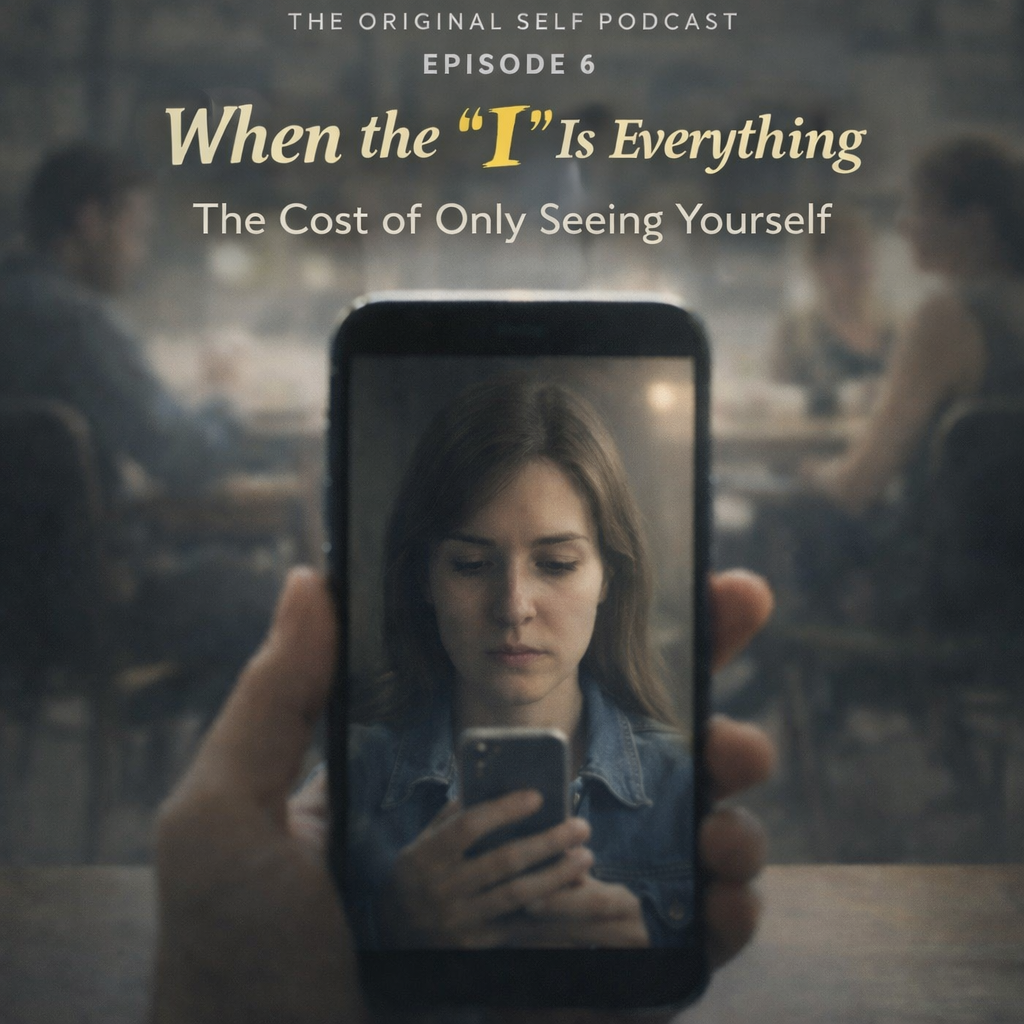
When the “I” Is Everything: The Cost of Only Seeing Yourself
We live in an era where everyone has a platform, an opinion, and a filter — and somewhere in the middle of it all, we stopped seeing each other. In this episode, Evet explores what happens when the "I" becomes everything: how hyper-individualism is quietly reshaping our capacity for connection, patience, and basic human decency across every generation. From loneliness and polarization to empathy erosion and othering, this episode names what so many are feeling but struggling to articulate, and then asks what we are willing to do about it.
A friend mentioned she’d seen a music show about an hour away. What stayed with her wasn’t the performance but how friendly everyone was, staff and patrons alike. That struck me as unusual, but shouldn’t it be the norm?
The more I sat with it, the more I noticed: over the past five to ten years, patience, tolerance, and presence have, somewhere along the way, become the exception, not the rule. But why? Is it the “I” phone? Social media? A lack of in-person socializing? Is it othering, hyper-individualism, or empathy erosion? Maybe it’s all of the above, and if it is, what is it costing us?
There’s a reason this shift didn’t happen gradually over generations; it happened very fast. The iPhone launched in 2007, and people changed somewhere in the years that followed.
We stopped noticing what was around us and became little versions of Spielberg, documenting everything instead. Selfies, photos of food, filtered versions of real life, and then, everyone felt they needed to post their opinions about everything. Stated with the confidence of a New York Times editor, whether the facts backed them up or not.
Today, with each opinion liked or hearted, the “I” obsession grows, and so does disconnection. It sounds counterintuitive: more connection, more disconnection. But the more praise we receive through algorithms, the more real connections fade.
The psychological term for what happens when a culture tips so far toward the self is hyper-individualism, and it isn’t just a theory. In their book The Narcissism Epidemic, psychologists Jean Twenge and W. Keith Campbell identify online attention seeking as one of the key drivers of rising narcissism in American culture, and it’s not hard to see why.
Research points to three specific costs: loneliness, polarization, and a slow erosion of empathy. Not because people become bad, but because the lens narrows. When we filter everything through “I” – my experience, my opinion, my image – there’s simply less room for anyone else.
You can see all three playing out across the last three generations, just in different ways.
Gen Z is the first generation to grow up entirely inside the “I” era, and connection, in every form, has paid the price. They date less and are significantly less sexually active than the previous generation was at their age. They are slower to get their driver’s license, less likely to spend time together in person, and more likely to consider gaming or scrolling through social media as hanging out.
AI enters the room. Teachers and professors across the country are frustrated and failing students who submit papers written entirely by artificial intelligence. Often, nothing is their own voice or reflects their own thinking. But the deeper loss is the disappearance of something that used to happen naturally: sitting with a question long enough to form an opinion, debating ideas with friends, being curious out loud, writing something, and discovering what you actually think in the process of writing it. AI doesn’t just do the work for them; it removes the struggle that builds a mind. It is the ultimate “I’ tool. Instant, frictionless, and entirely without the discomfort of genuine thought or human exchange
Millennials came of age in the era of participation trophies and unconditional praise, also known as the self-esteem movement. They were raised to believe that showing up was enough, but research by leading self-esteem social psychologist Roy Baumeister shows that this didn’t build confidence so much as it built fragility that follows them into adulthood. Combined with the rise of the “I” era during their formative years, hyper-individualism took on a particular shape in this generation: my feelings, my boundaries, my truth became the primary framework for navigating the world, sometimes at the expense of discomfort that real growth and real relationships require. Many are still living at home, working remotely, their most social interaction a Slack message. There’s comfort in the arrangement, and without the friction of real workplace dynamics or in-person relationships, they may have less urgency to develop the resilience that comes from navigating them. It’s not laziness, it’s what happens when an entire generation was never quite asked to be uncomfortable, and then handed a phone that confirmed their worldview with every scroll.
Gen X, my own generation, stays home, streams, and, if we’re being honest, doesn’t put much effort into maintaining friendships the way we once did. I feel like the pandemic pushed us toward aloneness quickly, and we settled into it like a warm bath. Soothing for a bit, but stay in too long, and the pruning bleeds into the oncoming wrinkles of old age.
Gen X’s version of hyper-individualism looks different from the generations that followed us. It doesn’t look like fragility; it looks like detachment. We are the ‘suck it up, buttercup’ generation. We don’t particularly care what people think; we handle our business, and we have very little patience for what we perceive as coddling. I watched it up close when I went back to school and was significantly older than my classmates. I worked full-time while carrying a full course load. I was accountable to myself because that’s what I knew how to be. Sitting next to students who couldn’t turn in assignments on time, who were overwhelmed to the point of not being able to attend class, was jarring. There was even a woman in my class who told me and then the professor that she was going to be late turning in her midterm essay because she had a date and had to get her nails done. The gap between us felt enormous.
Here’s the thing about judgment, and I say this from a lot of experience: it is its own form of the “I.” When we decide that our way of handling hardship is the right way, that our threshold for discomfort is the standard everyone else should meet, we stop being able to see people across that divide. We separate and separation, whatever generation it comes from, leads to the same place; less connection, less empathy, more alone.
Three generations with three different expressions of the same withdrawal
Yet by every measure, we are more connected than any generation in human history. That’s the paradox. The more we curate and perform our lives for an audience, the less we actually let anyone in. In 2023, former Surgeon General Vivek Murthy described loneliness as an epidemic on par with tobacco use and obesity- not a personal failing or a phase, but a public health crisis serious enough that the World Health Organization created an entire commission to address it. Loneliness, in his diagnosis, doesn’t just make us sad, but underpins violence, addiction, and extremism. Murthy states that human connection is the antidote, and that is the very thing the “I” generations have replaced with a screen.
Loneliness doesn’t stay private for long. When people stop truly connecting, they start dividing, and nowhere is that more visible right now than in our politics.
Us and them is where we are. I live in one of the most liberal parts of the country, and I won’t pretend I’m above it; my blood runs blue. I watch what is happening to this country under this administration, and I feel the heat of it. I have many friends, clients, and coworkers who won’t give the time of day to people who voted red, nor are they able to have a productive debate about their thoughts and opinions; they won’t even sit long enough with an opposing point to actually consider it. Where I live, supporting MAGA isn’t just a political difference of opinions in its purest form; it’s a moral failing, a conscious stripping of civil rights. And on the other side of the country, people feel the same way about us. That’s what is known as polarization. Two groups, both certain they’re right, both increasingly unable to see the humanity in the other. The “I” doesn’t just isolate us from individuals; it isolates us from entire groups of people who don’t reflect our tribal worldview to us.
A lot of this is by design because we are no longer consuming the same reality. The digital algorithm doesn’t show you the world; it shows you a mirror. It feeds you more of what you already believe until your feed becomes a closed loop, and everyone outside of it starts to look like the enemy. Fox News and One America News Network versus CNN and MS NOW viewers aren’t just disagreeing; they’re living in entirely different versions of what’s true. Those living in small towns versus living in cities might as well be living in different countries at this point, not just in politics but in daily reality, in access, in values, and in what they’re afraid might be the real truth.
Class is another big, yet rarely spoken about, polarizing divide that is fueling hyper-individualism. It is crushingly expensive to exist here because there are the ultra-wealthy and lower-income residents receiving tax or government program assistance, and then there’s the middle class, quietly failing, hanging on by their nails, too much to qualify for help and not enough to actually breathe. I am always very close to that edge, and I can tell you it creates its own kind of isolation. The unhoused crisis here is overwhelming and heartbreaking, and even that has become a polarizing issue; compassion on one side, frustration on the other, and very little willingness to sit in the complexity of both being true at the same time.
This is what hyper-individualism produces at scale. When my experience is the only lens, my truth becomes the only truth. When my truth is the only truth, there is no shared ground left. Not politically, economically, nor humanly. We stop asking what someone else is living through and start deciding what they deserve.
The culmination of loneliness and polarization leads to a spectrum of empathy erosion. We stop imagining how someone feels, and we stop caring about what’s happening to others. Psychologically, it grows out of living in the “I” reality, layered with stress, fear, and the dehumanization of others, so we can emotionally detach and ignore them, whether temporarily or over long stretches of time.
A comedian friend of mine posts funny stories and observations on social media. In many of her posts, she performs this exaggerated outrage at human behavior, but it’s clearly sarcastic and playful. Hundreds of people get the joke and love her content. But there’s always a small, stinging group that shows up with personal attacks that are shocking, ugly, and brutal.
She’s a beautiful woman, and yet people attack her appearance and, most relentlessly, the fact that she’s a female. It appalls me that people don’t pause to consider how those comments would feel if someone directed them back at the hate slingers, or at their own children and loved ones. Somehow, sitting alone behind a laptop permits us to say things we would never say face-to-face, to people we don’t know and will likely never meet, who will probably never affect our lives at all.
When did the person on the other side of the screen stop being a person?
The scholar, john a. powell, a Professor of Law at UC Berkeley and the Director of the Othering & Belonging Institute, has built his life’s work around a similar question. He asks: What happens when we stop seeing people as fully human? When interviewed on For the Wild Podcast, powell defined “othering” as any practice that denies someone their full humanity and dignity. That very denial is rooted in the belief that certain people are beneath us or simply irrelevant. Powell stated before this current administration that, at its extreme, it casts the other as a threat, warning that violence often follows. Hear that again, and tell me that doesn’t feel like a current headline.
The discussion and treatment of immigrants in this country is not a policy debate; it is othering in its most institutionalized form. When we accept othering as a justification for violence, belonging becomes conditional, and no one is truly safe.
In his 2024 book Belonging Without Othering, powell argues that we can build community without requiring an enemy to define ourselves against. We can belong without pushing someone else out. It sounds so simple, yet it is anything but.
Empathy erosion doesn’t stop at rudeness or political division. Follow it far enough, and you arrive at addiction and mental illness left unaddressed, and at children being trafficked and abused; the most vulnerable among us are rendered invisible by a society that has turned so far inward it can no longer see them.
That is the full cost of a myopic view, so the question becomes, is there another way?
Thinking back to my friend’s experience at the music show makes me realize that we have to try a little harder.
It starts with something as simple as being present. What would it be like to actually put the phone down at dinner, to look around at the people seated with us, or to notice what we are eating and recognize the work that went into making it? Presence is not a grand gesture; it’s a decision made in small moments, over and over again.
And when we’re present, we start to notice what we’ve been missing. Ask yourself, what gets lost when we’re half present? Maybe it’s your life when you use a crosswalk, staring down at your phone the entire time as traffic whirls nearby. Or maybe it’s something quieter, the unhoused person sitting on the same corner you pass every week. What would be the harm in smiling, saying hello, or even stopping to ask how they’re doing? Extending our circle of concern doesn’t require a grand gesture; it only requires looking up and seeing what’s in front of you.
Looking up also means being willing to see people we’d rather avoid. What if we actually sought out the discomfort, such as I don’t know, spending time with the other team? Open, honest conversations with people who see the world differently than we do. I know many people would say that’s not an issue for them, yet when it comes to political differences, I have a gut feeling the percentage who wouldn’t do it is significantly high, but can you imagine seeking it out rather than avoiding it? I will say this: I do it almost every time I work in the salon with MAGA-aligned clients. It may be uncomfortable, but it’s also the only way I know how to keep the circle from closing entirely.
Discomfort requires accountability, and accountability is simply owning what you do and say, and sitting with the consequences without looking for someone else to blame. It’s not being a passive participant in your life or in the lives of the people around you. Psychologists call this your internal locus of control, the belief that your choices, not your circumstances, determine your outcomes. It’s also one of the greatest builders of resilience. What you say lands somewhere, and what you do affects someone. Therefore, accountability is the decision to care about that, and caring builds trust, empathy, and respect. It slowly dismantles the ‘us and them,’ opens communication, and makes real resolution possible.
For me personally, accountability in how I show up in relationships starts with truly listening, not waiting for my turn to speak or forming my response before the other person has finished, but actually hearing what someone is saying to me. It means walking the talk and talking the walk; the values I speak about on this podcast, in my coaching, and in my life have to show up in the room when it’s inconvenient, when I’m tired, or when the person in front of me is difficult. That’s when it matters most, and although I wish I could say my accountability is absolute, it’s a trait I’m willing to continue to work on.
And sometimes accountability looks like something even smaller than that. Years ago, on vacation, I met a couple from the Netherlands who were baffled by something Americans do constantly. People passing by would say, “Hello, how are you?” and keep walking without waiting for an answer. I laughed and told them it was just part of the greeting. They paused, then said: “So you don’t really care about how we are, it’s just words?” My amusement faded quickly. They had just described an entire cultural habit in one sentence: self-absorption.
I realize that I can’t fix the country or the world, but I can attempt to make my small circle a little nicer. I start with small acts of kindness: a smile, eye contact, a compliment, a thank you, or asking someone how they really are, and then sticking around to hear the answer.
Which is exactly what my friend experienced at that music show, and it moved her enough to tell me about it. The world changes one circle at a time.
Whose circle could you step into this week, and what might you find there?
 Baumeister, R. F., & Tice, D. M. (2022, February 16). Ego depletion is the best replicated finding in all of ... Ego Depletion is the Best Replicated Finding in All of Social Psychology. https://lupinepublishers.com/psychology-behavioral-science-journal/pdf/SJPBS.MS.ID.000234.pdf
Jabbour, R. (2025, January 18). Empathy is dying and so are we. The SMU Journal. https://www.thesmujournal.ca/editor/empathy-is-dying-and-so-are-we
Kennedy, D. (2024, April 8). The role of personal accountability in Changing your life. Kevon Owen, Christian Counseling Clinical Psychotherapist. https://kevonowen.com/clinical-psychotherpy/the-role-of-personal-accountability-in-changing-your-life/
Othering & Belonging Institute (Ed.). (2025). American Press Institute: Designing gatherings where everyone belongs. Home | Othering & Belonging Institute. https://belonging.berkeley.edu/
Othering & Belonging Institute. (2026). John A. Powell. john a. powell. https://www.johnapowell.org/
Twenge, J. M., & Campbell, W. K. (2009). The Narcissism Epidemic: Living in the Age of Entitlement. Atria Books.
The Hidden Pattern Behind Procrastination: How Your Brain Turns Discomfort into Delay
The Original Self Podcast Episode 5: The Hidden Pattern Behind Procrastination How Your Brain Turns Discomfort into Delay
If you have ever cleaned your entire kitchen, reorganized a drawer for the third time, or started a four-season show instead of the one task that has been sitting at the top of your list for weeks — this episode is for you.
Most of us have been taught that procrastination is a discipline problem. A time management issue. A character flaw. But that understanding is incomplete. And in this episode, I want to give you something more accurate — and more useful — than shame.
What we cover:
We start by getting precise about what procrastination actually is — and what it is not. Not all delay is procrastination, and collapsing them into the same category is part of why we end up punishing ourselves for situations that were never in our control. I break down the difference between purposeful delay, inevitable delay, and emotional delay, and why each one deserves a different response.
From there, we explore the four distinct types of procrastination — hedonistic, arousal, irrational, and psychological distress delay — because recognizing which one you are dealing with changes how you respond to it.
At the center of this episode is the work of Dr. Timothy Pychyl, whose research makes one thing clear: procrastination is not about time. It is about emotion. We are not avoiding the task. We are avoiding the feeling attached to the task. And avoidance works — which is exactly what makes it so hard to break. I also explore the neuroscience behind why the brain chooses avoidance, and what it takes to override a nervous system that has learned to treat your most meaningful work as a threat.
We then look at what actually gets us unstuck, drawing on David Allen's Getting Things Done methodology and James Clear's argument that action comes before motivation — not the other way around.
The conversation deepens with Self-Determination Theory from psychologists Edward Deci and Richard Ryan, whose three basic psychological needs — autonomy, competence, and relatedness — reveal exactly why certain tasks feel nearly impossible to approach. I also bring in Dr. Kristin Neff's research on self-compassion, and why self-judgment does not correct the pattern of procrastination. It reinforces it.
I share a personal story about a period in my own life when procrastination had less to do with laziness and everything to do with shame — and the moment I realized the shame did not belong to me.
We close with the identity connection: how repeated avoidance builds a story about who we are, and how the Pygmalion and Golem Effects — the psychology of high and low expectations — shape not just what others believe about us, but what we have quietly come to believe about ourselves.
The reflection question to sit with:
What is the one thing you have been putting off that, if you are being honest with yourself, matters to you more than almost anything else on your list? And what is the very first physical step — not the whole thing, just the first movement — that you could take toward it this week?
I have, on more than one occasion, cleaned my entire kitchen, reorganized a drawer I have already organized three times, and once, very proudly, alphabetized a shelf of CDs I have not touched in years, all to avoid sitting down to write something I told myself I was going to write. If you are smiling, it is because you have your version of that story too. Maybe yours looks like scrolling instead of starting, answering every email except the one that actually matters, or starting a four-season show instead of the one task that has been sitting at the top of your list for weeks.
We call all of this procrastination, and most of us believe it’s a discipline problem, a time-management issue, or a character flaw. That understanding is incomplete, and what I want to offer here is something more accurate and more useful than shame.
Not All Delay Is Procrastination
Collapsing every form of delay into procrastination is part of why we end up punishing ourselves for situations that were never in our control, so it is worth getting precise about it. Procrastination has a specific definition: the voluntary delay of an intended action, even when you know that delay will make things worse. That word voluntary matters because it means you could act and choose, consciously or not, to avoid it.
Three other types of delay are not procrastination and deserve their own category.
Purposeful delay is intentional, the act of scheduling something for a time that genuinely fits your life based on practical reasoning.
Inevitable delay is when life intervenes in ways you cannot control, whether that is illness, an emergency, a canceled flight, or the internet going down in the middle of a deadline.
Emotional delay is avoiding something to escape a feeling, such as anxiety, grief, insecurity, or fear of failure. Emotional delay brings short-term relief but tends to carry a long-term cost in stress, guilt, and reduced performance.
Before you label yourself a procrastinator, it is worth asking honestly whether this is voluntary avoidance or whether something is genuinely in the way.
The Four Types of Procrastination
When something is actually procrastination, understanding which type you are dealing with changes how you respond.
Hedonistic delay is the most familiar: choosing immediate pleasure or gratification over a long-term goal, the show over the project, or the donut over the workout planned for later.
Arousal delay is waiting until the last minute for the thrill that urgency creates, and it is worth asking honestly whether you genuinely work better under pressure or whether it has simply become the only gear you use.
Irrational procrastination is putting something off even when you know clearly that the delay will make the outcome worse, with no pleasure or thrill involved, just avoidance despite knowing better.
Psychological distress delay is perhaps the most compassion-worthy of the four: the inability to begin, not because you are undisciplined, but because grief, overwhelm, or burnout has used up the emotional capacity that starting requires.
Why the Brain Chooses Avoidance
The psychologist, Dr. Timothy Pychyl, who has spent a significant part of his career researching procrastination, arrives at a conclusion that is deceptively simple: procrastination has nothing to do with time and everything to do with emotion. More specifically, it is what happens when the brain prioritizes feeling better right now over doing what we actually intended. In other words, we are not avoiding the task, but we are avoiding whatever the task makes us feel.
The reason this pattern is so hard to break is that avoidance works. The moment you set something aside, there is genuine relief, your body relaxes, and the discomfort lifts. Your brain logs that result and now has evidence that avoidance resolves the problem, so the next time that same feeling surfaces, it offers you the same solution. Eventually, the choice disappears entirely, then avoidance simply becomes your default.
The neuroscience behind this is worth understanding. When a task feels threatening, the amygdala, which is the part of the brain responsible for detecting danger, can effectively take the wheel from the prefrontal cortex, which handles rational thinking and decision-making. Once that happens, willpower is largely beside the point because you are no longer dealing with a logic problem. You are dealing with a nervous system that has categorized this particular task as something to be escaped.
That is what Pychyl means when he calls procrastination a negative reinforcer. It removes something unpleasant, in this case, the emotion, and that removal becomes the reward. This is not irrational behavior because, in the short term, it is actually quite effective, but the problem is accumulation. Every time we let avoidance handle the feeling, we make it slightly harder to face that task the next time around.
What Actually Gets Us Unstuck
David Allen, the author behind the Getting Things Done methodology, builds his entire framework around one central insight: overwhelm and uncertainty are not problems of willpower; they are problems of clarity. The way through is not motivation but identifying the very next physical action. Not the project or the goal or the full picture, just the first immediate and concrete step. Not 'work on the presentation' but 'open the document.' The brain can act on something specific and freeze in the face of something formless.
James Clear argues that action comes before motivation, not the other way around, and we sit and wait to feel ready or inspired or like the time is right while waiting for something that can only be created by beginning. Newton's First Law explains exactly why: an object at rest stays at rest, and an object in motion stays in motion. Procrastination is inertia. The task does not get harder the longer we wait, but starting does, and once we are in motion, even slightly, the next step becomes easier than it looked from the outside.
Self-Compassion and Procrastination
The connection between self-knowledge and the psychology of procrastination is a layer, I think, that often gets overlooked, and it may be the most important one.
Psychologists Edward Deci and Richard Ryan developed Self-Determination Theory to explain what genuinely drives human wellbeing and motivation from the inside out, and at the heart of their work are three basic psychological needs. The first is autonomy, the need to feel like your choices are genuinely yours and freely made. The second is competence, the sense that you are capable of handling what is in front of you and that you can grow within it. The third is relatedness, the feeling of belonging and connection, and that what you do and who you are actually matters to someone else.
When all three of those needs are present, people tend to function well, and when any one of them is missing or under threat, motivation quietly erodes. So, when you find yourself stalling on something, it is worth asking which of these feels most compromised, because the avoidance is rarely random and tends to point directly at something specific.
Dr. Kristin Neff, whose research on self-compassion draws from both Western psychology and Buddhist practice, offers what I believe is the most underused tool in this conversation, and it is not a more disciplined or stricter system. It is the act of treating yourself the way you would treat someone you love who was struggling with the same thing. The research is consistent on this: self-judgment does not reduce procrastination, it deepens it. When we avoid something and then criticize ourselves for avoiding it, we layer shame on top of the original discomfort, and shame is one of the hardest emotions to sit with, so we avoid that too. The task now carries two layers of feeling we are running from instead of one, and the self-criticism that was meant to push us forward actually digs the hole deeper. Brene Brown speaks to this as well, describing procrastination as often less about laziness and more about self-protection, a way of shielding ourselves from the vulnerability of judgment, of trying and falling short, instead of truly being seen for our efforts.
A Personal Story
Many years ago, I had a bad accident which resulted in many broken bones, six months off of work, followed by another twelve months of physical therapy and part-time work. In those eighteen months of physical healing, I lost control of my hair salon. When I say control, I mean the vibe, structure, and peace I wanted everyone to feel while spending time and money there. I worked very hard to create an environment that was beautiful and welcoming, where anyone could come regardless of status or appearance. I hired talented stylists, installed systems to help the salon flow effortlessly, and was ever-present to keep that vision alive.
When I could no longer work or worked far less, that feeling disappeared. When I would walk in, I could sense the stylists not caring about anything but themselves, not coming to meetings, and disrespecting everything I had built. I no longer wanted to be at the salon I had built from the ground up, and still, I kept procrastinating on speaking about how I was feeling because I knew it would not be received with understanding or compassion.
It was not until I recognized that feeling angry and undermined had taken away my initial reason for building the salon environment in the first place that something began to shift. I slowly realized that my sense of competence and relatedness was not gone. I had just buried it in the shame of self-judgment and avoidance. Once I recognized what was actually happening, everything changed. I had thrown my hat in the ring and put everything on the line, taken every risk and absorbed every cost financially, emotionally, and personally, and shown a level of vulnerability they had never dared to come close to. The shame I was carrying did not belong to me because I had confused their resistance with my failure, and once I stopped doing that, the clarity came back. The procrastination loosened its grip, the vision for the salon resurfaced, and I finally made the changes I had been resisting.
The Identity Connection
Procrastination, at its most stubborn, is often an identity problem as much as an emotional one. When we repeatedly avoid something, we build a story around the avoidance: I am someone who cannot finish things, I never follow through, I am not the kind of person who does this. And when a story about ourselves gets repeated long enough and goes unchallenged long enough, it stops feeling like a story and starts feeling like a fact.
In psychology, this dynamic is captured in two effects that sit on opposite ends of the same spectrum.
The Pygmalion Effect is what happens when someone genuinely believes in us and communicates a real expectation that we are capable, and studies show that belief alone can shift performance. When someone holds a high bar for us and makes that visible, something in us tends to reach for it.
You can see this play out in sports as clearly as anywhere. This season, the Golden State Warriors, my all-time favorite NBA team, have won 21 home games compared to 15 away. That means they have a 40% higher win rate at home than on the road. While Steph Curry’s extraordinary skill and the thousands of hours he has put into his craft are undeniable, I believe the crowd at Chase Center is part of that equation, too. I have taken part in thousands of people on their feet, believing in the players, expressing that belief loudly and without reservation, which fuels the team’s fire. Confidence has an audience, and the Pygmalion Effect suggests that the belief others hold for us doesn’t just feel good; it actually changes what we are capable of.
The Golem Effect runs in the opposite direction: when doubt is the message, spoken or unspoken, direct or delivered through a telling silence, we tend to shrink to fit it. Low expectations have a way of becoming self-fulfilling, not because we are weak, but because the nervous system is extraordinarily sensitive to what the people around us believe we are worth.
The free-throw line in an NBA away game is one of the clearest illustrations of the Golem Effect in action. The shooter stands alone, and the pressure comes from every direction at once: their coaches and team are counting on them to make the extra points, while their own mind runs commentary on their success or failure. However, the loudest pressure often comes from the crowd that doesn’t want them to succeed. Fans seated behind the basket swirl rally towels, clash noisemakers together, and boo with the kind of sustained intensity designed to make the shooter doubt themselves in that single unguarded moment. In some cities, the crowd is even incentivized with free chicken tenders if the away player misses both free throws, which gives thousands of people a very personal reason to make as much noise as possible. The message being sent is clear and collective: we don’t believe you can do this, and the research on the Golem Effect suggests that message, delivered loudly enough and by enough people, can actually work.
The question worth sitting with is not only what others have expected of you, but which of those expectations you have quietly made your own, and whether the voice driving your avoidance is actually yours or belongs to someone who decided a long time ago what you were and were not capable of.
Where to Begin
The next time you catch yourself avoiding something that matters, try getting curious before getting critical. Ask yourself what feeling this task is asking you to sit with that you have not yet given yourself permission to feel, which of your three psychological needs feels most at risk, and what the smallest possible physical action is that you could take right now before the feeling resolves. You do not need to feel ready or have the whole picture. You just need one concrete next step taken before the amygdala gets the final word, because patterns, once seen clearly, lose some of their grip, and some is always a starting place.
What is the one thing you have been putting off that, if you are being honest with yourself, matters to you more than almost anything else on your list? And what is the very first physical step, not the whole thing but just the first movement, that you could take toward it this week?
Helping you reflect deeper, grow stronger, and walk confidently back to yourself, through coaching, podcasts, and blogs.: decotalifecoaching.com
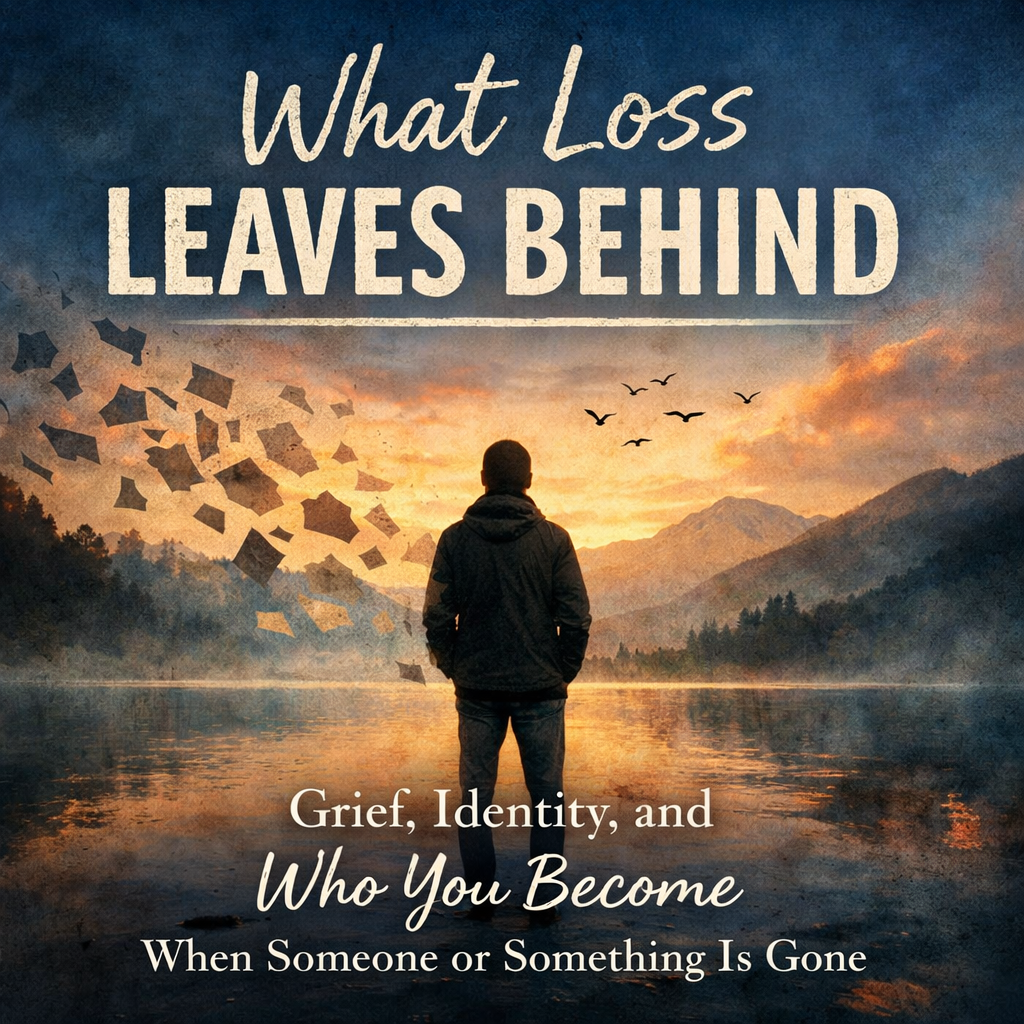
What Loss Leaves Behind:
Grief, Identity, and Who You Become When Someone or Something Is Gone
Welcome to The Original Self Podcast. I’m Evet DeCota, owner of DeCota Life Coaching. I’m a psychology-informed life coach exploring resilience, mindset, and the courage to become your authentic self. This is a space for honest conversations about growth, identity, relationships, and all the messy moments in between that shape who we become. Whatever brought you here today, you’re in the right place.
I’ve noticed over the years that, standing behind a salon chair and coaching individuals, people rarely come in for just a hair service or a single topic. They come to me carrying doubts, fears, dreams, and questions about who they are becoming.
Over time, I’ve realized that beneath all the noise of expectations, criticism, and life’s pressures, there is still a version of ourselves. Let’s explore What Loss Leaves Behind: Grief, Identity, and Who You Become When Someone or Something Is Gone.
Every loss changes the shape of the life around it. Some losses are announced with funerals and flowers. Others happen quietly, without ceremony, and nobody thinks to ask how you are doing.
Loss is not just about death. It’s about the absence of something or someone that once helped define who you were. Today I want to talk about all of it — the losses we name and the ones we never do. And I have brought someone with me who has lived through many of the same ones I have.
Stefan DeCota is my older brother by almost three years. We were very close as small children, drifted apart in our late teen years the way siblings sometimes do when they are busy becoming themselves, and found each other again in our mid-twenties in a way that has never wavered since. Our mother taught us to value one another and to be each other’s best friends. An argument has never lasted more than a few hours — it simply wasn’t allowed.
Stefan is a strategic business advisor with 25 years of experience at large startups and data-driven companies across marketing, finance, and fashion. But his real talents are not seen; they are felt. They are felt by everyone who knows him and everyone he takes an interest in. He celebrates people, he loves deeply, and because he loves so deeply, loss has hit him hard and often. He has carried a great deal, and yet he still stands. He doesn’t break, and that is exactly why his voice matters today.
When we lose a friend, through a huge rupture, a ghosting, a slow drift, or a death where circumstances kept us from being present, we are left holding a grief the world doesn’t have a name for.
Dr. Pauline Boss, a family therapist and researcher, developed the Theory of Ambiguous Loss. Ambiguous Loss describes grief that has no clear ending and no social recognition — the grief is real, but receives no permission to exist. Losing a friendship fits this perfectly. There’s no formal goodbye, and the world does not stop to acknowledge it. But the pain is real, and a shift in identity often follows. People often blame themselves or minimize it because there is no script for how to grieve someone who is still alive.
The Grief Nobody Names: Losing a Friendship -Ambiguous Loss
Questions:
• Have you ever lost a friendship that mattered to you — not through a fight or a clear ending, but just a slow disappearance? What was that like?
• Did losing that friendship change how you saw yourself at all?
I recently read research published in Nature Reviews Neuroscience that confirmed unacknowledged grief registers in the brain as genuine pain. The same neural regions activated by physical injury are also activated by social disconnection and loss. The fact that no one brought flowers does not mean the wound was not real.
Research presented by Duke and Yale Universities showed that friendships are biological. The bonds we form are governed by the same neural and biochemical systems woven into our health and survival. Stronger social bonds make us live longer and carry lower levels of cortisol, our stress hormone. This means losing a friendship is not just an emotional loss but one that the body registers and carries long after the conscious mind has moved on.
• Do you think men grieve the loss of friendships differently from women? Is it something men even talk about?
• Is there a loss in your life that did not fit neatly into any category — not a spouse, not a parent, not a traditional friendship — but hit you just as hard? How did you make sense of that grief when the world did not have a name for it?
• Is there anything harder than watching someone you love grieve, especially when you are grieving the same loss, and there is nothing you can do to take it away from them?
Romantic Relationships and Who You Were in Them: Identity Enmeshment and the Loss of the Relational Self
Psychologists who study relationships argue that our sense of self is partially constructed through our closest bonds. When a significant relationship ends, we do not just lose the person; we lose the version of ourselves that existed inside that relationship. The habits, the routines, the way we saw ourselves reflected in their eyes. This is sometimes called loss of the relational self, and it is why breakups and divorces can trigger a full identity crisis even when the relationship was not a healthy one.
Questions:
• When a significant relationship ends, do you think people lose more than just the person — do they lose a version of themselves too?
• How did you find your footing again after a significant relationship ended?
• Is there a version of yourself from a past relationship that you miss, or one you are glad is gone?
Losing Parents: Stages of Grief vs. Continuing Bonds Theory
For a long time, grief was understood as a process of letting go — moving through stages until you reached acceptance and release. Elisabeth Kubler-Ross gave us the five stages of grief: denial, anger, bargaining, depression, and acceptance. They were never meant to be a linear checklist but are often treated as one.
More recent research, particularly Continuing Bonds Theory developed by Klass, Silverman, and Nickman, challenges the idea that healthy grieving means detaching from the person you lost. Instead, it suggests that we can and do maintain an ongoing relationship with those we have lost — carrying them forward in how we think, how we make decisions, and who we are becoming.
Losing a parent also removes the people who have known you the longest, the witnesses to your own story, and that particular absence reshapes identity in ways that take years to understand fully.
Questions:
• When we lost Mom and Dad, how did it change you — not just emotionally, but in terms of who you are?
• Did losing them make you question anything about your own identity or the direction of your life?
• Was there a moment after losing them where you felt completely untethered — like the people who knew you best were gone?
• How do you carry them now? What does that look like for you day to day?
The Unexpected Grief of Outgrowing People: Ambiguous Loss
Outgrowing someone you love falls into that same territory. There is no big fight, no funeral, no moment you can point to and say that is where it ended. You look up one day and realize the distance between you has become too wide to cross, and nobody permitted you to grieve that either.
Questions:
• Have you ever grown in a direction that took you away from people you once felt close to? How did you handle that?
• Is there guilt that comes with outgrowing someone, even when the growth is healthy?
• What would you say to someone in the middle of that right now — outgrowing people they love but unsure how to move forward without them?
Loss and the Original Self
Questions:
• Looking back at all of it — the people we have lost, the relationships that ended, the versions of ourselves that changed — who are you now that you might not have become without those losses?
• Do you think loss ever brings people closer to their original selves?
• What is the one thing about grief that you wish more people understood?
Personal Reflection:
Well, there you have it. One man’s perspective on loss and grief, and how we walk through it, carry it with us, and can become more from experiencing it.
For me personally, loss shows up in many ways and scenarios. I’ve had close friendships end, causing my confidence to diminish.
I feel that deep grief, that’s always just right under the surface, over my mother’s sickness and ultimate passing. When I lost my mother and father, I realized that I was an orphan, but after time had passed, I realized a type of power in having to count on myself rather than following a familial and cultural construct.
I know that loss left behind part of my innocent original self, but merged most of her with a stronger and more able self.
Mindset Shift:
What Stefan and I shared today is the kind of insight that doesn’t come from a textbook. It comes from living, and I hope that somewhere in our words, you heard something that sounded like your own story. Loss and grief are some of the most isolating experiences a human can have, and yet they are also the most universal. You are not alone in what you are carrying.
Reflection Question:
As I prepared for this episode, a quote by C.S. Lewis has stayed with me: Grief is like a long valley, a winding valley where any bend may reveal a totally new landscape. That is loss. That is life, so with that, ask yourself:
What loss are you still carrying that you have never given yourself full permission to grieve?
Thank you for listening to The Original Self Podcast. If these reflections resonate with you and you’d like to explore your own growth, you can learn more about my coaching at DeCota Life Coaching.

The Authentic Algorithm: Can AI Enhance or Hinder Who You Really Are?
Welcome to The Original Self Podcast. I’m Evet DeCota, owner of DeCota Life Coaching. I’m a psychology-informed life coach exploring resilience, mindset, and the courage to become your authentic self. This is a space for honest conversations about growth, identity, relationships, and all the messy moments in between that shape who we become. Whatever brought you here today, you’re in the right place
I’ve noticed over the years that, standing behind a salon chair and coaching individuals, people rarely come in for just a hair service or a single topic. They come to me carrying doubts, fears, dreams, and questions about who they are becoming.
Over time, I’ve realized that beneath all the noise of expectations, criticism, and life’s pressures, there is a version of ourselves that still exists. Let’s explore The Authentic Algorithm: Can AI enhance or hinder who you really are?
Over the last month or so, I have been speaking to clients and listening to podcasts and news about how AI is taking over just about everything. Advertising and marketing to news, songs, and audiobooks, and to the obvious AI-generated content flooding social media reels and stories. It’s fun to watch media reels of dogs dancing in synch or barking out a sentence, yet no one is fooled by it. But watching celebrities, athletes, or politicians say something they never said, voices and mouths perfectly matched, is where I start to feel unsettled. People fall for these falsities, and as misinformation has shown us over the last decade, when we start to believe a false narrative, a small divide becomes a chasm between people, viewpoints, and feelings.
I have a heightened concern about businesses increasingly pressured by wealth and power to abandon any guardrails that companies may want to install on the use of AI. I worry about American jobs becoming extinct in a mere decade or less. What would we do for money? What would we do with our time? How will we learn new things that make our minds and bodies stronger? How will we connect, either empathetically or in real life? Will we all become like the characters in the Apple TV series Plur1bus, where AI merges all of humanity into a single collective consciousness, peaceful on the surface, but stripped of every individual thought and impulse that makes us who we are?
And then a thought turned me inward. Hadn’t I used AI for prompts, spelling, and grammar checks? Didn’t I rely heavily on AI to build the first rendition of my website because the whole field was new to me, and I felt very unsure about my ability to communicate who I was and what I wanted to present to the world? I wondered whether using AI would quietly erode everyone’s creativity and critical thinking abilities, and whether leaning on it the way some people lean on an emotional support dog for comfort, rather than capability, might do more harm than good.
In case you have been living under a rock in the last few years, AI, at its core, is a technology trained from an enormous amount of human-generated information, designed to learn from it, reason with it, and communicate in ways that can feel surprisingly human. It doesn’t feel, intuit, or originate. That distinction matters enormously when we are talking about authenticity.
The first time I used AI, it seemed similar to a Google search, but now it feels like it’s a totally different beast. The more it starts to reason and communicate, the more my psychology-informed, curious brain hears the faint beep of a dying smoke alarm.
I’ve had many conversations with friends, family, and clients about how they use AI in their personal lives. A few have told me that they use AI as a makeshift therapist in times of need, and believe that it is better than actually speaking to a licensed professional therapist. As a coach, that kind of thinking made me do a deep dive to find out how empathetic can AI truly be? I found a study by researcher Victor Frimpong called Empathy and the Human-Moment Gaps of AI Chatbots: Insights from Empathy Displacement Theory
The study speaks to how psychologists describe empathy as having three dimensions. The first, Affective empathy, is the ability to emotionally connect with what another person is feeling, including unconscious automatic mimicry. The second, Cognitive empathy, is the capacity to understand someone else’s perspective. And the third is Compassionate empathy, which moves us to actually do something about another person’s suffering rather than simply observe it.
The thing about empathy, though, is that it develops through trust, timing, tone, and the kind of presence that tells another person they are truly being seen, which is exactly why it’s so difficult for technology to replicate. Empathy assumes that both people in the exchange have actually felt something.
Frimpong identifies three ways the absence of genuine AI empathy does not just leave a gap, but actively changes how humans experience empathy over time. The first absence of empathy in AI is called Affective Surfaceism, meaning that people begin to prefer the predictable comfort of a chatbot over the messier reality of human connection. The second absence is Memory Fragmentation, which shows that a lack of any relational history distorts how we value empathy in our human relationships. The third part is Moral Framing Mismatch, which showcases how organizations begin to prioritize efficiency over genuine care.
Together, these three gaps form the foundation of what Frimpong calls Empathy Displacement Theory. AI-simulated empathy doesn’t just fill the space where real empathy used to be. It gradually retrains us to accept the imitation as the real thing, until the most pressing question is no longer whether AI can care about us, but what happens to us when we become used to the version of care it offers.
So even though many feel truly heard, supported, and seen by the AI therapist, it’s not programmed, YET, to know how the person feels through their own similar experiences, and it can’t mimic facial expressions, gestures, or tone to allow the human on the other side of the screen to feel really connected.
Reflection Question:
Take a moment to consider this: Think about a time you felt genuinely heard by another person. Not just agreed with, but truly heard. Could that moment have happened with a chatbot? If your answer is no, what does that tell you about what you actually need from the people in your life?
On my quest to find out if AI enhances or hinders our real selves, I reached out to two people who live and breathe the world of AI. The first works for a major AI company whose mission centers on safety and honesty. The second is my brother Stefan, a strategic business advisor with 25 years of experience inside large startups and vast data companies, AI included in all of it.
My contact at the major AI company and I have talked many times about it, specifically around the eventual programming and processing of emotions by chatbots, which is his main job. I know, frightening images straight out of the film iRobot, of thousands of enraged anarchist robots standing on shipping containers ready to strike while plotting the ultimate takeover of the human population, come to my mind.
He told me that AI will get closer to replicating human emotion, but it will never be a one-to-one match, and oversimplifying that distinction is part of the problem. If some form of independent intelligence does emerge, it will have developed from an entirely different set of parameters than humans, with no microexpressions, no physiological cues, and no instinctive sensitivity to the subtle signals we read in one another constantly. He said that AI may actually surpass us in objective decision-making because of how efficiently it processes information, but it can’t gather emotional data the way a human does. As he put it, ‘I might say one thing, and my body language will tell a therapist something completely different. There is no way for AI to know that piece.”
Stefan sees AI as a force that gradually erodes self-creativity and breeds reliance, making people increasingly dependent on it across nearly every area of life. He also points to mounting evidence of how quickly it is eliminating jobs, and while he believes a bounce back will eventually come for those who learn to master it creatively, he warns that AI will largely wipe out what remains of the middle class and drive poverty rates significantly higher over the next one to three years simply by making entire categories of human work obsolete.
Reflection Question:
Listener, consider this: What is the one thing you do, either in your work or your personal life, that you believe only a human being could do? And how certain are you that it will still be true in five years?
Those are some of the ways AI can work against who we are. But can it also enhance our original selves?
A client recently told me she was struggling with her family and had turned to a chatbot for support. After several conversations, I warned her that AI is the ultimate people-pleaser and may not challenge your thoughts and beliefs the way a therapist or coach would. But what she described was something different. She was using it to journal, to identify her own thinking patterns and ruminations, and to get to the crux of her emotional distress so she could frame it clearly, both to herself and to a professional. She used it as a sounding board for deeper self-reflection and to clarify what her core values actually are. It even suggested a psychological concept that she completely identified with, which led her to a course that she is now working through. The way she uses it offers her a glimpse of her original self, and that, in my book, is a win.
Personally, I use it to get unstuck, whether it’s a word I dropped out because I type too slowly, a jumble of words that are a complete run-on sentence that could use a little help from the concise tab, or amplifying my message without diluting what I meant when I wrote it the first time. In coaching, or heck, all communication, the clearer I project, the quicker and deeper someone can reflect on the subject.
Reflection Question:
So, I ask you: Think about how you currently use AI, or how you might use it. Are you bringing your own thoughts and questions to it and letting it help you go deeper? Or are you handing it a blank page and asking it to fill it in for you? The answer to the last question matters more than you might think.
So where does that leave us?
AI is not going anywhere. It will get more sophisticated, more convincing, and more woven into the fabric of daily life than most of us are prepared for. The question is not whether we will use it, but whether we will use it with enough intention versus abdication to keep ourselves in the equation.
What I have come to believe, through my own experience, research, and through the people I have talked to while preparing this episode, is that AI becomes a problem for the Original Self the moment we ask it to think for us instead of with us. The moment we hand it our voice and call the result our own. The moment we turn to it for the kind of comfort and connection that is only built between two people who actually have lived experiences.
But when we bring our own ideas, our own questions, our own half-formed thoughts, and let AI help us shape them into something clear, that is a tool in service of the original self and not a replacement for it. The ladder, not the climber.
My brother Stefan, along with many scientists and economists, sees the devastating financial consequences coming; they are real, and they are very serious. My contact inside the AI industry sees the empathy gap widening, and the very possible ability to eventually learn emotions on its own terms, and that deserves our utmost attention.
So notice it now. Use the tool, but stay in the room with yourself while you do. Remember, AI can hold the ladder, but you have to do the climbing. The tool doesn’t make the work yours, your intention, your voice, and your willingness to show up and think does.
Reflection Question:
Final reflection question to contemplate: When you use AI, are you bringing yourself to it, or are you slowly letting it replace you?
Thank you for listening to The Original Self Podcast. If these reflections resonate with you and you’d like to explore your own growth, you can learn more about my coaching at decotalifecoaching.com.
Source:
Frimpong , V. (2025). Brain. broad research in artificial intelligence and Neuroscience. Empathy and the Human-Moment Gaps of AI Chatbots: Insights from Empathy Displacement Theory. https://www.edusoft.ro/brain/index.php/brain/article/download/1934/2417

The Quiet Power Of Small Steps
In this episode of The Original Self Podcast, life coach Evet DeCota explores why big changes so often fail and why the smallest, most consistent actions are the most powerful path to lasting transformation. Drawing from personal experience and the science of habit formation, Evet unpacks the neuroscience behind why the brain resists dramatic change, how micro-habits quietly rewire behavior over time, and why motivation is not the starting point for change but rather the result of it. This episode is for anyone who has ever felt overwhelmed by the gap between who they are and who they want to become, and needs a reminder that one small step is always enough to begin.
The Original Self Podcast

Welcome to The Original Self Podcast. I’m Evet DeCota, owner of DeCota Life Coaching. I’m a psychology-informed life coach exploring resilience, mindset, and the courage to become your authentic self. This is a space for honest conversations about growth, identity, relationships, and all the messy moments in between that shape who we become. Whatever brought you here today, you’re in the right place
I’ve noticed over the years, standing behind a salon chair and coaching individuals, is that people rarely come in for just a hair service or one single topic. They come to me carrying doubts, fears, dreams, and questions about who they are becoming.
Over time, I’ve realized that beneath all the noise of expectations, criticism, and life’s pressures, there is a version of ourselves that still exists. Let’s explore The Quiet Power of Small Changes.
For the last couple of years, I have watched a woman who works in the building next to my salon really struggle as she walks up a small incline in the street. She looks about twenty-five years old, with a very pretty face, and a body that I recognized, because I had once carried that same weight myself.
I previously worked in that building on the floor above her, and we often rode the elevator up together. I would listen to her try to control her breathing as she gently wiped the sweat from her face. I knew instinctively that if she were alone in the lift, she would be breathing very heavily. I feel an abundance of empathy for her, and I use the word empathy intentionally, because I have been extremely overweight, and I know what it feels like to conceal heavy breathing after nothing more than walking up a slight incline, as if I had just run a 10k.
I was so overweight that walking 300 feet made me see black spots and feel dizzy. I sweated constantly even in 40° weather, got easily winded, and lived with many aches and pains all over my body, severe reflux, and a constant stomach ache. I went on like this for a couple of years until one day, in 90°degree heat, I walked home from the salon and almost passed out while only moving at a snail’s pace. I sat down for ten minutes when I got inside and thought about my family history of heart disease, high blood pressure, and diabetes, and knew all three were coming for me quickly. That was the moment I made the first very small change and texted my doctor for help.
What I didn’t know in that moment was that I had stumbled onto something science has been telling us for quite a while about sustainable change. Sometimes the smallest step, taken at the right moment, can quietly rewire everything. And understanding why that works begins with understanding how the brain responds to change.
Here’s the fascinating part. Our brains are actually designed to resist change, not because we are weak or lacking discipline, but because the brain’s primary job is to keep us safe and to conserve energy. When we attempt a dramatic lifestyle overhaul, the brain can interpret that sudden upheaval as a potential threat. The part of the brain involved in detecting threat, the amygdala, can trigger a stress response that shows up as procrastination, anxiety, or exhaustion. We end up quitting before the new behavior ever has a chance to take hold.
Maybe that’s why every time I decided to lose weight and eat healthier, it would last anywhere from two to four months and then fade out. I would start to feel bored and frustrated, my focus would shift entirely to the end goal, and when the results didn’t come fast enough, I would quietly give up.
Habit Formation:
The problem was never my desire to change; it was that I was trying to change everything at once. Small changes work very differently. They slip past the brain’s resistance almost undetected, and when you repeat a tiny action consistently over time, the part of the brain responsible for habit formation, known as the basal ganglia, begins to automate that behavior. What once required effort starts to feel natural and almost effortless, not because we forced the change, but because we allowed it to take root gradually. And perhaps that is why one of the most powerful things ever said about change has nothing to do with grand gestures at all. As Martin Luther King Jr said, “Faith is taking the first step even when you don’t see the whole staircase.”
In other words, lasting change rarely begins with a dramatic overhaul. It begins with a small decision repeated often enough that it quietly becomes part of who you are, so trust in the process. That is not just a philosophical idea; it’s actually backed by research.
The author James Clear wrote something in Atomic Habits that has stayed with me. He describes how a one percent improvement each day, something almost too small to notice, can compound into remarkable growth over a year. When I think about change through that lens, it stops feeling overwhelming and starts feeling completely possible.
I remember the moment I realized something had genuinely shifted. For a long time, my body would crave sweets at night, and I would immediately get up and find something. So, I made one small change. I started waiting five to ten minutes before acting on that craving, just sitting with it instead of immediately feeding it. What I discovered was that most of the time, if I waited for that short window, the craving would quietly pass on its own. Over time, I realized that on many nights, I hadn’t thought about it at all. I had simply waited without reminding myself to wait. It had stopped being a strategy and become something else entirely; a part of who I was.
Before we move forward, I want to offer you this question to reflect on: What is one habit you have tried to build before that faded out, and looking back, was too big to stick with?
Micro Changes:
So how do we make changes without getting frustrated, bored, and eventually giving up? I think many immediately picture a complete lifestyle overhaul that starts on Monday (insert incorrect buzzer sound), wrong! What we can make are micro-changes that are so small the behavior feels almost effortless, but will immediately make you feel like you are actually moving forward.
A micro-change I began in the beginning was drinking one extra glass of water per day and swapping one highly caloric meal out for a more nutrient-dense one three days per week. As I continued throughout the months, those micro-changes became a habit that I increased throughout the whole week and for each meal. Around the same time that I was implementing micro-changes in my diet, I was also micro-changing my mindset by replacing one negative thought with a neutral one, making a list, mental or on paper, of one thing I was grateful for every morning, and pausing before reacting negatively in a difficult moment. I will admit that the reaction change is an ongoing work in progress.
Clear also makes the point that habit formation is not just about doing something differently, but about becoming someone different; a change in identity. For me, exercise looks nothing like what you might see on social media. I have a brittle bone disease that limits what my body can do, so I had to completely redefine what movement meant for me. I used to tell myself that if I could not do a real workout, there was no point in doing anything at all. That story kept me completely still for a long time.
The micro-change was simple. I started stretching for five minutes before I got out of bed. Not at the gym, not in workout clothes, just five minutes of gentle movement before my feet hit the floor. It felt almost too small to count as a change, but I kept doing it, and somewhere along the way, something shifted. I stopped saying I am not someone who exercises and started saying I am someone who moves her body in the way that her body allows. That identity shift changed everything, because it was no longer about what I could not do, but about honoring what I could do.
Changing how I define myself is not so much a “fake it ‘till you make it” attitude, but more of a connection with my inner self, coming back to my original self. The part of me that never doubted my actions and my ability.
Pause here for a moment and consider this: What is one change so small it almost feels too easy that you could begin tomorrow?
Consistency vs Motivation
Understanding micro-changes is one thing, but putting them into practice over time is another. What actually determines whether a small change becomes a lasting habit has very little to do with how inspired or motivated we feel on any given day.
There is a belief that most of us carry around without ever questioning it. We treat motivation as the prerequisite for change, the catalyst that has to arrive before we can move forward. “Once I feel motivated, I will start; Once I feel ready, I will begin; Once I feel inspired, I will take action.” But behavioral psychology tells us something that completely challenges that assumption. Motivation does not create action. Action creates motivation. Let me say that again: Motivation does not create action. Action creates motivation. We have it completely backwards.
This is not just a philosophical idea; it is rooted in how the brain actually works. When we take action, even the smallest and most unglamorous action, the brain’s reward system responds. It registers that we followed through, releases a small amount of dopamine, and suddenly, we feel a little more capable, a little more like someone who follows through. That feeling is what we call motivation, and it was generated by the act of starting, not the other way around. Which means that every time we sit and wait to feel motivated before we begin, we are actually waiting for something that can only be created by beginning. Consistency is not what happens after motivation arrives. Consistency is what summons motivation in the first place.
I know this pattern intimately because I have lived it myself. When I first started promoting my coaching business, I had so many ideas about how to do it that I would become completely overwhelmed before I ever began. I thought that if I wrote a blog, I would need to cite every source like a college essay. I was uncomfortable with the idea of being on camera, and I secretly wanted to do a podcast but had no idea how, plus I convinced myself that nobody would care anyway. So, I ruminated on every idea I had and implemented none of them.
The mindset shift for me was not dramatic or sudden. It did not arrive with a lightning bolt moment of clarity. It arrived quietly, sometime around Christmas, when I simply stopped swirling around which idea was the right one and decided to try them all. I stopped waiting for the perfect plan and started treating every idea as worth attempting. Because the truth is, you can’t know what will resonate, what will feel natural, or what will actually reach people until you begin. The pursuit of perfection can become a very convincing form of avoidance. The shift from thinking to doing, from planning to starting, from waiting to beginning. That is where everything changed for me, and it can change for you, too.
Consistency for me has never looked particularly glamorous. Some days I write at my desk, other days I am typing on my phone, or voicing an idea into a notes app on a break, or talking to myself in the car because a thought arrived that I did not want to lose. Sometimes consistency looks like catching the idea wherever it finds you.
There are days when I sit down and feel like I have nothing new to say. On those days, I have found that the answer is not to push through the resistance but to move toward stillness. A little deep breathing, a moment of rest, and the thoughts begin to find their way back.
I have skipped days of writing, but I can’t remember a day when I did not jot down at least one idea. I have written things that were, to put it plainly, should have never seen the light of day, but I keep coming back. Not because every day feels inspired, but because somewhere along the way, writing and speaking, whether it’s a blog post, a social media caption, or this podcast, became less something I do and more simply a part of who I am.
I still see her sometimes, the young woman at the building next to the salon, making her way up that small incline. I no longer just feel empathy when I see her; I feel something closer to hope. I know that change doesn’t begin with a dramatic overhaul or a perfect plan or even the right amount of motivation. It begins with one small decision, made quietly, on an ordinary day. A text to a doctor, five minutes of stretching before your feet hit the floor, one glass of water, or one idea jotted down in a parking lot.
I don’t know her story, I don’t know what she carries or what she has already tried or what small changes she may already be making in ways I can’t see, but I know this. The most powerful transformations rarely announce themselves; they slip past the brain’s resistance almost undetected. One tiny action at a time, until one day you look up and realize you have become someone you almost did not believe you could be.
The science is clear, the research supports it, and if my own experience has taught me anything, it is that the smallest decisions made consistently over time are far more powerful than the grandest intentions made once and abandoned. That is the quiet power of small changes
The last reflection question I want to ask you is: Where in your life are you still standing at the bottom of the staircase, waiting to see the top, when all you really need to do is take one step?
Thank you for listening to The Original Self Podcast. If these reflections resonate with you and you’d like to explore your own growth, let’s talk.
Who You Were Before The World Told You Who To Be
Welcome to The Original Self Podcast. I’m Evet DeCota, creator of DeCota Life Coaching, and a psychology-informed life coach exploring resilience, mindset, and the courage to become your authentic self. Each week, we’ll explore the stories we tell ourselves, the patterns that hold us back, and the small shifts that help us move forward.
The Original Self Podcast
Welcome to The Original Self podcast. I’m Evet DeCota, owner of DeCota Life Coaching, and a psychology-informed life coach exploring resilience, mindset, and the courage to become your authentic self. It’s a space for honest conversations about growth, transition, identity, relationships, and all the messy, meaningful stuff in between that creates the small shifts that help move us forward. Whatever brought you here today, you’re in the right place
Today, we are talking about how, for many years, standing behind a salon chair and coaching individuals, I’ve noticed people rarely come in for just a hair service or one single topic. They come to me carrying doubts, fears, dreams, and questions about who they are becoming.
Over time, I’ve realized that beneath all the noise of expectations, criticism, and life’s pressures, there is a version of ourselves that still exists. Let’s explore Who You Were Before the World Told You Who to Be.
Earlier today, I was thinking about something people have said to me for most of my life: that I am a chameleon, someone who can adapt my behavior to other people’s personalities very quickly.
When I was younger, I used to think that was a talent that served me well as a hairstylist. Possessing pieces of many different traits allowed me to connect with a wide range of people and to appreciate the differences in personalities, cultures, perspectives, and the unspoken rules that shape how people move through the world, and it certainly can be.
But about 10 years ago, I noticed something that gave me pause. I realized that the benefits of adaptation did not always outweigh the masking of who I am authentically and what I might be losing in the process. The easier it was for me to shift to meet other people’s expectations, the less certain I felt about who I was underneath all of it. At different moments throughout the day, a quiet voice would interrupt my thoughts with questions I hadn’t seriously asked myself before: “Who are you?” “What actually matters to you?” and “Where are you in this narrative?” and over time, I realized that this experience wasn’t unique to me. And in many ways, it reflects something psychologists have been describing for decades
The psychologist Donald Winnicott had an idea of what he called the True Self, something I think of as the Original Self. Beneath the masks we wear, and the roles we play, remains a version of you that was never lost, only quieted. That is your original self, the part of you that existed before fear, before criticism, and before you learned to shrink yourself to fit into the expectations and boxes that people, culture, and society place around us.
For instance, even an infant will begin to change their behavior the moment a parent responds to them, positively or negatively. From the beginning, we are learning what’s expected of us. It’s not just taught by our parents, but by everyone we encounter and nearly every circumstance we move through. With each verbal, physical, or visual correction we absorb, a small piece of our Original Self quietly steps back. I think of it as a folder that’s moved to the back of the filing cabinet, a little further from reach each time.
So, what fills that filing cabinet? What are the forces doing the filing?
There are three that do the most work, and they often operate together so seamlessly that most of us never notice them as separate things. They are family, culture, and fear. And what makes them so powerful is that all three tend to do their deepest work on us before we are old enough to question them.
Let’s dissect how family affects us. Family is the first world a child ever knows. Before you have any frame of reference for who you are, your family is already communicating, through words, silences, reactions, and expectations, who you are supposed to become. Most families do not do this out of cruelty. They do it out of love, out of habit, and out of the unexamined beliefs they themselves inherited and never thought to question.
I have observed this across cultures and across generations in my work. The messages vary in their specifics but tend to rhyme with one another in their effect. For many women, the message arrived early and without discussion: you marry, you have children, you build your life around the people you love, and that is enough. Going further — going to college, building something of your own, wanting more than what was modeled for you — was either not encouraged or quietly discouraged, not because anyone wished them harm, but because that was the shape of the world they had been handed, and they were simply passing it along.
Religion adds another layer to this, and I want to be careful here because faith is a genuinely meaningful source of strength and purpose for many people. But there is a difference between a faith you have examined and chosen and a set of beliefs that were handed to you as a very small child, absorbed before you had the capacity to evaluate them. Many people spend years carrying a version of their religious upbringing that feels more like judgment than grace, more like a set of rules about who is acceptable and who is not, before they finally pause long enough to ask whether what they were taught actually reflects what they believe. That examination is not a betrayal of where they came from. It is part of the process of becoming who they actually are.
What all of these family messages share is that they arrive when we are too young to weigh them. A child cannot say, I appreciate your perspective, but I would like to form my own. They simply take it in. And what gets taken in early enough becomes the wallpaper of the self — so constant, so familiar, that most people never think to ask whether they chose it or whether it was chosen for them.
The second part that forms identity is culture. Culture operates the same way, only on a larger scale. If family is the first world, culture is the second one, and it moves in almost simultaneously. Culture tells us what is beautiful, what is valuable, what ambitions are reasonable for a person like us, and which ones are considered overreaching. It tells us, with remarkable consistency and very little apology, how much space we are allowed to take up.
For young people, the need to fit in is not vanity. It is closer to survival. At a certain age, belonging feels like a biological necessity, and the self gets shaped around that need in ways that are genuinely difficult to undo later. You learn which parts of yourself are welcome in the rooms you want to be in, and which parts make people uncomfortable. You learn to lead with the version of yourself that is acceptable and keep everything else somewhere quieter. And if you do this long enough, you can lose track of which version is actually you.
Youth is particularly vulnerable to this because the brain is still developing the capacity for the kind of self-reflection that would allow a young person to say, I am changing myself to belong here, and I want to notice that. Most young people do not have that yet. They are simply adapting, the way humans have always adapted, and the original self is filed a little further back with each adaptation.
Finally, there is fear, which I think is the most honest of the three, because at least fear does not pretend to be acting in your best interest, the way family and culture sometimes do. Fear is direct. It says: do not go there. Do not try that. Do not love that person or want that thing or step out of what is familiar, because something bad might happen if you do.
For me, fear arrived in some of its most formative shapes through loss. Losing people I loved deeply did something to the way I moved through the world that I did not fully understand until much later. Grief has a way of quietly tightening the radius of what feels safe. You become more careful. More protective. And sometimes, without realizing it, you start to make yourself smaller in ways that feel like wisdom but are actually just fear wearing a more acceptable coat.
Fear also arrives through the body, through hormones and aging, and the ways our physical experience shifts beneath us in ways we did not ask for and cannot fully control. The body is one of the places the original self lives most honestly, and when the body changes in ways that feel like loss, many of us respond by pulling back rather than leaning in. We quiet parts of ourselves that once felt natural, because they no longer seem to fit the version of ourselves, we think we are supposed to be at this stage of life.
I want to say something about that directly, because it is something I have lived. I have quieted the feminine part of myself over the years in ways I am only now beginning to examine honestly. Not because anyone told me to, at least not in so many words. But because somewhere along the way I absorbed the message that softness was vulnerability, that expressly feminine ways of moving through the world were less serious, less credible, less safe. And so I filed that part away too, the way we often do with parts of ourselves that we’ve been told, either directly or indirectly, don’t belong.
The original self does not disappear under the weight of family, culture, and fear. It waits. It gets quieter, and sometimes it gets very quiet, but it does not leave. And one of the things I have come to believe most deeply, both from my own life and from the work I do with others, is that the hunger to return to it never fully disappears either. It shows up as restlessness, as a feeling that something is missing even when everything looks fine, as a quiet voice asking questions you have been too busy or too afraid to answer.
That voice is not a problem to be solved. It is an invitation.
And one of the clearest ways to understand what I mean by the original self is to look at a young child.
If you watch a very young child, before the corrections have fully accumulated, you are watching someone who is almost entirely their original self. They want what they want without apology, feel what they feel without editing it first, and have not yet learned which parts of themselves need to be managed. And then, slowly, the shaping begins.
Now, I want to be clear, I’m not suggesting we skip the shaping entirely. I’m not trying to promote Jodi Foster as Nell because we know exactly how that turned out. Raise yourself in the woods with no outside influence whatsoever, and you end up saying “tay in da win” in your own language that works beautifully in the forest and absolutely nowhere else. Some correction is necessary, but the goal is not to become feral. It’s simply to notice how much of what shaped us was genuinely useful growth and how much of it was someone else’s fear or expectation wearing the costume of wisdom.
What I find so striking is that if you watch someone who is very old — someone who has truly lived long enough to make peace with most of it — you often see something remarkably similar. The same unguarded quality. The same willingness to say exactly what they think. The same absence of performance. I believe the elderly, at their best, have done something that takes an entire lifetime to accomplish. They have worn out their need for approval, outlasted most of their fears, and in that clarity, the original self has room to resurface.
I also think — and I hold this more as a feeling than a certainty — that something else may be drawing the very old back toward who they truly are. When we are close to the end of a life, things loosen. What felt urgent for so long begins to matter less. I wonder sometimes whether that loosening is the self preparing to return to something it always was, beneath everything it learned to be. I do not think it is a coincidence that the two groups most in touch with the original self are the ones closest to the beginning and the ones closest to the end. What the rest of us are doing, in the middle of our lives, is trying to find our way back without waiting that long.
And that is where so many of us find ourselves as adults, sensing that something essential is still there, even if we have not quite figured out how to return to it. Everything you have been through — the corrections, the expectations, the fear, the loss, the years of adapting yourself to fit into spaces that were not always built for who you actually are — none of it was wasted. All of it taught you something.
One of the most important things it taught you, even if it has taken a long time to see it clearly, is that the version of you that exists underneath all of that shaping is not only still there, but is the most capable, the most honest, and the most resilient version of you there has ever been. You did not survive all of that by accident. You survived it by being exactly who you are, even when you did not fully know it yet.
The original self was never the problem. It was never too much, or too soft, or too ambitious, or too different. It was simply waiting for you to stop apologizing for it and start accepting it instead.
And accepting it does not mean returning to who you were before the world got involved. It means taking everything the world has taught you and bringing it home to the truest version of yourself–the one that was there at the very beginning, the one that will still be there at the end.
So the question may not be who you need to become, but what parts of yourself may be ready to rediscover. And that, my friends, might be the quiet work in front of you.
Thank you for listening to The Original Self Podcast. If these reflections resonate with you and you’d like to explore your own growth, you can learn more about my coaching at decotalifecoaching.com.

Nobody Applies for This Job
On caring for a parent, and everything nobody warned you it would cost
On caring for a parent, and everything nobody warned you it would cost
More people are caring for an aging or ill parent than will ever talk about it openly. They are showing up day after day for someone they love, doing their best with what they have, and quietly losing ground in their own lives in the process. Most of them never saw it coming, and almost none of them felt ready when it arrived.
There was a moment, quiet and unremarkable from the outside, when I realized the dynamic between my mother and me had shifted in a way it would never shift back. I was no longer the child expecting care. I was the one giving it, and nobody had prepared me for how disorienting that would feel, or how much I would grieve a relationship that was still right in front of me.
No one hopes for this role; it arrives sideways, through a diagnosis or a fall or a phone call that changes the shape of everything. Even when you know they are sick, even when the facts are right in front of you, hope never fully leaves. Somewhere beneath the knowing, you keep believing they will get better. This illness is temporary, and the person you have always known is still in there and is coming back. That hope is not denial. It is love doing what love does: refusing to accept an ending before it has arrived.
When my mother's kidneys failed, and dialysis became the path forward, I threw myself into her care with the same totality I bring to everything that matters to me. I believed, with a certainty I now understand was more about love and fear than logic, that if I were there enough, present enough, attentive enough, I could slow what was happening to her. I would lift her spirits, show her she was not alone, and make my presence count in a way that the disease could not undo. What I did not fully account for was what that belief was quietly doing to me on the inside, because while I was pouring everything into her, I had stopped sleeping, stopped eating well, and was running entirely on adrenaline and devotion and the particular kind of panic that comes from watching someone you love slip away in slow motion.
You keep believing, somewhere beneath the knowing, that they will get better. That hope is not denial. It is love doing what love does.
Over time, the panic took on a new shape named control. I am not proud of the person I was in some of those moments, though I understand now exactly where she came from. I became bossy, convinced that if I could make my mother more active, get her out of the house, keep her social and moving, I could somehow prevent what was coming. It was as if love and sheer determination could compete with kidney failure, as if I trying hard enough and caring deeply enough could outrun the inevitable. The truth is that controlling behavior in a caretaker almost always grows from the same root: the unbearable feeling of helplessness in the face of someone you love suffering.
She hated dialysis because it depressed her, made her angry, and exhausted her entire being in a way that was painful to witness. She had a difficult time accepting that her kidneys no longer worked, and three times a week, dialysis forced her to face that undeniable truth. I had been the one to encourage her to try it, and the guilt of that never fully left me, not because I was wrong to ask, but because I knew, if I was honest with myself, that part of why I asked was not entirely for her. I was not ready for her to leave me. I wanted more time, and she was the one who had to endure the suffering to give it to me. Let me be clear, my mom ultimately decided to begin dialysis herself, but the guilt of my having asked her to do it stayed because love and selfishness are not always as cleanly separated as we would like them to be. We want the people we love to stay, and sometimes we ask them to bear things that are very hard to bear, because we cannot yet imagine the world without them in it.
For three and a half years, she dialyzed, and those years brought infections, sepsis, and hospitalizations that frightened me in ways I could not always let her see. Through all of it, there were moments when she would look at me and ask why this had happened to her, grieving her own life out loud, and I did not always handle those moments well. My instinct was to redirect her, to remind her of the grandchildren she still got to see, of the love surrounding her, of everything she still had. I thought I was helping, and I understand now that I was managing my own guilt far more than I was sitting with her pain. She did not need a reframe in those moments. She needed someone to hear her, and it took me far too long to learn the difference.
She did not need a reframe. She needed someone to hear her, and it took me far too long to learn the difference.
I finally learned to do that toward the end. I stopped trying to fix it, stopped redirecting and encouraging, and filled the silence with something more bearable. I just sat with her, held her, and let us both cry without either of us trying to make the other feel better about something that was not going to get better. It was the most honest thing I did in all of those years of caring for her, and it came the latest.
There was one moment in particular that I will carry for the rest of my life. She had been suffering through repeated infections, and I had been holding back words I knew I needed to say, because I also knew what it would mean when she heard them. Barely able to get the words out, I leaned in close to her ear and whispered that this was her decision, all she had to do was say she no longer wanted treatment, and the suffering would stop. She decided quickly, because she was ready, even though I was not, and in that moment, I understood that the most loving thing I had done throughout all of it was finally give her back the one thing that had always been hers, which was the choice.
I have thought a great deal since then about what makes caring for a parent different from other kinds of care. I say this carefully because I have never had children, and I do not want to minimize what that kind of love and labor requires. Caring for a child, as I understand it, moves in one direction. It is exhausting and consuming and all-encompassing, and then slowly and beautifully, the child begins to need you less, growing toward independence in a way that gives the work a sense of purpose and forward motion. Caring for a parent moves in reverse, and that reversal carries its own particular grief. The person who once held you up, who taught you how to navigate the world and was the first one you turned to when things fell apart, is slowly becoming someone who needs you to hold them up instead. You are not just losing them in the future. You are losing them in increments, in the present, while they are still right there with you.
In my Italian family, there was never a question about what we would do. We take care of our own, and my brother and I stepped in without deliberation because that is simply who we are and where we come from. I am genuinely grateful for that value, and I am also honest enough to say that the clarity of the obligation does not make its weight any lighter. You can love someone completely, show up for them without reservation, and still find yourself losing ground in your own life, in your sleep, your health, your sense of self, in ways that take a long time to recover from. Loving someone through their decline does not exempt you from its cost.
You can love someone completely, show up for them without reservation, and still find yourself losing ground in your own life in ways that take a long time to recover from.
If you are in the middle of this right now, I want you to hear something clearly. The guilt you feel does not mean that you are doing it wrong; it means you love them. The panic, the need to control, the sleepless nights spent replaying everything you did not do that day, do not make you a bad caretaker. They make you a human being facing something that love alone cannot fix, and choosing to show up anyway.
If you are on the other side of it and carrying what it costs you, know that grief doesn’t follow a schedule and never announces its end. The loss of a parent reshapes the architecture of your life in ways you continue to discover long after the immediate pain has settled. You may still be moving through that process. Give yourself the time. Give yourself the grace.
Nobody applies for this job. Yet the people who show up for it, imperfect and exhausted, and with their whole hearts, are doing something that deserves naming for exactly what it is. One of the most profound acts of love a person can offer another human being.
If you are navigating a caretaking role and feel lost inside it, I would love to talk with you.

Thought Patterns That Quietly Hold Us Back
We move forward when we change the story we tell ourselves about our circumstances. However, the inner critic, people-pleasing, catastrophizing, all-or-nothing thinking, and waiting until you’re ready patterns don’t announce themselves. They quietly keep you small.
Which one of these patterns do you recognize in yourself right now?
We move forward when we change the stories we tell ourselves about our circumstances
Most thought patterns don’t announce themselves or arrive loudly and dramatically. They settle in quietly, disguised as logic, practicality, or even humility, until one day you realize that the same invisible wall has been stopping you for years. The tricky part is that these patterns feel true and even reasonable, and that is exactly what makes them so powerful.
As someone who has spent decades observing human behavior up close, I’ve come to understand that the mind is extraordinarily good at protecting us from discomfort. No one wants to be uncomfortable, well, maybe a Buddhist monk sitting in the same position for hours on end; instead, we can’t always distinguish the difference between genuine danger and the healthy discomfort of growth. This makes the growth default to caution, self-doubt, and familiar narratives, even when those narratives keep us small.
Here are the five thought patterns I see most often, and what becomes possible when we start to notice them:
The Inner Critic
The inner critic is perhaps the most relentless of them all, telling you that you’re not smart enough, experienced enough, or ready enough to take up space. It critiques before you’ve even begun and judges after you’ve already tried; I know this voice well. When I went to college at fifty, surrounded by students thirty years younger than me, my inner critic was loud from the start. At first, I felt like an outsider until I reminded myself that we were all beginning from the same place with the same material. One would think that the better I did, the quieter the criticism would become. The exact opposite happened; it became louder, and with each A grade I earned, my feeling of a fraud intensified. I kept reminding myself that I had been an average student in high school, that I couldn’t possibly sustain this, and at some point, everyone would figure out I didn’t belong. When I graduated with the highest honors and was nominated for the best thesis, I realized that the inner critic was not 100% correct, but it never stopped trying to convince me of it. Deep down, I know the inner critic is a protective habit formed early in life that never learned we no longer need its services.
People-Pleasing
People-pleasing is another pattern that wears a convincing disguise. It looks like kindness, generosity, and selflessness from the outside. For me, it runs much deeper than that because I was born with a genetic bone disease, which resulted in many breaks throughout my life. My body has always carried a physical vulnerability that I had no control over, and somewhere along the way, I decided that if I couldn’t protect my body, I would protect my image. I would accommodate, adapt, and make myself relatively easy to be around. I would give people what they needed before they ever had to ask. People-pleasing, at its core, is often protective armor useful for maintaining in a world that feels unpredictable or unsafe. It quietly teaches us to make ourselves smaller so that others feel more comfortable, and over time, it creates a life that looks fine to everyone else but feels hollow on the inside.
All-or-Nothing Thinking
All-or-nothing thinking is the pattern that turns everything into a victory or a failure. If you can’t do something perfectly, there’s no point in starting, or you ruin the effort if you slip up once. This kind of thinking is exhausting because it leaves no room for the messy, nonlinear reality of how humans actually grow and change. Progress rarely looks like a straight line, and all-or-nothing thinking struggles to recognize anything in between.
Catastrophizing
Catastrophizing is what happens when the mind races ahead to the worst possible outcome before anything has even occurred, taking a realistic concern and amplifying it until it feels inevitable. The new venture becomes a guaranteed failure, the difficult conversation becomes a ruined relationship, and the bold move becomes a public embarrassment. Catastrophizing is often the mind working overtime to protect us from being blindsided, but when we live there permanently, we stop taking powerful risks that change everything. I often turn to a simple reframe that asks, what if this turns out better than I imagined? That one question doesn’t erase the fear, but it cracks the door open just enough to let possibility in.
“I’m Not Ready Yet”
The quiet belief that you are not ready yet is one of the most stubborn patterns of all, because it sounds so reasonable from the inside. I launched my coaching business in August of 2025 while still working full-time as a hairstylist, a career I have built over 39 years, but I didn’t hit the ground running. I moved slowly at first, and it wasn’t until January of 2026 that I began showing up consistently. Building something entirely new, without a roadmap, in an industry that relies heavily on social media presence and digital visibility, has been genuinely disorienting at times. I know how to connect with people, hold space, ask the right questions, and help someone see themselves more clearly, but what I am still learning is how to translate all of that into a business that finds the people who need it most. The uncertainty of not knowing which direction will work isn’t the same as not being ready, and I’ve come to believe that is a very different and important distinction to make.
What all five of these patterns have in common is that they operate best in silence. The moment you name them, something shifts. You create a small but significant distance between yourself and the thought, and in that space, you get to choose what you actually believe and what you’re ready to do next. That is not a small thing, but it is the beginning of everything.
If you recognize yourself in any of these patterns, I want you to know that noticing is not the same as being stuck, but means you’re already moving. If you’d like to explore what’s quietly holding you back and what’s waiting on the other side of it, I’d love to have that conversation with you.

Lessons From the Chair-Part 1
THE DIFFERENCE BETWEEN APPEARANCE CONFIDENCE & INNER CONFIDENCE
THE DIFFERENCE BETWEEN
APPEARANCE CONFIDENCE & INNER CONFIDENCE
What I’ve learned after decades behind the chair is that the confidence people ask for isn’t always the confidence they truly need.
There’s a moment at the beginning of every new client appointment that fascinates me. They sit down a little cautiously, describing what they want to change on the outside: the hair, the style, or the image they hope to project. It’s polite, friendly, and transactional, yet underneath that exchange, I always feel something deeper is happening. Most people think they’re talking about appearance to reach a certain level of confidence, but in reality, they’re often talking about inner confidence.
Watching this unfold has made me reflect on my own relationship with confidence and where it began. When I was younger, I could entertain myself for hours without anyone else around. If I wanted to hang out with a friend, I simply walked across the street and asked if they could come out and play. I didn’t fear rejection, I wasn’t shy, and I didn’t assume people were judging me, at least not until they did. Over time, I’ve realized that my inner confidence flourished from the steady love and support of my immediate and extended family. I knew where I came from. I knew our culture, our traditions, and the feeling of belonging. That quiet inner confidence carried me until around age ten, when I discovered that not everyone saw me the way my family did. That was the moment appearance confidence began to replace something deeper.
Inner confidence is the sense of safety within yourself, your internal anchor. It’s the knowing that your worth isn’t up for negotiation. It comes from self-trust, self-efficacy, belonging, and feeling grounded in who you are, even when no one else validates you. Appearance confidence, on the other hand, derives from the feedback we receive from the outside world. It grows from how others see and judge us, which is why it can feel strong one moment and uncertain the next.
I’ve noticed patterns in the way people carry confidence when they sit in my chair. Some clients, often in midlife and beyond, arrive with a grounded ease. They seem less concerned with how others judge them and more interested in what feels authentic. There’s a steadiness in them that speaks to inner confidence, the kind that comes from experience and self-acceptance rather than approval. They have done the work of shrugging off the judgment shawl.
Others spend much of the appointment studying themselves in the mirror, focusing on what they see as flaws. The conversation sometimes drifts toward fixing, improving, or buying something new in hopes that it will finally create a sense of satisfaction. What I often see underneath it is a deeper discomfort that no product or external change can fully resolve.
Some clients arrive with striking honesty. They talk openly about their struggles, their hopes, and the parts of themselves they are still learning to accept. Their vulnerability reminds me of the openness we have as children, before we learned to protect ourselves behind image or performance. Those are the moments that always feel the most real to me, and they continue to shape how I understand confidence in my own life.
What I’ve come to understand is that all of these clients are looking for the same thing, even if it shows up differently. As a hairstylist, my work is absolutely about enhancing someone’s outward appearance, and there is nothing wrong with wanting to feel good about how you look. The difference, at least from where I sit, is the intention behind the change. I want the transformation to feel like an expression of who someone already is, not a reaction to what an influencer or someone else says about how they should look. What if we flipped the mindset from dissatisfaction with our appearance to honoring ourselves as we are? Making peace with our forehead lines, sagging neck, and thinning hair may be what allows a deeper, more lasting inner confidence to grow.
I think many of us, myself included, spend years believing confidence is something we earn by improving what we and others see on the outside. We chase the right look, the right weight, expensive dinners, trips, and over-the-top celebrations, all in the hopes of quieting our inner critics. Sometimes it does help for a moment, but the feeling rarely lasts. Real confidence seems to arrive when we stop treating ourselves as a problem to fix and start relating to ourselves with the same kindness we so easily offer to others.
I feel incredibly lucky to learn from the experiences I share with my clients. They have offered me so much, allowing me to reflect on my confidence while feeling deeply connected, heard, and understood. I’ve noticed that the more vulnerable I am, the more they open up, and conversations move beyond appearance into the things that make us feel both strong and uncertain. Each time we speak honestly with one another, something shifts. Inner confidence grows quietly in the space of connection, reminding us that it isn’t something we create in the mirror, but something we recognize within ourselves.
If this speaks to you, I’d love to continue the conversation. Exploring confidence together is some of the most meaningful work I do.

FOOD & MY BRAIN
For nearly four decades, I was a sheep, blindly following diet culture’s herd mentality. I counted points, logged calories in apps, and readied my restaurant menu order, even before walking through the doors. I clung to the hope that the next diet would finally unlock lasting health and happiness, and I tried to control my body by controlling food.
Over time, points, calories, and “good” and “bad” foods became a constant tug-of-war between control and chaos. I told myself it was discipline, but really it was just mental noise. I’ve been overweight for a long time. The weight didn’t come on from a hard year or a loss; it accumulated through seasons of stress, boredom, and the relentless background chatter in my brain. Thinking about food, planning it, avoiding it, and negotiating with it built into a cacophony that never seemed to quiet. For years, that was simply my normal.
That cycle defined me. I might have stayed on that yo-yo rollercoaster, but something shifted when I went back to school at 50 to earn my psych degree. School became more than an academic pursuit; it became a mirror that showed me that dieting was never the answer for me. As I moved through my program, I started to see a clear pattern in the papers I researched and wrote, always circling back to how food influenced my brain, body, and mood.
The science stopped feeling abstract. As I studied how protein provides the amino acids that build serotonin and dopamine, shaping mood and motivation, I stopped treating it as theoretical information and began to ask what this meant to me. I learned that stable blood sugar and hormones regulate emotional steadiness and satiety, and I couldn’t ignore that I had watched my diabetic parents struggle with mood highs and lows for decades without applying that awareness to myself. I had to look honestly at the ultra-processed foods I was eating, the poor sleep I was normalizing, and the chronic inflammation I was living with. The real epiphany came when I understood that stress elevates cortisol, increasing cravings and fat storage, and I finally realized that my body wasn’t broken but adaptive.
That realization changed everything. For years, obnoxious doctors, trainers, or social media reels insisted it was “calories in/calories out,” and that I simply lacked willpower. What I really lacked was understanding. I hadn’t yet grasped that food didn’t have to be only emotional coping; it could be nourishment that supported my brain and resilience. I know some of you might be thinking, “No shit, Sherlock,” but truly, it was mind-blowing to me. When I began eating with that awareness, I noticed subtle but powerful shifts. My mood steadied, my focus improved, and I no longer felt exhausted all day.
For a while, that awareness felt like enough. Then a prescription for a GLP-1 entered my world, and the background chatter of food noise stopped. It felt like winning the lottery or discovering a cure. If that sounds hyperbolic, trust me, when you’ve lived with constant food noise for decades, its silence feels miraculous, spacious, and calm. What I didn’t anticipate was that the quiet would carry its own tension.
The silence didn’t just quiet cravings; it also quieted hunger itself. I barely eat now. The medication makes my hunger cues faint and mutes my desire to eat or even drink water. I find I have to remind myself to consume enough protein, vitamins, and calories to support the very brain and body I care so deeply about protecting. I’ve worked hard to move away from restriction and toward nourishment, and I don’t want to swing from overeating due to stress and boredom to undereating in control. It would make me feel disconnected from my body again, only this time in the opposite direction.
Even with this tension, I’m grateful for the relief from food obsession and more aware than ever that biology matters. I keep reminding myself that nourishment still matters even when hunger’s volume is now at a whisper. The truth is, I don’t have this figured out. Most days, I feel full, heavy, and uninterested in food, as if I’ve finished a Thanksgiving dinner twice. That sensation makes it difficult to trust my body’s signals. Am I nourished, or just suppressed? Am I listening, or overriding? Is quieting the food noise worth the risk of not eating enough to support my health?
With those questions in mind, I’m experimenting with intention rather than control, restriction, or force. I try to prioritize protein, and I mean try. I aim for small meals instead of waiting for hunger cues that may never fully arrive, learning to fuel my brain proactively rather than reactively, and to approach hunger with curiosity instead of judgment.
If my appetite is loud, I try to ask what it is really asking for, and if it’s quiet, I ask what it might still need. When stress, boredom, hormones, or medication are shaping my hunger, I try to respond with awareness instead of shame. These are not questions with clean answers, but they are the ones worth asking
I offer these questions to anyone who knows food noise, knowing that health is rarely a straight line but an ongoing adjustment, a recalibration, and most of all, an act of paying attention. Right now, I’m learning how to nourish a body that no longer shouts, and maybe you’re learning how to nourish one that does, in which case I’d welcome the conversation.

The Imposter and The Obnoxious Foe
The Imposter, Brain Chatter, and The Quiet Foe
There’s a particular kind of self-doubt that shows up when I start something new at this stage in my life. I expect it to feel exciting, like stepping into unfamiliar territory with excellent GPS and a lifetime of experience behind me. So, in my mind, I should be able to cruise into the new endeavor I’ve trained for with the utmost confidence. It occurred to me about a week ago that being competent for many years doesn’t inoculate me against fear and doubt; it just makes the arrival more surprising and changes the way fear shows up.
When I was younger, I never feared success. Perhaps it was because I started my career as a hairstylist so early, having grown up around the industry, and never seriously considering the possibility of failure. Without that awareness, there was little room for the kind of negative brain chatter that fuels self-doubt. I built my identity around my competence in business, technical skills, creativity, and client satisfaction to such a degree that I rarely stopped to think about what it actually takes to be successful.
So, as I skipped along my familiar, confidence-filled path, I eventually arrived at a fork in the road. The path to the left was clearly marked: Continue Down Known Road. The one to the right might as well have read: Pandemic- Pull The Rug Out From Under Yourself and Stumble Across Uncertain Ground.
Can you guess which path I chose? If you guessed the stumbling one, you win best guesser. I chose the one cluttered with too many directional signs, new technological skill sets to master, and an acute awareness of time, visibility, and reinvention. The vulnerability of it all was so palpable, it felt dizzying.
Almost overnight, the quiet hum in my mind grew louder. The brain chatter shifted from a hushed voice of encouragement and support to skeptical, then from skeptical to harsh. It began whispering, and sometimes shouting, phrases like, “You’re not good enough,” “You have no idea what you are doing,” “You’re not smart enough,” “You should quit before you embarrass yourself.” Before I fully realized it, the imposter became my obnoxious foe with a microphone.
The real self-doubt set in after finishing school. I had the knowledge, the degrees, the certifications, and the accolades, yet very little direct experience, which suddenly made me feel frustrated and invisible in the workforce. Not one company would take a chance on me, leaving me to ponder what experience really means and realizing what the imposter’s amplified voice conveniently ignored: I was not starting from nothing.
I am bringing decades of emotional intelligence, pattern recognition, and hard-earned clarity about my core values into this new chapter. Emotional intelligence has taught me how to regulate fear without letting it dictate my decisions. When my mind dreamed up catastrophic questions like “What if this goes wrong,” I practiced reframing it with “ What if everything goes according to plan?” or “What if the plan turns out even better than expected?”
Pattern recognition allows me to see that this surge of doubt is not a prophecy but a predictable and natural response to growth. Let me say this clearly: all-encompassing doubt is what often accompanies expansion, reinvention, and the decision to bet on yourself. It's not incapability or misalignment; it’s stretching beyond boundaries.
I also recognize that my core values of integrity, justice, resilience, and service could serve as anchors whenever my confidence wavers. These capacities didn’t disappear simply because I chose unfamiliar terrain; they came with me. I may be new to the role of life coach, but I’m not new to myself. This realization quieted my overbearing brain enemy long enough for me to remember who I am and what I am capable of becoming.
Digging down deeply to reach the core of who I am feels a bit like backing up in my first car, a Toyota Celica with a manual transmission. At first, I struggled to see clearly and couldn’t keep the car in a straight line. As I continued to reverse slowly and intentionally, the lines came into focus. I began to trust my knowledge, my skill, and the quiet steadiness that comes from experience. Eventually, I realized that to move forward with confidence sometimes requires you to back up long enough to recalibrate.
Living with vulnerability and trusting my intuition works much the same way for me. When I pause and return to my center, the noise in my head softens. The doubts do not disappear entirely, but they lose their urgency. I’m reminded that growth asks for participation, not perfection. That effort matters more than ego, and forward motion matters more than hesitation.
Beginning again in midlife is not a step backward but a deepening. The imposter may still speak, but I no longer confuse its volume with truth. I know who I am, I know what I value, and that’s enough to keep me moving.
Go away, imposter; you are not needed right now.

Integrity Needs Protection
Integrity Needs Protection
This might be uncomfortable to say, but it matters.
I don’t move through the world by cutting other people down, nor do I steady myself by questioning someone else’s confidence, minimizing their work, or quietly undermining their presence. When this happens to me, it creates a feeling of emotional vertigo, like being T-boned and shoved off my path, which is genuinely surprising, but I also know that disparagement is not a part of my relational language.
I tend to assume good faith in others and that people say what they mean. I also assume that there is room for more than one person to stand tall, and at the same time, relationships don’t require subtle power plays to function. Because I move through the world this way, it’s deeply disorienting to realize that not all of your relationships follow suit.
In my experience, when people feel insecure, threatened, or out of control, they sometimes search for relief in subtle, indirect ways. It doesn’t always look overt or cruel, but can appear as concern that doesn’t quite feel caring, feedback that lands with a thud rather than support, or questions that feel more like tests than genuine curiosity. At times, these actions have made me question my own morals, intentions, and truth, which eventually leads back to the emotional vertigo I mentioned earlier: I feel a sense of confusion when I don’t operate that way myself. I believe that this isn’t about bad people; it’s about unprocessed insecurity and nervous systems attempting to regain steadiness with the tools they have available.
In my experience, women in particular are often taught to compete quietly, to compare without naming it, and to diminish it indirectly rather than confront openly, and to smile or laugh while feeling smaller inside. Naming this pattern isn’t anti-woman; it’s pro-awareness. Everyone’s motto should state: what remains unnamed has a way of repeating itself.
The hardest part of these experiences for me is not the behavior itself, but the confusion that follows. I replay or reread the conversations, search for clarity, and wonder whether I missed something important. I’ll check myself to see what my part was in their behavior.
I realize that the way out is not fighting back, proving my worth, or hardening myself in response. It’s also not shrinking or learning to play the same game more skillfully. The way out is discernment.
Discernment allows me to recognize that not everyone shares my operating system and to let that realization inform my expectations without requiring me to abandon my values. When I trust my own read on reality and stay anchored in my core values, I stop personalizing behavior that was never about me. I stop seeking validation from places that cannot offer it honestly, which makes it possible for me to remain open-hearted while also protecting my dignity, and to stay kind without staying unguarded.
Once I come to these conclusions, I realize that kindness doesn’t require self-erasure and integrity doesn’t need defending; it needs protecting.

When Fear Is Rational, Choose Resilience
It all begins with Resilience
This year, my fear doesn’t feel abstract but specific, political, and most of all embodied. I am angry, scared, and I’m no longer interested in softening that truth for the sake of sounding neutral.
I am afraid that democracy is slipping closer and closer toward authoritarianism. I see leaders dismantling the guardrails that once felt sturdy, and they are doing it in plain sight. I am afraid that wealth and power have concentrated so intensely among a small group of white men that the laws are becoming optional for them and rigid for everyone else. When the highest court in our land grants extraordinary protections to one individual to reign, it doesn’t feel like balance; it feels like permission. “Reign” is the language of kings and unchecked rulers, and it has no place in the United States of America.
Rhetoric and party politics don’t unsettle me as much as the actions leaders are taking. I am watching the normalization of state violence and the murdering of innocent citizens while accountability evaporates. I’m seeing immigrants detained and families torn apart in ways that feel more like abduction than due process. It is the quiet creep of white nationalist ideology into positions of authority and the message that some lives matter less and some men answer to no one that continually spikes my adrenaline. These are not dramatic metaphors to me but lived fears.
As someone trained in psychology, I know that fear can either distort our perception or inform it, and anger can signal that something sacred is under threat. When systems that are meant to protect human rights begin to erode them, the nervous system responds. I feel my body responding in a negative way, along with my friends, family, and coworkers. I see it in their exhaustion, I hear it in their guarded voices, and I feel the heaviness that comes from feeling powerless against powerful forces. The heaviness is frustration and anger, followed by hopelessness when people begin to believe their voices don’t matter.
History has shown us how fragile democratic systems can be, but it has also shown us that humans possess an extraordinary capacity for resilience when they anchor themselves in meaning. The Holocaust psychiatrist Viktor Frankl survived by finding meaning in the suffering he endured. He didn’t deny the brutality he and millions suffered, nor did he sanitize oppression. What he observed was that even when circumstances stripped of fairness and humanity, individuals retained one irreducible freedom: the ability to choose their stance. The idea that people have a choice in how they respond to unimaginable circumstances holds a tremendous amount of strength.
Frankl’s theory doesn’t erase injustice, fix corruption, or undo harm; however, it does preserve agency. I cannot control court rulings, single-handedly dismantle concentrated wealth and power, rewrite immigration policy, or guarantee free elections. My anger tells me that I value justice and freedom, but my grief tells me I value human life. What I can do is choose who I become in response to fear. I can choose to stay informed without surrendering to despair. I can choose to vote, to speak, to organize, to support leaders and policies aligned with dignity and equity. I can choose to resist dehumanization in my own language and relationships and to care fiercely about democracy rather than withdrawing from it. Choice doesn’t eliminate fear; it gives it direction.
Resilience, for me, is engagement with clarity. It is refusing to let authoritarian energy dictate my character. It is refusing to let Aryan ideology define the moral center of this country, and it is choosing participation over paralysis. On days when resilience is small, it may mean calling a representative, donating to organizations protecting civil liberties, or supporting immigrant families in tangible ways. It looks like having difficult conversations instead of staying silent and grounding myself in community, so the fear and anger don’t isolate me. I don’t know exactly what lies ahead, but I do know that surrendering to helplessness ensures nothing changes.
As long as we retain the capacity to choose integrity, align with our values, and stand for human dignity, authoritarianism has not fully taken root in us. For now, this is where I find hope, and from that hope, my resilience grows.