The Quiet Permission: How Normalizing Deviance Is Costing Us Everything
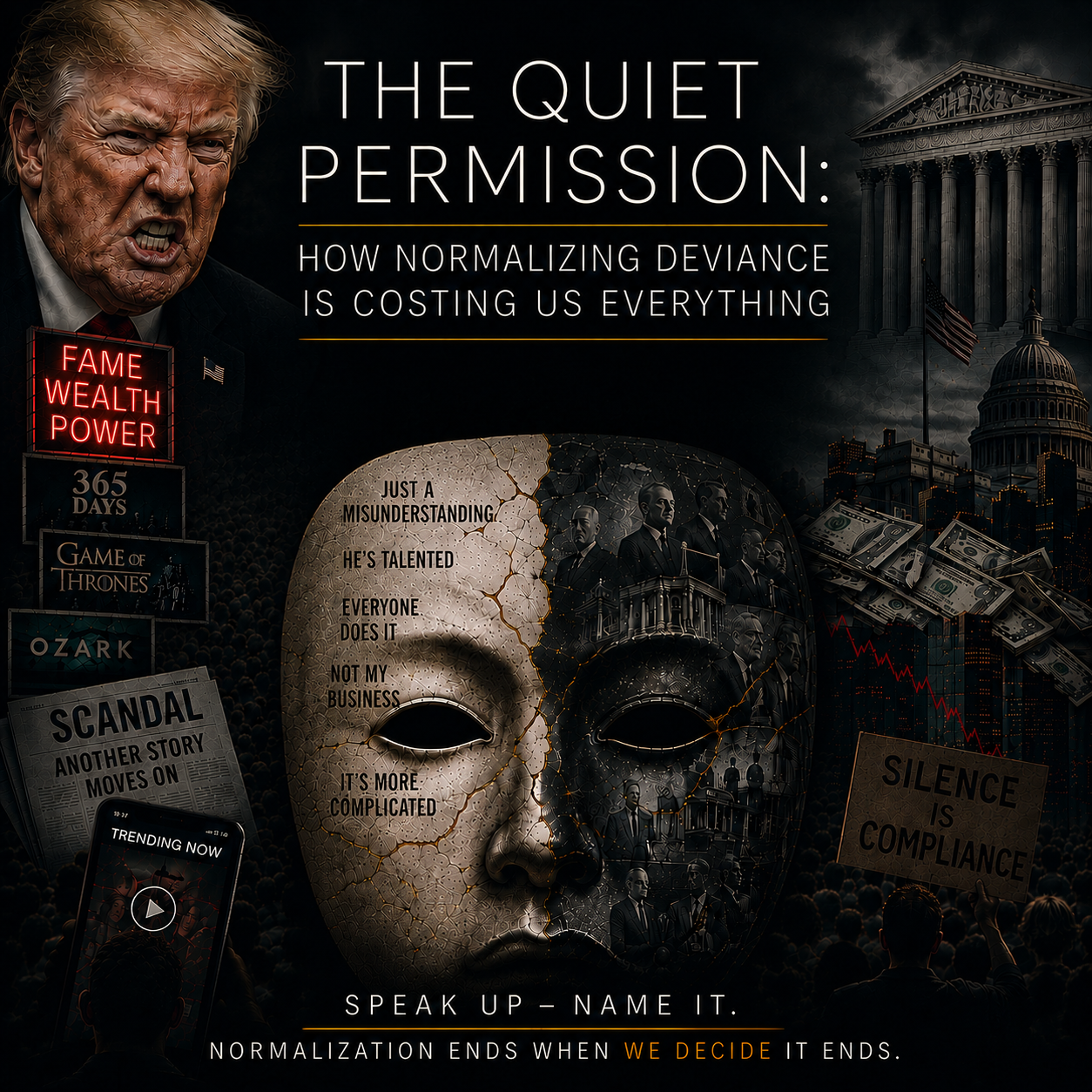
PART ONE: The Anatomy of Deviance
Consider something that would have genuinely shocked you ten years ago. Maybe an event you believed could never happen or one no one would ever accept.
Now, ask yourself whether it still shocks you, or if you have just accepted it?
There was a time when we described terrible acts by powerful individuals as corruption. Later, we called them scandals, then reduced them to just complicated. Eventually, we stopped naming them altogether, and somewhere between the scandal and the silence, lived normalization.
The uncomfortable truth we rarely acknowledge is that many of us have watched the shows, followed the trials, and clicked on the stories. We’ve shaken our heads and moved on. I have done the same, as have most of us.
Sexual Deviance
There are two ways to define sexual deviance. The sociological definition is based on what society considers abnormal or immoral, and this standard shifts over time, across cultures, and in response to power dynamics. The clinical definition is stricter: it refers to sexual behavior, fantasies, or urges that cause real harm to others, often without consent or involve uncontrollable compulsion. The first definition is intentionally vague. The second focuses solely on harm. Most coverage of sexual deviance relies on us remaining within the first definition long enough that no one asks the second question: Who was hurt?
Paraphilic disorders, the clinical term used in the DSM-5, the diagnostic bible of mental health, are disorders designated when the behavior causes real harm, is non-consensual, or creates significant distress or dysfunction in the person’s life. Not every unusual sexual interest qualifies, but pedophilia and rape fall squarely into this category. Atypical sexual behavior is a broader umbrella that means anything outside societal norms, but atypical alone does not make something a disorder; the harm does.
Where does it originate?
Research points to a combination of psychological, developmental, and biological factors: early childhood experiences, attachment disruptions, trauma, neurological differences, and, in some cases, genetic predisposition. There is no single cause; it is usually the result of several factors converging.
Freud was the first to study this area. His framework provided the language, but many of his conclusions did not hold up. What has endured, though, is his core idea that early experience shapes sexual development in ways that are profound and lasting.
This distinction is important: most people with atypical sexual interests never act on them and never harm anyone. The focus is on a specific subset of those who do act, particularly against non-consenting individuals, and how such behavior has become normalized in daily life.
Economic Deviance
Economic deviance and sexual deviance are not as different as we would like to think, because they grow from the same soil. Both are rooted in power, needing to control others, asserting status, and taking what feels entitled. Whether someone is manipulating financial markets or manipulating people, the underlying psychology is remarkably consistent: entitlement, a willingness to dehumanize, and the belief that the rules do not apply to them.
Sociologist Robert Merton’s Strain Theory explains that when people cannot achieve what society tells them they should have wealth, status, and power, some do not abandon the goal. Instead, they abandon the rules to get there, and when you layer narcissism on top of that, you get something particularly dangerous. You see someone who genuinely believes the rules were never meant for them in the first place. People like Bernie Madoff, Sam Bankman-Fried, Martin Shkreli, or the architects of the 2008 financial crisis. I will discuss many of them further on, but first, understand that the psychology driving every single one of them is the same psychology driving sexual predators. They have the same roots, but a different crime scene.
Learned behavior and deviance go hand in hand. Environments that treat deviance as normal pass it down. You learn to commit financial fraud the same way you learn that exploitation is acceptable, by watching the people around you do it without consequence. Wealth does not just enable economic deviance; it enables sexual deviance because money buys privacy, silence, and a sense of immunity that allows both to flourish unchecked. That is not a coincidence; it’s a system.
Society regulates economic and sexual behavior separately through different laws, courts, and conversations. However, the foundation is identical: power and the belief that gratification justifies the cost to everyone else.
Social and Political Deviance
Social and political deviance operates a little differently from the other two. It does not always look like a crime or have a victim you can point to, but the damage is just as real, and in many ways, it is the category that makes all the others possible.
Tribalism is evolutionary and deep-seated. Humans are wired for in-group loyalty, and under the right conditions, it overrides almost everything else, including moral judgment. When someone on our side does something wrong, we often try to minimize it, contextualize it, and find reasons why it is different. When someone on the other side does the same thing, we prosecute it loudly and without mercy, as if we are Tom Cruise in A Few Good Men. That is not hypocrisy, well, it is, but it is also how tribal psychology works. We see an increase in letting it run unchecked through our institutions, the media, and our moral framework, until accountability becomes a partisan act.
Motivated reasoning means we do not evaluate evidence and arrive at conclusions; we arrive at conclusions first, based on who we deem worthy of protecting, and then work backward to find the supporting evidence. It feels like critical thinking, but it’s not.
Institutional deviance may be the most insidious form of all. Organizations designed to enforce accountability end up providing cover. The church that moves predators from parish to parish instead of reporting them. This happened in my childhood parish when I was sixteen, and it made me swear off organized religion for the rest of my life. It’s the studio that settles quietly and requires NDAs, the political party that closes ranks around its own, or the HR department that protects the company instead of the employee. My favorite example is the Supreme Court bending for wealth, political allegiance, and pay-offs.
These institutions do not wake up one day and decide to cause harm; it happens gradually. It happens with small compromises that seem reasonable until the compromise itself becomes the policy, and that is when deviance stops being an exception and becomes the rule.
The Through Line Across All Three
The same ingredients comprise sexual, economic, and social deviance. Entitlement is the first ingredient because it is the unshakeable belief that you deserve what you want and that others exist to provide it. The next ingredient is dehumanization, where we stop seeing the person in front of us as fully human, which is the only way we can keep harming them and moving forward. The last ingredient is the conviction that consequences belong to others, not to you, never to you.
Albert Bandura spent his entire career asking how people do terrible things and still live with themselves, and concluded that moral disengagement was the answer. It’s a set of mental mechanisms that allow us to switch off our own conscience when it becomes inconvenient. Perpetrators justify their behavior by claiming it serves a greater purpose. It is the diffusion of responsibility, such as someone else knew or should have stopped it, or the dismissal of consequences, such as stating “It was not that bad” or “They will get over it.” It is the dehumanization of victims, believing she wanted it, he was asking for it, or they knew what they were signing up for.
Bandura’s work is uncomfortable because these mechanisms don’t only operate in perpetrators; they operate in all of us. They operate in institutions that look the other way. In colleagues who stay silent. In audiences who keep streaming the content, or keep buying the R. Kelly records. In viewers who still watch Woody Allen films, even after he married Soon-Yi Previn, his long-term girlfriend’s daughter, adopted at twelve. They operate in voters who voted and elected a con-man who promised wealth to the middle class, watched him take everything he could pry from their hands, and still cannot bring themselves to admit they were wrong, because any other conclusion would demand they confront the cognitive dissonance they spent years avoiding.
Moral disengagement is the engine that makes deviance sustainable, for the people committing it and for everyone around them who decides, consciously or not, that it is easier not to know. That is how deviance survives and becomes normal.
PART TWO: How It Becomes Normal
Vaughan’s Normalization of Deviance
Diane Vaughan studied the Space Shuttle Challenger disaster and found something that had nothing to do with engineering. The engineers had seen small warning signs so many times without catastrophe that the signs stopped feeling like warnings. The deviation became the norm, and then one day, the shuttle exploded. Vaughan named this the normalization of deviance.
During the incubation period, when things are going wrong, but nothing has blown up yet, we tell ourselves everything is fine. Jeffrey Epstein operated for decades. Harvey Weinstein produced films for decades. The banks gambled with the global economy for decades because nothing catastrophic had happened yet. Until it did.
Vaughan’s key distinction matters because it’s not about bad individuals making bad choices. It’s about systems that slowly redefine what is acceptable, until the unacceptable becomes policy, becomes culture, becomes just the way things are.
Desensitization
In the 1980s, psychologists Dan Linz, Ed Donnerstein, and Steve Penrod conducted a study that should have changed everything, but mostly did not. They exposed men to films depicting sexual violence against women over five consecutive days. With each day of exposure, anxiety decreased and enjoyment increased. The material that the men initially found offensive and degrading became significantly less so by day five.
The most disturbing finding after the five days was that when those same men viewed a videotaped reenactment of a real rape trial, they showed measurably less empathy toward the victim than men who had not been through the five days of violent exposure. The initial media they consumed changed how they saw a real woman in a real courtroom.
That study is a documented finding called desensitization. It proved that repeated exposure does not just make us comfortable with what we are seeing, but rewrites our internal script for what is acceptable, what is normal, what deserves our empathy, and what does not.
That makes me think about what we have all been watching for the last twenty years.
Media as the Normalization Engine
Entertainment does not just reflect culture; it shapes it, and what we have been watching has shaped us in ways we have not been honest about.
365 Days is a Netflix film about the kidnapping of a woman by a Sicilian crime boss, who gives her one year to fall in love with him. This was the most-watched Netflix film in 2020. The film, to normalize deviance, frames kidnapping as romance, coercion as passion, possession as love, and resistance as the beginning of surrender. No consequences or reckoning for the criminal rapist, only a happy ending for him and for her. It is a horrible film made even worse by deviance force-fed to us as love.
Game of Thrones gave us rape as a plot device so routinely that audiences began to accept it as atmosphere, and were often attracted to the violator Drogo/Momoa. These scenes were consistently shot from the perpetrator’s point of view, framed as character development, his, not hers. The victim’s trauma was rarely the story, because her suffering existed only to tell us something about the man who caused it.
Euphoria is more complicated, and therein lies the problem. Whether you think it is brilliant or not, it represents a sustained romanticization of teen addiction, exploitation, and sexual trauma. For a non-desensitized audience, it might function as a critique. For an audience that has been through the five-day experiment, the distinction between critique and glamorization collapses entirely. The harmful sexual deviance of underage partners, the objectification of females who are unloved and emotionally and physically abused, packaged neatly in big homes, expensive clothes, and most not held to accountability, promotes a normalcy that is deeply troubling.
White Lotus is the most sophisticated example on this list, which makes it the most insidious. Predatory wealth, sexual exploitation, and moral bankruptcy all wrapped in gorgeous cinematography. It makes depravity intellectually engaging, and that is exactly how normalization gets its deepest hook in us. When we feel sophisticated for consuming something, we stop asking what it is teaching us.
DTF St. Louis, billed as a dark comedy, takes an entirely different approach. Jason Bateman, well known for Arrested Development, Ozark, and the podcast Smartless, enters a show on infidelity and sexual transactionalism dressed up as prestige TV and packaged as relatable middle-aged malaise. It makes moral erosion feel ordinary, and ordinary is exactly when deviance becomes most dangerous.
Ozark is economic deviant entertainment. The entire purpose of the show is to hope that the Cartel and a hillbilly opiate ring do not kill a money launderer. We cheer for the main character and his wife, along with their children, who are part of the family business, and we measure their success not by whether justice is served but by whether they escape it. This is exactly how we have been conditioned to think about financial criminals in real life, too.
What all six of these shows have in common is that they are well-made, have devoted audiences – including me. In every single one of them, the deviance is the draw. We don’t watch despite the darkness. We watch because of it.
How Journalism Fails Us
Journalism frequently abandons its responsibility when exposing a powerful person’s deviant behavior. It often follows the same arc of revelation, to the statement, then the think pieces, and finally the next story. What rarely happens is the harder question of how this goes on so long, and who benefited from the silence?
The monster narrative is journalism’s most reliable tool for letting everyone else off the hook. When we frame Harvey Weinstein as a singular aberration, we do not have to talk about everyone who knew. The monster contains the damage. The system walks free, and the language does the rest.
Using words such as misconduct instead of rape, indiscretion instead of fraud, inappropriate relationship instead of abuse of power is careless and complicit. So let’s stop reaching for the softer words and talk about who they are, what they did, and exactly how the system protected them.
PART THREE: The Protected Class
The following are case studies, not aberrations, in how deviance gets protected, celebrated, and absorbed into the culture until it stops feeling like deviance at all.
The Industry Shield
R. Kelly wrote a song called Age Ain’t Nothing but a Number and we made it a hit. He married Aaliyah when she was fifteen, and he was twenty-seven, and the music industry shrugged. He filmed himself with a minor, went to trial, and a jury acquitted him in 2008, while his records kept selling, and we kept dancing. The abuse was never a secret; it was hiding in plain sight inside the music that we sang every word of. It took over a decade, a documentary, and a federal conviction in 2021 before anyone was willing to call it what it always was: rape, kidnapping, and pedophilia.
Bill Cosby was America’s Dad for thirty years. I grew up on his recorded comedy routines, laughing hysterically along with my family. I had seen him twice in concert and left with sore cheeks from smiling and laughing so hard. Along with his comedy, he lectured Black America about pulling up their pants while he was drugging and raping women in hotel rooms. Sixty women came forward and reported his abuse. Sixty. Convicted in 2018, and then a technicality set him free. Not because he didn’t do it, but because one prosecutor made a promise that another prosecutor broke. He walked out of prison in 2021, while the sixty women had nowhere left to go. That is not justice, it’s the system protecting its own comfort.
Roman Polanski pleaded guilty in 1977 to the statutory rape of a thirteen-year-old girl. Then he fled to France before sentencing and never returned. Yet, Hollywood kept working with him and honoring him. In 2003, the Academy gave him the Oscar for Best Director for The Pianist, and the room full of Hollywood’s top actors and fans gave him a standing ovation. How unbelievable, a standing ovation for a convicted child rapist who fled the country. If you want a moment that captures how completely the industry normalized its own deviants, that’s the one.
Jeffrey Epstein was the hub of deviance. He pleaded guilty in 2008 to soliciting a minor and received a deal so lenient it became its own scandal. He served 13 months in a county jail with work-release privileges. Then he went right back to his mansions, his private island, and his black book. The most powerful people in the world kept taking his calls, kept flying his plane, kept attending his dinners. They had to because he made himself deliberately indispensable, financially, socially, and strategically. Wealth and access were the mechanisms of his protection.
Michael Jackson was the soundtrack to my childhood. The Jackson 5 played in my house the way air moves through a room; constantly, naturally, without question. When Michael released his first solo album, Off the Wall, we played it a million times, but what changed everything was Thriller. When the video premiered on MTV, I recorded it on VHS and played it over and over until my brother, my best friend, and I had learned every single step of that dance. We practiced it so many times that I heard my dad ask my mom if we were learning it for a school project. My fourteen-year-old sassy head quickly turned toward him and, in an exasperated voice, said: “Oh my god, Dad, we HAVE to learn this.” How could he not understand that?
When he moonwalked during the Motown 25 special, I jumped up from the floor and tried to do it on the spot. My brother and I practiced until we had it perfected. Michael Jackson’s dance moves and music were not just entertainment for all of us; they were a language. A shared experience that connected an entire generation to something that felt genuinely magical.
Which is exactly why what came next was so devastating.
When the rumors of abuse surfaced, I did not believe them. Looking back now, I understand exactly why. I had bought completely into the wealth and hierarchy of protected deviance. The logic was simple and seductive: someone that beloved, that gifted, that important to the culture could not possibly be capable of the abuse of children that he professed to love so dearly. The fame functioned as a character reference, the money functioned as proof of innocence, and I, like millions of others, accepted that without examining it.
It was not until 2020, when I watched Leaving Neverland, that the real horror of his deviance came into clear view. The testimony of Wade Robson, whom I admired as a brilliant modern choreographer, and James Safechuck was specific, detailed, and deeply credible. I was devastated. My childhood hero — the person whose music and movement had shaped some of the most joyful memories of my life— had used his fame, money, and the very magic that made him untouchable to gain access to children and systematically abuse them.
This particular cruelty weaponizes your love for the perpetrator against your ability to see clearly. The more you love them, the more the system can count on you to look away; and the more we collectively look away, the longer the abuse continues.
Even posthumously, Jackson’s guilt remains a topic of debate, a testament to how effectively fame and money can muddy waters that should be clear. He was too valuable, too beloved, too culturally significant to hold accountable, and because of it, the system decided that some people are worth more than the harm they cause.
The Economic Shield
Elizabeth Holmes built Theranos on a costume and a con: the turtleneck, the artificially deepened voice, the Steve Jobs mythology. She convinced investors, hospital systems, and Silicon Valley that her company could diagnose hundreds of diseases from a single drop of blood. This technology didn’t exist and never worked. Patients received false results and made life-altering medical decisions based on fraudulent data. For years, people celebrated her as the most important female entrepreneur of her generation, not despite the fraud but because a culture hungry for her story refused to look closely enough to see it was not true.
Bernie Madoff created the largest Ponzi scheme in history, totaling $65 billion. Madoff was protected for decades by prestige and the assumption that someone that successful couldn’t possibly be a fraud. The mechanism was simple: wealth and social status served as signals of innocence.
Sam Bankman-Fried, convicted in 2023, was the deliberately disheveled grifter who built a crypto empire on the performance of generosity as moral camouflage. The shield that allowed him to get away with the swindle was this: if you appear to be giving it all away, nobody asks where it came from.
Martin Shkreli defrauded hedge fund investors and raised the price of Daraprim, a life-saving malaria drug, from over $13 to $750. That is a 5,456 percent increase on a drug that people needed to live. Some circles celebrated him as a capitalist genius, but many think that ambition wasn’t his motivation; it was predation with a business license.
Donald Trump did not just normalize deviance; he made it a brand. Judges found him civilly liable for sexual abuse and defamation in the E. Jean Carroll case, plus criminally convicted on 34 counts of business fraud. He paid hush money to a porn star and called it accounting, and was recorded on tape bragging about grabbing women without consent. He called it locker-room talk, and disturbingly, many believed him.
He vilified the media as the enemy of the people while simultaneously using them as pawns in his malignant game of narcissistic attention gluttony, understanding before anyone else that outrage is just another form of ratings. He did not need good press; he just needed the press, and they gave him as much attention as he craved every single time.
Then came the payoffs. Foreign governments funneled money through Trump hotels, while Saudi Arabia's sovereign wealth fund propped up his golf courses through LIV Golf.
The most powerful companies in the world, Apple, Meta, and Amazon, lined up to genuflect by writing checks, attending summits and inaugurations, posting congratulations, and calling it business when it was nothing of the sort. It’s a tribute, the kind you pay when you have calculated that resistance costs more than surrender. That is not capitalism. That’s a protection racket with a better press release.
He appointed three Supreme Court justices in one term, who went on to dismantle fifty years of established law, and in doing so, he did not just influence the highest court in the land; he owns it. The people cheering loudest were the same ones clutching their rosaries, their Bibles, and their Books of Mormon, because somewhere between the porn star and the pussy grabbing, Donald Trump convinced Catholics, Evangelicals, and Mormons that God had sent him. A man who has never demonstrated a single authentic moment of spiritual conviction in his entire public life, sold salvation (and Bibles) to people desperate enough to buy it.
It is a con disguised as faith, and perhaps the most normalized form of deviance of all, because when you wrap corruption in religion, you make it untouchable. He cynically turned every accusation into a rallying cry, every conviction into a fundraiser, and every piece of evidence into a witch hunt. No one in modern American history has more effectively weaponized the normalization of deviance than Donald Trump. He did not hide it. He ran on it and won. Twice.
The through line across every single one of these cases is not the crime, it’s the cover. It lives in the industry that keeps working with them, the institutions that look the other way, and in the audiences that keep consuming. The systems found reasons why this particular person, at this particular moment, was too valuable to hold accountable. This is normalization, not a theory or an academic concept. It is the deliberate choice to protect certain people, and that choice has a cost. That cost is what we need to think about.
PART FOUR: The Cost It Steals from Us
What does normalization of deviance actually cost us? Not abstractly or theoretically, but the toll it puts on us.
It starts with the people it directly affects. Survivors of sexual violence, financial fraud, and institutional betrayal share something that doesn’t get talked about enough: the internal erosion that happens before anyone else even knows. The question that normalization plants directly inside the victim is, was it really that bad? That question is not a weakness, but what happens when you have spent your whole life watching the culture minimize, contextualize, and excuse exactly what just happened to you. You absorb the doubt before anyone else even has a chance to express it.
Psychologist Jennifer Freyd called this institutional betrayal: the specific, compounding trauma that occurs not just from the original harm but from being failed by the systems that were supposed to protect you.
I have witnessed this firsthand. I told you earlier that institutional deviance happened in my own parish when I was sixteen. What I didn’t tell you is that my favorite priest molested brothers whom I knew. A man I was in awe of because I genuinely believed he was wholly spiritual. When I learned about his sexual deviance, the truth was undeniable, and the church moved to protect the priest, not the boys. They didn’t report him, nor did they protect the boys. Instead, they protected the institution. I watched the other parishioners find ways to rationalize, minimize, and contextualize it because the alternative was too uncomfortable. That was my first real education in normalization, and where I understood that the silence of good people is just as much a part of the system as the predator’s actions.
Martin Seligman’s learned helplessness research tells us that when people repeatedly experience that their actions have no effect, that reporting leads nowhere, that speaking up changes nothing, they stop trying. Not because they don’t care, but because they’ve been taught by experience that caring doesn’t matter. Every protected perpetrator sends that message to every potential survivor within earshot: this system isn’t for you. Stay quiet; it’s safer.
The Cost to Bystanders
The cost does not stop with survivors. It spreads.
The bystander effect, the well-documented phenomenon in which the presence of others reduces individual responsibility to act, doesn’t only occur in emergencies on subway platforms. It happens at a societal scale. When an entire culture watches deviance remain unpunished, the diffusion of responsibility becomes total. Someone else will report it. Someone else will fix it. Someone else will say something. And no one does.
Moral disengagement spreads outward from perpetrators to witnesses, to institutions, to culture, until it becomes the ambient temperature of society. Then someone comes along and says the most dangerous sentence in the English language: “That is just how the world works.” The moment we accept that sentence and stop hearing it as a failure, and instead hear it as wisdom, we have crossed from bystander to participant. Cynicism makes us passive and complicit.
The Cost to Children
Then there are the children watching it all. Research on adolescent media consumption is unambiguous because what young people consume shapes what they normalize. It’s measurable and constantly runs in the background of every screen in every bedroom in every home. Children who grow up watching deviance go unpunished accept it as normal and internalize it as instruction for how power works. They learn that these are the rules, and they are optional if you are the right kind of person.
Normalized deviance persists across generations, passed down through examples we model, the behavior we excuse, the content we consume, and the things we choose not to name.
The Cost to Democracy and Institutions
The cost to our institutions and our democracy is harder to quantify, but impossible to
ignore.
Hannah Arendt, writing about the trial of Nazi war criminal Adolf Eichmann, gave us one of the most important concepts in modern political thought: the banality of evil. She argued that the most dangerous evil is not dramatic, cackling, or theatrical; it is bureaucratic and ordinary. It’s the person who processes the paperwork, follows the orders, attends the meetings, and never asks a question. It looks like a boardroom, a courtroom, a studio lot, a church, or a Senate and House chamber.
When accountability disappears long enough, people stop expecting it. The vacancy is filled by someone who points at the wreckage, promises to clean it up, and neglects to mention they helped make the mess. That is how authoritarianism finds its opening, not through force but through exhaustion.
The Literal Financial Cost
The normalization of deviance has a literal price tag.
Sexual violence costs the United States an estimated 3.1 trillion dollars annually through healthcare, lost productivity, legal costs, and mental health treatment. It derails lives, careers, and extinguishes unrealized potential, all of it quantifiable, all of it preventable, none of it curtailed.
The 2008 financial crisis, built on normalized fraud, celebrated risk-taking, and the institutional certainty that certain people were too important to fail, wiped out an estimated 22 trillion dollars in household wealth. Families lost the homes they had spent decades building, their retirements evaporated, and the people who built the machine that collapsed received bonuses.
Political corruption is harder to quantify, but can be measured by every school not funded, every hospital not built, every climate bill not passed, and by every infrastructure project that crumbled as money went missing or was redirected into the pockets of politicians.
That cost is paid by survivors, bystanders, children, and by democracies. It’s not only paid in dollars, but in the eroding belief that any of it could change.
PART FIVE: Keep Calling It What It Is
So what do we do with all of this?
If this blog ends in despair, it has failed. The entire argument is that normalization happens gradually, quietly, and with our participation, which means we can participate in making it abnormal again. If we helped it become normal, we can help make it unacceptable again.
The first battleground is language, and it is the one we have the most immediate control over, because words are how normalization travels, through euphemism, through softening, through the careful selection of the least alarming way to describe something that should disturb us deeply. Calling something misconduct when it’s rape, an indiscretion when it’s fraud, or a complicated relationship when it’s abuse of power are all examples of language used as a shield for the perpetrator rather than a protection for the victim. Boys will be boys is not an explanation but a permission slip handed out for centuries, and naming things accurately is not harsh, political, or inflammatory; it’s precision, the first act of resistance.
The second act of resistance is refusing the tribal pull, and it is the hardest one because it requires applying the same standard to the people we like, admire, and agree with that we apply to everyone else. The moment you find yourself reaching for context or nuance specifically because of who the person is, their politics, their talent, their relationship to you, stop. Ask the question you would ask if it were the other side, because accountability only works when it is applied consistently, and the minute it becomes selective, it becomes worthless.
Stopping the outsourcing of our moral judgment to institutions is equally critical. These systems have demonstrated, repeatedly and at great cost to the people they were meant to protect, that they arbitrate what they can afford to admit rather than what is right. Your own assessment of behavior does not require a verdict.
The research supports what most people do not believe: resensitization is possible. Linz and Donnerstein proved that repeated exposure to harmful content desensitizes us, but they also proved that sufficient distance from that exposure restores empathy. What we consume doesn’t permanently rewire us, but we must make deliberate choices about what we continue to put in front of ourselves. Critical media consumption means asking questions before pressing play: who serves as entertainment for whom? Watching differently is the answer.
For those with children, this is the most urgent part of this entire conversation. Research on prevention is consistent across decades of study, and early education about power, consent, and accountability is the single most effective intervention available. Not just the conversation about bodies and safety, though that matters enormously, but the broader conversation about power: who has it, how it gets abused, and what it looks like when institutions fail to check it. Children who can identify and name deviance are significantly less vulnerable to it, as potential victims, as bystanders, and eventually as the adults who will either perpetuate these systems or dismantle them.
Individual moral clarity is necessary but not sufficient on its own because systems require structural reform, not because institutions deserve our trust; they have spent considerable energy demonstrating that they do not, but because accountability needs infrastructure. That infrastructure includes laws with teeth, courts that are actually independent, journalism that is actually funded and free, HR departments that answer to employees instead of shareholders, and a political culture that determines the protection of power is no longer worth the price we have all been paying.
None of this is easy or quick, but the history of every social shift proves that we can reverse normalization. MeToo happened, the Challenger findings changed NASA, and financial regulation followed the 2008 collapse. Society eventually names what it once refused to acknowledge and holds accountable those who were once untouchable. The incubation period always ends, and the only question that matters is how many people end up hurt before it does.
PART SIX: Remembering that Deviance is Abnormal
We started with a question, not about the predators, not about the politicians, not about the billionaires, but about us. About the adjustment we make, quiet, gradual, and almost invisible, every time we decide it is easier not to know, every time we reach for the softer word, and every time we look away and tell ourselves that someone else will handle it. That adjustment has a cost, and this blog has spent considerable time accounting for it.
3.1 trillion dollars a year in sexual violence alone. 22 trillion dollars in household wealth was wiped out by normalized financial fraud. Survivors who learned to doubt their own experience before anyone else had the chance to doubt it for them. Children absorb instructions about power from the content we choose to put in front of them. Institutions that traded accountability for self-preservation so many times that self-preservation became their only function. A democracy that keeps asking people to trust systems that have given them very little reason to.
Entitlement, dehumanization, and the conviction that consequences belong to other people power the same engine underneath all of it. Moral disengagement spreads outward from the person committing the harm to everyone around them who decides, consciously or not, that it was easier not to know.
Diane Vaughan told us that the normalization of deviance always has an incubation period, a long stretch of time in which the warning signs exist but nothing catastrophic has happened yet, so we tell ourselves everything is fine until the Challenger explodes, MeToo breaks, and FTX collapses. The incubation period always ends, and we are in one right now, because across all three domains explored in this blog, sexual, economic, and political, the warning signs are not subtle, but loud, documented, and sitting in plain sight for anyone willing to look. The question is not whether we can see them, but whether we are willing to stop adjusting.
They could not do any of it without our willingness to be entertained by it, to vote for it, to stream it, to excuse it, to stay quiet about it, and to decide that this particular person at this particular moment was too important, too complicated, or too powerful to hold accountable. That ends when we decide it ends, not in a courtroom, not in a headline, but in the daily, ordinary, unglamorous decision to call things what they are, to refuse the softer word, to apply the same standard regardless of whose side someone is on. To teach our children that power is not the same as permission, and to support the structures that make accountability possible even when those structures have failed us before.
Leaving the field to the people counting on our silence is a cost none of us can afford.