What Loss Leaves Behind:
Grief, Identity, and Who You Become When Someone or Something Is Gone
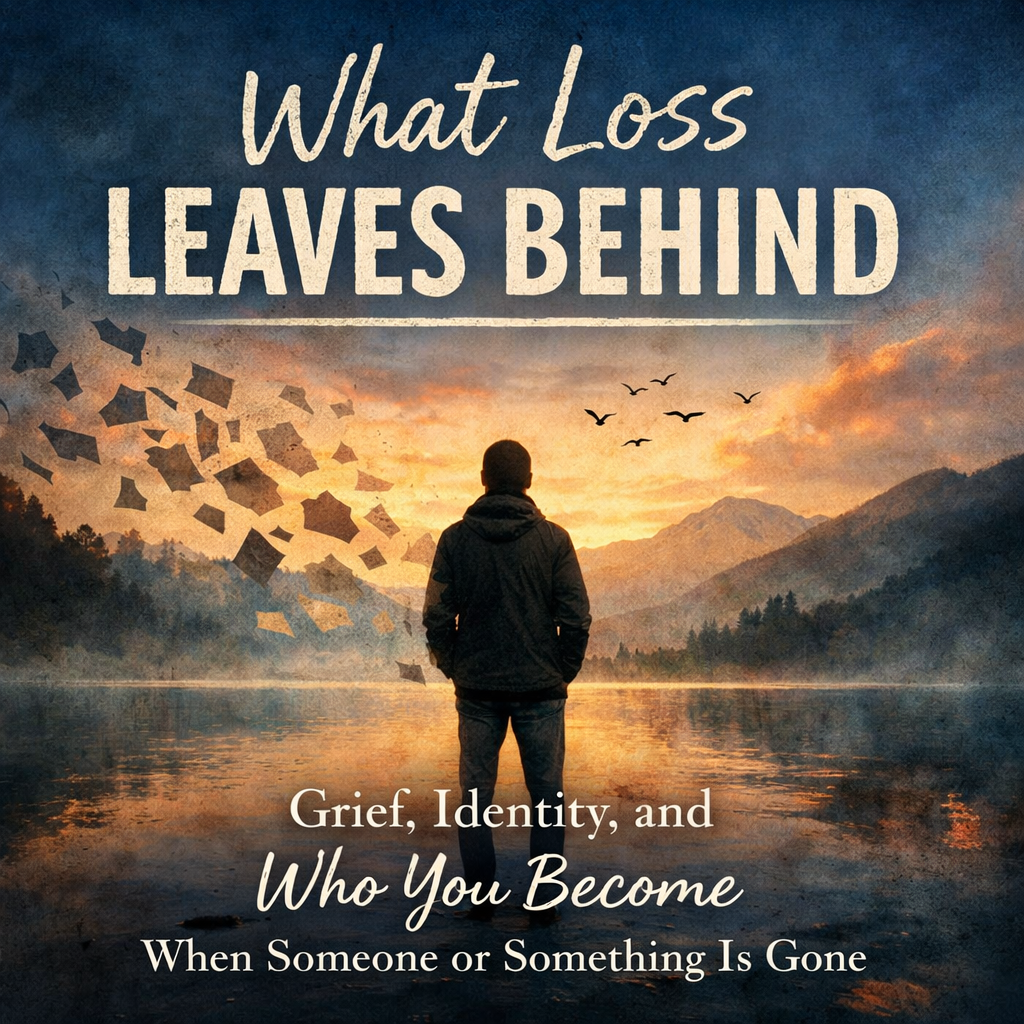
Welcome to The Original Self Podcast. I’m Evet DeCota, owner of DeCota Life Coaching. I’m a psychology-informed life coach exploring resilience, mindset, and the courage to become your authentic self. This is a space for honest conversations about growth, identity, relationships, and all the messy moments in between that shape who we become. Whatever brought you here today, you’re in the right place.
I’ve noticed over the years that, standing behind a salon chair and coaching individuals, people rarely come in for just a hair service or a single topic. They come to me carrying doubts, fears, dreams, and questions about who they are becoming.
Over time, I’ve realized that beneath all the noise of expectations, criticism, and life’s pressures, there is still a version of ourselves. Let’s explore What Loss Leaves Behind: Grief, Identity, and Who You Become When Someone or Something Is Gone.
Every loss changes the shape of the life around it. Some losses are announced with funerals and flowers. Others happen quietly, without ceremony, and nobody thinks to ask how you are doing.
Loss is not just about death. It’s about the absence of something or someone that once helped define who you were. Today I want to talk about all of it — the losses we name and the ones we never do. And I have brought someone with me who has lived through many of the same ones I have.
Stefan DeCota is my older brother by almost three years. We were very close as small children, drifted apart in our late teen years the way siblings sometimes do when they are busy becoming themselves, and found each other again in our mid-twenties in a way that has never wavered since. Our mother taught us to value one another and to be each other’s best friends. An argument has never lasted more than a few hours — it simply wasn’t allowed.
Stefan is a strategic business advisor with 25 years of experience at large startups and data-driven companies across marketing, finance, and fashion. But his real talents are not seen; they are felt. They are felt by everyone who knows him and everyone he takes an interest in. He celebrates people, he loves deeply, and because he loves so deeply, loss has hit him hard and often. He has carried a great deal, and yet he still stands. He doesn’t break, and that is exactly why his voice matters today.
When we lose a friend, through a huge rupture, a ghosting, a slow drift, or a death where circumstances kept us from being present, we are left holding a grief the world doesn’t have a name for.
Dr. Pauline Boss, a family therapist and researcher, developed the Theory of Ambiguous Loss. Ambiguous Loss describes grief that has no clear ending and no social recognition — the grief is real, but receives no permission to exist. Losing a friendship fits this perfectly. There’s no formal goodbye, and the world does not stop to acknowledge it. But the pain is real, and a shift in identity often follows. People often blame themselves or minimize it because there is no script for how to grieve someone who is still alive.
The Grief Nobody Names: Losing a Friendship -Ambiguous Loss
Questions:
• Have you ever lost a friendship that mattered to you — not through a fight or a clear ending, but just a slow disappearance? What was that like?
• Did losing that friendship change how you saw yourself at all?
I recently read research published in Nature Reviews Neuroscience that confirmed unacknowledged grief registers in the brain as genuine pain. The same neural regions activated by physical injury are also activated by social disconnection and loss. The fact that no one brought flowers does not mean the wound was not real.
Research presented by Duke and Yale Universities showed that friendships are biological. The bonds we form are governed by the same neural and biochemical systems woven into our health and survival. Stronger social bonds make us live longer and carry lower levels of cortisol, our stress hormone. This means losing a friendship is not just an emotional loss but one that the body registers and carries long after the conscious mind has moved on.
• Do you think men grieve the loss of friendships differently from women? Is it something men even talk about?
• Is there a loss in your life that did not fit neatly into any category — not a spouse, not a parent, not a traditional friendship — but hit you just as hard? How did you make sense of that grief when the world did not have a name for it?
• Is there anything harder than watching someone you love grieve, especially when you are grieving the same loss, and there is nothing you can do to take it away from them?
Romantic Relationships and Who You Were in Them: Identity Enmeshment and the Loss of the Relational Self
Psychologists who study relationships argue that our sense of self is partially constructed through our closest bonds. When a significant relationship ends, we do not just lose the person; we lose the version of ourselves that existed inside that relationship. The habits, the routines, the way we saw ourselves reflected in their eyes. This is sometimes called loss of the relational self, and it is why breakups and divorces can trigger a full identity crisis even when the relationship was not a healthy one.
Questions:
• When a significant relationship ends, do you think people lose more than just the person — do they lose a version of themselves too?
• How did you find your footing again after a significant relationship ended?
• Is there a version of yourself from a past relationship that you miss, or one you are glad is gone?
Losing Parents: Stages of Grief vs. Continuing Bonds Theory
For a long time, grief was understood as a process of letting go — moving through stages until you reached acceptance and release. Elisabeth Kubler-Ross gave us the five stages of grief: denial, anger, bargaining, depression, and acceptance. They were never meant to be a linear checklist but are often treated as one.
More recent research, particularly Continuing Bonds Theory developed by Klass, Silverman, and Nickman, challenges the idea that healthy grieving means detaching from the person you lost. Instead, it suggests that we can and do maintain an ongoing relationship with those we have lost — carrying them forward in how we think, how we make decisions, and who we are becoming.
Losing a parent also removes the people who have known you the longest, the witnesses to your own story, and that particular absence reshapes identity in ways that take years to understand fully.
Questions:
• When we lost Mom and Dad, how did it change you — not just emotionally, but in terms of who you are?
• Did losing them make you question anything about your own identity or the direction of your life?
• Was there a moment after losing them where you felt completely untethered — like the people who knew you best were gone?
• How do you carry them now? What does that look like for you day to day?
The Unexpected Grief of Outgrowing People: Ambiguous Loss
Outgrowing someone you love falls into that same territory. There is no big fight, no funeral, no moment you can point to and say that is where it ended. You look up one day and realize the distance between you has become too wide to cross, and nobody permitted you to grieve that either.
Questions:
• Have you ever grown in a direction that took you away from people you once felt close to? How did you handle that?
• Is there guilt that comes with outgrowing someone, even when the growth is healthy?
• What would you say to someone in the middle of that right now — outgrowing people they love but unsure how to move forward without them?
Loss and the Original Self
Questions:
• Looking back at all of it — the people we have lost, the relationships that ended, the versions of ourselves that changed — who are you now that you might not have become without those losses?
• Do you think loss ever brings people closer to their original selves?
• What is the one thing about grief that you wish more people understood?
Personal Reflection:
Well, there you have it. One man’s perspective on loss and grief, and how we walk through it, carry it with us, and can become more from experiencing it.
For me personally, loss shows up in many ways and scenarios. I’ve had close friendships end, causing my confidence to diminish.
I feel that deep grief, that’s always just right under the surface, over my mother’s sickness and ultimate passing. When I lost my mother and father, I realized that I was an orphan, but after time had passed, I realized a type of power in having to count on myself rather than following a familial and cultural construct.
I know that loss left behind part of my innocent original self, but merged most of her with a stronger and more able self.
Mindset Shift:
What Stefan and I shared today is the kind of insight that doesn’t come from a textbook. It comes from living, and I hope that somewhere in our words, you heard something that sounded like your own story. Loss and grief are some of the most isolating experiences a human can have, and yet they are also the most universal. You are not alone in what you are carrying.
Reflection Question:
As I prepared for this episode, a quote by C.S. Lewis has stayed with me: Grief is like a long valley, a winding valley where any bend may reveal a totally new landscape. That is loss. That is life, so with that, ask yourself:
What loss are you still carrying that you have never given yourself full permission to grieve?
Thank you for listening to The Original Self Podcast. If these reflections resonate with you and you’d like to explore your own growth, you can learn more about my coaching at DeCota Life Coaching.