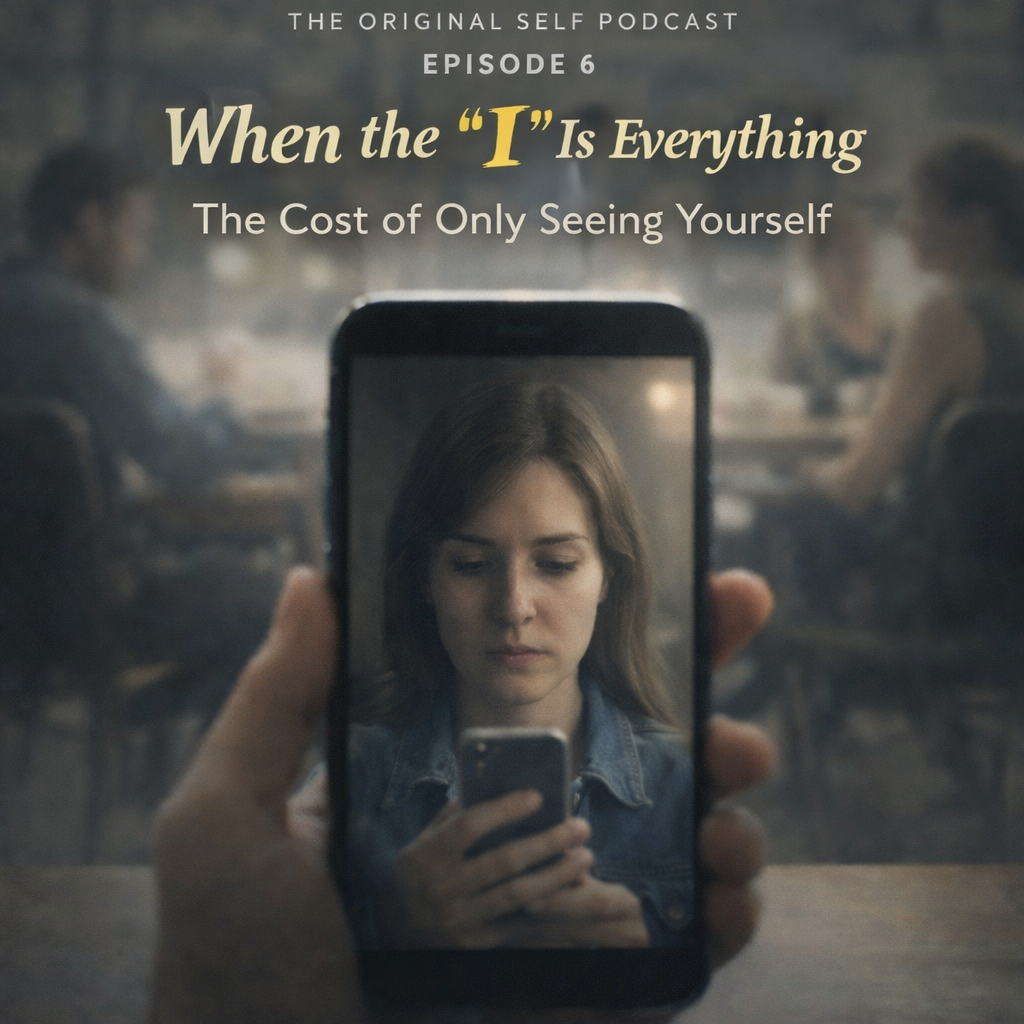
A friend mentioned she’d seen a music show about an hour away. What stayed with her wasn’t the performance but how friendly everyone was, staff and patrons alike. That struck me as unusual, but shouldn’t it be the norm?
The more I sat with it, the more I noticed: over the past five to ten years, patience, tolerance, and presence have, somewhere along the way, become the exception, not the rule. But why? Is it the “I” phone? Social media? A lack of in-person socializing? Is it othering, hyper-individualism, or empathy erosion? Maybe it’s all of the above, and if it is, what is it costing us?
There’s a reason this shift didn’t happen gradually over generations; it happened very fast. The iPhone launched in 2007, and people changed somewhere in the years that followed.
We stopped noticing what was around us and became little versions of Spielberg, documenting everything instead. Selfies, photos of food, filtered versions of real life, and then, everyone felt they needed to post their opinions about everything. Stated with the confidence of a New York Times editor, whether the facts backed them up or not.
Today, with each opinion liked or hearted, the “I” obsession grows, and so does disconnection. It sounds counterintuitive: more connection, more disconnection. But the more praise we receive through algorithms, the more real connections fade.
The psychological term for what happens when a culture tips so far toward the self is hyper-individualism, and it isn’t just a theory. In their book The Narcissism Epidemic, psychologists Jean Twenge and W. Keith Campbell identify online attention seeking as one of the key drivers of rising narcissism in American culture, and it’s not hard to see why.
Research points to three specific costs: loneliness, polarization, and a slow erosion of empathy. Not because people become bad, but because the lens narrows. When we filter everything through “I” – my experience, my opinion, my image – there’s simply less room for anyone else.
You can see all three playing out across the last three generations, just in different ways.
Gen Z is the first generation to grow up entirely inside the “I” era, and connection, in every form, has paid the price. They date less and are significantly less sexually active than the previous generation was at their age. They are slower to get their driver’s license, less likely to spend time together in person, and more likely to consider gaming or scrolling through social media as hanging out.
AI enters the room. Teachers and professors across the country are frustrated and failing students who submit papers written entirely by artificial intelligence. Often, nothing is their own voice or reflects their own thinking. But the deeper loss is the disappearance of something that used to happen naturally: sitting with a question long enough to form an opinion, debating ideas with friends, being curious out loud, writing something, and discovering what you actually think in the process of writing it. AI doesn’t just do the work for them; it removes the struggle that builds a mind. It is the ultimate “I’ tool. Instant, frictionless, and entirely without the discomfort of genuine thought or human exchange
Millennials came of age in the era of participation trophies and unconditional praise, also known as the self-esteem movement. They were raised to believe that showing up was enough, but research by leading self-esteem social psychologist Roy Baumeister shows that this didn’t build confidence so much as it built fragility that follows them into adulthood. Combined with the rise of the “I” era during their formative years, hyper-individualism took on a particular shape in this generation: my feelings, my boundaries, my truth became the primary framework for navigating the world, sometimes at the expense of discomfort that real growth and real relationships require. Many are still living at home, working remotely, their most social interaction a Slack message. There’s comfort in the arrangement, and without the friction of real workplace dynamics or in-person relationships, they may have less urgency to develop the resilience that comes from navigating them. It’s not laziness, it’s what happens when an entire generation was never quite asked to be uncomfortable, and then handed a phone that confirmed their worldview with every scroll.
Gen X, my own generation, stays home, streams, and, if we’re being honest, doesn’t put much effort into maintaining friendships the way we once did. I feel like the pandemic pushed us toward aloneness quickly, and we settled into it like a warm bath. Soothing for a bit, but stay in too long, and the pruning bleeds into the oncoming wrinkles of old age.
Gen X’s version of hyper-individualism looks different from the generations that followed us. It doesn’t look like fragility; it looks like detachment. We are the ‘suck it up, buttercup’ generation. We don’t particularly care what people think; we handle our business, and we have very little patience for what we perceive as coddling. I watched it up close when I went back to school and was significantly older than my classmates. I worked full-time while carrying a full course load. I was accountable to myself because that’s what I knew how to be. Sitting next to students who couldn’t turn in assignments on time, who were overwhelmed to the point of not being able to attend class, was jarring. There was even a woman in my class who told me and then the professor that she was going to be late turning in her midterm essay because she had a date and had to get her nails done. The gap between us felt enormous.
Here’s the thing about judgment, and I say this from a lot of experience: it is its own form of the “I.” When we decide that our way of handling hardship is the right way, that our threshold for discomfort is the standard everyone else should meet, we stop being able to see people across that divide. We separate and separation, whatever generation it comes from, leads to the same place; less connection, less empathy, more alone.
Three generations with three different expressions of the same withdrawal
Yet by every measure, we are more connected than any generation in human history. That’s the paradox. The more we curate and perform our lives for an audience, the less we actually let anyone in. In 2023, former Surgeon General Vivek Murthy described loneliness as an epidemic on par with tobacco use and obesity- not a personal failing or a phase, but a public health crisis serious enough that the World Health Organization created an entire commission to address it. Loneliness, in his diagnosis, doesn’t just make us sad, but underpins violence, addiction, and extremism. Murthy states that human connection is the antidote, and that is the very thing the “I” generations have replaced with a screen.
Loneliness doesn’t stay private for long. When people stop truly connecting, they start dividing, and nowhere is that more visible right now than in our politics.
Us and them is where we are. I live in one of the most liberal parts of the country, and I won’t pretend I’m above it; my blood runs blue. I watch what is happening to this country under this administration, and I feel the heat of it. I have many friends, clients, and coworkers who won’t give the time of day to people who voted red, nor are they able to have a productive debate about their thoughts and opinions; they won’t even sit long enough with an opposing point to actually consider it. Where I live, supporting MAGA isn’t just a political difference of opinions in its purest form; it’s a moral failing, a conscious stripping of civil rights. And on the other side of the country, people feel the same way about us. That’s what is known as polarization. Two groups, both certain they’re right, both increasingly unable to see the humanity in the other. The “I” doesn’t just isolate us from individuals; it isolates us from entire groups of people who don’t reflect our tribal worldview to us.
A lot of this is by design because we are no longer consuming the same reality. The digital algorithm doesn’t show you the world; it shows you a mirror. It feeds you more of what you already believe until your feed becomes a closed loop, and everyone outside of it starts to look like the enemy. Fox News and One America News Network versus CNN and MS NOW viewers aren’t just disagreeing; they’re living in entirely different versions of what’s true. Those living in small towns versus living in cities might as well be living in different countries at this point, not just in politics but in daily reality, in access, in values, and in what they’re afraid might be the real truth.
Class is another big, yet rarely spoken about, polarizing divide that is fueling hyper-individualism. It is crushingly expensive to exist here because there are the ultra-wealthy and lower-income residents receiving tax or government program assistance, and then there’s the middle class, quietly failing, hanging on by their nails, too much to qualify for help and not enough to actually breathe. I am always very close to that edge, and I can tell you it creates its own kind of isolation. The unhoused crisis here is overwhelming and heartbreaking, and even that has become a polarizing issue; compassion on one side, frustration on the other, and very little willingness to sit in the complexity of both being true at the same time.
This is what hyper-individualism produces at scale. When my experience is the only lens, my truth becomes the only truth. When my truth is the only truth, there is no shared ground left. Not politically, economically, nor humanly. We stop asking what someone else is living through and start deciding what they deserve.
The culmination of loneliness and polarization leads to a spectrum of empathy erosion. We stop imagining how someone feels, and we stop caring about what’s happening to others. Psychologically, it grows out of living in the “I” reality, layered with stress, fear, and the dehumanization of others, so we can emotionally detach and ignore them, whether temporarily or over long stretches of time.
A comedian friend of mine posts funny stories and observations on social media. In many of her posts, she performs this exaggerated outrage at human behavior, but it’s clearly sarcastic and playful. Hundreds of people get the joke and love her content. But there’s always a small, stinging group that shows up with personal attacks that are shocking, ugly, and brutal.
She’s a beautiful woman, and yet people attack her appearance and, most relentlessly, the fact that she’s a female. It appalls me that people don’t pause to consider how those comments would feel if someone directed them back at the hate slingers, or at their own children and loved ones. Somehow, sitting alone behind a laptop permits us to say things we would never say face-to-face, to people we don’t know and will likely never meet, who will probably never affect our lives at all.
When did the person on the other side of the screen stop being a person?
The scholar, john a. powell, a Professor of Law at UC Berkeley and the Director of the Othering & Belonging Institute, has built his life’s work around a similar question. He asks: What happens when we stop seeing people as fully human? When interviewed on For the Wild Podcast, powell defined “othering” as any practice that denies someone their full humanity and dignity. That very denial is rooted in the belief that certain people are beneath us or simply irrelevant. Powell stated before this current administration that, at its extreme, it casts the other as a threat, warning that violence often follows. Hear that again, and tell me that doesn’t feel like a current headline.
The discussion and treatment of immigrants in this country is not a policy debate; it is othering in its most institutionalized form. When we accept othering as a justification for violence, belonging becomes conditional, and no one is truly safe.
In his 2024 book Belonging Without Othering, powell argues that we can build community without requiring an enemy to define ourselves against. We can belong without pushing someone else out. It sounds so simple, yet it is anything but.
Empathy erosion doesn’t stop at rudeness or political division. Follow it far enough, and you arrive at addiction and mental illness left unaddressed, and at children being trafficked and abused; the most vulnerable among us are rendered invisible by a society that has turned so far inward it can no longer see them.
That is the full cost of a myopic view, so the question becomes, is there another way?
Thinking back to my friend’s experience at the music show makes me realize that we have to try a little harder.
It starts with something as simple as being present. What would it be like to actually put the phone down at dinner, to look around at the people seated with us, or to notice what we are eating and recognize the work that went into making it? Presence is not a grand gesture; it’s a decision made in small moments, over and over again.
And when we’re present, we start to notice what we’ve been missing. Ask yourself, what gets lost when we’re half present? Maybe it’s your life when you use a crosswalk, staring down at your phone the entire time as traffic whirls nearby. Or maybe it’s something quieter, the unhoused person sitting on the same corner you pass every week. What would be the harm in smiling, saying hello, or even stopping to ask how they’re doing? Extending our circle of concern doesn’t require a grand gesture; it only requires looking up and seeing what’s in front of you.
Looking up also means being willing to see people we’d rather avoid. What if we actually sought out the discomfort, such as I don’t know, spending time with the other team? Open, honest conversations with people who see the world differently than we do. I know many people would say that’s not an issue for them, yet when it comes to political differences, I have a gut feeling the percentage who wouldn’t do it is significantly high, but can you imagine seeking it out rather than avoiding it? I will say this: I do it almost every time I work in the salon with MAGA-aligned clients. It may be uncomfortable, but it’s also the only way I know how to keep the circle from closing entirely.
Discomfort requires accountability, and accountability is simply owning what you do and say, and sitting with the consequences without looking for someone else to blame. It’s not being a passive participant in your life or in the lives of the people around you. Psychologists call this your internal locus of control, the belief that your choices, not your circumstances, determine your outcomes. It’s also one of the greatest builders of resilience. What you say lands somewhere, and what you do affects someone. Therefore, accountability is the decision to care about that, and caring builds trust, empathy, and respect. It slowly dismantles the ‘us and them,’ opens communication, and makes real resolution possible.
For me personally, accountability in how I show up in relationships starts with truly listening, not waiting for my turn to speak or forming my response before the other person has finished, but actually hearing what someone is saying to me. It means walking the talk and talking the walk; the values I speak about on this podcast, in my coaching, and in my life have to show up in the room when it’s inconvenient, when I’m tired, or when the person in front of me is difficult. That’s when it matters most, and although I wish I could say my accountability is absolute, it’s a trait I’m willing to continue to work on.
And sometimes accountability looks like something even smaller than that. Years ago, on vacation, I met a couple from the Netherlands who were baffled by something Americans do constantly. People passing by would say, “Hello, how are you?” and keep walking without waiting for an answer. I laughed and told them it was just part of the greeting. They paused, then said: “So you don’t really care about how we are, it’s just words?” My amusement faded quickly. They had just described an entire cultural habit in one sentence: self-absorption.
I realize that I can’t fix the country or the world, but I can attempt to make my small circle a little nicer. I start with small acts of kindness: a smile, eye contact, a compliment, a thank you, or asking someone how they really are, and then sticking around to hear the answer.
Which is exactly what my friend experienced at that music show, and it moved her enough to tell me about it. The world changes one circle at a time.
Whose circle could you step into this week, and what might you find there?
 Baumeister, R. F., & Tice, D. M. (2022, February 16). Ego depletion is the best replicated finding in all of ... Ego Depletion is the Best Replicated Finding in All of Social Psychology. https://lupinepublishers.com/psychology-behavioral-science-journal/pdf/SJPBS.MS.ID.000234.pdf
Jabbour, R. (2025, January 18). Empathy is dying and so are we. The SMU Journal. https://www.thesmujournal.ca/editor/empathy-is-dying-and-so-are-we
Kennedy, D. (2024, April 8). The role of personal accountability in Changing your life. Kevon Owen, Christian Counseling Clinical Psychotherapist. https://kevonowen.com/clinical-psychotherpy/the-role-of-personal-accountability-in-changing-your-life/
Othering & Belonging Institute (Ed.). (2025). American Press Institute: Designing gatherings where everyone belongs. Home | Othering & Belonging Institute. https://belonging.berkeley.edu/
Othering & Belonging Institute. (2026). John A. Powell. john a. powell. https://www.johnapowell.org/
Twenge, J. M., & Campbell, W. K. (2009). The Narcissism Epidemic: Living in the Age of Entitlement. Atria Books.