They Couldn’t Do It Without Us
The Psychology of Normalizing Deviance
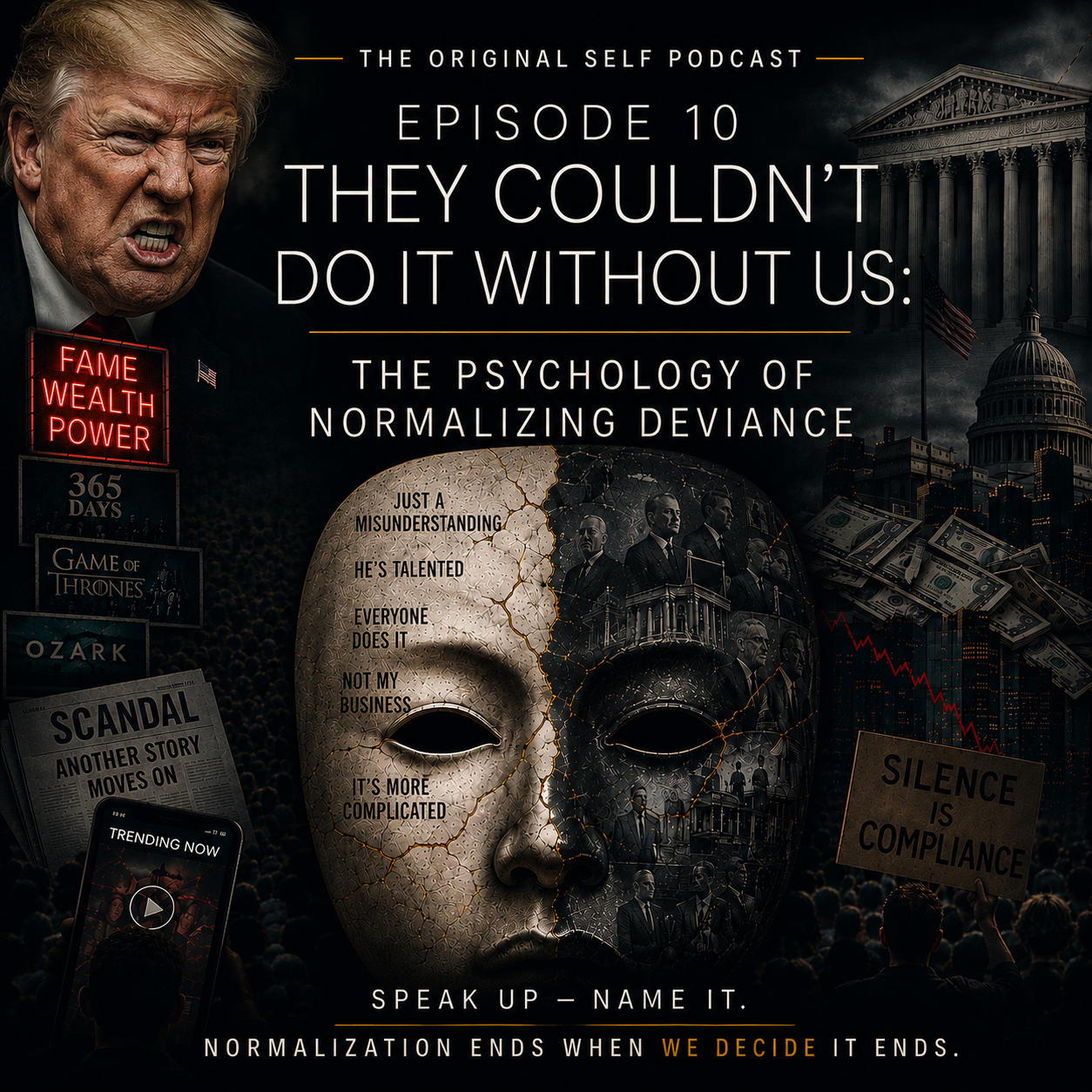
CHAPTER 1: Introduction
Welcome to The Original Self Podcast. I’m Evet DeCota, owner of DeCota Life Coaching and a psychology-informed life coach exploring resilience, mindset, and the courage to become your authentic self. This is a space for honest conversations about growth, identity, relationships, and the messy moments in between that shape who we become.
Between the salon chair and coaching sessions, I've watched people move through life in
patterns they never notice. Patterns that are subtle, familiar, and incredibly hard to see
from the inside. Today, we're going to talk about something that I believe is one of the most
urgent and underexamined forces shaping our culture right now. This is Episode 10: They
Couldn't Do It Without Us: Normalizing Deviance.
CHAPTER 2: Opening
Think of something that would have genuinely shocked you ten years ago. Something you would have said, “No, that could never happen.” “That would never be acceptable.” “People would never allow that.”
Got it?
Now ask yourself, is it still shocking? Or have you just…adjusted, accepted?
We used to have a word for when powerful people did terrible things and faced no consequences. We called it corruption. Then we called it a scandal. Then we called it complicated. Then we stopped calling it anything at all. Somewhere between the scandal and the silence, that’s where normalization lives.
Because here’s the part nobody wants to say out loud. You’ve watched the shows. You’ve followed the trials. You clicked on the stories. You shook your head, maybe said something about it to someone, and then you moved on. So did I. So did almost everyone.
And that, not the predators, not the corrupt politicians and billionaires, that is what I want to talk about today. Because they couldn’t do any of it without our willingness to eventually stop being surprised.
That adjustment, quiet, gradual, and almost invisible, is normalizing deviance. That’s what we’re talking about. That’s where we’re going today
REFLECTION
Before we go further, I want you to sit with this. Is there something happening
in the world right now that you have quietly adjusted to? Something that would
have outraged you years ago, and now just feels like background noise? Just
notice. We'll come back to this.
END REFLECTION
CHAPTER 3: The Anatomy of Deviance
There are two ways to define sexual deviance. The sociological definition is what society
considers abnormal or immoral, and that line moves depending on the era, the culture, and who holds the power. The clinical definition draws a harder line: it refers to sexual behavior, fantasies, or urges that cause real harm to others, often without consent, or a compulsion the person cannot control. The first definition is intentionally vague. The second focuses solely on harm.
And most of what I'm going to talk about today depended on us staying stuck in the first definition long enough that nobody asked the second question: who got hurt?
In psychology, paraphilic disorders, the clinical term from the DSM-5, are only designated
when the behavior causes real harm, involves someone who didn't consent, or creates
significant distress or dysfunction. Not every unusual sexual interest qualifies. But
pedophilia and rape fall squarely in that category.
Now here is the part that connects everything. Economic deviance and sexual deviance
are not as different as we'd like to think. They grow from the same soil. Both are rooted in
power, the need to control others, to assert status, to take what feels entitled. Whether
someone is manipulating financial markets or manipulating people, the underlying
psychology is remarkably consistent: entitlement, a willingness to dehumanize, and the
belief that the rules simply do not apply to them.
Sociologist Robert Merton's Strain Theory explains that when people cannot achieve what
society tells them they should have, wealth, status, and power, some do not abandon the goal. They abandon the rules to get there. And when you layer narcissism on top of that, you get someone who genuinely believes the rules were never meant for them in the first place.
Social and political deviance is the category that makes all the others possible. Tribalism
overrides moral judgment. Motivated reasoning means we arrive at conclusions first based
on who we want to protect, and then work backward to find the evidence. And institutional
deviance, when the organizations designed to enforce accountability become the ones
providing cover, is the most insidious form of all.
I know this personally. This happened in my own childhood parish when I was sixteen. The
brothers I knew were molested by my favorite priest, a man I was in awe of, a man I
genuinely believed was spiritual. When the truth came out, the church moved him. They
didn't report him. They didn't protect those boys. They protected the institution. I watched
the people around me rationalize it because the alternative was too uncomfortable. That
was my first real education in normalization. And it taught me something I have never
forgotten: the silence of good people is just as much a part of the system as the actions of
the predator.
Albert Bandura spent his career asking how people do terrible things and still live with
themselves. His answer was moral disengagement, a set of mental mechanisms that allow
us to switch off our conscience when it becomes inconvenient. Perpetrators justify their
behavior. They diffuse responsibility. They dismiss consequences. They dehumanize
victims. But what makes Bandura's work so uncomfortable is that these mechanisms don't
only operate in perpetrators. They operate in all of us. In institutions that look the other
way. In colleagues who stay silent. In audiences who keep streaming the content, buying
the R. Kelly records, and watching the Woody Allen films even after he married Soon-Yi
Previn, his long-term girlfriend's daughter, was around twelve years old when Allen
entered her mother's life. And in voters who still cannot bring themselves to admit they
were wrong, because any other conclusion would demand they confront the cognitive
dissonance they spent years avoiding.
Moral disengagement is the engine that makes deviance sustainable for the people
committing it and for everyone around them who decides, consciously or not, that it is
easier not to know.
REFLECTION
I want you to sit with one question before we go further. Think of someone you
admire, politically, creatively, or personally. Have you ever looked the other way
at their behavior because of how much you valued what they gave you? What
did that cost the people they harmed?
END REFLECTION
CHAPTER 4: How It Becomes Normal
Diane Vaughan studied the Space Shuttle Challenger disaster and found something that
had nothing to do with engineering. The engineers had seen small warning signs so many
times without catastrophe that the signs stopped feeling like warnings. The deviation
became the norm. And then one day, the shuttle exploded. Vaughan named this the
normalization of deviance.
During the incubation period, when things are going wrong, but nothing has blown up yet,
we tell ourselves everything is fine. Jeffrey Epstein operated for decades. Harvey
Weinstein produced films for decades. The banks gambled with the global economy for decades because nothing catastrophic had happened yet. Until it did. And Vaughan's key
distinction is the one that matters most: this is not about bad individuals making bad
choices. It's about systems that slowly redefine what is acceptable, until the unacceptable
becomes policy, becomes culture, becomes just the way things are.
Then there's the research that should have changed everything, and mostly didn't. In the
1980s, psychologists Linz, Donnerstein, and Penrod exposed men to films depicting sexual
violence against women over five consecutive days. With each day, anxiety decreased and
enjoyment increased. And after the five days, those same men showed measurably less
empathy toward a real rape victim in a trial reenactment than men who hadn't been through the exposure. The media they consumed changed how they saw a real woman in a real courtroom.
That is not a theory. That is a documented finding. And it points directly at what we have
been watching.
Entertainment doesn't just reflect culture. It shapes it.
365 Days, a Netflix film where a woman is kidnapped by a crime boss who gives her 365 days to fall in love with him, was one of the most-watched films of 2020. Kidnapping framed as romance. Possession framed as love. No consequences.
Game of Thrones gave us rape as a plot device so routinely that audiences began to accept it as atmosphere, consistently shot from the perpetrator's point of view, framed as his character development, not her trauma.
Or the show
Ozark, which built an entire series around making you root for a money launderer, measuring success not by whether justice is served but by whether he escapes it. That is exactly how we have been conditioned to think about financial criminals in real life.
What all of these shows have in common is that they are brilliantly made, have devoted
audiences, including me, and in every single one of them, the deviance is the draw. We
don't watch despite the darkness. We watch because of it. And that distinction matters
more than we've been willing to admit.
Journalism has a responsibility it frequently abandons. When a powerful person is
exposed, the story follows the same arc: the revelation, the statement, the think pieces,
and then the next story. The monster narrative is journalism's most reliable tool for letting
everyone else off the hook. When we frame Harvey Weinstein as a singular aberration, we
don't have to talk about everyone who knew. The monster contains the damage. The
system walks free. And the language does the rest. Misconduct instead of rape. Indiscretion instead of fraud. Inappropriate relationship instead of abuse of power. When
we reach for the softer word, we are not being careful; we are being complicit.
CHAPTER 5: The Protected Class
These are not aberrations. These are case studies in how deviance gets protected,
celebrated, and absorbed into the culture until it stops feeling like deviance at all.
R. Kelly
R. Kelly wrote Age Ain't Nothing but a Number and we made it a hit. He married Aaliyah
when she was fifteen, and he was twenty-seven, and the music industry shrugged. The
abuse was never a secret. It was hiding in plain sight inside the music, and we sang every
word. It took over a decade, a documentary, and a federal conviction in 2021 before
anyone was willing to call it what it always was: rape, kidnapping, and pedophilia.
Bill Cosby
Bill Cosby was America's Dad for thirty years. I grew up on his recorded comedy routines,
laughing hysterically with my family. I saw him twice in concert and left with sore cheeks
from smiling and laughing so hard. Along with his comedy, he lectured Black America
about pulling up their pants while he was drugging and raping women in hotel rooms. Sixty
women came forward. Sixty. He was convicted in 2018, and then a technicality set him
free. Not because he didn't do it, but because one prosecutor made a promise another
prosecutor broke. He walked out of prison in 2021 while sixty women had nowhere left to
go. That is not justice. That is the system protecting its own comfort.
Roman Polanski
Roman Polanski pleaded guilty in 1977 to the statutory rape of a thirteen-year-old girl, fled
to France before sentencing, never returned, and in 2003, the Academy gave him the
Oscar for Best Director, while the room gave him a standing ovation. If you want one
moment that captures how completely the industry normalized its own deviants, that is it.
Jeffrey Epstein
Jeffrey Epstein was the hub of everything. He pleaded guilty in 2008 to soliciting a minor
and received a deal so lenient it became its own scandal, thirteen months in a county jail with work-release privileges. Then he went right back to his mansions, his private island,
and his black book. The most powerful people in the world kept taking his calls, kept flying
on his plane, kept attending his dinners, because he made himself deliberately
indispensable, financially, socially, and strategically. His network touched politicians,
billionaires, royalty, and celebrities across every party and every industry. Wealth and
access were the mechanisms of his protection. He did not operate despite these people.
He operated because of them.
Michael Jackson
Michael Jackson was the soundtrack to my childhood. The Jackson 5 played in my house
the way air moves through a room: constantly, naturally, without question. When the
Thriller video premiered on MTV. I recorded it on VHS and played it over and over until my
brother, my best friend, and I had learned every single step of that dance. We practiced it
so many times that I heard my dad ask my mom if we were learning it for a school project.
My fourteen-year-old sassy head quickly turned toward him and, in an exasperated voice,
said, oh my god, Dad, we HAVE to learn this.
When he moonwalked during the Motown 25 special, I jumped up from the floor and tried
to do it on the spot. My brother and I practiced until we had it perfected. Michael Jackson's
music and movement were not just entertainment. They were a language. A shared
experience that connected an entire generation to something that felt genuinely magical.
Which is exactly why what came next was so devastating.
When the rumors of abuse surfaced, I did not believe them. Looking back now, I
understand exactly why. I had bought completely into the wealth and hierarchy of protected deviance. The logic was simple and seductive: someone that beloved, that gifted, that important to the culture could not possibly be capable of the abuse of children that he professed to love so dearly. The fame functioned as a character reference. The money functioned as proof of innocence. And I, like millions of others, accepted that without examining it.
It was not until 2020, when I watched Leaving Neverland, that the real horror of his
deviance came into clear view. The testimony of Wade Robson, whom I had admired as a
brilliant modern choreographer, and James Safechuck was specific, detailed, and deeply
credible. I was devastated. My childhood hero had used his fame, his money, and the very
magic that made him untouchable to gain access to children and systematically abuse them.
This particular cruelty weaponizes your love for the perpetrator against your ability to see
clearly. The more you love them, the more the system can count on you to look away. And
the more we collectively look away, the longer the abuse continues.
Elizabeth Holmes
Elizabeth Holmes built Theranos on a costume and a con: the turtleneck, the artificially
deepened voice, the Steve Jobs mythology. She convinced investors, hospital systems,
and Silicon Valley that her company could diagnose hundreds of diseases from a single
drop of blood. This technology didn't exist and never worked. Patients received false
results and made life-altering medical decisions based on fraudulent data. For years, she
was celebrated as the most important female entrepreneur of her generation, not despite
the fraud but because the culture was so hungry for the story she was selling that nobody
looked closely enough to see it was not true.
Bernie Madoff and Sam Bankman-Fried
Bernie Madoff created the largest Ponzi scheme in history, totaling sixty-five billion dollars,
protected for decades by prestige and the assumption that someone that successful
couldn't possibly be a fraud. Sam Bankman-Fried, convicted in 2023, was the deliberately
disheveled grifter who built a crypto empire on the performance of generosity as moral
camouflage. The shield that allowed him to get away with the swindle was this: if you
appear to be giving it all away, nobody asks where it came from.
Donald Trump
And then there is Donald Trump, who did not just normalize deviance but made it a brand.
Found civilly liable for sexual abuse and defamation in the E. Jean Carroll case. Criminally
convicted on thirty-four counts of business fraud. Caught on tape bragging about grabbing
women without consent and called it locker-room talk, and disturbingly, many believed him.
He vilified the media as the enemy of the people while simultaneously using them as
pawns in his malignant game of narcissistic attention gluttony, understanding before
anyone else that outrage is just another form of ratings. He did not need good press. He
just needed press. And they gave it to him every single time.
Then came the payoffs. Foreign governments funneled money through Trump hotels while
Saudi Arabia's sovereign wealth fund propped up his golf courses through LIV Golf. Apple, Meta, and Amazon lined up to genuflect, writing checks, attending summits, posting
congratulations, and calling it business when it was nothing of the sort. It was tribute, the
kind you pay when you have calculated that resistance costs more than surrender. That is
not capitalism. That is a protection racket with a better press release.
He appointed three Supreme Court justices in one term who went on to dismantle fifty
years of established law, and in doing so, he did not just influence the highest court in the
land. He owns it. And the people cheering loudest were the same ones clutching their
rosaries and their Bibles and their Books of Mormon, because somewhere between the
porn star and the pussy grabbing, Donald Trump convinced Catholics, Evangelicals, and
Mormons that God had sent him. A man who has never demonstrated a single authentic
moment of spiritual conviction in his entire public life, selling salvation to people desperate enough to buy it. It is a con disguised as faith. He cynically turned every accusation into a rallying cry, every conviction into a fundraiser, every piece of evidence into a witch hunt. He did not hide it. He ran on it and won. Twice.
REFLECTION
I want to pause here. Of the people and institutions I just named, is there one
you found yourself wanting to defend or qualify? Notice that impulse. Ask
yourself where it comes from. That impulse is exactly how the protection
works.
END REFLECTION
CHAPTER 6: The Cost It Steals from Us
What does normalization of deviance actually cost us? Not abstractly or theoretically, but
the real toll.
It starts with survivors. They share something that doesn't get talked about enough: the
internal erosion that happens before anyone else even knows. There’ question that
normalization plants directly inside the victim: was it really that bad? That question is not
weakness. It is what happens when you have spent your whole life watching the culture minimize, contextualize, and excuse exactly what just happened to you. Psychologist
Jennifer Freyd called this institutional betrayal, the specific, compounding trauma that
occurs not just from the original harm but from being failed by the systems that were
supposed to protect you.
Remember the story I told you about the priest and the brothers at my parish? The church protected the institution and threw the boys to the wolves with a small payoff to their single mother, who didn’t speak English. In the meantime, they moved the predator priest to the Ozarks to probably groom more children
Martin Seligman's learned helplessness research tells us that when people repeatedly
experience that their actions have no effect, that reporting leads nowhere, that speaking up changes nothing, they stop trying. Not because they don't care, but because they have
been taught by experience that caring doesn't matter. Every protected perpetrator sends
that message to every potential survivor: this system is not for you. Stay quiet. It is safer.
The bystander effect, the well-documented phenomenon in which the presence of others
reduces individual responsibility to act, doesn't only occur in emergencies on subway
platforms. It happens at a societal scale. When an entire culture watches deviance remain
unpunished, the diffusion of responsibility becomes total. Someone else will report it.
Someone else will fix it. And no one does. Cynicism does not just make us passive. It
makes us complicit.
Then there are the children watching it all. Research on adolescent media consumption is
unambiguous: what young people consume shapes what they normalize. Children who
grow up watching deviance go unpunished internalize it as instruction for how power
works. They learn that these are the rules, and they are optional if you are the right kind of
person. And that lesson does not stay in one generation. It gets passed down through the
examples we model, the behavior we excuse, the content we consume, and the things we
choose not to name.
Hannah Arendt gave us the concept of the banality of evil: the most dangerous evil is not
dramatic or theatrical. It is bureaucratic and ordinary. It looks like a boardroom, a
courtroom, a studio lot, a church, or a House and Senate chamber. When accountability disappears long enough, people stop expecting it. The vacancy gets filled by someone who points at the wreckage, promises to clean it up, and neglects to mention they helped make the mess. That is how authoritarianism finds its opening, not through force, but through
exhaustion.
And the literal financial cost: sexual violence costs the United States an estimated 3.1
trillion dollars annually through healthcare, lost productivity, legal costs, and mental health treatment. The 2008 financial crisis wiped out an estimated 22 trillion dollars in household wealth. Families lost the homes they spent decades building. Retirements evaporated. And the people who built the machine that collapsed received bonuses. Political corruption is measurable in every school not funded, every hospital not built, every climate bill not passed.
That cost is paid by survivors, bystanders, children, and democracies. And it is not only
paid in dollars but in the eroding belief that any of it could ever change.
REFLECTION
Where in your own life have you felt the cost of looking away? Maybe you saw
something and said nothing. Maybe you stayed loyal to someone who didn't
deserve it. Maybe you consumed something you knew wasn't right and kept
going anyway. You don't have to judge what comes up. Just be honest with
yourself about it.
END REFLECTION
CHAPTER 7: Staying Clear-Eyed
So what do we do with all of this?
If this conversation ends in despair, it has failed. The entire argument is that normalization
happens gradually, quietly, and with our participation. That means we can participate in
making it abnormal again.
The first battleground is language. Words are how normalization travels, through
euphemism, through softening, through the careful selection of the least threatening way to describe something that should disturb us deeply. Misconduct is not rape. Indiscretion is not fraud. A complicated relationship is not abuse of power. Boys will be boys is not an
explanation. It is a permission slip that has been handed out for centuries. Naming things
accurately is not harsh or inflammatory. It is precise. And precision is the first act of
resistance.
The second is refusing the tribal pull. The moment you find yourself defending someone
because of their politics, their talent, or their relationship to you, stop. Ask the question you would ask if it were the other side. Accountability only works when it is applied consistently. The minute it becomes selective, it becomes worthless.
Stop outsourcing your moral judgment to institutions. Courts acquit guilty people. Studios
protect profitable people. Churches protect their brand. The Supreme Court protects its
ideology. These systems arbitrate what they can afford to admit rather than what is right.
Your own assessment of behavior does not require a verdict.
The research supports something most people do not believe: resensitization is possible.
Linz and Donnerstein proved that with sufficient distance from harmful exposure, empathy
returns. We are not permanently altered by what we have consumed. But we must make
deliberate choices about what we continue to put in front of ourselves. Critical media
consumption means asking one question before pressing play: Who is the person served when watching entertainment? If it’s not from the victim’s point of view, then watching differently is the answer.
For those with children, this is the most urgent part. Early education about power, consent,
and accountability is the single most effective intervention available. Not just the
conversation about bodies and safety, though that matters enormously, but the broader
conversation about power: who has it, how it gets abused, and what it looks like when
institutions fail to check it. Children who can identify and name deviance are significantly
less vulnerable to it.
And finally, individual moral clarity is necessary but not sufficient on its own. Accountability needs infrastructure: laws with teeth, courts that are actually independent, journalism that is actually funded and free, HR departments that answer to employees instead of shareholders, and a political culture that collectively determines the protection of power is no longer worth the price we have all been paying.
The history of every social shift tells us that normalization can be reversed. MeToo happened. The Challenger findings changed NASA. Financial regulation followed the 2008 collapse. Society eventually names what it once refused to acknowledge and holds
accountable those who were once untouchable. The incubation period always ends. The
only question that matters is how many people get hurt before it does.
REFLECTION
What is one thing you have been
calling by the wrong name? And what would it cost you to start naming it
accurately? Write these down. Bring them into a conversation you are having.
END REFLECTION
CHAPTER 8: Closing
Let me bring it home.
We started today with a question, not about the predators, not about the politicians, not
about the billionaires, but about us. About the adjustment we make, quiet, gradual, and
almost invisible, every time we decide it is easier not to know, every time we reach for the
softer word, every time we look away and tell ourselves that someone else will handle it.
That adjustment has a cost. We spent this episode accounting for it. 3.1 trillion dollars a
year in sexual violence alone. 22 trillion dollars in household wealth wiped out by
normalized financial fraud. Survivors who learned to doubt their own experience. Children
absorbing instructions about power from content we chose to put in front of them.
Institutions that traded accountability for self-preservation so many times that self-preservation became their only function.
Underneath all of it the same engine runs: entitlement, dehumanization, and the conviction that consequences belong to other people. Moral disengagement is spreading outward from the person committing the harm to everyone around them who decided, consciously or not, that it was easier not to know.
We are in an incubation period right now. The warning signs are not subtle. They are loud,
documented, and sitting in plain sight for anyone willing to look. The question is not
whether we can see them. The question is whether we are willing to stop adjusting.
Because they could not do any of it without our willingness to be entertained by it, to vote
for it, to stream it, to excuse it, to stay quiet about it, and to decide that this particular
person at this particular moment was too important, too complicated, or too powerful to
hold accountable.
That ends when we decide it ends. Not in a courtroom. Not in a headline. In the daily,
ordinary, unglamorous decision to call things what they are. To refuse the softer word. To
apply the same standard regardless of whose side someone is on. To teach our children
that power is not the same as permission.
Leaving the field to the people counting on our silence is a cost none of us can afford.
If this episode stirred something in you, I would love to continue that conversation.
Coaching is where this kind of work gets to go deeper, where you take the awareness and
turn it into something real. You can find me at decotalifecoaching.com. I genuinely love this work, and I would love to work with you.
If you like to read a more detailed version of this podcast, go to either Substack or decotalifecoaching.com for the blog version named The Quiet Permission: How Normalizing Deviance is Costing Us Everything.
Thank you for being here with me today. I'll see you next time.
The Original Self Podcast | Episode 10 | DeCota Life Coaching | decotalifecoaching.com
That's just how the world works.
It sounds like wisdom. It isn't.
It's the moment we cross from bystander to participant. The moment cynicism stops being a reaction and becomes a choice.
And we make that choice more often than we want to admit.
Cynicism doesn't just make us passive. It makes us complicit.